

A routine electrical job or a straightforward concrete pour can turn into a 12-month legal battle that drains your cash and your crew's morale before a single invoice gets paid. Average dispute values hit $60.1 million in North America in 2024, and even smaller subcontractor-level disputes can cripple a trade business for months. Understanding where disputes come from, and what you can do before they start, is the most valuable thing you can do for your bottom line this year.
Table of Contents
- Criteria for identifying subcontractor contract risks
- Top 5 common subcontractor contract disputes
- Comparison table: Common disputes at a glance
- How to guard against common disputes
- A hard lesson: Prevention pays more than dispute wins
- Smart solutions to prevent disputes
- Frequently asked questions
Key Takeaways
| Point | Details |
|---|---|
| Payment issues dominate | Most subcontractor disputes arise from delays or nonpayment, especially regarding mechanics liens. |
| Scope creep is preventable | Ambiguous scope and informal change orders are leading causes of arguments but can be avoided with clear documentation. |
| Resolve clauses early | Misaligned contracts on dispute resolution can force costly multi-forum battles if not reconciled before signing. |
| Disputes are costly | A typical construction dispute takes over a year and involves major financial risk. |
| Proactive prevention | Using software and disciplined contract management reduces the likelihood and cost of disputes. |
Criteria for identifying subcontractor contract risks
Having established the stakes, let's define what signals trouble before it starts. Not every contract is a landmine, but certain patterns show up again and again in the disputes that end up in arbitration or court. Knowing these patterns lets you negotiate better terms, push back on vague language, and protect your business before the first nail goes in.
The three biggest risk drivers are ambiguous scope definitions, weak change order procedures, and incomplete documentation. When a scope section says something like "all work necessary to complete the project," you are essentially signing a blank check. That language gives the general contractor enormous leverage to demand extra work without paying for it. Experienced trade contractors treat scope definitions and change order authority as primary risk controls, not just administrative paperwork.
Here are the key red flags to watch for when reviewing any subcontract:
- Vague scope language that references drawings not yet finalized or specifications "to be provided later"
- No formal change order process, or a process that requires written approval but provides no timeline for the GC to respond
- Pay-if-paid clauses that make your payment contingent on the owner paying the GC, not on the work you actually completed
- Unilateral termination rights that allow the GC to end the contract for convenience with little or no compensation
- Dispute resolution clauses that force you into a forum or jurisdiction that is expensive or impractical for your business
- Short notice requirements for claims that give you only a few days to document and submit a dispute before you lose your rights
Pro Tip: Before signing, mark every clause that uses the words "reasonable," "as directed," or "at the discretion of." These are negotiation targets. Vague discretionary language almost always benefits the party with more leverage, which is usually not you.
Effective risk identification is not just about protecting yourself legally. It directly supports your ability to negotiate better terms upfront and to price jobs accurately. When you know exactly what the scope includes, you can bid with confidence and avoid the painful situation of doing work you cannot get paid for. Pairing a careful contract review with solid change order management tips gives you a repeatable system that scales across every project you take on.
Top 5 common subcontractor contract disputes
With criteria for risk in mind, here are the concrete dispute types you are most likely to encounter on a project. Each one has a distinct trigger, and each one has a prevention strategy you can apply right now.
-
Payment delays and nonpayment. Payment disputes are the most common construction disputes for subcontractors, covering everything from slow pay to outright nonpayment, defective work withholding, and mechanics lien issues. A GC who is squeezed by the owner often passes that pressure down the chain, and the subcontractor at the bottom absorbs the hit. Mechanics liens are your most powerful remedy, but they require strict compliance with notice deadlines that vary by state.
-
Scope creep and extra work disputes. Scope creep from ambiguous scope and insufficient change order procedures is one of the most recurring practical drivers of subcontractor disputes. You start a drywall job, and three weeks in the GC is asking you to frame out a new mechanical room that was never on the drawings. Without a clear change order process, you either do the work and hope to get paid or stop work and risk a termination claim.
-
Change order process failures. Even when a change order process exists on paper, disputes erupt when the GC ignores submitted change orders, delays approval past the point of no return, or approves verbal changes and then denies them later. This is where thorough written documentation becomes the difference between getting paid and eating the cost.
-
Dispute resolution clause conflicts. When the prime contract between the owner and GC includes an arbitration clause, but your subcontract references litigation in a different state, you can end up fighting the same battle in two separate forums simultaneously. Conflicting dispute resolution provisions create procedural landmines that force parallel disputes and dramatically increase legal fees.
-
Quality and defective work claims. A GC or owner who wants to avoid paying you has a strong incentive to claim your work is defective. These disputes are especially damaging because they can trigger withholding of your entire contract balance, not just the portion in question. Clear quality benchmarks in the contract, tied to specific drawings and specifications, are your best defense.
"Cashflow and payments disputes affected over 14% of projects globally, ranking fourth among all dispute causes post-2020. For subcontractors, that percentage is almost certainly higher because they sit at the end of the payment chain."
Good scope documentation insights can help you build a paper trail that makes these disputes far easier to resolve in your favor, or avoid entirely.
Comparison table: Common disputes at a glance
To help you visualize the issues, let's compare these dispute types directly. The table below gives you a quick benchmark for understanding your risk exposure across the most common dispute categories.
| Dispute type | Prevalence | Primary trigger | Avg. resolution time | Key prevention |
|---|---|---|---|---|
| Payment delay or nonpayment | Very high | Pay-if-paid clauses, owner default | 12+ months | Mechanics lien notices, prompt pay statutes |
| Scope creep or extra work | High | Vague scope, verbal instructions | 6 to 14 months | Written scope, formal change orders |
| Change order process failure | High | No approval timeline, verbal approvals | 6 to 12 months | Documented requests, response deadlines |
| Dispute resolution clause conflict | Moderate | Mismatched prime and subcontract terms | 12 to 18 months | Pre-signing clause reconciliation |
| Defective work claim | Moderate | Unclear quality standards, poor records | 8 to 16 months | Spec-tied quality benchmarks, inspection logs |
The 2025 Arcadis Construction Disputes Report puts the average resolution time at 12.5 months and average dispute value at $60.1 million in North America. Even scaled down to a subcontractor-level dispute worth $50,000, a 12-month fight means carrying that receivable on your books for a year while your crew still needs to be paid.
The table also reveals something important: procedural disputes, those involving change orders and dispute resolution clauses, tend to take longer to resolve than performance-based disputes. That is because procedural fights often involve questions about which rules apply, before anyone even gets to the facts of the case. Fixing these issues at contract signing costs you nothing. Fixing them in arbitration costs you everything.
How to guard against common disputes
Understanding the risks is just the start. Here is how to actively mitigate them before they become expensive problems.
-
Scrub every scope section before signing. Read the scope of work line by line and flag anything that is undefined, references documents you have not seen, or uses open-ended language. Request specific drawings and specifications to be attached as exhibits. If the GC refuses, that tells you something important about how disputes will be handled on that job.
-
Reconcile dispute resolution clauses across all contracts. Before signing, reconcile dispute resolution and forum-selection provisions across the prime contract and the subcontract. Ask for a copy of the relevant sections of the prime contract before you sign your subcontract. If there is a conflict, request an amendment that aligns both documents.
-
Document every communication and change request in writing. Verbal instructions are not instructions. If a foreman tells your crew to add work, send a written confirmation email that same day. Build a habit of creating a paper trail for every decision that could affect your scope, schedule, or cost. This is not paranoia. It is professional practice.
-
Know your prompt payment deadlines. Prompt payment regimes can eliminate common-law defenses if a GC fails to timely respond to a payment application. Every state and territory has different rules. In some jurisdictions, a GC who does not respond to your pay application within a set window loses the right to dispute it. Know these deadlines cold, and submit your applications on time, every time.
-
Use contract administration software to maintain organized records. Spreadsheets and email threads are not a system. A dedicated platform for documenting change orders and tracking payment applications gives you an audit-ready record that is far more persuasive in a dispute than a stack of forwarded emails.
Pro Tip: Set a calendar reminder for every notice deadline in your contract, including preliminary notice, mechanics lien filing, and claim submission deadlines. Missing one of these by even a day can cost you your legal rights entirely.
The most effective subcontractors treat contract administration as a revenue protection activity, not an administrative burden. Every hour you spend organizing your records is an hour that could save you weeks of legal fees later.

A hard lesson: Prevention pays more than dispute wins
Here is the uncomfortable truth that most contractors only learn after surviving a brutal dispute: winning a construction dispute rarely feels like winning. You might recover your money after 14 months, but you have spent that entire time chasing invoices instead of bidding new work, managing your crew, and growing your business. The legal fees alone can eat a significant portion of whatever you recover.
The Arcadis data on 12.5-month resolution times is not just a statistic. It represents a year of your business operating under financial stress, distracted leadership, and strained relationships with suppliers and employees who need to be paid regardless of what is happening in arbitration.
What we have seen across decades of working with trade contractors is that the businesses that thrive long-term are not the ones with the best lawyers. They are the ones with the best systems. They review every contract before signing. They document every change. They submit payment applications on time and follow up immediately when payment is late. They use digital contract records to maintain an organized, timestamped history of every project decision.
There is also a subtler risk that even experienced contractors underestimate. Scope, payment, and dispute resolution processes are not three separate issues. They are interconnected. A vague scope creates extra work disputes. Extra work disputes create payment disputes. Payment disputes escalate into formal claims under whatever dispute resolution clause happens to apply, which may or may not be the one you thought you agreed to. Tightening all three at once, before the job starts, is the only approach that actually works.
The contractors who tell us they never have disputes are not lucky. They are disciplined. They treat every contract as a risk management document, not just a formality to get through so the work can start.
Smart solutions to prevent disputes
Ready to put these best practices into action? Here is how technology can make risk management effortless.
Managing scope, change orders, payment applications, and dispute documentation across multiple active jobs is genuinely hard to do with generic tools. Important notices get buried in email. Change order logs live in spreadsheets that no one updates consistently. Payment deadlines slip past because there is no automated reminder system in place.
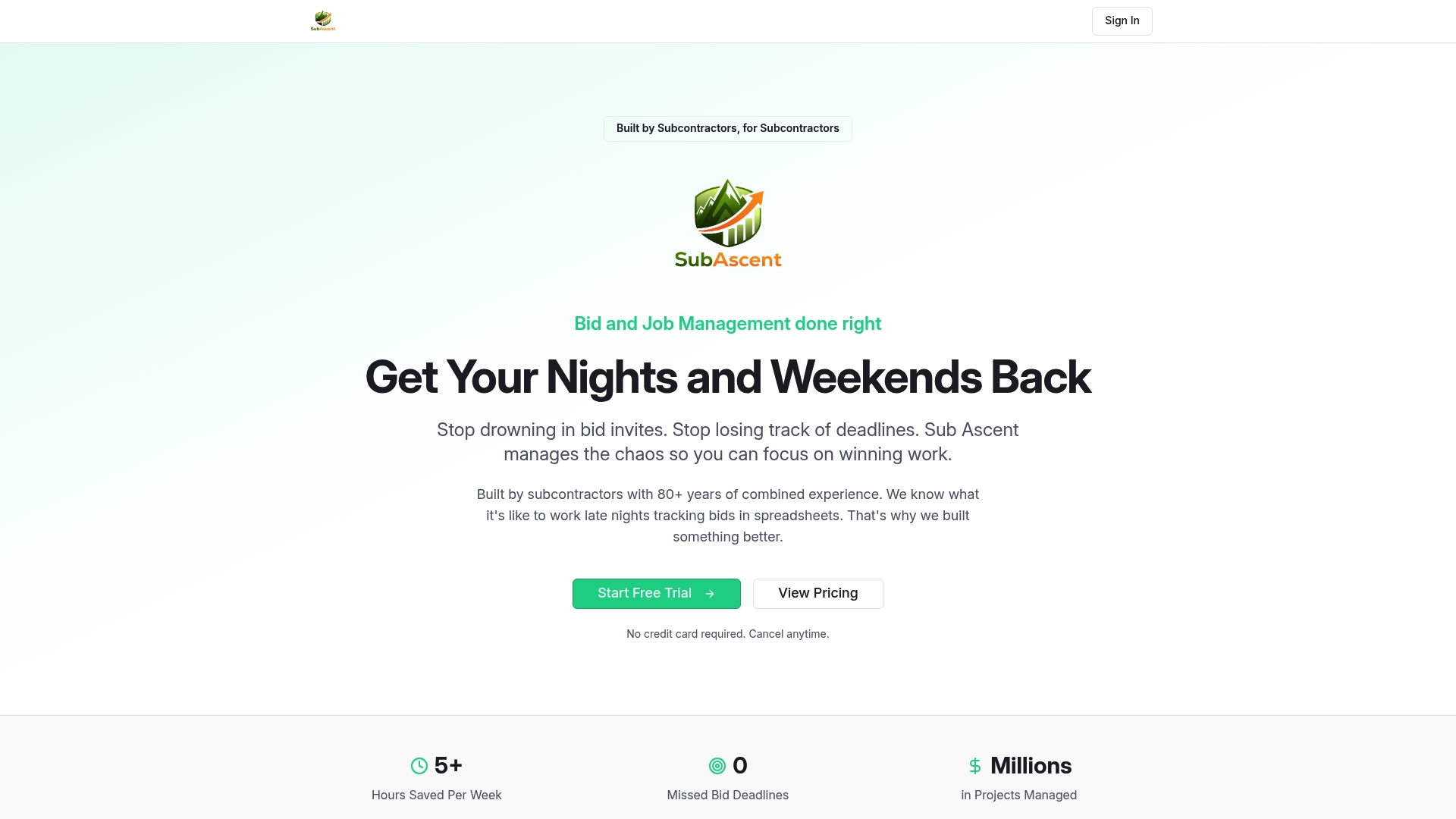
The subcontractor job management platform at Subascent is built specifically for trade contractors who need a better system. With over 80 years of industry experience behind its design, Subascent centralizes your bids, job tracking, change orders, and project communications in one place. Whether you are running an electrical crew in Texas, a plumbing operation in the UK, or a roofing business in Australia, the platform gives you the organized, audit-ready records that protect you when disputes arise and help you avoid them in the first place.
Frequently asked questions
What is the most common cause of subcontractor contract disputes?
Payment delays and nonpayment are consistently cited as the most common triggers, including disputes involving mechanics liens and defective work withholding.
How long does it typically take to resolve a construction contract dispute?
In North America, average resolution time is 12.5 months, meaning most disputes tie up your cash and attention for over a year.
How can a subcontractor avoid a dispute over extra work or scope creep?
Define your scope by reference to specific drawings and establish a formal written process for approving changes, because scope creep from ambiguous scope is one of the most recurring practical drivers of subcontractor disputes.
What should subcontractors check before signing a contract?
Look for conflicting dispute resolution provisions between the prime contract and your subcontract, and make sure scope, change order procedures, and payment terms are specific and unambiguous.