
If you run an electrical, plumbing, or HVAC crew, you already know the frustration: your workers show up Monday, but the money from that completed phase still hasn't arrived. Understanding how subcontractor crews get paid isn't just an accounting exercise. It directly affects whether you can make payroll Thursday, whether your foreman trusts you, and whether that roofing or drywall job actually made money. The laws protecting your payment rights exist in nearly every state, but most trade owners don't know how to use them. This guide changes that.
Table of Contents
- Understanding subcontractor payment flow and timing
- Legal frameworks shaping subcontractor payments in the US and UK
- Common payment schedules and subcontractor payroll cycles
- Managing cash flow and profitability amid payment delays
- Best practices for accurate payment processing and audit trails
- Why traditional payment delays persist despite legal safeguards
- Streamline your subcontractor payments with Sub Ascent software
- Frequently asked questions
Key Takeaways
| Point | Details |
|---|---|
| Weekly payroll cycles | Crew timecards are submitted weekly, with payroll approval and payment following a consistent schedule to maintain cash flow. |
| 7-day prompt payment rules | Most US states mandate subcontractor payment within 7 days of contractor receipt, supported by penalties for late payments. |
| Cascading payment timelines | Payments flow from owner to contractor to subcontractors, with timelines cascading down the chain and differing slightly by jurisdiction. |
| Cash flow strategies | Subcontractors manage cash flow gaps using lines of credit and tracking retainage and lien waivers carefully. |
| Robust payment controls | Attaching contracts, routing approvals, and maintaining audit trails are essential to ensure accurate and compliant subcontractor payments. |
Understanding subcontractor payment flow and timing

The subcontractor payment process runs on two parallel tracks: the internal crew payroll cycle and the external payment waterfall from owner to general contractor to your firm. Confusing the two is where most cash flow problems start.
Here's how the external chain typically works:
- The project owner approves a pay application from the general contractor.
- The GC receives funds, usually within 7 to 30 days depending on contract terms.
- The GC then releases payment to your firm, the specialty trade sub.
- You pay your crew from those funds, or from a line of credit if the timing doesn't align.
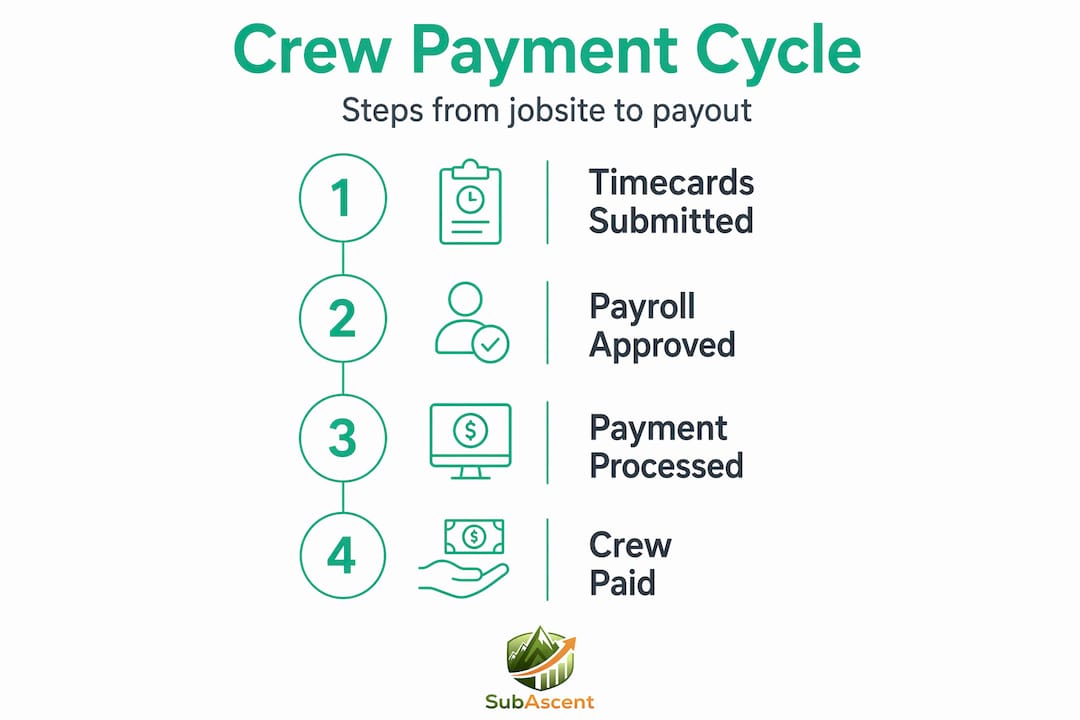
The internal crew payroll cycle runs on a tighter loop. Your foreman submits timecards every Friday or Monday. Payroll personnel verify and approve those timecards early the following week, and crew members receive payment by Thursday. That Thursday deadline is non-negotiable if you want to retain good field labor.
On the legal side, most US states have enacted prompt payment laws to protect this flow. The Texas Prompt Payment Act requires contractors to pay subcontractors within 7 days of receiving owner payment. California goes further: California law imposes a 7-day payment deadline with penalties for violations. In the UK, the Procurement Act enforces 95% payment of valid invoices within 30 days, flowing down the supply chain on public projects.
Key facts about subcontractor payment schedules worth knowing:
- Prompt payment laws apply at each tier, not just at the top of the chain.
- Most laws cover both public and private projects, though timelines can differ.
- Penalties for late payment are automatic in many states, not something you have to sue for.
Legal frameworks shaping subcontractor payments in the US and UK
Laws don't guarantee payment. But they do set the floor. If you understand the legal backdrop, you can negotiate better contracts and enforce your rights without hiring an attorney every time a GC drags their feet.
Here's a comparison of key prompt payment frameworks:
| Jurisdiction | Deadline to pay sub | Penalty for late payment |
|---|---|---|
| Texas | 7 days after owner pays | Interest plus attorney's fees |
| California | 7 days, private projects | 2% monthly penalty plus fees |
| Federal (US) | 7 days after GC receives funds | Interest owed automatically |
| UK (public) | 30 days, 95% of invoices | Cascading obligation down chain |
A few things that table doesn't capture:
- "Pay-if-paid" clauses attempt to shift the risk of owner nonpayment onto you. Most states treat them as unenforceable. Courts generally read them as timing provisions, not payment waivers.
- "Pay-when-paid" clauses are different. They set a reasonable time limit tied to when the GC gets paid. These are generally enforceable, but they can still delay your cash by weeks.
- Retainage is withheld at each tier, typically 5% to 10% of each pay application, and released only at substantial completion. That money sits in limbo for months on longer jobs.
"Clear contract language defining payment timing, retainage release, and dispute resolution is the single most effective protection a specialty trade sub can have."
The milestone-based payment schedules you negotiate before signing a contract matter more than any law passed after the fact. Get the payment terms in writing, tied to specific milestones, and make sure retainage release conditions are spelled out.
Common payment schedules and subcontractor payroll cycles
Most specialty trade subs, whether you're running a framing crew, a fire protection team, or a flooring operation, follow a weekly internal payroll cycle. It's the backbone of crew retention. Miss it once and you'll hear about it. Miss it twice and your best people start answering calls from your competitors.
Here's the standard weekly cycle most trade owners use:
- Friday or Monday: Foreman submits crew timecards, either on paper, by text, or through a mobile app.
- Monday or Tuesday: Payroll personnel review hours, verify against job codes, and flag discrepancies.
- Wednesday: Payroll is processed and submitted to the bank or payroll provider.
- Thursday: Crew members receive direct deposit or checks.
Pro Tip: If your foreman is submitting timecards on paper and you're manually entering them on Monday, you're adding a full day of risk to your payroll cycle. One illegible timecard or a missed call can push your Thursday payment to Friday. That's when crews start calling in sick. A simple mobile timecard submission, even a photo of a handwritten sheet sent to a shared inbox, cuts that risk significantly.
The practical implications of this cycle for an HVAC or masonry operation:
- You're paying crew weekly whether or not the GC has paid you yet.
- On a 90-day job, you might fund 12 weeks of payroll before seeing a single dollar from the GC.
- That gap is where lines of credit, factoring, or owner equity get consumed.
Understanding payroll management for subcontractors as a distinct function from accounts receivable is the first step toward managing it intentionally rather than reactively.
Managing cash flow and profitability amid payment delays
Here's the uncomfortable math. You complete a concrete pour or a rough-in electrical phase. The GC submits their pay application to the owner. The owner takes 20 days to approve it. The GC holds it another 10 days before releasing your portion. You've been paying your crew every Thursday for 30 days on that phase. That's the payment waterfall in action, and it's why subcontractors may wait 30 to 90 days after milestone completion before seeing cash.
The tools that protect you in this environment:
- Retainage tracking: Know exactly how much is being withheld on each job, when it's scheduled for release, and what conditions must be met. A $40,000 retainage balance sitting uncollected on a closed job is a real problem that shows up on your P&L as phantom profit.
- Lien waivers: Conditional and unconditional lien waivers at each payment milestone reduce legal risk and create a clear paper trail. They also signal to the GC that you're organized and will enforce your rights.
- Lines of credit: Most roofing, insulation, and glazing operations that run more than two jobs simultaneously carry a revolving line of credit specifically to cover crew payroll during payment gaps.
Pro Tip: Run a simple cash flow projection every Monday morning. List every job, the next expected payment date, the amount, and your current payroll obligation for the week. If those two numbers don't align, you have five days to act before Thursday payroll hits. That's enough time to call the GC, draw on a credit line, or delay a material order.
The connection between payment timing and managing subcontractor job profitability is direct. If you don't know when money is coming in relative to when it's going out, you can't accurately judge whether a job is profitable until it's long over.
Best practices for accurate payment processing and audit trails
Sloppy internal payment processes cause more disputes than GC bad faith. Here's the sequence that keeps your books clean and your payments defensible:
- Set up vendor records before the first invoice arrives. Attach the signed subcontract and a current W-9 to every vendor file. If you're paying a lower-tier sub or a labor crew, this is non-negotiable for tax compliance.
- Enter bills before your bank feed reconciles. If you wait for the bank statement to tell you what you spent, you're always looking backward. Enter the bill when you receive it, even if payment is 30 days out.
- Route every payment through a defined approval process. Owner approves anything over $5,000. PM approves routine vendor payments. No exceptions. This creates an audit trail that protects you in a dispute.
- Align your payment timing with your job costing system. When a bill is paid, it should immediately hit the correct job code and cost category. If it doesn't, your budget-versus-actual reports are worthless.
Attaching contracts and W-9s, entering bills before bank feeds, and routing approvals through defined channels are the foundational controls that keep payment records audit-ready.
The payment approval workflows you build now will save you hours during a payment dispute, a lien claim, or a tax audit. Documentation isn't bureaucracy. It's leverage.
Why traditional payment delays persist despite legal safeguards
Here's the view that most payment articles won't give you: prompt payment laws are necessary, but they're not sufficient. The real reason subcontractor crews still face delayed payments isn't that GCs are universally dishonest or that owners are cash-strapped. It's that the administrative machinery required to trigger those legal protections is broken at almost every tier.
Think about what has to happen before your 7-day clock even starts. The GC must certify your work. The owner's rep must approve the pay application. The lender may require an inspection. The GC's accounting team must process the payment. Each of those steps has a person, a deadline, and a potential bottleneck. Payment schedules tied to milestones need strong administration to avoid bottlenecks, and that administration rarely exists in practice.
Most specialty trade subs, especially those running under $5 million in annual revenue, don't have the leverage to push back when a GC's billing cycle runs on the 25th of the month and your work was certified on the 3rd. You wait. The law says 7 days. Reality says 30.
The contract language problem compounds this. Pay-if-paid clauses are unenforceable in most states, but they still appear in contracts and still intimidate subs into waiting. Many electrical and plumbing owners sign contracts without reading the payment terms carefully because they're focused on winning the work. That's understandable. It's also expensive.
The path forward isn't litigation. It's improving subcontractor payment workflows through better internal systems, cleaner contract language, and faster invoicing. The subs that get paid fastest aren't the ones with the best lawyers. They're the ones whose paperwork is always right, always on time, and always impossible to dispute.
Streamline your subcontractor payments with Sub Ascent software
Managing weekly crew payroll, tracking retainage across six active jobs, chasing lien waivers, and keeping your job costing current is a lot to hold together in a spreadsheet. Most GC-built software doesn't solve this problem for specialty trade subs because it was never designed for how your business actually runs.
Sub Ascent is built specifically for subcontractor job and bid management at electrical, plumbing, HVAC, roofing, drywall, and other specialty trade firms. It centralizes your contracts, lien waivers, and vendor records so your payment records are always audit-ready. It connects your payment schedules to your job costing so you know in real time which jobs are making money. And it reduces the administrative bottlenecks that cause payment delays in the first place. If Thursday payroll is a weekly source of stress, it doesn't have to be.
Frequently asked questions
How soon must subcontractors be paid after a general contractor receives payment?
In most US states, subcontractors must be paid within 7 days after the contractor receives owner payment, under prompt payment laws like those in Texas and California.
What happens if a contractor fails to pay subcontractors on time?
Late payments trigger automatic interest penalties and potentially attorney's fees, including a 2% monthly penalty under California law, designed to incentivize timely payment.
Can subcontractors rely on "pay-if-paid" clauses to guarantee payment?
No. Pay-if-paid clauses are unenforceable in most states. Subcontractors should push for clear "pay-when-paid" language that ties payment timing to contractor receipt, not owner solvency.
How does the UK Procurement Act affect subcontractor payments?
It requires 95% of valid invoices on public sector projects to be paid within 30 days, with that obligation flowing down through every tier of the subcontractor chain.
What are common payroll cycles for subcontractor crews?
Crews typically submit timecards on Friday or Monday. Payroll personnel approve them early the following week, and payments are issued by Thursday, maintaining a consistent weekly cycle regardless of when the GC pays.