

Two trades show up to the same floor on the same morning. Neither can proceed. Your crew stands around while the clock runs, and the GC is already calling. This scenario plays out on job sites across the country more often than anyone wants to admit, and the cost adds up fast. Reducing scheduling conflicts is not just about keeping peace on site. It protects your margins, your reputation, and your relationships with general contractors. This guide walks you through a practical, step-by-step system for identifying, resolving, and preventing scheduling conflicts, covering both process improvements and contract-level protections that veteran subcontractors rely on.
Table of Contents
- Recognizing common sources of scheduling conflicts
- Preparing your project for smooth scheduling
- Step-by-step conflict resolution process
- Validating your solution and avoiding future disputes
- What most subcontractors miss about conflict resolution
- How Sub Ascent streamlines scheduling conflict resolution
- Frequently asked questions
Key Takeaways
| Point | Details |
|---|---|
| Coordinate early | Structured meetings and look-ahead schedules catch conflicts before they begin. |
| Use proven steps | A clear resolution workflow ensures fair, rapid alignment on schedule changes. |
| Document everything | Proper logs and contract references prevent disputes and protect all parties. |
| Leverage digital tools | Integrated software improves communication, early warning, and task tracking for every subcontractor. |
| Check for root causes | Most schedule conflicts trace back to process gaps or unclear contracts, not just slow work. |
Recognizing common sources of scheduling conflicts
With the stakes clear, let's begin by pinpointing exactly where and how conflicts tend to emerge.
Scheduling conflicts in construction fall into two broad categories. Spatial conflicts happen when two or more trades need the same physical space at the same time, like electricians and HVAC crews both trying to run systems through the same ceiling cavity. Temporal conflicts occur when one trade's work depends on another finishing first, but the schedule does not reflect that dependency clearly. Both types are common, and both are almost always preventable.
Some of the most damaging conflicts are not obvious until they have already stalled the project. These are called latent process lags, meaning delays that build up quietly in the background. Requests for information (RFIs, which are formal written questions sent to the design team for clarification) can sit unanswered for days or weeks. Submittal approvals get stuck in review queues. Sequencing confusion, where no one has clearly defined which trade goes first in a given area, creates a vacuum that fills with conflict.
Common triggers for scheduling conflicts include:
- Outdated drawings being used in the field while a newer revision is already in circulation
- Unclear installation sequences on drawings or in the project schedule
- Resource bottlenecks, such as a single crane or lift needed by multiple trades simultaneously
- Incomplete scope definitions that leave gray areas between trade responsibilities
- Poor communication between the GC's project manager and individual subcontractor foremen
Forensic schedule delay analysis shows that edge-case conflicts frequently arise from overlapping dependencies and approval or response latency, sometimes pushing approval turnaround times to 45 days or more on complex projects. That kind of lag can cascade through an entire schedule.
Real-world example: On a mid-size commercial fit-out, an electrical subcontractor waited 38 days for a lighting submittal approval. By the time the approval came through, the ceiling contractor had already closed up the grid. The result was a costly rework order and a two-week schedule extension that affected three other trades downstream.
Helonic's guidance on subcontractor coordination confirms that structured coordination methods are essential for preventing these situations, and that communication gaps are almost always the root cause when things go wrong.
| Conflict type | Common trigger | Typical impact |
|---|---|---|
| Spatial overlap | No zone assignment in schedule | Crew standby, rework |
| Temporal dependency | Missing sequence logic | Cascading delays |
| Approval latency | Slow RFI/submittal turnaround | Critical path delays |
| Resource bottleneck | Shared equipment, no booking | Productivity loss |
| Drawing revision gap | Old plans in the field | Rework, safety risk |
Preparing your project for smooth scheduling
Now that you can recognize trouble spots, let's set up your project for better coordination from day one.
The single most effective thing you can do before work begins is run a pre-install coordination meeting. This is not a general kickoff call. It is a working session focused specifically on sequencing, staging areas, drawing revisions, and how trades will hand off work to each other. The people in the room should include your foremen, project leads from every affected trade, and the GC's superintendent. Anyone who touches the schedule or the work area needs a seat at the table.
During this meeting, your team should work through a specific checklist:
- Confirm everyone is working from the same drawing revision and that the revision date is documented
- Walk through the sequence logic step by step, identifying any areas where two trades could end up in conflict
- Agree on staging areas and material delivery windows so that one trade's materials are not blocking another's access
- Identify any open RFIs or submittals that could affect the sequence and assign owners to each
- Set a cadence for look-ahead schedule reviews, typically weekly, so that upcoming conflicts get flagged before they become emergencies
Look-ahead schedules are short-range planning tools, usually covering the next three to six weeks, that translate the broader project bar chart into daily and weekly commitments. They are far more actionable than a master schedule alone. Helonic's subcontractor coordination guidance notes that combining look-ahead meetings with explicit communication protocols significantly reduces future conflicts.
Pro Tip: Treat your look-ahead meeting as a commitment session, not a status update. Each foreman should leave with a specific list of what their crew will accomplish each day for the next two weeks. Vague agreements create conflict. Specific commitments create accountability.
Here is how traditional look-ahead scheduling compares to using a digital job management software for subcontractors:
| Feature | Traditional look-ahead | Digital job management platform |
|---|---|---|
| Update speed | Manual, often delayed | Real-time, instant sharing |
| Visibility | Limited to meeting attendees | All stakeholders, anytime |
| Conflict flagging | Reactive, spotted in meetings | Proactive, automated alerts |
| Documentation | Paper or spreadsheet | Centralized, searchable logs |
| Integration with contracts | Separate process | Linked to scope and schedule |
The comparison is not about technology for its own sake. It is about reducing the gap between what is planned and what is actually happening on site. That gap is where conflicts live.
Step-by-step conflict resolution process
Sometimes, even with the best preparation, conflicts happen. Here is how to resolve them before they escalate.
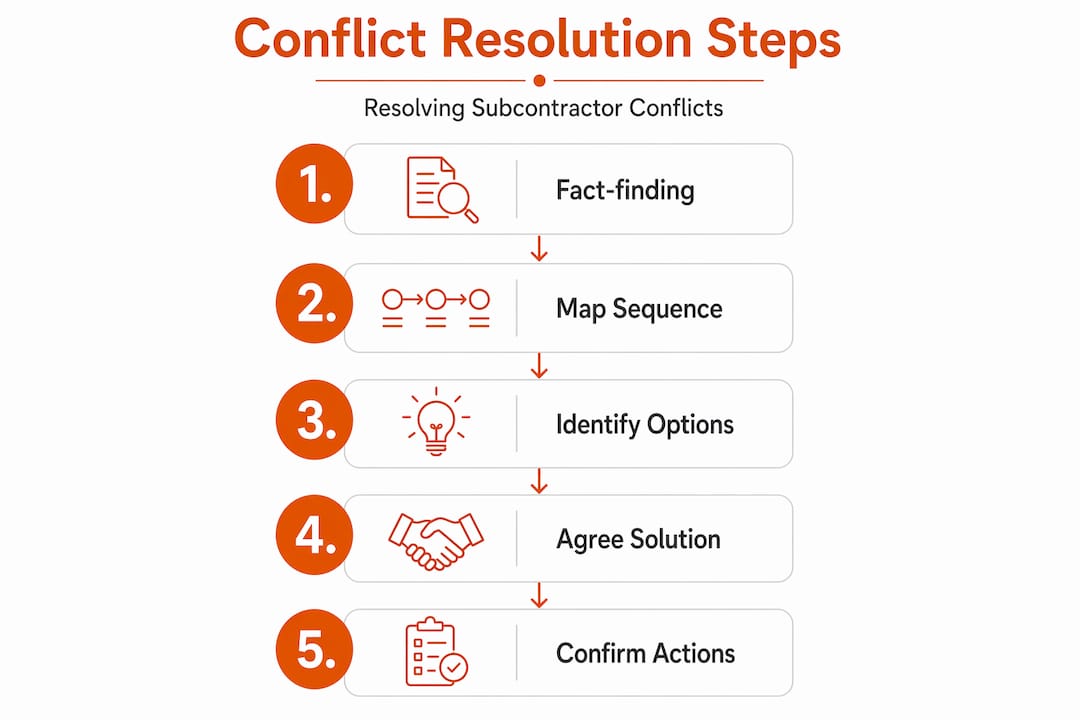
When a scheduling conflict surfaces, the instinct is often to push harder or negotiate informally on the fly. That approach rarely works and frequently makes things worse. Instead, follow a structured resolution process that protects everyone's interests and creates a paper trail if the situation escalates to a formal dispute.
-
Gather all stakeholders immediately. Bring together every party affected by the conflict, including the GC's superintendent and any trade foremen involved. The goal of this first meeting is fact-finding, not blame assignment. Map out the sequence as it was planned versus what is actually happening on site.
-
Review the contract language. JDSupra's analysis of scheduling and risk allocation makes clear that scheduling conflicts are often exacerbated by unclear contract terms around sequencing rights, re-sequencing authority, and delay responsibility. Pull the relevant clauses before the meeting so everyone understands the contractual baseline.
-
Apply concurrent delay analysis. Concurrent delay means two or more independent delays are happening in the same time window. ProjectManager's resource on concurrent delay explains that coordinated analysis across all stakeholders is essential for resolving overlapping delays fairly. You need to identify which delays are truly independent and which are caused by one party's actions affecting another.
-
Agree on a revised schedule. Once the facts are established and the contract context is clear, the group should agree on a realistic, revised sequence. Assign specific action items with owners and deadlines. Do not leave the meeting without a written summary of what was agreed.
-
Document everything. Update your project logs, RFI records, and schedule immediately after the meeting. If the conflict eventually leads to a delay claim, your documentation is your evidence. Verbal agreements that are not recorded are worth nothing in a dispute.
Pro Tip: Focus on resolving the process problem first, not assigning fault. Once the work is moving again, you can have the harder conversation about who bears the cost of the delay. Mixing those two conversations in the same meeting almost always slows down resolution.
| Step | Key action | Output |
|---|---|---|
| 1. Fact-finding | Stakeholder meeting, sequence mapping | Shared understanding of the conflict |
| 2. Contract review | Identify sequencing and delay clauses | Contractual baseline for resolution |
| 3. Delay analysis | Concurrent delay assessment | Clear responsibility assignment |
| 4. Revised schedule | Agreed sequence and action items | Written, signed schedule update |
| 5. Documentation | Update all logs and records | Dispute-ready paper trail |
Validating your solution and avoiding future disputes
Even the best plan needs regular feedback. Finish strong by validating changes and preventing repeat conflicts.

Resolving a conflict is only half the job. The other half is making sure the solution actually holds and that you are not setting up the same problem two weeks down the road. Start by immediately updating every platform, log, and communication channel with the revised schedule. If your foremen are still working from the old sequence, the resolution meeting accomplished nothing.
After the update, monitor for early warning signs that the conflict is recurring or that a new one is forming:
- Watch for RFIs stacking up without responses. A backlog of unanswered RFIs is almost always a leading indicator of an upcoming schedule disruption.
- Track missed commitments from the look-ahead schedule. If a trade misses two consecutive weekly commitments, that is a signal worth escalating before it becomes a crisis.
- Check whether staging areas and access routes are still clear. Physical congestion on site often precedes scheduling conflict.
- Confirm that all parties have received and acknowledged the updated drawings and schedule.
Digital platforms play a critical role here. RealCONs comparative case study research found that construction scheduling and coordination tools improved forecast accuracy and schedule adherence when compared to traditional methods across key project metrics. The study validated this through real project data, not just theoretical modeling.
"Projects using integrated digital scheduling tools showed measurably better adherence to planned sequences and faster recovery from disruption events compared to those relying on manual coordination methods." This finding reflects what experienced subcontractors already know from the field: visibility is the best defense against conflict.
Earned Value Management (EVM) and Earned Schedule Management (ESM) are two analytical frameworks used to measure whether a project is on track financially and temporally. While these tools are more common on large projects, the underlying principle applies to any job: you need objective data, not gut feelings, to know whether your schedule recovery is real. Digital platforms make this kind of data accessible even for smaller subcontractors who do not have a dedicated scheduler on staff.
What most subcontractors miss about conflict resolution
Let's step back and look at why some teams repeatedly struggle while others prevent most issues before they start.
Most subcontractors approach a scheduling conflict as a logistics problem. Move this crew, shift that delivery, work overtime to catch up. That thinking is understandable because it is fast and it feels decisive. But it misses the deeper issue almost every time.
The real problem is usually a combination of weak documentation habits and contract language that nobody read carefully until something went wrong. When a conflict escalates, the subcontractor who wins is almost never the one who worked the hardest to catch up. It is the one who can show a clear record of what was agreed, what was communicated, and what caused the delay. Amerisure's analysis of construction disputes reinforces this point directly: treating conflict resolution as both an operational workflow problem and a dispute-risk problem is what separates subcontractors who absorb losses from those who recover them.
Veteran subcontractors do something that newer ones rarely do. They tie every conflict discussion to written commitments and specific contract language before they agree to any revised sequence. They do not just shake hands and get back to work. They send a follow-up email summarizing what was decided, who is responsible, and what the schedule now says. That email becomes evidence if the situation deteriorates.
The other thing experienced subs do differently is invest in operational workflow and communication enhancements before a conflict forces them to. They build the documentation habit, the look-ahead meeting cadence, and the RFI tracking discipline during the quiet periods, not during a crisis. Reactive firefighting is expensive. Proactive systems pay for themselves many times over across a year of projects.
The uncomfortable truth is that most scheduling conflicts are predictable. The warning signs are almost always there in the RFI log, the look-ahead schedule, or the staging plan. The subcontractors who catch them early are not luckier. They are more systematic.
How Sub Ascent streamlines scheduling conflict resolution
To make your process even more reliable, consider digital tools designed specifically for subcontractors.
Scheduling conflicts cost you time, money, and credibility with the GCs who decide whether to invite you back for the next bid. The good news is that most of the process improvements described in this guide are far easier to implement when you have the right platform supporting them.

Sub Ascent job management gives subcontractors in electrical, plumbing, HVAC, concrete, masonry, and other trades a centralized place to track jobs, manage communications, and maintain the documentation that protects you when conflicts arise. The platform is built on over 80 years of industry experience, which means it reflects how trades actually work, not how software developers think they work. Real-time updates, integrated logs, and clear job tracking mean your team spends less time chasing information and more time executing. If preventing and resolving scheduling conflicts is a priority for your business, Sub Ascent is built to support exactly that.
Frequently asked questions
What is concurrent delay and why does it complicate conflict resolution?
Concurrent delay means two or more independent delays occur within the same time frame, which makes it difficult to assign responsibility to a single party without careful analysis of each delay's cause and timing.
How do digital scheduling tools help resolve conflicts faster?
They allow real-time updates, flag issues early, and integrate project data for faster decisions. Digital scheduling tools have been shown in comparative studies to improve forecast accuracy and schedule adherence significantly.
What's the single most effective prevention tactic?
Holding structured pre-install coordination meetings with all affected trades and reviewing the latest drawings is the most reliable way to catch and prevent conflicts before work begins.
How do contracts affect scheduling conflicts?
Contract clauses on sequencing and risk allocation set the legal baseline for who bears responsibility when delays occur, making clear contract language one of the most important protections a subcontractor can have.
What if an RFI or approval takes weeks longer than planned?
Track the delay in writing from day one, notify project leads immediately, and use your RFI process data to support any extension requests or delay claims if the situation escalates.