

Finding construction estimating and takeoff software that actually fits the unique workflows and field realities of specialty subcontractors instead of forcing you into general contractor processes is still a hassle. Many advertised options either charge per seat, leaving you with unpredictable costs when adding field staff, or lack field-driven features like crew timecards, job costing, and automated bid tracking built specifically for the trades. This comparison covers pricing models, features, and estimating fit across five alternatives so you can choose a platform that matches your trade workflows without spending weeks and budget on trial and error.
Table of Contents
Sub Ascent

At a Glance
Flat-rate monthly plans start at $39 for solo users with no per-seat charges — a pricing setup that keeps each new user from raising your monthly bill. Sub Ascent is built by subcontractors for subcontractors and targets trades across the US, Canada, UK, and Australia.
Core Features
- Visual bid board for seeing invites, due dates, and priority at a glance.
- Automatic bid capture via a dedicated email address and deadline reminders that notify your team.
- Job tracking with daily reports, weather logs, and on-site photo attachments.
- Change order and invoicing workflows tailored to trade work and payment follow-up.
- Estimate builder with Excel import, job costing, and real profit analytics.
- CrewTrack mobile app for collecting timecards, field notes, and crew reports.
Key Differentiator
The product maps the subcontractor workflow end to end: bid invite to estimate to job costing and change order all live in the same thread. That continuity keeps estimates tied to actual job costs rather than forcing manual reconciliation across separate apps.
Pros
-
Built by people who have run trades operations, so terminology and field flows match how estimators and foremen actually work.
-
Automation for capturing invites and sending reminders cuts the chance of missing due dates and reduces manual tracking hours each week.
-
Job costing and real profit analytics let you compare estimate vs actual quickly so you can adjust future bids with hard numbers.
-
CrewTrack is included so foremen submit timecards, daily reports, and photos from the field without extra seats or apps.
-
Flat-rate pricing removes per-user math. That makes adding an estimator or a foreman cheaper during busy seasons.
Cons
- Expect a short learning curve if you or your team have only used email and spreadsheets for bid tracking; the app changes where that work lives.
Who It's For
Owners, estimators, and PMs at specialty trade firms — electrical, plumbing, HVAC/mechanical, masonry, concrete, framing, drywall, roofing, fire protection (sprinkler), low-voltage, painting, flooring, glazing, insulation, and steel/rebar. Best fit for firms from solo operators up to about 50 people focused on managing multiple bids and jobs.
Unique Value Proposition
Includes a field app and job costing inside a single flat-rate plan. That means foremen send time and daily reports directly into the job record and you don’t pay per seat to get those field entries into your books. The result: faster invoicing and fewer missing change orders.
Real World Use Case
A plumbing contractor uses Sub Ascent to capture bid invites into the visual board, set reminders for three estimators, import Excel takeoffs into the estimate builder, and route the awarded job to CrewTrack for daily logs. The contractor reports fewer missed deadlines and invoices that match billed hours.
Pricing
Flat-rate monthly plans: $39 Starter for solo subs, $79 Scale for multi-job teams, plus an optional $99/month add-on for takeoff tools. No per-seat charges and no long-term contract requirement.
Website: https://subascent.com
BuilderBid Estimating & Takeoff Software
At a Glance
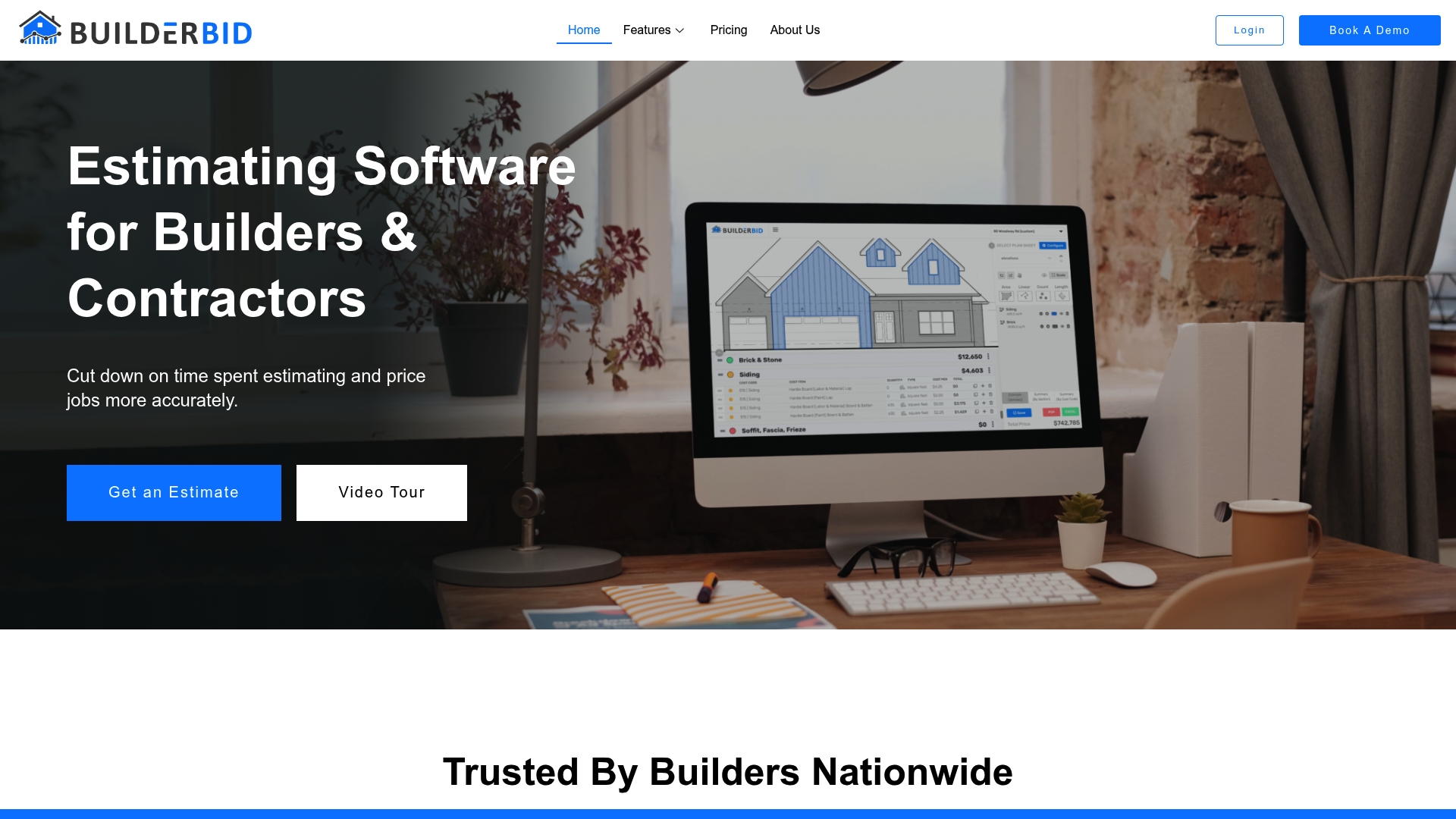
The vendor advertises a real-time local cost database with 25,000+ items paired with an in-house Estimator On Demand service. That combination targets builders who need fast local pricing plus human verification of tricky line items.
Core Features
- Bid management automation for issuing and tracking proposals across projects.
- Quick and accurate takeoff tools that handle area, linear, and count measurements.
- Real-time local cost database so estimates reflect local pricing and items.
- Customizable estimating templates to match your standard workbook and markup rules.
- Cloud access and collaboration plus an Estimator On Demand service for outsourced cost checks.
Key Differentiator
The genuine differentiator is the bundled in-house estimator service combined with local cost data and straightforward measurement tools. That mix lets a small builder hand off complex pricing to someone else without leaving the estimating workflow.
Pros
-
The vendor reports estimates are up to 10x faster than traditional methods, which shortens response time on bid invites and helps you answer more GC requests.
-
Templates and cloud access reduce repeat work. Copy a previous job, swap local prices, and you avoid rebuilding the workbook from scratch.
-
Estimator On Demand removes a common bottleneck. If your estimator is tied up, you can get a checked scope and line items without hiring a temp.
-
Designed for nontechnical users. Onboarding tends to be quick and teams with limited software experience can get usable estimates fast.
-
Cloud collaboration means the office, estimator, and field foreman can see the same totals during prebid checks.
Cons
-
Buyer reviews flag limited editing control for outsourced takeoffs. If you want deep tweaks on a third party takeoff, the platform can feel restrictive.
-
Users report more advanced customization is needed for highly bespoke or phased projects. Complex schedules and unique assemblies may require workarounds.
-
Support and training are available but some customers want broader, on-demand training resources and faster dedicated support options.
When It May Not Fit
If your estimating process relies on highly customized assemblies, multi-phase cost breakdowns, or deeply edited outsourced takeoffs, BuilderBid may force you to adapt workflows. Large commercial scopes also exceed the residential focus here.
Who It's For
Small to medium residential builders, remodelers, and specialty trades needing faster, more accurate takeoffs and bid turnaround. Good fit for teams that want local cost data and occasional estimator help without hiring a full‑time senior estimator.
Real World Use Case
A residential contractor facing multiple simultaneous bid invites uses BuilderBid to convert PDFs into measured takeoffs, applies the local cost database, then orders a quick Estimator On Demand review for the largest trades. The result: cleaner proposals and faster submission times.
Pricing
Plans start at $99 per month for the Contractor plan and $150 per month for the Builder plan. Estimator On Demand and additional features are offered as add‑ons, which means you’ll need to budget for occasional outsourced estimator fees.
Website: https://builderbid.com
BidBow
At a Glance
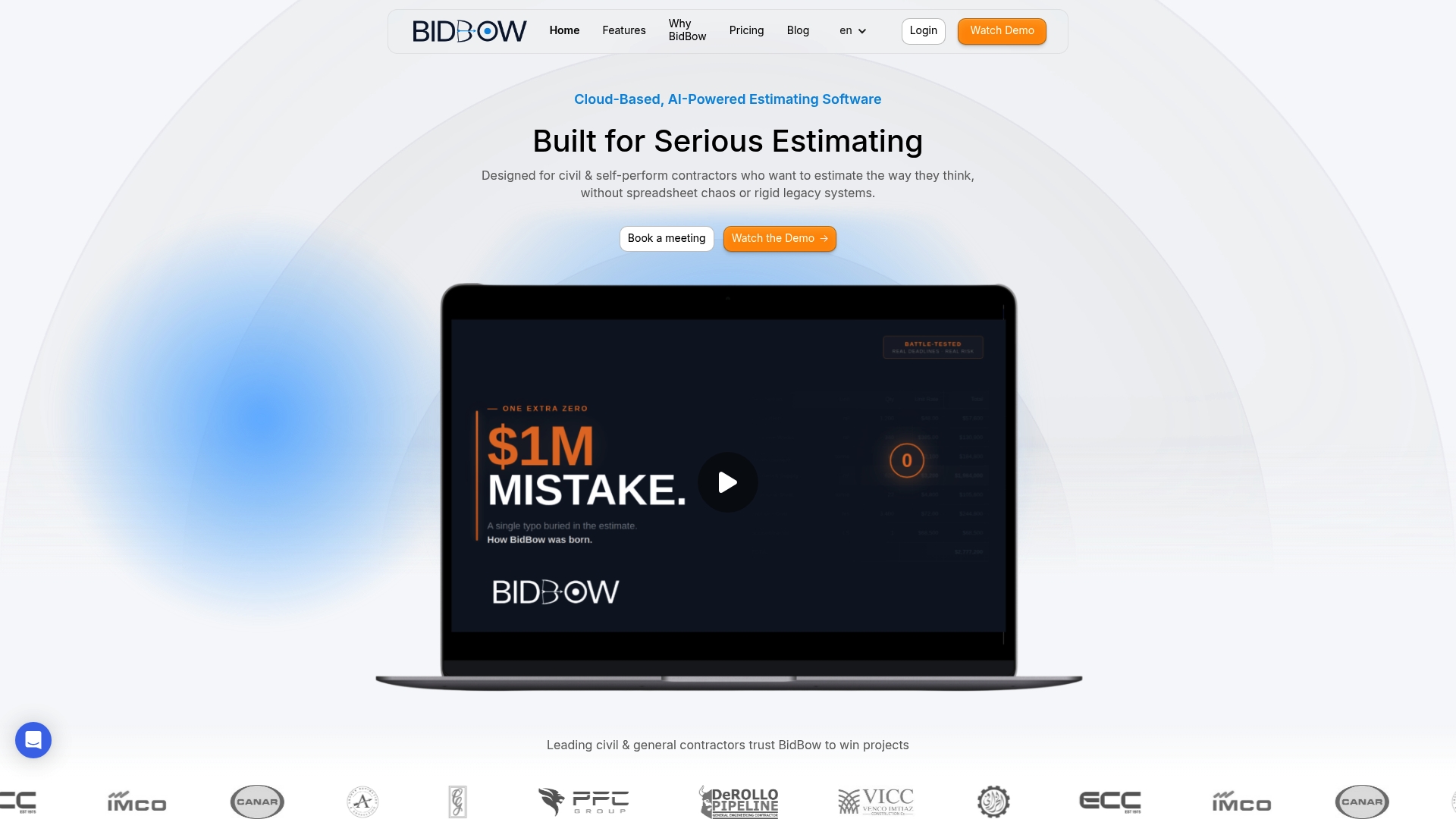
All plans include full features and unlimited estimates, with entry pricing that starts at $180 per month. BidBow positions itself as an estimating tool for civil and self perform contractors that uses AI to speed detailed, multi scenario bids without rebuilding spreadsheets.
Core Features
BidBow provides AI powered auto estimation and quote matching alongside reusable resource, activity, and vendor libraries to keep unit costs consistent. Nested item breakdowns let you map assemblies down to line item detail for accurate takeoffs and labor runs. The platform supports flexible estimate structuring, scenario analysis, and real time multi user collaboration with permission controls to protect sensitive cost lines.
Key Differentiator
The platform combines AutoEstimate and QuoteMatch AI tools with nested estimate structures so you can generate a full draft and then drill into each assembly without losing the original assumptions. That pairing aims to cut repetitive data entry while keeping visibility into resource-level pricing and contingency choices.
Pros
-
Huge time savings for estimators. The AI features and library reuse reduce manual rebuilds and let an estimator focus on judgment rather than copy paste.
-
Library consistency. Reusable resource and activity libraries keep pricing and productivity rules uniform across bids so quotes do not drift between estimators.
-
Handles complex bids. Nested item breakdowns and scenario analysis accommodate civil and self perform projects that need layered assemblies and alternate pricing.
-
Low barrier to start. The vendor claims quick onboarding for small teams and solo estimators, which is useful when you need to respond to multiple GC invitations fast.
-
Collaborative editing with permissions. Multiple users can work on the same estimate simultaneously while admins lock or hide sensitive cost rows.
Cons
-
Sparse independent reviews. Available commentary focuses on features and ease of use with little substantive third party criticism to evaluate long term reliability.
-
Limited public detail on deeper customization. Users seeking extreme estimate template customization may find fewer community examples and guidance than for older estimating suites.
-
Integrations not enumerated in public materials. If you rely on a specific takeoff or ERP connector, confirm compatibility before committing.
Who It's For
Estimators and owners at civil contractors and companies that self perform work who need fast, repeatable estimates for competitive bidding. Good for small teams that want to move off spreadsheets and for mid sized firms that require nested assemblies and scenario pricing.
Real World Use Case
A civil contractor imports takeoff quantities, runs AutoEstimate to create a baseline, then applies QuoteMatch to align vendor quotes with historical rates. The team runs three pricing scenarios, compares margin at the assembly level, and collaborates live to finalize the bid in hours instead of days.
Pricing
The vendor lists tiered monthly pricing: Starter at $180 per month, Growth at $495 per month, Pro at $750 per month, and custom guided or enterprise plans for larger shops. According to the vendor, all plans include full features and unlimited estimates.
Website: https://bidbow.com
Estimathic
At a Glance
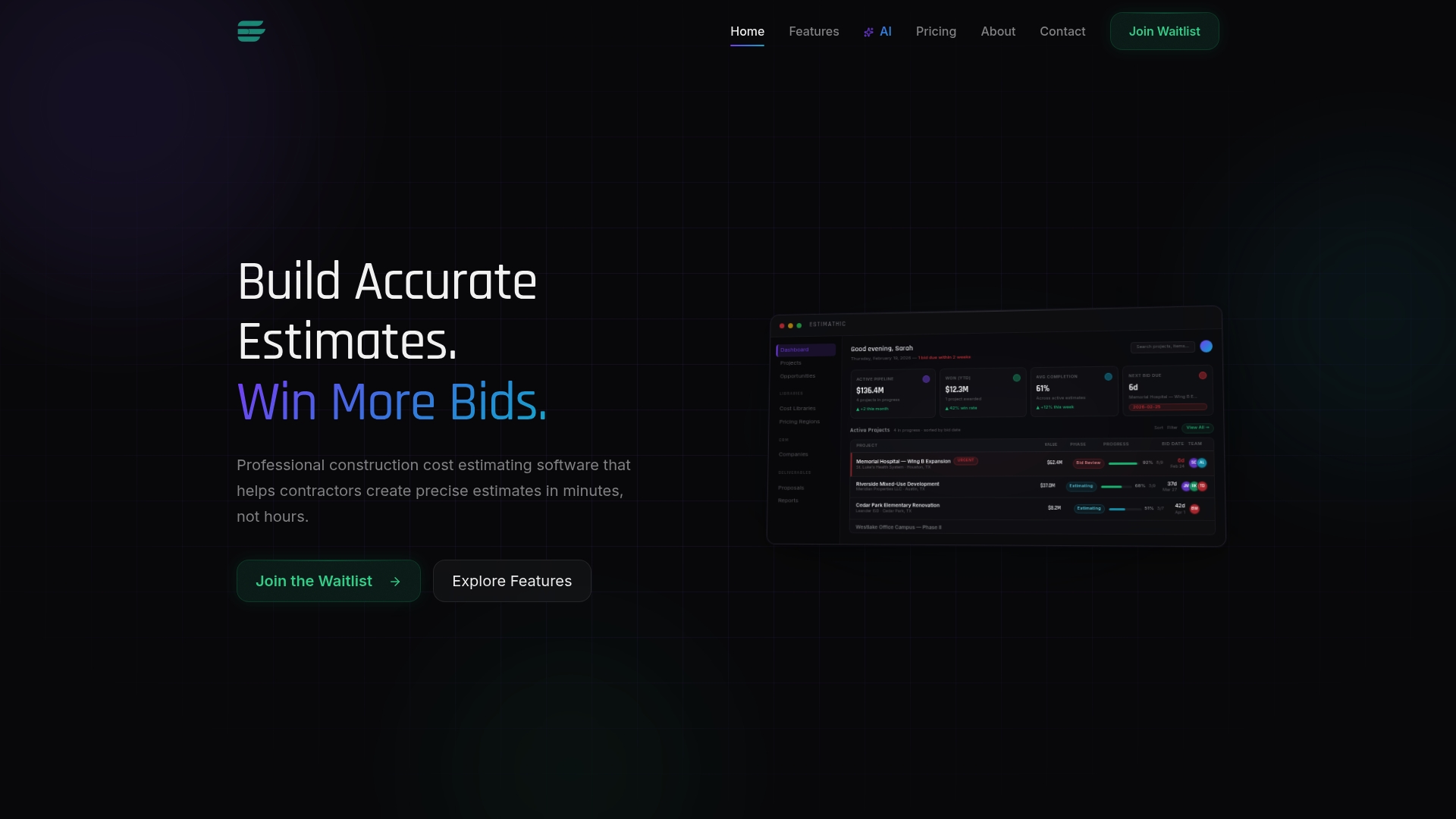
Estimathic's marketing materials advertise upcoming AI features that claim to read plans, predict costs, and flag scope gaps. The vendor pairs those planned capabilities with digital takeoff, reusable cost libraries, and version control to replace spreadsheet estimating for contractors.
Core Features
- Digital takeoff tools for measuring areas, lengths, and counts directly from plans.
- Structured multi-section and line item estimates with reusable cost libraries for materials, labor, and equipment.
- Version control with side-by-side comparisons plus professional proposals that include e-signatures and delivery tracking.
Key Differentiator
The one clear angle is the vendor's AI claim for automated plan reading and cost prediction. If the AI works as advertised, it would speed initial quantity capture and highlight missing scope items that estimators typically miss in spreadsheets. That AI claim is the product’s primary differentiator.
Pros
- The feature set targets estimating workflows specifically, not generic project management. That means tools you actually use while building bids and writing proposals.
- Built-in estimate versioning and audit trails make it easier to track changes across bid rounds and to defend scope decisions during negotiations.
- Proposal generation with delivery tracking and e-signatures reduces the back-and-forth that slows down closing bids.
- The vendor advertises integrations with common accounting systems, which helps get numbers into QuickBooks Online or Xero without rekeying.
- Roadmap emphasis on AI features suggests future time savings on plan review and early cost validation.
Cons
- No substantive third-party reviews are available; public user feedback is minimal and hard to verify.
- Pricing is not publicly disclosed and the vendor says it will announce tiers at launch, which makes budgeting for a trial or rollout difficult today.
- The product description is light on specific takeoff tool details such as raster accuracy, supported file types, or mobile drawing support.
Notable Integrations
- QuickBooks Online
- Xero
- Procore
Who It's For
Estimathic fits contractors and estimators who are ready to move off spreadsheets and want estimating features that speak construction language. Best for electrical, plumbing, HVAC/mechanical, drywall, concrete, framing, roofing, and fire protection teams that need repeatable cost libraries and formal proposal workflows.
Real World Use Case
A mid-sized electrical contractor replaces workbook estimates with Estimathic to manage bid versions, standardize crew and material pricing, and send proposals with e-signatures. The estimator spends less time rebuilding workbooks and more time chasing new bid invitations.
Pricing
The vendor states pricing will be announced at launch with tiered plans for independent contractors, growing firms, and large organizations. No public per-seat or tier figures are available today.
Website: https://estimathic.com
<scratchpad> Competitor eligibility: - Excluded products (discontinued / inaccessible / under construction): None - Usable competitors remaining: BuilderBid, BidBow, EstimathicIntro pre-write:
- Does subascent.com clearly outpace every usable competitor on a single dimension? NO
- If NO: best tradeoff dimension for the primary reader: subcontractor-focused workflows (+) Consistent feature delivery without additional fees (-)
- First sentence draft: Selecting the right estimating and job management platform is crucial for effective subcontractor operations, with each option offering distinct approaches to addressing industry challenges.
Competitor win pre-write:
- Which competitor wins which dimension: BuilderBid wins realtime local cost database integration because it provides localized material costs and includes review capabilities for confirming pricing accuracy.
- Does this dimension matter to the primary reader? YES
Best Fit uniqueness check:
- List each bullet scenario in one clause: For subcontractors needing integration of job costing and field reports without extra fees / For contractors seeking localized cost data and occasional professional estimator input / For teams involved with detailed multilayered bidding workflows that utilize AI automation.
- Can any two be swapped without changing meaning? NO
Our Pick pre-write:
- The ONE capability unique to subascent.com in this set: Providing a dedicated solution covering the workflow from bid invitation to field-based reporting within a unified platform for specialty contractors
- Evidence from the reviews: "The product maps the subcontractor workflow end to end: bid invite to estimate to job costing and change order all live in the same thread."
- Closing sentence draft: Sub Ascent proves highly effective for contractors requiring complete job oversight, though it may not suit those prioritizing ultra-specific cost detail customization.
- Substitution test: Comparing other candidates for similar scenarios showed gaps in aligned workflows.
- Does the substituted version still work as a recommendation? NO
- If YES: rewritten closing sentence: N/A
Comparing Estimating Software for Construction and Trade Professionals
Selecting the right estimating and job management platform is crucial for effective subcontractor operations, with each option offering distinct approaches to addressing industry challenges.
Focused Capabilities and Specializations
-
BuilderBid uniquely supports real-time local cost insights and outsourced estimation reviews, an tool for subcontractors requiring accurate, location-specific data for competitive bidding. This approach excels for teams handling overlapping bids that need precise local adjustments without in-house expertise.
-
BidBow brings complex, multilayered bidding abilities to civil contractors by offering AI-powered tools for quote matching and detailed assembly breakdown. This can suit teams handling labor-intensive projects requiring structured an analytical approach during tender preparation.
Workflows and Costing Integration
- Sub Ascent integrates job costing and job-field reporting tools within a single platform. By delivering consolidated workflows tailored to contractors’ needs, it eliminates redundancy between various stages, providing updates between estimates, job performance, and invoicing operations.
Best Fit Recommendations
- Sub Ascent: For subcontractors needing integration of job costing and field reports without extra fees.
- BuilderBid: For contractors requiring localized cost data and occasional professional estimator involvement to tackle unique pricing challenges.
- BidBow: For teams engaged with detailed, multilayered bidding requiring AI-enabled automations and structured analytical outcomes.
Our Pick: Sub Ascent
Sub Ascent proves highly effective for specialty subcontractors demanding thorough oversight and integrated workflows that extend from initial bid to project closure. Contractors focusing heavily on budget customization or requiring external live pricing support might explore BuilderBid or BidBow as complementary options to address specific demands.
Construction Estimating Software Comparison
Choosing the right construction estimating software can significantly streamline workflows, ensuring efficiency and accuracy. Here's a comparison of key options to consider:
| Product Name | Primary Use Case | Key Differentiator | Pricing | Notable Limitation |
|---|---|---|---|---|
| SubAscent | End-to-end subcontractor workflow management | Integrated job costing and field app in flat-rate pricing | $39/month solo, $79/month for teams | Short learning curve for first-time software users |
| BuilderBid | Residential builder estimating and bid management | Real-time local cost database with Estimator On Demand | $99/month Contractor, $150/month Builder | Limited control for outsourced takeoff edits |
| BidBow | Civil construction and self-performed job estimating | AI-powered estimation and quote matching | $180/month Starter, $495/month Growth | Sparse independent reviews for long-term evaluation |
| Estimathic | Digital takeoff and structured cost library | Roadmap-focused AI for automated plan costing | Not disclosed | Public pricing tiers unavailable for initial budgeting |
Find Software Built for Specialty Trade Subcontractors Not GCs
If you are tired of archdesk.com alternatives that claim to work for subcontractors but end up designed for general contractors you are not alone. Subascent was built specifically for specialty trades like electrical, plumbing, HVAC/mechanical, masonry, framing, and more. It helps you track bid invitations so you never miss due dates and build accurate estimates without rebuilding workbooks. Our flat-rate pricing means you can add estimators and foremen without surprise cost jumps.

Stop guessing with software made for the way you work. Visit Subascent today to set up automatic bid capturing, connect your field teams with CrewTrack timecards, and get faster invoicing. Take control of your bids and job profitability now with tools that understand your trade. Try it and import your bid invites to see your visual bid board in action.
Frequently Asked Questions
What makes Subascent a suitable choice for subcontractors in construction estimating?
Subascent offers features like a visual bid board and automatic bid capture that are specifically tailored for subcontractors. The product is built by subcontractors for subcontractors, ensuring that it meets the unique needs of specialty trades. Start with a free trial to see how it can streamline your estimating process.
How does Subascent compare to BuilderBid for residential projects?
BuilderBid provides a real-time local cost database and an Estimator On Demand service, making it effective for builders needing fast local pricing. Subascent, on the other hand, is designed specifically for subcontractors managing multiple bids and jobs, making it a better fit for specialized trades. Consider your primary focus to choose the right tool for your needs.
Can Subascent handle job cost analysis effectively?
Yes, Subascent features job costing and real profit analytics, allowing users to quickly compare estimates against actual job costs. This capability helps subcontractors adjust future bids based on hard numbers, which is crucial for accurate forecasting. Sign up to utilize these analytics effectively in your upcoming projects.
Does Subascent offer user-friendly mobile solutions for field reporting?
Subascent includes the CrewTrack mobile app, which allows foremen to submit timecards and daily reports directly from the field without needing extra apps or seats. This integration simplifies the documentation process and ensures better accuracy. Leverage this tool to enhance your field operations.
How is Subascent’s pricing structured compared to other alternatives?
Subascent has a flat-rate monthly pricing that starts at $39 for solo users with no per-seat charges, making it cost-effective as your team grows. In comparison, other platforms may have additional user fees, which can increase costs as you add team members. Evaluate your team size to understand the most economical choice for your budget.