

If you're an electrical, plumbing, or HVAC estimator still building bids in spreadsheets, you already know the pain. You spend hours chasing sub quotes, updating line items, and reformatting output — only to lose the job to someone who turned around a cleaner bid two days faster. The benefits of estimating software for small subs go far beyond convenience. The right tool changes how many bids you can chase, how accurately you price them, and whether you're building a business or just staying busy.
Table of Contents
- Why speed and accuracy matter for small specialty subs
- Key features to look for in estimating software for small subs
- Popular estimating software options for small specialty trades
- How estimating software improves efficiency and risk management
- Cost versus time savings: calculating the ROI of estimating software
- Why small specialty subs should embrace estimating software now
- Discover Sub Ascent: Simplify your subcontractor estimating and bid management
- Frequently asked questions
Key Takeaways
| Point | Details |
|---|---|
| Time savings | Estimating software can save small subcontractors 4 to 8 hours per bid by automating manual tasks. |
| Improved accuracy | Standardized templates and local cost data reduce errors and protect profit margins. |
| Lower risk | Software reduces reliance on individual memory, ensuring consistent professional bids. |
| Affordable ROI | Software costs are typically much lower than a full-time estimator’s salary, offering strong ROI. |
| Competitive advantage | Faster bids and professional proposals help small subs win more jobs against the competition. |
Why speed and accuracy matter for small specialty subs
Manual bidding is slow. For a complex electrical or fire protection bid, manual bid management — including sub outreach, follow-ups, and organizing responses — typically consumes 4 to 8 hours per bid. That's a full workday on a single estimate. Multiply that by 10 bids a month and you've spent two weeks just managing paper and inboxes.
Speed matters because GCs don't wait. When a bid invitation drops Friday afternoon with a Monday due date, the sub who responds first with a clean, professional number gets the call. Slower turnaround means fewer opportunities, not just missed ones.
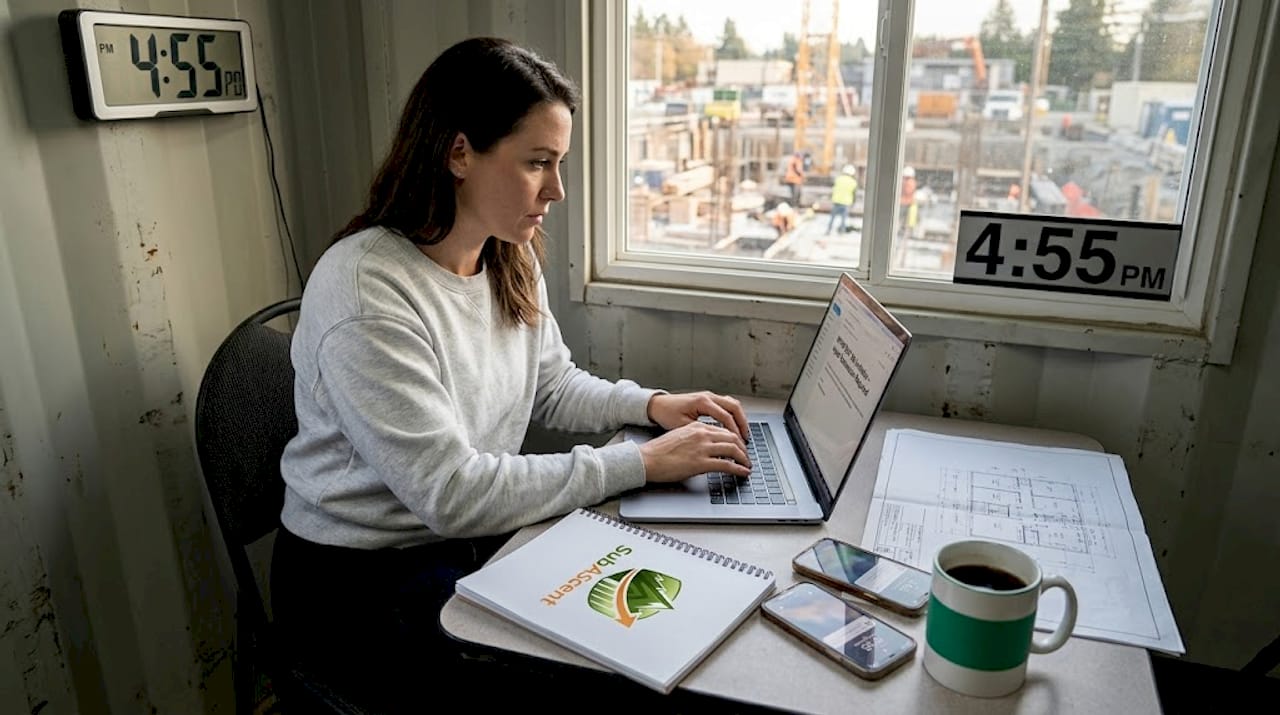
Accuracy is the other half of the equation. Tight margins — often 5 to 10 percent on specialty trade work — mean one missed item or one misread spec can wipe out your profit on an entire job. Estimating software reduces that risk by pulling from current cost databases, flagging incomplete scope, and keeping your labor rates consistent across every bid.
Here's what estimating software actually helps with for small specialty subs:
- Takeoff automation that counts fixtures, calculates linear footage, or measures square footage directly from PDF plans
- Live templates that update every line item when material costs change
- Automated bid outreach to lower-tier subs or suppliers without manual emails
- Built-in follow-up tracking so nothing falls through the cracks
- Output formatting that looks professional to GCs without extra polish time
Reducing subcontractor scheduling conflicts also becomes easier when your estimates are tied to realistic labor forecasts rather than gut feel. And when bids are documented clearly, you're far less likely to end up in the kind of subcontractor contract disputes that drain time and money post-award.
Key features to look for in estimating software for small subs
Not all estimating software is built for a 5-person drywall or insulation crew. A lot of it is designed for large general contractors with dedicated IT staff and six-figure software budgets. If you're a small specialty sub, the features valuable for small subs look very different from what enterprise platforms advertise.
Here's what actually matters at your scale:
- Ease of use. If it takes three weeks to learn, your estimator won't use it under deadline pressure. Look for software with a learning curve measured in hours, not months.
- Affordable pricing. Most small subs don't need to pay enterprise rates. Good tools exist in the $30 to $200 per month range.
- Live template updates. The best estimating software for small teams makes revisions fast, with templates that update live, line items you can swap in seconds, and output formats your clients can actually read. Over the course of a year, that alone saves dozens of hours.
- Local cost database integration. Material and labor costs vary significantly between markets. Software that pulls from regional databases keeps your numbers competitive and realistic.
- Cloud access. You or your PM needs to review and adjust bids from the jobsite, the truck, or a hotel room. Cloud-based platforms make that possible without emailing files back and forth.
- Automated outreach. For subs who send invitations down to suppliers or lower-tier trades, automation handles the routine follow-up that otherwise consumes 30 to 60 minutes per bid.
Pro Tip: Before committing to any software, run a real bid through it during the trial period. Don't test it with a fake project. Use an actual scope you know well. That's the only way to evaluate whether it genuinely fits your workflow.
When evaluating options, it also pays to think about how the tool fits into your job management process after the bid is won. Software that connects scheduling conflict solutions to your estimating workflow means fewer handoff problems when the job kicks off.
Popular estimating software options for small specialty trades
With those criteria in mind, here's how some of the leading platforms stack up for small specialty subs.
Buildertrend is a full-management suite designed for custom home builders and large-scale remodelers with real-time client selections. It's powerful, but it's built for GC-side workflows. If you're a plumbing or framing sub, you'll pay for a lot of features you'll never touch.
Clear Estimates is designed specifically for remodelers, with a pre-loaded library of over 10,000 line items for fast quotes. Solid for residential work. Less suited for commercial specialty trades where scope complexity runs deeper.
Buildxact is popular with small to mid-sized contractors because of its simplicity and coverage of the full bid-to-build cycle. It's approachable for shops that are just starting to move off spreadsheets.
Bidi uses AI to automate plan analysis, quantity extraction, and subcontractor bid management, saving 4 to 8 hours per bid. For specialty subs managing high bid volume, that time savings adds up fast.
| Software | Best fit | Price range | Key strength |
|---|---|---|---|
| Buildertrend | Custom home builders, large remodelers | $$$$ | Full project management suite |
| Clear Estimates | Residential remodelers | $$ | 10,000+ pre-loaded line items |
| Buildxact | Small to mid-sized specialty contractors | $$ | Simplicity, bid-to-build workflow |
| Bidi | High-volume specialty subs | $$$ | AI-powered takeoff and outreach |
One note on GC-first platforms: tools built for general contractors often push subs into a secondary role within their system. If you've run into subcontractor contract disputes that originated from scope ambiguity, part of the problem may be that your estimating tool doesn't give you the documentation control you need on your own terms.
How estimating software improves efficiency and risk management
There's a risk that most small trade businesses don't talk about openly: tribal knowledge. One experienced estimator holds all the pricing logic, the labor hour assumptions, the material waste factors. When that person is out sick, takes a vacation, or leaves the company, the whole estimating function either stalls or produces inconsistent numbers.
Software solves this directly. As one analysis of the issue puts it:
"Tribal knowledge is a major risk for small businesses. Relying on one person's memory for pricing or assembly logic creates a single point of failure. Using software to standardize templates and pricing libraries ensures that any team member can produce a consistent, professional bid, regardless of who is running the software." — Bidi Contracting
That's not a technology argument. It's a business continuity argument. A roofing or masonry shop that can only produce accurate bids when one specific person is in the office has a fragile operation.
Beyond continuity, there are efficiency gains that compound over time:
- Consistent bid structure means GCs can compare your submissions easily and trust your numbers
- Transparent cost breakdowns build credibility with owners and GCs who scrutinize estimates closely
- Early risk flags in the estimate phase catch scope gaps before they become change orders or losses
- Freed-up estimator time shifts focus to reviewing bids strategically rather than reformatting cells
For HVAC and low-voltage subs dealing with complex system scopes, the ability to catch a missing equipment line or an underestimated wire pull during the estimate phase rather than mid-job is worth more than the software subscription many times over. Understanding how to reduce subcontractor default risk starts with accurate estimates that don't leave you underwater on labor.
Cost versus time savings: calculating the ROI of estimating software
Here's the math most small subs skip. A full-time estimator costs $70,000 to $90,000 per year — roughly $5,800 to $7,500 per month. Any software that meaningfully reduces your estimating workload is dramatically cheaper than that.
Most small sub estimating tools price between $30 and $300 per month. Here's how to evaluate whether the investment makes sense for your shop:
- Measure your current bid time. Track how long a typical bid takes from invitation to submission, including all follow-up and formatting.
- Calculate your hourly estimating cost. Divide your estimator's annual salary (or your own time value) by 2,080 work hours.
- Project time savings. If software cuts bid time from 6 hours to 2, that's 4 hours saved per bid.
- Apply that to your bid volume. Twelve bids per month at 4 hours saved equals 48 hours recovered. At $35 per hour, that's $1,680 in recovered labor time monthly.
- Compare to software cost. A $150/month tool paying back $1,680 in time savings has an ROI of over 1,000 percent.
| Scenario | Monthly software cost | Hours saved per bid | Bids per month | Monthly labor recovered |
|---|---|---|---|---|
| Solo operator | $50 | 2 hours | 8 bids | $560 (at $35/hr) |
| Small 5-person shop | $150 | 4 hours | 12 bids | $1,680 (at $35/hr) |
| Growing specialty sub | $300 | 5 hours | 20 bids | $3,500 (at $35/hr) |
The numbers are conservative. They don't account for the cost of an estimating error on a concrete or steel rebar bid that wipes out 3 months of profit. And they don't reflect the revenue upside from being able to chase more bids in the same time window.
Pro Tip: Track your close rate before and after adopting software. If your close rate improves by just 2 to 3 percentage points, the revenue impact on a $5 million annual revenue shop is $100,000 to $150,000 in additional contract value. That dwarfs any software subscription cost. Understanding how estimating impacts payments helps you connect bidding accuracy directly to cash flow.
Why small specialty subs should embrace estimating software now
Here's the uncomfortable truth: most small specialty subs are still running estimating processes that haven't changed since 2005. Spreadsheets, email chains, sticky notes on monitors. Meanwhile, the subs winning the most work in 2026 are turning around bids faster, with cleaner scopes and tighter pricing.
The construction software market is expected to reach $2.33 billion by late 2026 as builders move away from manual processes to protect their 5 to 10 percent profit margins. That market growth isn't driven by large GCs alone. It's being driven by specialty trade shops that figured out their margins were too thin to absorb estimating inefficiency.
The real risk isn't paying $200 per month for software. The real risk is continuing to operate with a process your competitors are abandoning. When a GC has three electrical subs they can call, and two of them respond within hours with clean, professional estimates, the third one is calling back two days later wondering why they keep not getting selected.
This is also about growth capacity. A solo HVAC estimator running everything manually hits a ceiling fast. With the right software, that same person can handle 40 percent more bid volume without working longer hours. That creates space to grow revenue without hiring before you're ready.
The subs who adopt overlooked scheduling conflict solutions alongside better estimating tools are the ones who win work and then actually execute it profitably. One feeds the other.
Don't wait for a painful estimating error or a lost GC relationship to force the change. The tools are affordable, proven, and purpose-built for shops your size. The window to get ahead of competitors is right now.
Discover Sub Ascent: Simplify your subcontractor estimating and bid management
You've seen what the right software can do. Faster bids, tighter pricing, less time chasing responses, and a process that doesn't fall apart when your best estimator is unavailable. Sub Ascent is built specifically for small specialty subs — electrical, plumbing, HVAC, roofing, drywall, and more — who need these results without the complexity of a GC-focused platform.
Sub Ascent automates bid outreach and response tracking, gives your team live templates that update when costs change, and ties your estimating workflow directly to job management. You can test it against your own real bids with a free trial. No drawn-out onboarding. No enterprise contract. Just a tool that fits how specialty trade subs actually work, with support to help you tailor it to your business from day one.
Frequently asked questions
How much time can estimating software save small specialty subcontractors per bid?
Estimating software can save 4 to 8 hours on complex bids by automating takeoffs, sub outreach, follow-ups, and bid organization. For high-volume shops, that adds up to multiple full workdays recovered each month.
What features should small subs prioritize when selecting estimating software?
The best tools for small teams offer live template updates, local cost database integration, cloud access, and output formats GCs can read without reformatting. Ease of use and affordable pricing should rank as high as any feature.
Can estimating software reduce risks associated with relying on individual knowledge?
Yes. Standardizing templates and pricing libraries means any team member can produce a consistent, professional bid, removing the single point of failure that comes with one estimator holding all the pricing logic in their head.
Is the cost of estimating software justified compared to hiring a full-time estimator?
At $10 to $300 per month versus a full-time estimator's cost of $5,800 to $7,500 per month, the ROI is straightforward. Even modest time savings make the software dramatically cheaper than adding headcount.
Does estimating software improve a small sub's chances of winning bids?
Faster response times directly affect close rates. AI-powered tools can reduce response times by up to 10 times and increase close rates by 40 percent, meaning the subs who respond first and cleanest win more work from the same bid invitations.