
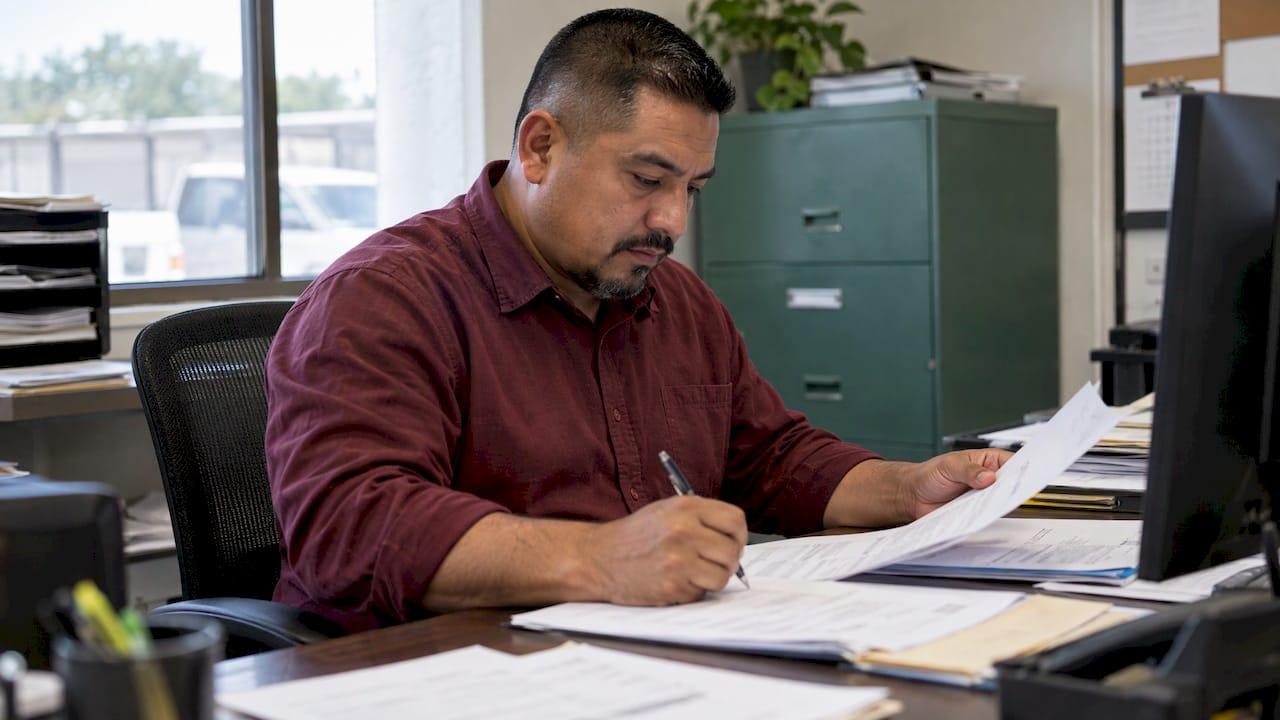
Certified payroll is a weekly payroll report, signed under penalty of law, that proves you paid every worker on a public job at least the required wage. If you are an electrical, plumbing, HVAC, masonry, concrete, drywall or any other specialty sub on a federal or federally assisted project, you file it every week the crew is on site, and so does every sub below you. The hard part is not the form. It is getting clean hours, by worker, by job, by classification, out of the field in time to sign. Fix that, and the paperwork takes minutes.
TL;DR
- Certified payroll is the weekly proof of payment. Prevailing wage is the rate you must pay. One is the report, the other is the rule behind it.
- On federal or federally assisted construction contracts, every contractor and sub at every tier submits weekly certified payrolls with a signed Statement of Compliance.
- Form WH-347 is optional, but the weekly submission is not. Reports are due within seven days after the regular payment date.
- Keep your payroll records for three years after all work on the prime contract is complete.
- Late, wrong or falsified reports can mean withheld payments, debarment, and criminal exposure. Good field timecards prevent most of it.
Table of Contents
- Certified payroll versus prevailing wage
- Who has to file
- What Form WH-347 is, and whether you need it
- What goes on each weekly report
- How to do certified payroll each week
- Records, errors and penalties
- Setting up your business for certified payroll
- Getting clean hours out of the field
- Where Sub Ascent fits
- FAQ
- Sources
Certified payroll versus prevailing wage
These two terms get mixed up, and the difference matters when you read a bid package.
Prevailing wage is the minimum hourly rate, plus fringe benefits, that a public project requires for each classification of work in a given county. On federal work it comes from the Davis-Bacon and Related Acts, and the rates are listed in a wage determination attached to the contract. Your bid has to carry that labor cost, so read the wage determination while you are still estimating.
Certified payroll is the report that shows you actually paid those rates. The U.S. Department of Labor explains that the Copeland Act and its regulations require weekly certified payrolls from contractors and subcontractors on federal or federally assisted construction contracts, each with a signed Statement of Compliance saying wages meet the Davis-Bacon rates, fringes included.
So a project can have prevailing wage requirements, and the proof you send the prime contractor or agency each week is the certified payroll.

Many states and some cities run their own prevailing wage programs on state-funded work, with their own forms and portals. Your contract documents tell you which program applies. This guide follows the federal rules, which most state programs resemble.
Who has to file
The federal rule is broad. The Associated General Contractors' guide to Davis-Bacon says every person doing on-site laborer or mechanic work is covered regardless of any contractual relationship, and that contractors and subcontractors at all tiers submit weekly certified payrolls.
In practice:
- Laborers and mechanics are covered. That includes your journeyman electricians, pipefitters, bricklayers, tenders, finishers, glaziers, roofers and apprentices working on site. Office staff and your own time as an owner doing management work generally fall outside, but if you or a partner work with the tools on site, ask your contracting agency how to report it.
- Every tier files. If you are a second-tier sub, you send your payroll up to the sub above you, and the prime contractor submits the full set to the agency.
- Each employer reports its own people. The prime contractor does not fill out your payroll for you, and you cannot rely on them to catch a mistake before it is signed.
For a plain overview of which workers and contractors are covered on public jobs, this piece on prevailing wage on government flooring jobs walks through the basics from a trade installer's side.
What Form WH-347 is, and whether you need it
WH-347 is the Department of Labor's standard certified payroll form. Per the DOL, use of the form is optional, but weekly submission is required, and a properly completed WH-347 satisfies the regulations in 29 CFR parts 3 and 5. The current instructions are the January 2025 revision.
You can use any format that carries the same information, as long as the Statement of Compliance has identical wording. The regulation at 29 CFR 3.3 says the statement goes on the back of WH-347 or on any form with identical wording, signed by the contractor or an authorized officer or employee who supervises payment of wages.
That is why most subs just use WH-347. Agencies and primes know it, and nobody argues about the layout.
What goes on each weekly report
The DOL's Employment Law Guide lists what each weekly payroll must contain: each covered worker's name and identifying number, classification, hourly rates including fringe contributions or cash equivalents, daily and weekly hours, deductions, and actual wages paid.
Here is how that maps to the columns people trip over:
| Item | What to enter | Where it goes wrong |
|---|---|---|
| Classification | The work the person actually did that week, matched to the wage determination | Using the person's title instead of the work performed |
| Daily and weekly hours | Hours on this project, by day | Hours rounded from memory on Friday afternoon |
| Column 6A | Actual hourly rate paid for straight time and overtime | Leaving out a higher actual rate when you pay above the determination |
| Column 6B | Total fringe benefit credit taken toward the required fringe rate | Taking credit for contributions you did not actually make |
| Column 7A | Gross amount earned that week on the project | Mixing in hours from other jobs |
| Deductions | Only those allowed under 29 CFR part 3 | Unexplained deductions |
The column definitions come from the DOL's WH-347 instructions.
Workers in more than one classification
If a mason spends Monday and Tuesday as a bricklayer and Wednesday through Friday tending, he gets separate entries with an accurate hours breakdown. The instructions on the form call for this. A single lump of 40 hours at the higher or lower rate is the kind of line that draws questions from an auditor.
This is a timecard problem, not a payroll problem. If your foreman records only total hours per man, you cannot rebuild the split later.
Overtime and fringes
Overtime over 40 hours in a week must be entered as overtime on contracts covered by the Contract Work Hours and Safety Standards Act, and time-and-a-half of the basic rate is required when the prime contract exceeds $100,000, per the same form instructions.
If you pay part of the required fringe as cash on the paycheck instead of into a plan, show it separately from the base rate. The instructions give an example of writing it as a base rate over a cash amount, because overtime is figured on the basic rate, not on the cash fringe. Fringes are reported under paragraph 4(a) for plan payments, 4(b) for cash in lieu, and 4(c) for the partial-plan exception.
A worked example. The wage determination for a classification is $30.00 base plus $10.00 fringe. You put $10.00 into a benefit plan, and the fringe is covered. The worker puts in 45 hours. Overtime is time-and-a-half on the $30.00 base, so the 5 extra hours are paid at $45.00. If instead you paid the whole $10.00 as cash, you would show it as $30.00/10.00 and still compute overtime on $30.00 only.
How to do certified payroll each week
Here is the routine, start to finish.
- Read the wage determination before you bid. Pull the classifications and rates for your trade and county into your estimate. A bid built on your usual rates can lose money on day one.
- Set up each worker once. For every employee who will work on the job, record name, identifying number, classification, base rate and fringe approach. Doing it before the first week avoids Friday scrambles.
- Collect hours daily, by job and classification. Not weekly. The foreman logs who worked, what they did and for how long, each day.
- Approve the timecards before payroll runs. A second set of eyes catches missing days and wrong classifications.
- Run payroll and enter the actual pay. Gross pay for the week on the project, deductions, and net, should match what hit the paychecks.
- Complete the report and Statement of Compliance. Enter phone number and email as the DOL instructions require.
- Sign it properly. The statement must be signed by the contractor or the agent who paid or supervised payment of the workers that week. The DOL says an original handwritten signature or a legally valid electronic signature works. Photocopied or scanned signatures do not.
- Submit on time. The Employment Law Guide says payrolls are due within seven days after the regular payment date, by whatever method the contracting agency permits. Ask your GC or agency which one.
- File a copy. More on retention below.
The DOL also offers a web reporting tool for WH-347 that walks you through adding workers, wage rates and deductions, then reviewing the completed form. Check with your contracting agency whether it accepts that output.
Weeks with no work
If you have a covered contract and nobody worked on it for a week, ask the prime or agency how they want that recorded. Many agencies expect a no-work report rather than silence, and a missing week looks the same as a missed week.
Who signs
The signer certifies the facts under the penalties of 18 U.S.C. § 1001. The statement need not be notarized, but the NLR's form instructions note it carries a fine, up to five years in prison, or both. Sign only when you know the facts. That is a reason to have the person who actually knows the hours and pay, usually the owner or office manager, review every report.
Records, errors and penalties
The Employment Law Guide says required payroll records must be preserved for three years after all work on the prime contract is completed. The AGC guide adds that each sub keeps its own payrolls and basic records such as time cards, and the prime keeps the complete set including sub payrolls. Keep the timecards, not just the finished reports, because the timecards are your proof if a classification is ever questioned.
The consequences come from the same DOL guide. Contractors who disregard their obligations may be debarred for three years. Contract payments can be withheld to cover unpaid wages and overtime liquidated damages. Falsifying certified payrolls can bring civil or criminal prosecution.
For a small sub, a withheld payment hurts first. A GC holding retainage or a pay application until a missing payroll arrives is a cash flow problem you can avoid by filing on time.
The most common causes of trouble are ordinary ones:
- A foreman hands in hours on Monday for the week before, and half of them are guesses.
- A worker is paid under the wrong classification because the job sheet said "laborer" for everyone.
- Hours from two projects are blended into one line.
- The report is signed by someone who never saw the payroll.
- Reports are filed but the timecards are thrown away at the end of the job.
Every one of these starts in the field, not in the office.
Setting up your business for certified payroll
If you are bidding your first prevailing wage job, spend a day on setup before the notice to proceed.
- Name one person who owns the weekly report and one backup.
- Build a classification list for your trade from the wage determination, so a foreman picks from a short menu instead of typing a title.
- Agree on a cutoff. If payday is Friday and you want the report out within the seven-day window, timecards must be in and approved by a fixed time.
- Decide how fringes are paid. Plan contributions, cash in lieu, or a mix, per worker. Document it.
- Ask the GC for their submission method and format and whether they want the Statement of Compliance on every report.
- Check your labor burden on the job. Prevailing wages with fringes change the real cost of a labor hour. Our labor burden calculation guide shows the formula with an example.
For a longer walk-through written for trade owners, see our certified payroll reporting guide for trade subs.
Getting clean hours out of the field

This is the step that decides whether certified payroll is a 20 minute task or a Friday night problem. The report needs hours by worker, by day, by classification, by project. Paper tickets, texted hours and Monday memory do not give you that.
Two things help most. First, daily entry, so the foreman records the hours while the work is fresh. Second, an approval step before payroll, so mistakes get fixed before anyone signs. We cover both in our guides on digital timecards for construction and timecard approvals for trade subcontractors. If your crews are paid by the hour, how subcontractor crews get paid lays out how hours turn into pay.
We run a trade business, so we know the Friday problem. The office needs the hours by 10 a.m., and the foreman is still on a lift. Certified payroll does not forgive that gap. It turns it into a signed statement.
That is why we built Sub Ascent around the field first. CrewTrack, our mobile app, is where foremen log crew timesheets and daily reports, and it comes free with the subscription. When hours are captured per job as the work happens, the office is not rebuilding a week from a crumpled sheet. And when jobs sync to QuickBooks, the payroll side starts from the same numbers.
Estimating matters here too. A prevailing wage job is won or lost on the labor line, and our estimating and takeoff tools are built for specialty trades, not general contractors. Know the real rate before you bid, capture the real hours while you build, and the weekly report becomes routine.
Dave
Where Sub Ascent fits
Sub Ascent is job and bid management software for specialty trade subs. For certified payroll, the pieces that matter are CrewTrack crew timesheets and daily reports, which foremen use on their phones at no extra charge, and invoicing and QuickBooks sync, so what you bill and what you pay stay tied to the same job.
Plans are published at subascent.com: Starter is $49 per month ($490 per year), Scale is $99 per month ($990 per year), and Pro is $179 per month ($1,790 per year). PDF takeoff is a separate add-on at $99 per month. A free trial comes before you subscribe.

If prevailing wage work is a growing share of your backlog, start with how your foremen record time. It is the cheapest fix and the one that touches every report.
FAQ
Do I have to use Form WH-347?
No. The DOL says the form is optional, but weekly certified payrolls are required on covered contracts. Any format works if it contains the same information and the Statement of Compliance has identical wording. Most subs use WH-347 because primes and agencies recognize it.
How long do I keep certified payroll records?
The DOL's Employment Law Guide says to preserve required payroll records for three years after all work on the prime contract is completed. Keep the underlying timecards as well as the reports. The prime contractor keeps the full set, including sub payrolls.
Can I sign a certified payroll with a scanned signature?
No. The DOL's WH-347 instructions accept an original handwritten signature or a legally valid electronic signature, and say photocopies or scanned copies of a signature do not satisfy the requirement. The signer should be the contractor or the agent who paid or supervised payment of the workers that week.
What is the difference between prevailing wage and certified payroll?
Prevailing wage is the required minimum rate and fringe for each classification in the wage determination. Certified payroll is the weekly signed report proving you paid at least that. You need to pay one and file the other.
Does a state prevailing wage job use the same form?
Not always. Many states have their own programs, forms or online portals for state-funded work. Your contract documents or the awarding agency will say which applies, and which submission method they accept.
Sources
- DOL Form WH-347 and instructions
- DOL WH-347 web reporting
- DOL Employment Law Guide: Prevailing Wages in Construction
- eCFR, 29 CFR 3.3, Certified payrolls
- AGC Contractor Guide to the Davis-Bacon Act
- Instructions for Completing Certified Payroll Report Form
- Prevailing Wage and Government Flooring Installation