

To get final payment released, deliver your trade's O&M manuals, warranties, as-built drawings, test and commissioning reports, and lien waivers, backed by photo evidence of a completed punch list, before you submit your final application for payment. The one action that stalls more retainage checks than anything else is submitting that application before change orders and back charges are fully reconciled. A printable subcontractor closeout checklist follows below, organized by phase so your office can run it without guessing what comes next.
TL;DR:
- Submit final payment applications only after all warranties, warranties registration, as-built drawings, test reports, and photo evidence of punch list completion are provided and reconciled.
- Start organizing closeout documents early, six weeks before substantial completion, and follow a structured timeline to avoid delays caused by last-minute efforts.
- Photograph every punch list item with geotagged, timestamped images and assign responsible parties to prevent disputes and speed up re-walk validation.
- Use indexed, consistently named PDF packets tailored to the GC’s preferred delivery method, such as portal upload or physical binder, to streamline review and approval.
- Regular follow-up on vendor document requests, with reminders at one and two weeks, speeds up vendor responses and enhances reputation for efficient closeouts.
Table of Contents
- Your Subcontractor Closeout Checklist, Start to Finish
- Working Through Each Closeout Phase
- Financial Closeout: Lien Waivers and the Final Pay Application
- Who Delivers What: Roles and Response Times
- When to Start and How to Track Progress
- Avoiding the Mistakes That Delay Retainage
- Templates and Formats That Speed Up Delivery
- What Actually Speeds Up Retainage Release
- Handling Deficiencies Found After Closeout
- Reconciling Your Final Billing
- Storing Closeout Records for the Long Term
- What Actually Moves the Needle on Closeout
- How Subascent Keeps Closeout From Becoming a Second Job
- Sources
Your Subcontractor Closeout Checklist, Start to Finish
Closeout is not a single event at the end of a job. It is a sequence that should start while your crews are still on site. Subcontractors who wait until substantial completion to think about documentation almost always end up chasing vendors for warranty paperwork while the GC is holding their check. Here is the order that keeps you out of that spot.
-
Six or more weeks before substantial completion: Pull your subcontract and spec sections to confirm exactly what closeout documents your scope requires. Start a spreadsheet or job folder organized by spec section, and email every equipment vendor and manufacturer for O&M manuals and warranty registration now, not later. This is also when you review your subcontract agreement for any closeout obligations you may have missed at bid time.
-
Four weeks out: Confirm the substantial completion date directly with the GC's project manager. Subcontractor checklists consistently flag this step because dates slip, and a stale assumption about the schedule throws off every deadline that follows. Start assembling your as-built markups from field redlines rather than waiting until the punch walk to reconstruct them from memory.
-
Two to three weeks out: Run your first coordinated punch walk with the GC's superintendent. Photograph every item with a geotagged, timestamped image, tagged by location and trade. Assign each item an owner and a due date inside your own tracking sheet, even if the GC also maintains a master list.
-
One to two weeks out: Submit trade-specific closeout items as they finish. Electrical subs turn in panel schedules and arc flash labels. Fire protection subs deliver hydrostatic test certificates and inspection reports. HVAC and mechanical subs assemble startup logs, TAB (testing, adjusting, balancing) reports, and commissioning documentation, an area where EPA guidance on HVAC systems is a useful reference for what a complete air quality and system commissioning record should contain. Roofing and glazing subs pull warranty certificates that often require a separate manufacturer inspection before they will even issue the paper.
-
Punch resolution week: Close out every item from the walk, then request a re-walk to verify. Insulation, drywall, and painting subs should photograph patched or touched-up areas against the original punch photo so there is no argument about whether the fix matches the standard.
-
Documentation packaging: Compile everything into one indexed PDF, or upload to the GC's closeout portal if one is specified. Include an index or cover sheet listing every document by spec section, and name files consistently, something like
[SpecSection]_[DocType]_[Date].pdfworks across every trade. Steel and rebar subs should include mill certificates and any required inspection reports in this same package rather than sending them separately. -
Attic stock and spare parts: Deliver any required spare parts (extra tile, flooring planks, paint cans with matched lot numbers, filters) with a signed delivery receipt from the owner's representative or GC.
-
Financial package: Submit your final pay application alongside lien waivers, reconciled change orders, and payroll certification if the project requires it.
-
Final sign-off: Get written acceptance of your scope from the GC or owner's rep, confirming punch completion and document receipt.
Packaging matters as much as content. A GC's closeout coordinator working through a dozen subcontractor submissions favors the packet that opens cleanly, indexes itself, and doesn't require an email back asking where the warranty for the rooftop unit went.
Working Through Each Closeout Phase
Pre-closeout: set the folder up before you need it
The best time to organize your closeout documentation is the week your crew mobilizes, not the week they demobilize. Set up a job folder with subfolders for warranties, as-builts, test reports, photos, and correspondence. Send your first vendor document request during the submittal phase, when equipment gets ordered, and ask for O&M manuals and warranty start paperwork at the same time you request the equipment cut sheets. Waiting until the equipment is installed to ask a manufacturer for its warranty documentation is how painting and flooring subs end up sitting on a finished job for three extra weeks.
Confirm the substantial completion date with the GC as soon as it's set in the master schedule, and confirm it again as the date approaches. Subcontractor-focused closeout guides recommend building a spec-section spreadsheet early and proactively requesting vendor documents rather than waiting for the GC to ask, because GCs are managing dozens of subs and will not chase your paperwork for you.
- Confirm the GC's preferred closeout format (portal upload, single PDF, physical binder) at the start of the job, not at the end.
- Request O&M manuals and warranty documents from vendors the moment equipment ships.
- Set up a shared drive folder tree by spec section before the first submittal goes out.
- Log every vendor request with a date, so you know when to follow up.
Punch list: coordinate the walk, capture the evidence
A punch walk works only when everyone involved agrees on what "complete" looks like before the walk starts. That means reviewing acceptance criteria with your foreman ahead of time, particularly for trades like drywall and painting where "acceptable" finish quality is more subjective than a pass/fail electrical test.
Run the walk with the GC's superintendent present whenever possible, not just your own foreman. Photograph every item at the moment it's flagged, with the phone's geotag and timestamp turned on. A photo-backed punch completion report with before and after images attached to each line item is one of the fastest ways to cut down on the back-and-forth disputes that stretch a two-week punch process into six.
- Assign every punch item an owner and a due date the same day it's identified.
- Take a "before" photo when the item is flagged and an "after" photo when it's fixed.
- Request a re-walk within 48 hours of marking items complete, while the crew is still mobilized.
- Track punch items in one shared list, even if the GC keeps a separate master version.
- Escalate any item disputed on scope (whose responsibility it is) immediately, rather than letting it sit unresolved through multiple walks.
Pro Tip: Foremen who log punch items in real time on a phone, rather than scribbling on a paper list and transcribing it that night, cut punch-related callbacks noticeably because the photo and the fix happen in the same visit. If you want a deeper breakdown of how field crews should own this step, see the foreman's role in punch list management*.*
Documentation submission: build the index before you build the packet
Every trade's closeout packet should open with an index sheet listing every document inside it by spec section number, document type, and page reference. This single sheet is what separates a packet a closeout coordinator can process in ten minutes from one that gets kicked back with questions.
The core documents that belong in nearly every trade's packet:
- O&M manuals for any equipment or system you installed, indexed by equipment tag.
- As-built drawings reflecting field changes, redlined and reconciled against the design set. As-built accuracy directly affects permit closeout in jurisdictions that require final as-builts before issuing a certificate of occupancy.
- Warranty certificates, including manufacturer warranties and any extended warranty registration paperwork.
- Commissioning and test reports, which for mechanical and fire protection trades often means startup logs, TAB reports, and hydrostatic or flow test certificates. Life-safety systems in particular tend to fall under NFPA testing and certification standards that require a signed report before the system is considered accepted.
- Attic stock lists, documenting spare materials delivered with quantities, lot numbers, and a signed receipt.
- Training sign-off sheets, if your scope included instructing the owner's maintenance staff on equipment operation.
Missing any one of these is the single most common reason a closeout packet bounces back for revision, according to the same subcontractor-focused checklist guidance that recommends building your spec-section spreadsheet early.
Final completion: what changes once the owner signs off
Substantial completion and final completion are not the same milestone, and treating them as interchangeable is where a lot of subs lose track of their own deadlines. Substantial completion means the space is usable for its intended purpose, even with outstanding punch items. Final completion means every punch item is closed, every document is submitted, and the owner has formally accepted the work. Your warranty period typically starts at substantial completion, not final completion, so the date on that certificate matters more than most subs realize when a warranty claim comes in eighteen months later.
Certificate of occupancy timing varies by jurisdiction and by trade scope, but it generally depends on final inspections passing, which in turn depends on your test reports and as-builts being submitted and accepted. A mechanical sub who is three weeks late turning in TAB reports can hold up a CO for the entire building, which is not a position that makes the GC eager to release your retainage quickly.
Financial Closeout: Lien Waivers and the Final Pay Application
Financial closeout runs on a simpler rule than most subs treat it: nothing gets signed as final until every dollar is accounted for, including change orders that were verbally approved but never formally documented. A construction closeout checklist built around avoiding documentation gaps consistently flags missing lien waivers and unreconciled financials as top blockers to final payment, right alongside incomplete punch lists.

Use conditional lien waivers when you submit an invoice or pay application, since they only take effect once payment actually clears. Switch to unconditional waivers only after the check has cleared your bank, never before. Signing an unconditional waiver in exchange for a promise of payment gives up your lien rights on money you haven't received yet, and that mistake is not reversible once you sign it. A full breakdown of when to use each waiver type is worth keeping in your closeout template folder.
Seasoned project managers treat final financial reconciliation, meaning every approved change order and back charge resolved on paper, as a prerequisite for submitting the final application, because an open dispute can legally block retainage release even when your physical work is complete. Documenting change orders as they happen, rather than reconstructing them at closeout, avoids this entirely.
Before you submit that final application, confirm:
- Every change order has a signed approval on file, not just an email thread referencing it.
- Any back charges are documented and either resolved or formally disputed in writing.
- Lien waivers from your own subs and material suppliers are collected, so you can pass clean waivers up the chain.
- Payroll certification is attached if the project requires certified payroll (common on public and federally funded work).
- Consent of surety is obtained if the project is bonded, since final payment on bonded jobs often requires the surety's signoff.
If the job is federally funded, confirm the applicable FAR payment clause early. Federal contracts follow their own payment timing rules, and finding out about them during final billing instead of at mobilization is a scheduling mistake you can avoid with one phone call.
Who Delivers What: Roles and Response Times
Closeout drags when nobody agreed up front on who owns each deliverable. Setting this at mobilization, not at the final punch walk, saves weeks.
- Subcontractors supply: O&M manuals, warranty certificates, as-built markups for their own scope, test and commissioning reports, attic stock, and their own lien waivers up the chain.
- General contractors typically supply: the compiled master closeout submittal to the owner, coordination of the final punch walk across trades, and the request for certificate of occupancy.
- Architects and engineers of record typically supply: final inspection sign-offs, certification of design compliance, and review of as-built accuracy against the design intent.
- Owners or their reps supply: final written acceptance, training session scheduling, and confirmation of warranty start dates in writing.
Set response-time expectations early. A reasonable standard is 48 hours for a GC to acknowledge a submitted closeout document and five business days to flag any deficiency in it. Ask the GC's preferred delivery method (portal, email packet, physical binder) at your very first project meeting, not during the closeout crunch. Subs who wait to ask often find out the GC wanted everything uploaded to a specific portal only after they've already emailed three PDFs that now need to be reformatted.
When to Start and How to Track Progress
Start closeout tasks roughly six weeks before your projected substantial completion date. That gives enough runway to request vendor documents, complete a punch walk, and fix items without compressing everything into the final week, a pattern phased closeout planning consistently recommends against.
Build a simple tracking sheet with columns for: item description, spec section, responsible party, date requested, date received, and status. Pair it with a folder tree that mirrors those spec sections so nothing gets buried in a generic "closeout docs" folder no one can search.
Checkpoints that keep this on track:
- 6 weeks out: vendor document requests sent, folder structure built.
- 4 weeks out: substantial completion date reconfirmed with GC.
- 2 weeks out: first punch walk complete, items assigned.
- 0 weeks (substantial completion): punch re-walk scheduled, documentation packet 80% assembled.
Pro Tip: Tie your demobilization schedule to punch completion, not to the calendar. Pulling crews off site before every punch item is verified closed almost guarantees a second, more expensive trip back for a $200 fix.
Avoiding the Mistakes That Delay Retainage
The same handful of mistakes show up across every trade, and nearly all of them are avoidable with a routine, not a heroic effort at the end.
- Late warranties: electrical and roofing subs especially get burned waiting on manufacturers. Request warranty paperwork the day equipment ships, not the day it's installed.
- Weak punch evidence: a punch list with no photos invites disputes. Photograph every item, before and after, with location tags.
- Unpaid lower-tier subs: an unpaid supplier or sub-sub can file a lien even after you've been paid, so collect their waivers before you release final payment to them, not after.
- Missing test reports: fire protection and HVAC/mechanical trades are the most common offenders here, since commissioning reports often require a scheduled third-party inspection that has to be booked in advance.
- Undefined acceptance criteria: agree on what "complete" means for subjective finishes (paint, drywall texture) before the walk, not during an argument at the walk. Clear contract language around scope prevents most of these disagreements before they start.
Templates and Formats That Speed Up Delivery
The format of your closeout packet affects how fast it moves through a GC's review, sometimes more than the content itself. A disorganized 40-page PDF with no index gets set aside; an indexed packet with a clear cover sheet gets processed the same week.
- Cover/index sheet: lists every document by spec section, with page numbers, so a reviewer never has to search.
- O&M index: one line per piece of equipment, with manufacturer, model, and manual location noted.
- Warranty register: a simple table of warranty start date, duration, and manufacturer contact for every warrantied item.
- Punch completion report: each item with its before/after photo pair attached inline, not as a separate zip file.
- Naming convention:
[SpecSection]_[DocType]_[Date].pdf, applied consistently across the whole packet.
| Delivery method | Best used when |
|---|---|
| GC closeout portal upload | GC has specified a portal (Procore, Autodesk Build, or similar) at mobilization |
| Single indexed PDF via email | No portal specified, or job is small enough that email is standard practice |
| Physical binder | Owner or public agency contract requires hard-copy submission |
Confirm which format the GC wants before you build the packet, since reformatting a completed submittal costs more time than asking the question up front.
What Actually Speeds Up Retainage Release
Practical experience across trade businesses points to a pattern worth stealing: the subs who get paid fastest treat vendor document requests like a recurring task, not a one-time scramble. Set a standing reminder to follow up on any outstanding vendor document seven days after the first request, then again at fourteen days if nothing's come back. A short, direct follow-up ("Following up on the O&M manual and warranty registration for [equipment], needed for project closeout by [date]") gets a faster response than a vague check-in.
There's a longer-term payoff too. GCs and bonding agents both track how cleanly a sub closes out a job, and a reputation for fast, complete closeout packets shows up later when you're being considered for prequalification on bigger work or better bonding terms. A sub who closes out clean on a $2 million job builds a track record that matters more at bid time than most owners realize.
Pro Tip: Keep a "closeout template" folder on your shared drive with a blank index sheet, warranty register, and punch report format already built. Copying a template into a new job folder on day one takes five minutes; building one from scratch during a closeout crunch takes an afternoon you don't have.
Handling Deficiencies Found After Closeout
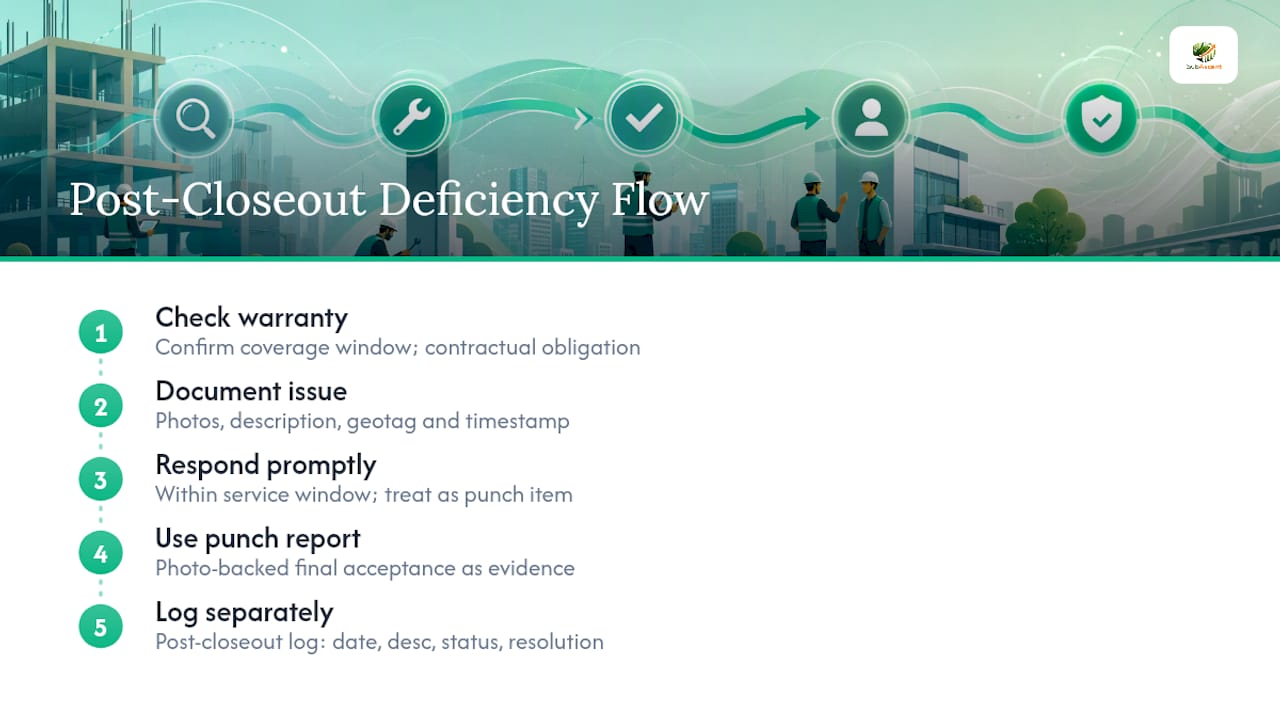
Closeout does not mean every issue is permanently resolved. Warranty claims, latent defects, and items missed during the punch walk can surface months after final payment, and how you handle them affects both the immediate fix and your standing on future bids with that GC.
Start by checking your warranty register for the specific item and its coverage window, since a post-closeout issue that falls inside an active warranty period is a contractual obligation, not a favor. Document the reported issue with photos and a description, then respond within your normal service window, treating it with the same urgency as an active punch item rather than letting it sit because the job is officially closed.
For issues outside warranty coverage, or disputes over whether a defect existed at handover versus developed afterward, the original punch completion report becomes your evidence. A photo-backed record showing the area was accepted in good condition at final walk protects you from being blamed for damage that happened after your crew left the site. This is another reason geotagged, timestamped punch photos matter well beyond the walk itself.
Keep a simple post-closeout issue log separate from your active job tracker, with columns for date reported, description, warranty status, and resolution date. On multi-building or phased projects, this log also helps you spot patterns, like the same equipment failing across several units, that point to a manufacturer defect rather than an installation issue.
Reconciling Your Final Billing
Final billing reconciliation is where a lot of subcontractors leave money on the table simply because they stop tracking change orders once the physical work wraps up. The process starts with a line-by-line comparison of your original contract value against every approved change order, credit, and back charge applied during the job.
Pull your original schedule of values and update it with every change order number, amount, and approval date. Cross-check this against payments already received, including any partial retainage releases, to calculate exactly what remains owed. Discrepancies almost always trace back to a change order that was verbally approved on site but never formally documented, which is why tracking change order paperwork as it happens matters more than trying to reconstruct it at closeout.
Back charges deserve particular attention here. If a GC has charged you for cleanup, damage, or corrective work performed by another trade, verify the charge against your contract terms before accepting it on the final application. Disputed back charges should be flagged in writing rather than silently deducted, since signing a final pay application that includes an unresolved back charge you disagree with can be read as accepting it.
Once the numbers match, submit your final application for payment alongside your lien waiver and any required payroll certification. Understanding how payment actually flows from owner to GC to sub helps explain why this reconciliation step, not the physical completion of work, is often the real bottleneck to getting your final check.
Storing Closeout Records for the Long Term
Closeout documentation earns its keep long after the check clears. Warranty claims, liability questions, and even future bid references can require you to pull a specific test report or as-built drawing from a job that finished years ago.

Store the complete closeout packet, not just a summary, in a permanent digital archive organized by job number and year. Cloud storage with a consistent folder structure beats a local hard drive that can fail or a filing cabinet that can flood. Keep the same spec-section folder tree you used during active closeout, so a document is exactly where you'd expect it if you need it again in three years.
Retention periods matter more than most subs plan for. Warranty documentation should be kept for the full warranty period plus a buffer, often a year beyond the stated term, since claims sometimes surface right at the edge of coverage. Financial records, including lien waivers and final pay applications, are worth keeping for at least the length of your state's statute of limitations on written contracts, which commonly runs several years.
Back up anything stored locally to a second location, whether that's a cloud drive or an external server your office controls. A single archived copy of a closeout packet is one hard drive failure away from being gone entirely, and reconstructing a five-year-old as-built from memory is not a realistic option.
What Actually Moves the Needle on Closeout
Most closeout advice treats every deliverable as equally urgent, and that is where it goes wrong. Warranties and O&M manuals matter, but they rarely hold up a check on their own. What actually blocks retainage, almost every time, is an unresolved punch item without photo evidence or a change order that was never formally documented. Fix those two things and most of the rest falls into place on its own.
The conventional advice to "start closeout early" is right but incomplete. Starting early only helps if you're tracking the right things, meaning vendor documents requested at the point of order, not installation, and punch items logged with photos the moment they're flagged, not reconstructed from memory during a walk. A six-week head start with no tracking system behind it buys you very little.
If you take one thing from this checklist, make it the photo discipline around punch completion. It is the single habit that turns a contested closeout into a fast one, and it costs nothing but a phone already in your foreman's pocket.
— Dave
How Subascent Keeps Closeout From Becoming a Second Job
Subascent gives specialty trade subcontractors one place to run everything this checklist covers, instead of chasing punch photos in a group text and warranty PDFs in an inbox. It builds closeout document packets, captures punch items with geotagged photos tied to each line, and keeps checklist templates ready to copy into a new job the moment you're awarded the work, syncing final billing straight to QuickBooks so reconciliation doesn't mean re-entering numbers by hand.
If you're evaluating a closeout tool during a trial, test three things specifically: whether it can export a complete, indexed closeout packet in one file, whether photo evidence attaches cleanly to each punch item without a separate upload step, and whether your final invoice reconciles against payments received without a spreadsheet on the side. Those three tests separate a tool that looks good in a demo from one that actually holds up on a real job. You can start a trial and run your next closeout through it at Subascent's landing page.
Sources
- Construction Closeout Checklist (Free Download) | PunchOutPro
- 10-Step Construction Closeout Checklist for Subcontractors | Billd
- Construction Project Closeout Checklist (Word, Excel) | MASTT
- Heating, Ventilation, and Air Conditioning (HVAC) systems — EPA (IAQ)
- Acquisition