

Most electrical, plumbing, and HVAC contractors assume the subcontract they sign defines all their obligations. It does not. Knowing how to read a subcontract agreement means going beyond the pages the GC hands you. Incorporated documents, flow-down provisions, and referenced general conditions can expand your scope, restrict your payment rights, and shift liability in ways that are not obvious from the face of the document. This article gives you a practical, trade-specific framework to interpret every core section of a subcontract before you put boots on the ground.
Table of Contents
- Key Takeaways
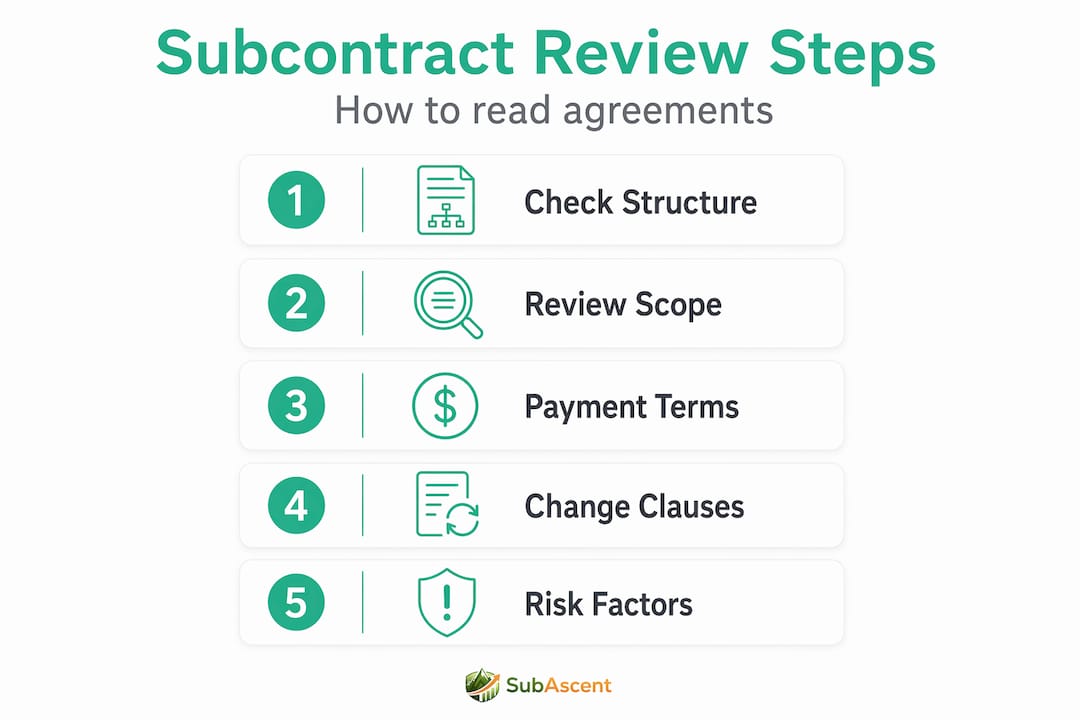
- How to read a subcontract agreement: start with structure
- Reading and clarifying the scope of work
- Payment terms and lien waiver provisions
- Change control, insurance, and risk-transfer clauses
- Reviewing a subcontract as a risk document
- My honest take on what most subs miss
- Manage your subcontracts without the chaos
- FAQ
Key Takeaways
| Point | Details |
|---|---|
| Flow-down expands obligations | Incorporated prime contract terms can extend your scope, schedule, and dispute obligations beyond what your subcontract states. |
| Scope must be explicit | Vague references to drawings or specs without listing specific documents create disputes that cost real money. |
| Lien waivers carry hidden risk | Partial and final waivers can surrender more than mechanic's lien rights depending on exact wording and jurisdiction. |
| Change orders must be written | Verbal approvals are invalid in most standard subcontract templates, leaving change work unpaid. |
| Review again mid-project | Contract obligations shift as work progresses. A single read at signing is not enough. |
How to read a subcontract agreement: start with structure
Before you read a single clause, understand what you are actually holding. Most GC-issued subcontracts are not standalone documents. They reference and incorporate other agreements. An AIA A401-style subcontract, for example, typically incorporates the A201 General Conditions, the prime contract between the GC and owner, project drawings, specifications, and addenda.
AIA-style subcontracts require you to read both the subcontract and the incorporated general conditions to understand your full obligations. Flow-down provisions are the mechanism that makes this happen. A flow-down clause binds you to every obligation the GC owes the owner, except as specifically limited in your subcontract.
Here is what that means in practice:
- Scope: The owner's scope in the prime contract may be broader than what the GC described verbally or even wrote in your subcontract.
- Schedule: Liquidated damages and milestone requirements that the GC agreed to with the owner can flow down directly to you.
- Payment: Pay-when-paid and pay-if-paid clauses create conditional payment triggers tied to the GC receiving funds from the owner.
- Disputes: Arbitration and dispute forum clauses must be explicitly incorporated or stated in the subcontract to bind you. Generic incorporation language often fails in court.
Pro Tip: When you receive a subcontract package, list every document referenced in the incorporation clause. Request any document you do not already have. You cannot review what you have not read.
Order of precedence also matters. If your subcontract conflicts with an incorporated document, the subcontract typically controls. But that hierarchy only applies to conflicts, not gaps. Gaps in your subcontract may be filled by the prime contract terms, often to your disadvantage.
Reading and clarifying the scope of work
Scope is where most disputes start. A vague scope of work is not neutral territory. It gets interpreted by whoever has more leverage, and on most jobs, that is not you.
Here is a practical way to verify scope before you sign:
- Identify every drawing and specification listed. The subcontract should reference specific drawing numbers and specification sections, not just "all drawings and specs applicable to this trade." If it says the latter, push back and attach an exhibit listing the exact documents.
- Define the start and end points of your work. An HVAC subcontractor needs to know whether their scope ends at the equipment connection or includes startup, commissioning, and testing. A plumbing sub needs to know whether rough-in, trim-out, and fixtures are all included or just rough-in.
- Verify material and equipment supply responsibilities. Who furnishes the ductwork? Who furnishes the VAV boxes? Who pays for the crane pick? These are scope items that disappear into subcontract language and resurface as disputes on day 60 of a 120-day project.
- List explicit exclusions in writing. If you are not doing fire stopping, concrete cutting, or seismic bracing, say so in an exhibit attached to the subcontract. Verbal exclusions during scope review meetings are not worth the paper they are not written on.
Scope tied only to general references to drawings or specs reliably generates disputes. The safest position is a subcontract scope exhibit that specifically names included items, excluded items, and interface points with other trades. For a framing or drywall contractor, that interface point with the painter or the flooring sub matters. Get it defined before you mobilize.
Payment terms and lien waiver provisions

Payment is where understanding subcontract agreements pays for itself most directly. Most subcontracts have three interlocking payment mechanisms you need to understand: payment schedules, conditional payment triggers, and lien waiver requirements.
Comparing key payment clause types
| Clause type | What it says | What it means for you |
|---|---|---|
| Pay-when-paid | GC pays sub within X days of receiving owner payment | Payment timing depends on owner's behavior, not your performance |
| Pay-if-paid | GC only obligated to pay sub if owner pays GC | Shifts owner insolvency risk entirely to you |
| Retainage | GC withholds 5%–10% until final completion | Funds are held sometimes 12–18 months on longer projects |
| Conditional lien waiver | Waives rights only upon actual payment receipt | Safer; rights not surrendered until check clears |
| Unconditional lien waiver | Waives rights immediately upon signing | Dangerous if payment does not follow immediately |
Executed lien waivers are typically required monthly with pay applications and as final waivers at closeout. The danger most roofing, flooring, and insulation contractors miss is that waiver scope can extend beyond mechanic's lien rights. Depending on the jurisdiction and exact wording, a waiver may also surrender delay claims, impact claims, or other accrued rights.
Payment timing and lien waiver enforceability depend on whether you sign a conditional or unconditional waiver, and whether signing happens before or after you actually receive payment. Signing an unconditional waiver before your check clears is a paperwork trap. Your cash flow and lien rights can both disappear in the same transaction.
Pro Tip: Map every pay application due date to the corresponding waiver type required. Write it into your internal calendar as a workflow, not a one-time review.
Change control, insurance, and risk-transfer clauses
These three areas are often buried deep in a subcontract. They also generate the most expensive surprises.
On change orders, the rule is simple: if it is not in writing and signed, it did not happen. Verbal authorizations are invalid in virtually every standard subcontract template. That means your crew doing four days of ceiling demo that the GC superintendent verbally approved is work you may never collect on. Written change order requirements also govern time extensions. If you do not get a written change order that adjusts the schedule, you may be liable for delay damages on work the owner changed.
On insurance, the most common pitfall is assuming your current certificate of insurance satisfies the subcontract. Check these points specifically:
- Additional insured endorsements: Most subcontracts require the GC and owner to be named as additional insureds on your general liability policy. A certificate alone does not create coverage. You need the actual endorsement from your carrier.
- Coverage limits: The subcontract will specify minimum limits. Your policy may meet them, or it may not. Check the numbers, not just the coverage types.
- Indemnity provisions: Indemnity caps and overly broad indemnities risk being unenforceable in some states. An indemnity clause that requires you to cover the GC's own negligence may be void under your state's anti-indemnity statute. But you still need to know it is there.
- Umbrella requirements: Many GCs now require umbrella policies of $5M or $10M on commercial projects. Verify before you sign so you can price the premium into your bid.
For glazing, fire protection, or low-voltage contractors working on complex commercial jobs, the insurance section alone can take an hour to review properly. That hour is worth it. Being non-compliant with insurance requirements gives the GC grounds to withhold payment and, in some contracts, to terminate your subcontract.
Reviewing a subcontract as a risk document
Most project managers at specialty trade firms read subcontracts looking for scope. The better approach is to read them looking for risk. A practical risk-document view of subcontracts produces better operational decisions than treating contracts as legal formalities.
Here is a review framework built for that purpose:
- Pull the full document set first. Collect the subcontract, all incorporated documents, the drawings list, and the specification index before you start reading.
- Flag the high-risk clauses in your first pass. Scope, payment triggers, lien waiver requirements, change order process, insurance requirements, indemnification, termination rights, and dispute resolution. These are your eight categories. Flag them before you read the details.
- Build a clause-to-process map. For each flagged clause, write down what it requires your team to do and when. A clause-to-process map ties each pay application to specific waiver timing and documentation, which is the difference between protected lien rights and forfeited ones.
- Review alongside the prime contract. Pull up the relevant sections of the prime contract when reviewing flow-down language. If the dispute forum clause in the prime sends disputes to a specific arbitration body in a specific city, and that clause flows down to you, your dispute is happening there.
- Review again at 30% completion. Approved submittals and warranties become legally critical records mid-project. A second contract read at the one-third mark catches compliance drift before it becomes a claim. For common contract disputes that masonry, concrete, or steel/rebar contractors face, catching the issue at 30% is far cheaper than catching it at 90%.
The goal is a living document review, not a one-time legal checkbox.
My honest take on what most subs miss
I have seen electrical contractors lose $80,000 in change work because they kept a paper trail of texts instead of signed change orders. I have seen a roofing sub sign a final lien waiver on a Friday, get a returned check the following Monday, and spend eight months in court trying to recover rights they had already surrendered on paper.
In my experience, the two most dangerous assumptions in specialty trade contracting are that your relationship with the superintendent protects you, and that the subcontract you signed is the only document that matters. Both are wrong. The superintendent cannot override what the contract says. And the prime contract your GC signed may contain obligations that land squarely on your crew even if your subcontract never mentions them directly.
What I have found actually works is treating contract review as a pre-mobilization deliverable, not a precondition to signing. Read it before you sign, yes. But also assign someone, whether that is you or your PM, to re-read the payment, change order, and lien waiver sections before the first pay application goes out. The contract language you forgot about in month one will cost you in month six.
— Dave
Manage your subcontracts without the chaos
Reading and understanding subcontract agreements is only the first step. Tracking every pay application, waiver deadline, change order, and submittal across five active jobs is where most specialty trade teams break down. Subascent is built specifically for electrical, plumbing, HVAC, masonry, roofing, and other trade contractors who need to manage bids, jobs, and contract compliance without duct-taping together spreadsheets and email threads. From bid and job management to tracking submittals and change orders in one place, Subascent gives your team a system that matches how specialty trades actually work. See what it looks like for your trade at subascent.com.
FAQ
What is a flow-down clause in a subcontract?
A flow-down clause binds the subcontractor to the same obligations the general contractor owes the project owner, including scope, schedule, and dispute resolution requirements. These provisions can significantly expand your responsibilities beyond what the subcontract itself states.
What is the difference between a conditional and unconditional lien waiver?
A conditional lien waiver surrenders your rights only upon confirmed receipt of payment, while an unconditional waiver takes effect immediately upon signing regardless of whether payment actually arrives.
What should I do if the subcontract scope is vague?
Request a scope exhibit that lists specific drawing numbers, specification sections, included items, and explicit exclusions before you sign. Vague scope language tied only to general references to drawings is a leading cause of construction disputes.
Are verbal change order approvals valid?
No. Verbal authorizations are invalid under most standard subcontract templates. Always get change orders in writing and signed before proceeding with changed work.
How often should I review a subcontract during a project?
Review the subcontract at signing, again before the first pay application, and at approximately the one-third completion mark. Mid-project reviews catch compliance drift on submittals, waivers, and change order documentation before they become formal claims.