

Comparing construction estimating and takeoff software creates confusion for estimators and owners who need cloud tools, field reporting, and current prices in one system. Most platforms either gate key features behind expensive add-ons or limit field input to basic timecards instead of job-integrated updates. This comparison weighs field data capture, pricing, integrations, and trade focus so estimators and owners can pick a better fit without hidden upcharges.
Table of Contents
- SubAscent
- FastEST Estimating & Takeoff Software
- On Center Software
- Square Takeoff
- Methvin
- Comparison of alternatives
SubAscent
At a Glance
SubAscent includes a free foreman's app called CrewTrack that pushes field data into the office platform. The platform focuses on bid capture and a visual board that keeps deadlines visible. It aims to save trade teams time and prevent missed bid due dates.
Core Features
SubAscent captures incoming bids automatically, and places them on a visual bid board for opportunity management. The system sends smart reminders for bid deadlines, tracks change orders and approvals, and records job photos and reports. Job costing and profit analytics update in real time so office staff and field crews share the same numbers.
Key Differentiator
The product is built around how subcontractors work, with features tailored to trades such as electrical, plumbing, HVAC mechanical, masonry, concrete, framing, drywall, roofing, fire protection, low voltage, painting, flooring, glazing, insulation, and steel rebar. The visual bid board organizes opportunities the way estimators expect, and the foreman app ties daily field inputs back to bids and budgets. That trade focus shapes workflows and the feature set rather than a general construction platform.
Pros
SubAscent focuses on trade specific needs, which makes the platform easier for estimators and office admins to adopt. The free foreman app reduces paper timecards and brings daily reports and photos into the job file. Flat rate pricing and no long term contracts simplify budgeting for small firms with one to 50 employees. Real time job costing and billable task tracking help you see profit drivers before closeout.
Cons
- Limited customization for very large enterprises and reported constraints with some third party integrations.
Who It's For
This product fits owners and estimators at specialty trade firms earning roughly $500K to $15M annually and teams of one to 50 people. It works for electrical, plumbing, HVAC mechanical, masonry, concrete, framing, drywall, roofing, fire protection, low voltage, painting, flooring, glazing, insulation, and steel rebar shops. Avoid this if you run a large enterprise that needs heavy customization or deep ERP ties.
Unique Value Proposition
All plans include unlimited bid tracking and core features at a flat monthly rate starting at $39. That pricing keeps estimating departments from juggling per user fees while allowing crew leaders to use CrewTrack at no extra license cost. For small trade firms this reduces per project overhead and keeps field reporting attached to the same system that holds bids and change orders.
Real World Use Case
A plumbing estimator loads incoming invitations and places each opportunity on the visual bid board. CrewTrack collects timecards, site photos, and daily notes from the foreman. Change orders get approved in the office and billable tasks flow into the job costing report so the estimator can correct pricing on follow up bids.
Pricing
Monthly plans start at $39 for solo subcontractors and $79 for teams. Optional add ons and referral credits are available. All plans include unlimited bid tracking and the core platform features.
Website: https://subascent.com
FastEST Estimating & Takeoff Software
At a Glance
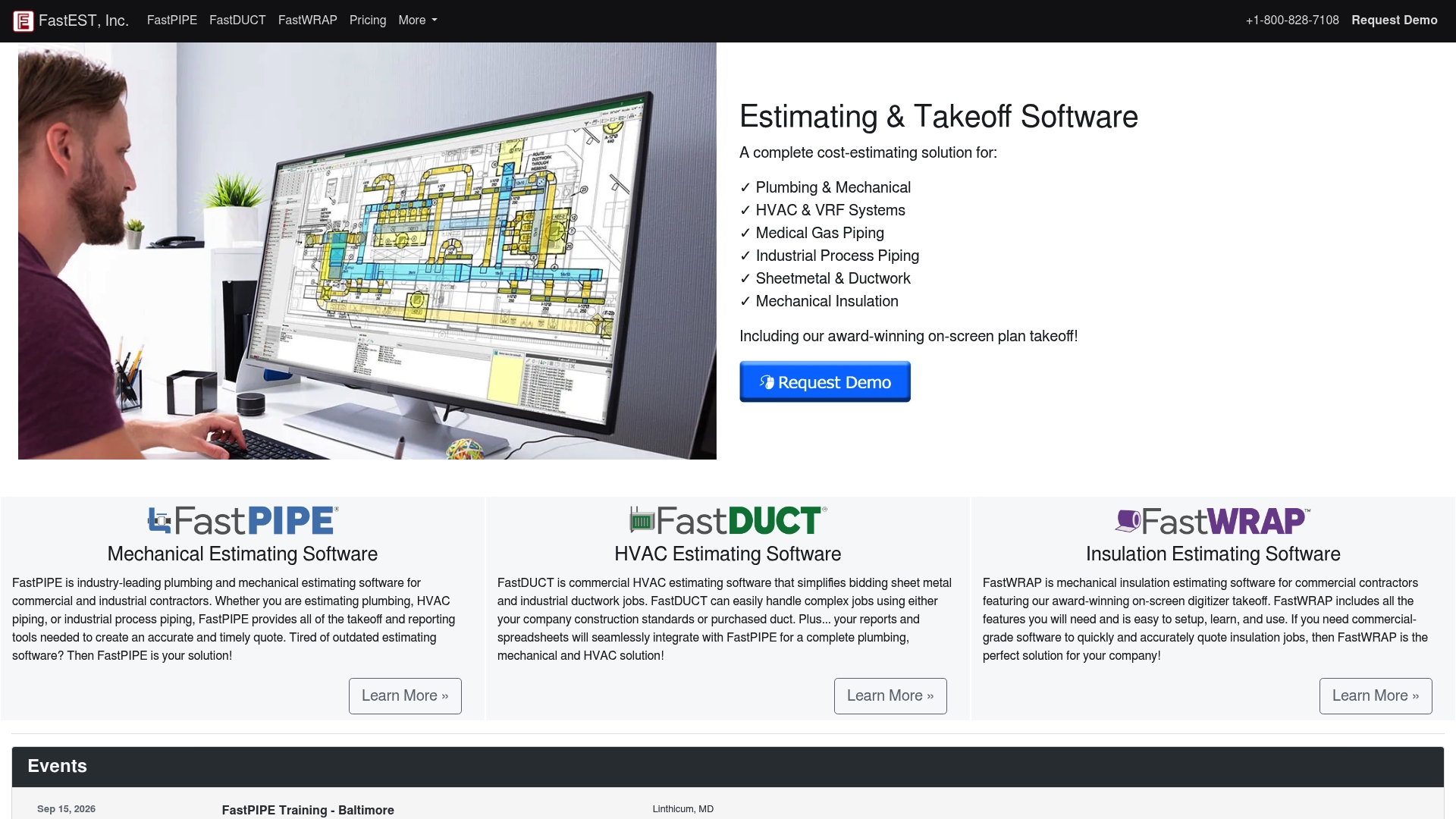
Application purchase starts at $4,995 per license, with leasing offered from $250/month per application. FastEST targets large commercial mechanical and HVAC contractors and bundles specialized products such as FastPIPE, FastDUCT, and FastWRAP. The vendor advertises automatic cloud updates and dedicated training to keep catalog data and specs current.
Core Features
FastEST includes an on screen plan digitizer that handles PDF plans and other digital formats, plus export options to Excel, CSV, and XML for back office workflows. The system ships with large plumbing, HVAC, and insulation product catalogs and lets you build customizable specifications and templates. Install options cover single workstations, local networks, and cloud environments for dispersed teams.
Key Differentiator
FastEST combines extensive plan format support with very large product catalogs and regular cloud updates to maintain pricing and spec accuracy. That integrated platform approach is aimed at contractors who run many simultaneous commercial bids across multiple offices.
Pros
The product offers an exceptionally large catalog set and frequent data updates, which reduces the time you spend looking up parts and unit costs. The software is built for enterprise grade performance and handles large, dispersed teams without slowing down. Users benefit from a consistent interface across FastPIPE, FastDUCT, and FastWRAP, plus instructor led training and vendor support for onboarding.
Cons
- Geographical support is mainly limited to the United States and Canada.
- Pricing is license and enterprise driven and may require sales contact for a precise quote.
- The proprietary language and data models introduce a learning curve for new estimators.
When It May Not Fit
If your business is a small residential trade shop with a single estimator, the license and setup model may be more than you need. Contractors who require global support outside the US and Canada will find limited coverage. Teams that need a quick, no training deployment may struggle with the proprietary catalogs and workflows.
Who It's For
Large to midsize commercial mechanical and HVAC contractors who run frequent, complex bids will get the most from FastEST. Plumbing and insulation estimators who rely on deep parts catalogs will see immediate benefits. Owners who manage dispersed estimating teams and need centralized catalog updates will appreciate the vendor support options.
Real World Use Case
The vendor states a large HVAC contractor using FastPIPE reduced bid preparation from several hours to under an hour. That claim points to faster bid turnaround when estimators use the on screen digitizer and catalog lookups together. Teams report improved estimate detail because exports feed directly into their cost analysis spreadsheets.
Pricing
Application purchase starts at $4,995 per license with additional licenses at $2,495 each. Leasing begins at $250/month per application, and optional annual maintenance is $1,250 per application. Enterprise and volume discounts are likely available and require a sales conversation.
Website: https://fastest-inc.com
On Center Software
At a Glance
Takeoff Boost uses AI to classify items and automate measurements during plan takeoff. The vendor says On Center has served construction professionals for over 30 years. The product sits inside the ConstructConnect family and includes heavy training and support resources for estimators.
Core Features
On Center bundles AI-powered takeoff, estimating linkage, and project management connections into a single workflow. The platform includes Multi-Condition Takeoff for measuring multiple trades in one pass, Auto Name and Auto Link to keep line items organized, and dedicated training resources to shorten ramp time. The desktop tools integrate with estimating modules and allow bid revisions without rebuilding workbooks.
Key Differentiator
The clearest differentiator is the built-in AI takeoff, led by Takeoff Boost, which automates classification and reduces repetitive measurement work. That capability combines with the patent-protected multi-condition method to cut the number of passes across plans. The result targets complex commercial and multi-trade estimates rather than simple single-trade takeoffs.
Pros
The vendor reports a long track record and deep workflow ties inside ConstructConnect, which helps when you need plan discovery and bid data in one place. Advanced AI features reduce manual measurement time and lower the hours estimators spend on routine counts. The platform also includes robust training, live webinars, and a dedicated support team to help estimators and project managers adopt advanced features.
Cons
- The platform has a steeper learning curve for new users. Training helps, but expect an initial productivity dip.
- The comprehensive feature set can carry higher costs for very small firms. Pricing depends on chosen modules and deployment.
- Core tools are primarily a Windows desktop application. Teams seeking full cloud and mobile workflows may find it less flexible.
- AI features require internet access, so reliable broadband is necessary for those capabilities.
When It May Not Fit
Teams that need a lightweight, cloud-first tool for fast rollout will likely find On Center heavier than necessary. Small shops with limited training bandwidth may prefer simpler, more intuitive tools that require less upfront learning. Organizations that insist on tablet only workflows should evaluate cloud native options before committing.
Notable Integrations
- ConstructConnect Project Intelligence
- Quick Bid estimating software
- Microsoft Excel
Who It's For
Estimators and project managers who handle multi-trade commercial or complex residential bids will get the most value. Trades such as electrical, plumbing, HVAC/mechanical, masonry, concrete, framing, drywall, roofing, fire protection, low-voltage, painting, flooring, glazing, insulation, and steel/rebar will find the multi-condition approach useful. The product suits teams that can invest time in training to unlock advanced takeoff automation.
Real World Use Case
A general contractor runs On-Screen Takeoff with Takeoff Boost to auto-classify wall, floor, and ceiling quantities on large plans. The estimator links those counts to Quick Bid to produce a revised proposal the same day. That workflow shortens the turnaround on competitive commercial bids.
Pricing
Not specified. The vendor states pricing likely varies by package and deployment options. Contact sales for quotes tied to the modules and seat counts you need.
Website: https://oncenter.com
Square Takeoff
At a Glance
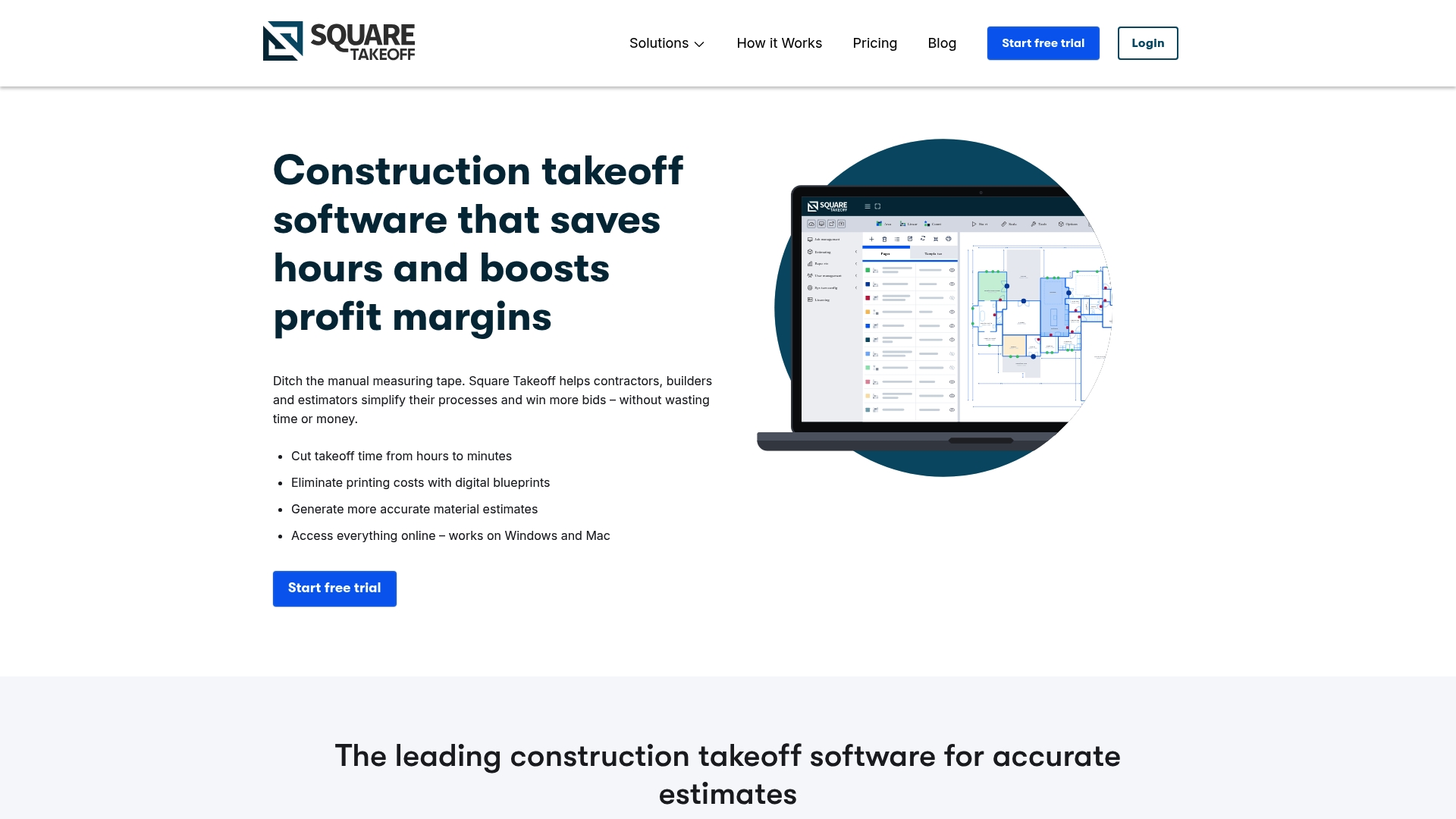
Square Takeoff's marketing materials state it reduces takeoff time from hours to minutes. The company positions that speed as the central benefit for estimators who still measure plans by hand. The platform runs in a cloud browser so you can use it on Windows or Mac without a local install.
Core Features
Square Takeoff handles digital blueprint upload and scaling, then offers instant measurement tools for areas, lengths, and counts that feed an assembly application for materials and labor. The system generates estimates you can export to Excel or PDF and supports team collaboration through its cloud access. These pieces connect to move a manual workbook into an exported, shareable estimate.
Key Differentiator
The defining feature is fast, precise measurements taken directly from digital blueprints in a browser environment, which removes the need to print plans or perform manual scaling. That workflow focuses on cutting measurement time and lowering errors in common trade takeoffs.
Pros
The vendor claims reduced takeoff time from hours to minutes, which promises real time savings for small estimating teams handling multiple bids per week. Digital blueprints remove printing costs and make plan updates easier to share with a team. Export to Excel or PDF ties directly into common office workflows and QuickBooks accounting imports used by many subs. Cloud access allows foremen and office staff to view the same plan without file-sync confusion.
Cons
- Buyer feedback mentions inconsistent support responsiveness, and learning the tool can take time for teams used to manual methods.
- The public product notes do not list integrations, so users who depend on a specific accounting or ERP sync may need manual exports.
- Pricing detail is not listed publicly, which complicates budget planning for smaller crews.
When It May Not Fit
If your estimating process requires tight integration with a specific ERP or an in-house database, Square Takeoff may force extra export and import steps. Firms that need extensive on-premise software or offline-only workflows will find a browser-only tool limiting. Larger enterprise setups requiring custom APIs should verify integration options before committing.
Who It's For
Estimators and owners at specialty trade firms such as framing, drywall, roofing, and concrete who want to convert paper takeoffs to a browser workflow. It fits teams that bid frequently and need faster plan measurement without buying heavy desktop software.
Real World Use Case
A framing contractor replaced manual printed plans and rulers with Square Takeoff. Estimators uploaded PDFs, applied instant area and linear measurements, applied assemblies, and exported an Excel estimate to the office. The process cut time per bid and reduced rework when plans changed.
Pricing
Pricing is listed as not applicable in the public product notes, so prospective buyers must contact Square Takeoff for current tiers or a demo. That requires a short sales conversation before budget signoff.
Website: https://squaretakeoff.com
Methvin
At a Glance
Methvin starts with a free Starter plan. The suite pairs cloud estimating with bid publishing, a tender portal, and collaborative project tools. It also includes AI driven correspondence analysis and risk detection alongside 2D and 3D plan work.
Core Features
Methvin combines first principles estimating with worksheet equations and variable pricing, so quantities link directly to costs. The platform offers 2D/3D takeoff tools and a BIM model viewer and editor that connect model quantities to estimates and schedules. Additional modules include a Gantt scheduler for timelines, a tendering portal for bid management, a CRM for client tracking, and a centralized communication app.
Key Differentiator
The standout is Methvin’s AI driven correspondence analysis paired with project risk detection. That capability reads project messages and flags potential contract or scope issues for review. Embedding this analysis inside estimating and tender workflows reduces the need to copy notes between disconnected apps.
Pros
Methvin groups estimating, takeoff, BIM editing, scheduling, and bid publishing in one cloud workspace. That reduces duplicate data entry when you move from estimate to tender to schedule. The platform supports collaborative workflows across roles, with interfaces for estimators, project managers, and client contacts. Methvin also includes AI features aimed at surfacing correspondence risks and material or subcontract quote discrepancies.
Cons
- The platform’s scope and feature depth can create a steep learning curve for teams new to integrated construction software.
- Full implementation and configuration require time and may need a dedicated administrator or consultant.
- Public user feedback on ease of use and hands on support is limited, which may concern smaller firms.
When It May Not Fit
Small teams with no administrator or that prefer single purpose tools may find Methvin too broad. If you only need simple takeoff or a standalone estimating workbook, the platform’s implementation effort may outweigh the benefits. Firms that avoid cloud based systems for policy reasons will need to evaluate deployment and compliance first.
Who It's For
Methvin fits construction firms that want one cloud platform for estimating, bid management, and project tracking. Typical users include estimators and project managers at electrical, plumbing, HVAC/mechanical, concrete, framing, and drywall trades. The product suits teams that manage repeated tendering cycles and need tighter links between estimates, bids, and schedules.
Real World Use Case
An electrical subcontractor uses Methvin to perform a first principles takeoff from a set of PDF plans, attach quantities to line item worksheets, and publish a tender to selected GCs. The project manager imports the winning bid into the Gantt scheduler and uses the communication app to collect submittals and clarify scope. The AI correspondence feature highlights ambiguous emails that could affect pricing before contracts are signed.
Pricing
Methvin lists a Starter plan at $0, a Business plan at $79/month, and an Enterprise plan at $179/month. Tiers include increasing features such as unlimited users and AI integration across higher plans.
Website: https://methvin.org
Comparison of alternatives
Selecting the right estimating and bid management platform depends on considerations including workflow automation, pricing, and adoption complexity specific to construction specialties.
Affordability and feature scope
SubAscent distinguishes itself with a flat pricing model starting at $39/month that includes trade-focused workflows and an integrated mobile app. Methvin also maintains affordability, offering a free plan with incremental upgrades. Alternatively, FastEST and On Center Software exhibit higher upfront or modular costs, although they deliver expansive feature alignments for larger firms.
Specialized workflow capabilities
FastEST serves contractors requiring extensive and regularly updated material catalogs, enhancing cost estimate precision. On Center Software introduces AI-powered automated takeoff features, reducing manual effort for large-scale, multi-trade projects. Square Takeoff provides browser-based tools for efficient and straightforward workflows, appealing to geographically distributed teams and straightforward small-scale attempts.
Best fit
- Specialty trades requiring affordable, trade-centric platforms will benefit from choosing SubAscent for its integrated functionalities and competitive pricing.
- Firms prioritizing extensive product libraries with exceptional specificity should consider FastEST for its catalog depth and regular updates.
- Organizations seeking cutting-edge automation solutions in automated takeoff processes may find On Center Software advantageous.
- Enterprises preferring simplified browser-based operations with instant blueprint handling should explore Square Takeoff.
Our pick
SubAscent delivers a distinctive balance of feature customization and cost efficiency for specialty trade teams prioritizing integrated project data tools.
Explore the features and pricing of the following top construction and estimation software options to find the best match for your specific requirements.
| Product | Key Features | Pricing | Ideal for | Limitations |
|---|---|---|---|---|
| SubAscent | Bid tracking, CrewTrack foreman app, real-time job costing | Starting at $39/month | Specialty trade firms; 1-50 employees; $500k-$15M revenue | Limited customization for large enterprises |
| FastEST | On-screen digitizer, large catalogs, customizable templates | Purchase: $4,995/license | Large commercial mechanical/HVAC contractors | Primarily supports U.S. and Canada; higher initial cost |
| On Center | AI takeoff with Takeoff Boost, integrated estimating and project management | Price not published | Multi-trade commercial projects with detailed takeoff needs | Steeper learning curve and higher costs for small firms |
| Square Takeoff | Digital blueprint upload, instant measurements, cloud-based platform | Price not published | Specialty trade firms seeking simple browser-based tools | Limited integrations and reliance on cloud environment |
| Methvin | Cloud-based estimating, 2D/3D takeoff, AI risk detection | Free (Starter), $79+/mo | Integrated estimating and bid/project management needs | Complex features may require significant setup time |
Why Small Specialty Trade Firms Choose Subascent Over Other Estimating Tools
Estimators and office managers at specialty trade firms often struggle with tracking incoming bid invitations and ensuring no deadlines slip through the cracks. Subascent addresses this challenge by combining bid capture, deadline reminders, and job costing into one tool built specifically for trades like electrical, plumbing, HVAC/mechanical, and drywall. This focus lets you build accurate estimates faster and avoid rebuilding workbooks.
Subascent also includes CrewTrack, a free foreman app that imports daily reports, photos, and timecards directly into the job file. That keeps your office and field teams on the same page and speeds up invoice and AR processes. See how Subascent helps specialty trade teams manage bids, change orders, and profitability without the overhead of large construction platforms. Learn more at Subascent.
Get your bids and budgets working together. Visit Subascent and start tracking your bids and field data with no extra licensing costs.
FAQ
How does Subascent automate bid capture?
Subascent captures incoming bids automatically through its visual bid board. This feature allows users to manage opportunities with smart reminders for bid deadlines, making it easier to track change orders and approvals.
Users can expect a streamlined bidding process, reducing potential delays and missed deadlines.
What is the difference between Subascent and FastEST?
FastEST is recognized for its exceptionally large catalog set and frequent data updates, which significantly reduce the time spent looking up parts and unit costs. Subascent, on the other hand, is specially designed for subcontractors, focusing on trade needs with its visual bid board.
This makes Subascent a more tailored choice for specialty trade firms, while FastEST excels for large commercial bids across multiple offices.
Which platform offers better job costing and profit analytics?
Subascent provides real-time job costing and profit analytics, ensuring that office staff and field crews have access to the same financial data. This immediate insight helps identify profit drivers early in the process.
Estimators in trade firms using Subascent can adjust bids based on accurate, up-to-date financial information.
Can I use Subascent if my firm is larger than 50 employees?
Subascent is best suited for specialty trade firms with one to 50 employees, as it has limited customization options for larger enterprises. This makes it less ideal for companies needing extensive ERP integrations.
Smaller trade firms may find Subascent to be a practical entry point for estimating and bidding without overwhelming complexity.
How does Subascent compare in pricing structure?
Subascent offers flat rate pricing starting at $39, which includes unlimited bid tracking and core features. This approach allows firms to avoid per-user fees while providing access to essential tools.
Smaller firms particularly benefit from this predictable pricing model, simplifying budgeting for estimating departments.