
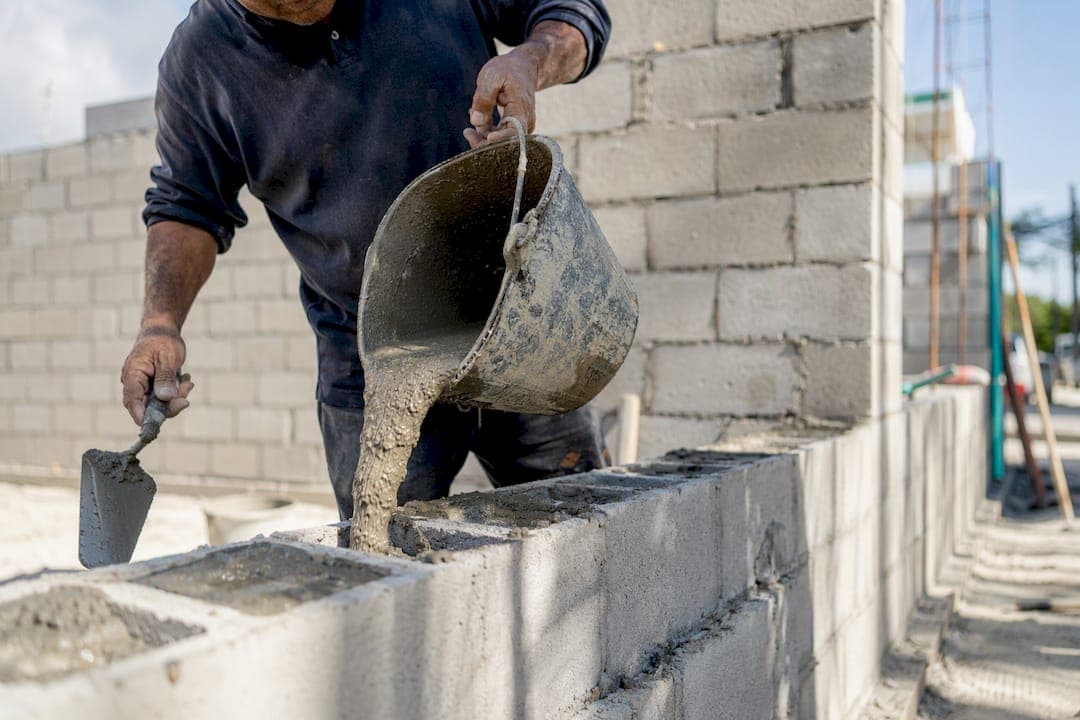
Grout flows into joints and cavities as a filler and light reinforcement; mortar stays thick to bond and bed masonry units or tile. That's the whole distinction in one line, and it's the reason substituting one for the other on a job site leads to cracked joints, water intrusion, or a failed inspection.
- Use grout when you're filling tile joints, embedding rebar in a masonry core, or need a flowable, self-leveling fill. Reference ASTM C476 for masonry grout classification.
- Use mortar when you're setting brick or block, bedding tile with thinset, or need a stiff, workable bond. ASTM C270 governs masonry mortar types.
- Labor note: grout crews often need pumps or careful pour sequencing; mortar crews need board time and tooling skill. Mixing them up on a bid sheet costs you either material or labor money.
Key Takeaways
Grout's flowability makes it the correct choice for filling joints and cores, while mortar's stiffness makes it the correct choice for bonding and bedding masonry or tile.
| Point | Details |
|---|---|
| Function decides material | Grout fills and flows; mortar bonds and beds, per ASTM classifications. |
| Match type to joint width | Sanded grout above 1/8 inch, unsanded below, epoxy for wet or high-traffic areas. |
| Water ratio drives performance | Higher water content in grout enables flow; lower water content in mortar preserves workability and bond. |
| Budget labor, not just material | Epoxy grout and fast-set mortars need skilled crews and extra cleanup time on the bid sheet. |
| Cite standards in submittals | Reference ASTM C476, C270, C404, and ANSI/TCNA alongside the manufacturer TDS. |
Table of Contents
- What Is Grout Versus Mortar in Practical Terms?
- Side-by-Side: Grout Versus Mortar at a Glance
- What's In Grout and Mortar, and Why It Matters
- Which Grout or Mortar Type Fits the Job?
- How Do Mixing and Workability Differ On Site?
- Why Substitution Fails: Strength and Permeability
- Field Steps for Prep, Placement, and Sealing
- Which Standards Should You Cite in a Submittal?
- What Should Estimators Check Before Pricing Grout or Mortar?
- Frequently Asked Questions
- Sources
What Is Grout Versus Mortar in Practical Terms?
An estimator doesn't need a materials science lecture. You need to know which one goes where, and why swapping them causes callbacks.
Grout is the flowable one. It's mixed with more water than mortar, which lets it pour or pump into narrow tile joints, block cores, and the gaps around embedded rebar. That flowability is the whole point: grout needs to self-consolidate into tight spaces without you having to pack it in by hand. The Spruce notes that grout fills joints and gaps and helps prevent moisture infiltration and tile movement, while mortar's job is holding units in place, not filling voids.
Mortar is the thick one. It has to stay put on a trowel, hold its shape on a vertical wall, and grip a brick or block long enough to set without slumping. That stiffness comes from a lower water-cement ratio and, in most masonry mortars, hydrated lime for plasticity. TileFactory's comparison makes the point bluntly: mortar's consistency and shrinkage behavior make it a poor substitute for grout in narrow, water-exposed joints. If a green apprentice tries to "just use the mortar we've got" to fill tile joints, you'll see cracking and staining inside a season.
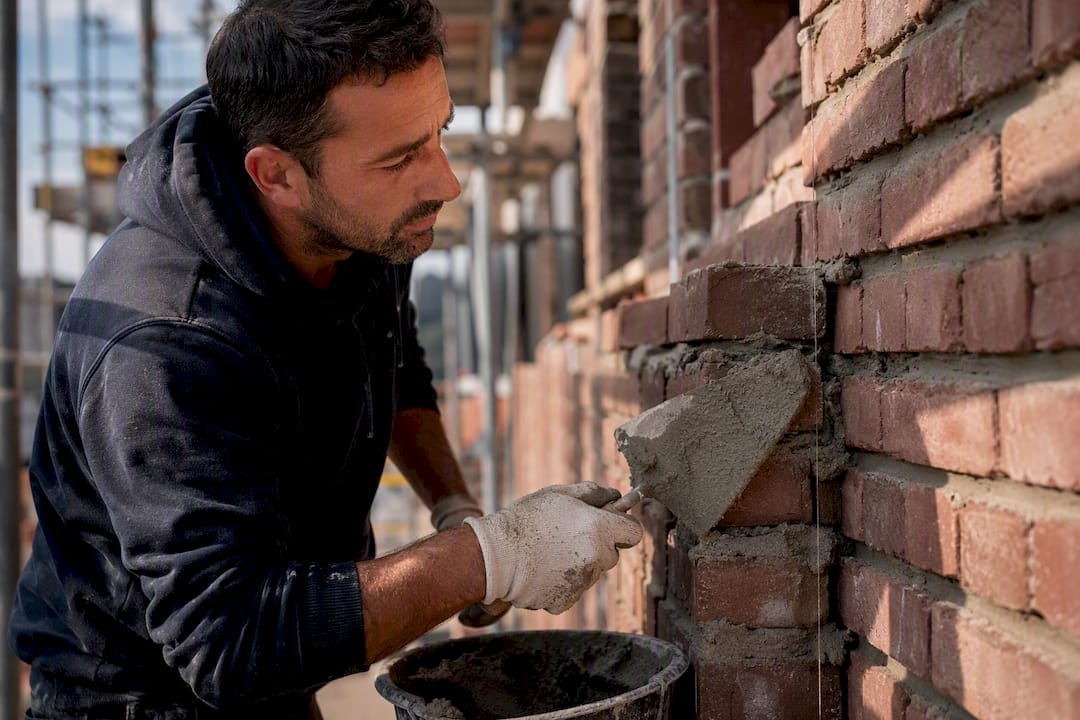
Side-by-Side: Grout Versus Mortar at a Glance
| Factor | Grout | Mortar |
|---|---|---|
| Intended function | Fills joints, cores, and voids; light reinforcement bond | Bonds and beds masonry units or tile |
| Typical composition | Cement, fine or coarse aggregate, high water content | Cement, sand, lime, lower water content |
| Consistency/flow | Pourable, self-consolidating | Stiff, trowelable, holds a shape |
| Common types/additives | Sanded, unsanded, epoxy, polymer-modified | Type N/S/M/O, thinset adhesive mortar |
| Typical joint/application | Tile joints, block cores, rebar cells | Brick/block beds, tile substrate (thinset) |
| Compressive behavior | Engineered for strength in cores per ASTM C476 | Bond strength matters more than raw compressive value |
| Cleanup/sealing | Needs sponge cleanup; cementitious grout often needs sealing | Cleanup during tooling; rarely sealed |
| Labor/installation | Pump or pour, fast cure on some types | Board time, hand-packing, tooling skill |
Quick read: specify epoxy grout for wet, high-traffic showers and commercial kitchens. Specify Type N mortar for above-grade brick veneer, and thinset for setting the tile itself.
What's In Grout and Mortar, and Why It Matters
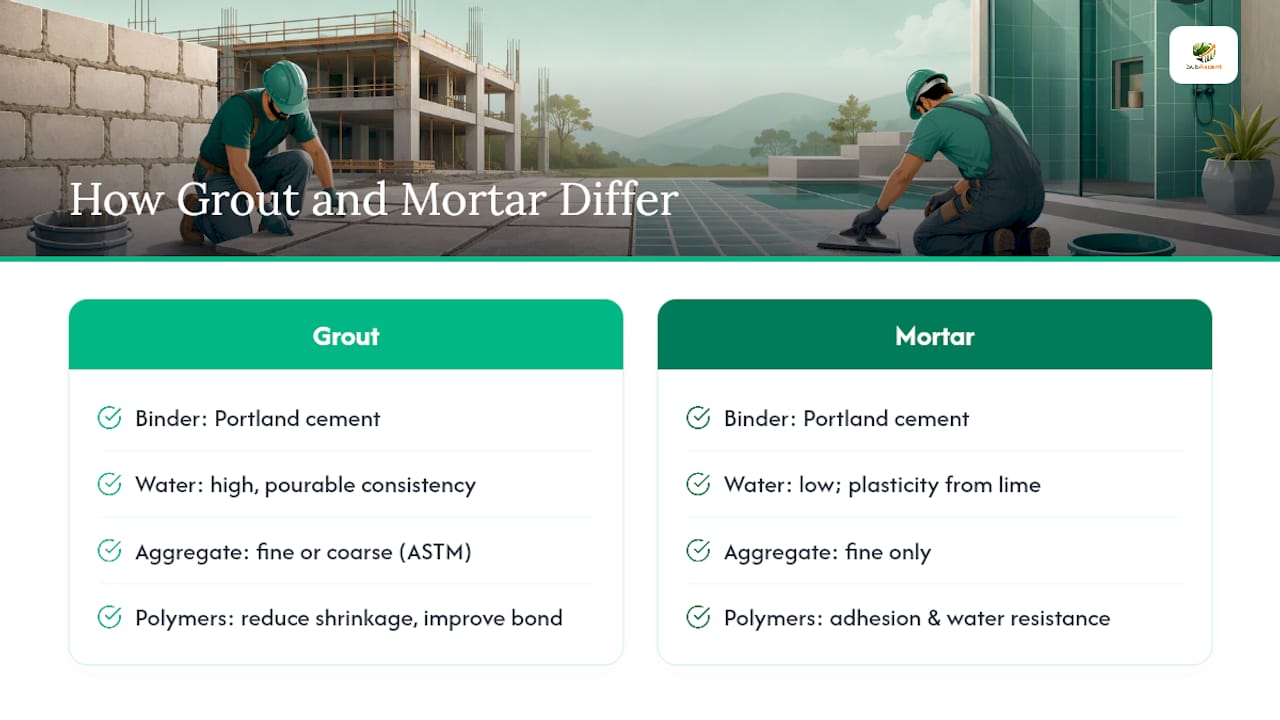
Portland cement is the binder in both, but everything else diverges, including the choice of concrete blocks and drainage pipes that influence coarse grout aggregate sizing. Grout adds enough water to hit a pourable consistency, sometimes with fine aggregate only (fine grout) or with coarse aggregate added for larger cavities, a distinction ASTM C476 and ASTM C404 spell out for masonry work. Mortar keeps water content lower and adds hydrated lime, which gives it plasticity and workability without turning it soupy.
Polymer modifiers show up in both materials but for different reasons. In grout, polymers reduce shrinkage cracking and improve bond to tile edges. In mortar, they boost adhesion and water resistance, which matters most in thinset used under exterior tile.
Water-cement ratio is the variable that decides almost everything on site: how far the material flows, how fast it sets, and how long your crew has before it goes off.
Pro Tip: Pull the manufacturer's Technical Data Sheet before you bid, not after you order pallets. The TDS tells you flow rate, pot life, recommended joint width, and substrate compatibility, details that change your crew size and schedule more than the price per bag does.
Which Grout or Mortar Type Fits the Job?
Picking the right category is half the battle in a submittal review. Get the type wrong and you're rewriting scope after the GC's rep flags it.
- Sanded grout works for wider joints; it resists shrinkage better than unsanded mixes in those wider gaps, per National Tile Authority's guidance.
- Unsanded grout is the call for narrower joints, polished stone, or anywhere sand would scratch a soft finish.
- Epoxy grout handles chemical exposure, wet environments, and high-traffic commercial floors, at a materially higher cost and a steeper learning curve for the crew.
- Furan and specialty hybrids show up in industrial settings with heavy chemical or thermal exposure, not typical residential or light commercial work.
- Masonry mortar Types N, S, M, and O scale by compressive strength and use case. Type N handles most above-grade veneer; Type S steps up for below-grade or higher-load walls; Type M is reserved for heavy structural loads.
- Thinset (dryset mortar) is the adhesive layer under tile, distinct from both grout and traditional masonry mortar, as Arizona Tile's comparison lays out.
Match the type to joint width, moisture exposure, and whether the assignment is structural or purely cosmetic. That decision belongs in your submittal, not left to whoever's on the truck that morning.
How Do Mixing and Workability Differ On Site?
Mixing errors are where good specs go bad. Here's the sequence that keeps both materials performing the way their TDS promises:
- Measure water first, then add dry material gradually. Overwatering either grout or mortar is the single most common field mistake, and it weakens both cured strength and bond.
- Mix to manufacturer-specified consistency, not by eye. A grout that's too stiff won't self-consolidate into a block core; a mortar that's too wet won't hold a brick in plumb.
- Match aggregate size to the application. Coarse grout needs adequate clear space in the cell; cramming coarse aggregate into a narrow cavity causes voids.
- Track pot life aggressively on quick-set products. A 20-minute pot life on a fast-set mortar changes your crew size and batch timing, not just your mixing method.
Equipment differs too: mortar boards and hoists for bed mortar, grout pumps for masonry cores, and simple grout floats and saws for tile work. Quick-setting formulations shrink your working window and often demand a larger crew to keep pace.
Why Substitution Fails: Strength and Permeability
Grout can be engineered for high compressive strength because its job in a masonry core is structural, reinforcing the cell around embedded rebar. Mortar's job is different: bond strength and workability matter more than raw compressive number, which is why lime content, not aggregate volume, drives its performance.
Permeability and shrinkage are where substitution bites hardest. Mortar packed into a tile joint shrinks and cracks because it wasn't formulated for that geometry or that water exposure, a failure mode TileFactory's trade comparison calls out directly. The IMI technical brief ties aggregate sizing and pour clearance under ASTM C476 to consistent fill and reduced void risk in masonry cells, the exact defect that causes cracking and efflorescence later.
Field Steps for Prep, Placement, and Sealing
Rework on grout and mortar jobs almost always traces back to skipped prep steps, not bad material.
- Clean and clear the joint or cavity. Remove loose debris, dust, and any old material before placing new grout or mortar.
- Verify joint depth and width against spec. Confirm you match the manufacturer's minimum joint depth before mixing a batch.
- Place grout or mortar in the correct sequence. Grout typically follows tile or unit setting; mortar comes first as the bed.
- Tool and finish before initial set. Strike joints, remove excess, and shape the profile while the material is still workable.
- Clean residue promptly. Haze on tile or smears on masonry face harden fast and cost real labor hours to remove later.
- Seal cementitious grout where moisture exposure warrants it. Epoxy grout typically doesn't need sealing; cementitious grout in wet areas usually does.
When repointing old masonry, remove deteriorated mortar to a depth of at least 3/4 inch, because fresh mortar won't bond to old mortar, a detail This Old House flags for repair crews.
Pro Tip: Epoxy grout costs more in material and needs a skilled applicator, but it also eats more cleanup time than crews expect. Budget the extra labor hour, not just the premium material line, or you'll eat the difference on change order day.
Which Standards Should You Cite in a Submittal?
Attach the right standard to the right claim, and your submittal gets approved faster.
- ASTM C476 governs masonry grout classification, fine versus coarse, and pour requirements.
- ASTM C270 sets the mix proportions and property requirements for masonry mortar Types N, S, M, and O.
- ASTM C404 specifies aggregate standards used in masonry grout mixes.
- ANSI/TCNA guidelines cover tile-setting mortars and grouts, including joint width and substrate requirements.
Always attach the manufacturer's TDS alongside the spec clause named in the project manual. That pairing, standard plus TDS, is what gets a submittal through review on the first pass instead of bouncing back with an RFI.
What Should Estimators Check Before Pricing Grout or Mortar?
Get these on your takeoff sheet before you price the line item:
- Joint width and depth from the drawings, not an assumption based on similar past jobs.
- Exact grout or mortar type specified, since epoxy, sanded, and thinset carry different unit costs and labor rates.
- Equipment and crew skill required, particularly for pumped grout or epoxy application.
- Cleanup and sealing time, which epoxy and cementitious grout both need but at very different rates.
- Contingency for fast-set products, since a compressed pot life can force a larger crew or split pours.
Here's the tradeoff in practice: epoxy grout runs higher on material cost and demands a higher-skilled crew, but it needs far less long-term maintenance. Standard cementitious grout costs less upfront but usually needs resealing and more frequent joint repair. Price both the labor and the material side of that equation, not just the bag price, and build in waste allowance, pump time, and a cure-window buffer before the next trade can walk the floor. For scope clarity between grout and mortar line items in a subcontract, a scope review checklist helps keep the submittal and the bid aligned.
A Foreman's-Eye View on Grout and Mortar Choices
Spec sheets tell you what should happen. Mockups tell you what actually will. Build a small mockup panel before committing a crew to epoxy grout or a fast-set mortar, and log the real labor hours it took. That number, not the catalog estimate, is what should show up in your next bid.
Frequently Asked Questions
What is grout versus mortar in a single sentence? Grout is a flowable filler for joints, cores, and reinforcement cells; mortar is a thicker bonding agent used to set masonry units or hold tile substrate in place.
Can you use mortar instead of grout for tile joints? No. Mortar's shrinkage and consistency make it unsuitable for narrow, water-exposed tile joints, and it won't provide the moisture resistance grout is formulated to deliver.
Why use grout instead of mortar in masonry cores? Grout's high water content lets it flow around embedded rebar and consolidate in tight cavities without voids, something stiffer mortar can't do reliably.
What's the best grout for tile in wet areas? Epoxy grout handles moisture and chemical exposure better than standard cementitious grout, though it costs more in material and skilled labor.
Do you need to seal grout after installation? Cementitious grout in wet or high-traffic areas usually benefits from sealing; epoxy grout typically doesn't require it.
When should you use Type S mortar over Type N? Type S suits below-grade applications or higher structural loads; Type N covers most above-grade veneer work.
Sources
- TECHNOLOGY BRIEF — Masonry Grout (IMI)
- The differences between grout and mortar — The Spruce
- Tile grout types: Sanded, unsanded, epoxy, and more — National Tile Authority
- Grout, Mortar, and Thinset: What’s the difference? — Arizona Tile
- Grout vs Mortar vs Thinset — TileFactory blog