

Masonry bids need escalation clauses because they protect your margin when volatile material prices move after you submit a fixed-price bid. Without one, you absorb every dollar of increase on brick, CMU, cement, rebar, and anchors out of your own pocket. A well-written clause shifts that risk transparently and keeps your initial number competitive.
Every effective escalation clause for a masonry bid includes these non-negotiable elements:
- Named commodities: Specify the exact materials covered (e.g., face brick, concrete masonry units, Portland cement, Grade 60 rebar, stainless steel anchors).
- Trigger event: Define what activates the clause (a verified supplier quote increase, an index movement, or a schedule slip past a defined milestone).
- Measurement method: Tie adjustments to an objective published index such as the BLS Producer Price Index or the ENR materials index, or to a supplier-invoice comparison.
- Threshold: Adjustments apply only when movement exceeds a defined percentage (typically 3–5%).
- Adjustment formula: State the exact calculation so there is no room for dispute.
- Notice and audit provisions: Require written notice within a set window and give both parties the right to verify supporting documents.
Escalation language is only half the solution. The other half is preconstruction discipline: tracking supplier quote validity, buying out critical materials early, and setting a realistic bid-validity window. The clause protects you when procurement slips; the buyout schedule prevents the slip in the first place.
Table of Contents
- Why do masonry bids need escalation clauses more than other trades?
- What types of escalation clauses work for masonry contracts?
- When should you include escalation language in a bid?
- How do you calculate price adjustments for masonry materials?
- Sample escalation clause you can adapt for masonry bids
- How do you negotiate escalation clauses with GCs and owners?
- What mistakes do masonry contractors make with escalation clauses?
- How do you administer escalation claims during the job?
- Trade-tested practices: turning escalation into an operational tool
- Key Takeaways
- The clause won't save you if the discipline isn't there
- Subascent helps masonry subs track quotes, buyouts, and escalation triggers
- Useful sources and further reading
Why do masonry bids need escalation clauses more than other trades?
Masonry subcontractors carry a disproportionate share of material-price risk compared to most other specialty trades. Your scope is material-heavy by nature. A single mid-rise brick façade can contain hundreds of thousands of face brick units, thousands of CMU blocks, tons of Portland cement, and significant quantities of steel reinforcing and anchors. When any one of those commodity prices moves, the dollar impact hits fast.

The specific materials that drive exposure on a typical masonry scope are face brick and modular brick, concrete masonry units, Portland cement and mortar mix, Grade 60 steel rebar, stainless or galvanized wall anchors, waterproofing membranes, and specialty cladding systems with long fabrication lead times. Cement and steel in particular track global commodity markets and can move sharply in response to tariffs, energy costs, or supply-chain disruption.
Escalation clauses let contractors submit leaner initial bids because they shift certain material-price risks to the owner or make the adjustment mechanism transparent. Without that mechanism, you have two bad options: pad the bid with a speculative contingency large enough to cover a worst-case scenario (and lose the job on price) or carry the risk naked and hope prices hold. Neither is a business strategy.
The risk scenarios that make escalation language necessary include long award timelines on public projects, procurement delays caused by permitting or design changes, tariff-driven price spikes on imported materials, and supply-chain disruptions that push lead times out by months. Any of these can turn a profitable job into a break-even or a loss before the first block is laid.
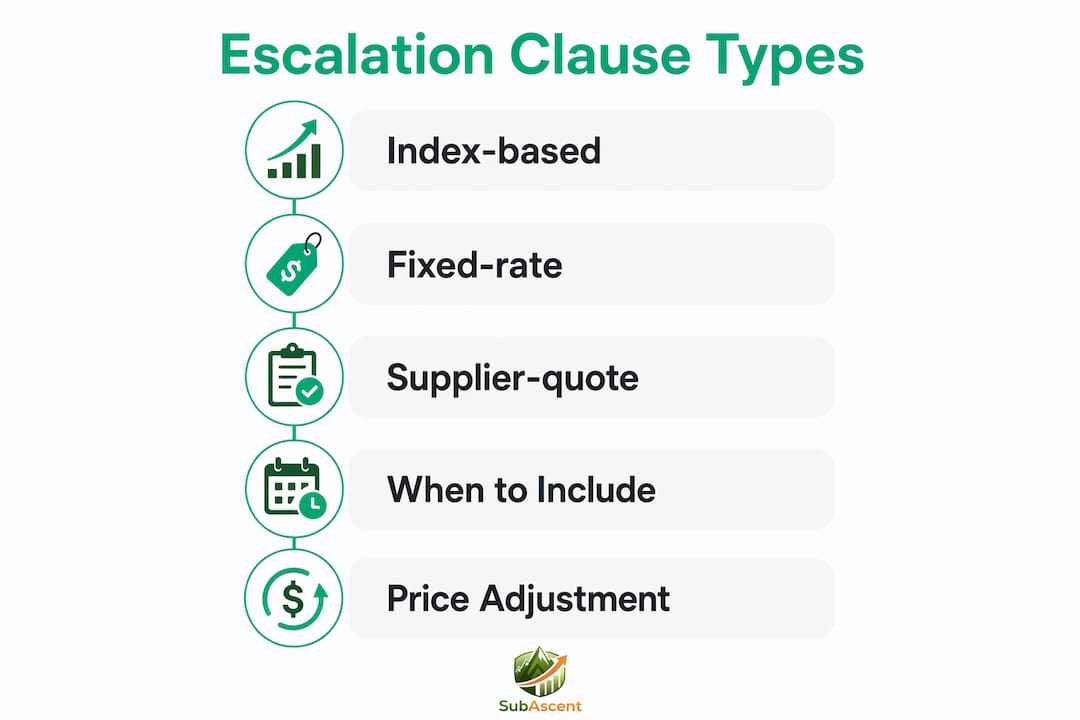
What types of escalation clauses work for masonry contracts?
Three main structures exist, and the right one depends on your project duration, the commodity involved, and how much administrative overhead you can carry.

Index-based escalation
You tie price adjustments to a published, objective index. The BLS Producer Price Index publishes subcomponents for concrete products, steel mill products, and other construction materials. The Engineering News-Record (ENR) materials index tracks broader construction cost movements. Index-based clauses are the most defensible because neither party controls the number.
The main caveat: index granularity. The BLS PPI for "concrete products" does not perfectly track your specific CMU supplier's price in a regional market. Build in a note that the index serves as the measurement mechanism and that both parties accept it as the agreed proxy.
Fixed-rate escalation
You and the GC agree upfront on a set percentage or dollar-per-unit adjustment that applies after a defined period. Simpler to administer, but riskier when market moves are asymmetric. If you agree to a 5% annual adjustment and cement jumps 18% in eight months, you're still short. Fixed-rate clauses work best on shorter jobs (under six months) where the range of outcomes is narrower.
Supplier-quote / passthrough
Adjustments are calculated directly from invoice-to-invoice comparisons or verified supplier quotes. Most accurate, but administratively heavier. You need to retain the original quote, the updated quote or invoice, and a clear paper trail showing the same material, same supplier, same unit. This approach works well for long-lead fabricated items (specialty brick, custom anchors) where no published index maps closely to the actual product.
Key decision points for masonry bids:
- Short duration (under 6 months), standard materials: Fixed-rate or index-based, with a 3–5% threshold.
- Multi-season or phased projects: Index-based with quarterly reset dates and a schedule-slip trigger.
- Long-lead fabricated items: Supplier-quote passthrough, with the original quote attached to the contract as an exhibit.
- High-volatility commodities (steel, cement): Index-based tied to the BLS PPI subcomponent, with best practice thresholds that also allow de-escalation when prices fall.
When should you include escalation language in a bid?
Not every masonry bid needs a full escalation clause. Run through this checklist before you submit.
Include escalation language when:
- The time from bid submission to expected material purchase exceeds your supplier's quote validity window (typically 30–60 days for brick and CMU, shorter for steel).
- Your scope contains volatile commodities: steel rebar, Portland cement, specialty cladding, or long-lead fabricated masonry units.
- The project has an uncertain start date, phased construction, or known permitting delays that could push procurement out by months.
- The job spans more than one construction season.
Consider fallback pricing instead when:
- The owner or GC has a hard "no escalation" position (common on public bid projects with fixed-price contracts).
- The award-to-start window is short and your supplier quotes are locked.
- The material portion of your scope is small relative to labor.
On public projects where escalation language is contractually prohibited, your fallback options are: a shorter stated bid-validity period (e.g., 30 days), a material allowance line item that separates volatile commodities from your fixed scope, or bid proposal exclusions that explicitly state your price assumes purchase within a defined window. None of these are as clean as a proper escalation clause, but they document your exposure and give you a basis for a conversation if prices move.
Per guidance from the Mason Contractors Association, unless materials are pre-purchased, contractors must pay current market prices at the time of purchase. That single fact is the entire argument for escalation language on any job with a gap between bid and buyout.
How do you calculate price adjustments for masonry materials?
Two formula patterns cover most masonry escalation scenarios.
Index-based formula:
Adjustment = (Current Index ÷ Base Index − 1) × Covered Line-Item Cost
Supplier-quote formula:
Adjustment = (Current Unit Price − Base Unit Price) × Quantity
Adjustments apply only when the calculated movement exceeds the agreed threshold (typically 3–5%). Below that threshold, the contractor absorbs the variance. Above it, the full movement from the base price is recoverable, not just the amount above the threshold. Confirm which approach your clause uses.
The base date matters more than most estimators realize. Setting the base date at the contract execution date (rather than the bid date) gives you a cleaner starting point because it aligns with when the owner accepted your price. If you use the bid date, you may be absorbing price movement that occurred during a long award process.
Worked example: brick wall assembly
| Material | Base Unit Price | Current Unit Price | Quantity | Movement | Threshold (5%) | Adjustment |
|---|---|---|---|---|---|---|
| Face brick | — | — | — | 11.8% | Triggered | — |
| CMU (8") | — | — | — | — | Triggered | — |
| Grade 60 rebar | — | — | — | — | Not triggered | — |
| Total adjustment | $6,680 |
In this example, a 11.8% brick price increase and a 10% CMU increase on a modest wall assembly produce a $6,680 adjustment. On a larger project, those percentages hit much harder.
Documentation you need to support any calculation: the original supplier quote with date, the updated supplier quote or invoice with date, the index printout showing base and current values with series name and date, and the contract line-item breakdown showing covered costs. Keep historical price records for each commodity. They let you set defensible thresholds and give you a baseline when a GC challenges your numbers.
Sample escalation clause you can adapt for masonry bids
Below is a copy-ready sample clause. Adapt the bracketed fields to your project. Have your attorney review before use.
Material Price Escalation Clause — Masonry Subcontract
Covered Materials. This clause applies to the following materials included in Subcontractor's scope: face brick, concrete masonry units (CMU), Portland cement, Grade 60 steel reinforcing bar (rebar), and stainless steel wall anchors (collectively, "Covered Materials").
Base Price and Base Date. The base price for each Covered Material is the unit price stated in Subcontractor's bid dated [Bid Date], which is incorporated herein as Exhibit A. The Base Date is [Contract Execution Date].
Trigger Threshold. An adjustment is available when the verified price of a Covered Material increases or decreases by more than [5]% from its Base Price, as measured by [BLS PPI Series ID: specify] or, where no applicable index exists, by a verified supplier quote from Subcontractor's current supplier of record.
Adjustment Calculation. The adjustment equals: (Current Price ÷ Base Price − 1) × the line-item cost for that Covered Material in the contract schedule of values. Adjustments apply to both increases and decreases.
Notice Requirement. Subcontractor must provide written notice to Contractor within [21] calendar days of the date Subcontractor first becomes aware that a trigger threshold has been met. Notice must include the supporting documentation described in Section 6.
Documentation. Subcontractor must provide: (a) original supplier quote or index printout establishing the Base Price; (b) current supplier quote, invoice, or index printout establishing the Current Price; (c) the quantity of Covered Material affected; and (d) the calculated adjustment amount.
Audit Rights. Contractor has the right to audit Subcontractor's supporting documentation within [14] calendar days of receipt of notice. Subcontractor must retain all supporting records for [3] years after project completion.
Schedule Linkage. If Subcontractor's material purchase is deferred beyond [the contract milestone date for structural masonry] due to Owner- or Contractor-caused delay, the Base Date resets to the date Subcontractor is directed to proceed with procurement, allowing adjustments if procurement is delayed.
Annotation notes:
- Section 1 (Covered Materials): Name every commodity specifically. "Masonry materials" or "building materials" is too vague to enforce, per Stable Ground Consulting's analysis of why escalation clauses fail in practice.
- Section 3 (Trigger Threshold): The threshold percentage is a starting point. For highly volatile commodities like rebar, a lower threshold may be chosen, while more stable materials might have a higher threshold.
- Section 5 (Notice): A written notice window of a few weeks is common. Shorter periods favor the contractor; general contractors often request shorter windows. Never leave notice timing undefined.
- Section 8 (Schedule Linkage): This is the clause most masonry subs omit. Without it, a GC-caused delay that pushes your procurement out by six months leaves you holding the price risk. Per Masonry Magazine's practitioner guidance, linking adjustments to schedule slippage is critical for deferred procurement scenarios.
Customization notes: For short jobs (under 4 months), you can simplify to a supplier-quote passthrough and drop the index reference. For multi-season projects, add quarterly reset dates in Section 2. When the owner is purchasing materials directly, carve those items out of Section 1 entirely and note the carve-out in your masonry subcontract scope review.
ConsensusDocs 200.1 provides a standard material price escalation amendment that follows similar principles and is worth reviewing alongside any custom clause you draft.
How do you negotiate escalation clauses with GCs and owners?
Most GCs will push back on escalation language the first time you raise it. That's normal. The goal is not to win the argument in one conversation but to give them a structure they can defend to their owner.
Opening script: "We're happy to hold a firm price on labor and fixed-cost items. For brick, CMU, and rebar, we'd like to tie any adjustment to the BLS PPI so both sides have an objective number. We're proposing a 5% threshold, so small moves stay with us. Anything above that, we share the documentation and process a change order."
Tradeoffs you can offer:
- Cap: Agree that your total escalation recovery is capped at a percentage of the material line item (e.g., 15%). This limits the owner's exposure and often gets the clause accepted.
- Shared-risk band: Propose a 50/50 split on increases above the threshold. You absorb half; the owner absorbs half. Fairer than all-or-nothing.
- Carve-outs for long-lead items only: If the GC won't accept broad escalation, ask for it on fabricated specialty items with documented lead times. Harder to refuse when you attach a supplier's lead-time confirmation.
- Sunset date: Offer to limit the clause to a defined window (e.g., the first 12 months of the contract). After that, the price is fixed.
When escalation is flatly refused, your fallbacks are: a shorter bid-validity period stated clearly on your proposal, a material allowance that separates volatile commodities from your fixed scope, or an early buyout clause that commits the owner to a procurement decision by a defined date. On hard-bid projects where no escalation is permitted, document your exposure in writing and price accordingly. Walking away from a job where the risk isn't priceable is a legitimate business decision.
Present historical price trend data when you can. A chart showing 18-month brick or rebar price movement is more persuasive than a verbal argument. Attach a sample supplier quote showing the validity window. GCs who understand the supply chain usually accept the logic once they see the documentation.
What mistakes do masonry contractors make with escalation clauses?
Most escalation clauses that fail in practice fail for the same reasons. Stable Ground Consulting's analysis identifies vague language as the primary culprit: clauses that say "in the event of material increases, the parties will negotiate in good faith" define nothing and resolve nothing.
Common mistakes and quick fixes:
- Vague commodity language. "Masonry materials" or "building products" is unenforceable. Fix: name each commodity by type and specification (face brick, 8" CMU, Grade 60 rebar).
- No measurement method. Without a named index or a supplier-quote comparison protocol, there is no objective basis for the adjustment. Fix: name the BLS PPI series or specify the supplier-quote comparison process.
- Missing threshold. A clause with no trigger threshold means every price movement generates a dispute. Fix: set a specific percentage (3–5%) below which the contractor absorbs the variance.
- No notice window. If the clause doesn't state when notice must be given, the GC can argue you waived your right. Fix: require written notice within 21 days of the trigger event.
- No audit rights. Without audit language, the GC has no mechanism to verify your claim and no incentive to accept it. Fix: include a 14-day audit window and a document-retention requirement.
- No schedule linkage. If the project is delayed and your material purchase is deferred, a clause without schedule linkage leaves you holding the price risk for a delay you didn't cause. Fix: add a Base Date reset provision tied to owner- or GC-caused schedule slippage.
When a GC inserts broad "no escalation" language into the subcontract, you have three practical responses: negotiate a commodity-specific carve-out for long-lead items, convert volatile materials to a material allowance line item, or price the risk into your base bid and document your assumptions in writing. Accepting a hard "no escalation" clause without any of these protections is a business decision, not a contract requirement.
How do you administer escalation claims during the job?
The clause is only as good as your administration. A well-written clause with no documentation behind it is nearly impossible to enforce.
Notification timing and content. Send written notice as soon as a trigger threshold is met. Don't wait until the end of the job. Your notice should include: the commodity affected, the base price and current price with dates, the index printout or supplier quote comparison, the quantity affected, and the calculated adjustment amount. Send it to the GC's project manager and copy your own file.
Change-order workflow. Convert the escalation calculation into a formal change order request using the same format you use for scope changes. Attach all supporting documentation as exhibits. A clean, well-organized change order package gets processed faster and is harder to dispute. Reference the escalation clause section number in the request.
Accounting and billing. Track escalation adjustments as separate line items in your job cost ledger. Don't bury them in your general material costs. When you bill, show the escalation adjustment as a distinct line on the application for payment. This makes it easier to reconcile with your QuickBooks or accounting system and gives the GC a clear audit trail.
Buyout and procurement controls. The best escalation administration is the kind you never have to do. Track supplier quote expiry dates actively. When a quote is about to expire and the project hasn't started procurement, either refresh the quote or send a notice preserving your escalation rights. Staged buyouts, where you purchase materials in phases aligned with the construction schedule, reduce your total exposure. When the owner is purchasing materials directly, confirm the scope of that purchase in writing and carve those items out of your escalation clause.
Linking escalation to schedule slippage is especially important when GC-caused delays push your procurement window out. Document every schedule change with a dated written record. That paper trail is what converts a schedule-linked escalation clause from a theoretical protection into a recoverable claim.
Trade-tested practices: turning escalation into an operational tool
Pro Tip: Treat escalation clauses as part of your estimating and procurement workflow from day one, not as a post-bid negotiation fallback. The clause is only enforceable if the documentation exists; the documentation only exists if you built the tracking into your process.
Most masonry subs who lose escalation claims don't lose them because the clause was poorly written. They lose them because the paperwork wasn't there when it mattered.
Fields to track in your estimating software or spreadsheet for every volatile line item:
- Supplier name and contact
- Quote date and quote expiry date
- Base unit price and unit of measure
- Material category (brick, CMU, cement, rebar, anchors)
- BLS PPI series name and base index value
- Lead time (weeks)
- Planned order date and actual order date
Columns to maintain for escalation support during the job:
- Purchase order number and date
- Invoice number and date
- Installed quantity vs. ordered quantity
- Current unit price vs. base unit price
- Calculated adjustment amount
- Notice sent date and change order number
When you combine this tracking with bid management software that flags quote expiry dates and tracks buyout progress, you get an audit-ready paper trail without rebuilding it from scratch every time a claim arises. The masonry bid invitation checklist is a good place to add a pre-bid check for whether the GC's documents permit or prohibit escalation language.
If escalation is rejected, quote validity tracking and defensible contingencies based on historical price data are your next best protection. Software that surfaces expiring quotes before they lapse gives you time to either refresh the quote or send a notice preserving your rights.
Key Takeaways
Masonry bids need escalation clauses because named-commodity, index-tied, threshold-triggered language is the only reliable way to protect margin when material prices move between bid and buyout.
| Point | Details |
|---|---|
| Name every commodity | Vague language like "masonry materials" is unenforceable; specify face brick, CMU, rebar, cement, and anchors. |
| Tie to an objective index | Use the BLS Producer Price Index subcomponents or ENR materials index to remove subjectivity from adjustment calculations. |
| Set a trigger threshold | A 3–5% threshold means small price moves stay with you; only significant shifts trigger a recoverable adjustment. |
| Link to schedule slippage | Without a Base Date reset provision, GC-caused delays that defer your procurement leave you holding the price risk. |
| Subascent tracks it operationally | Subascent's bid and job management tools track quote expiry, buyout progress, and change-order workflow to keep escalation claims audit-ready. |
The clause won't save you if the discipline isn't there
Here's the part most guides skip: an escalation clause is not a safety net you deploy after things go wrong. It's a tool that works only when you've done the preconstruction work to support it.
The contractors who actually recover on escalation claims are the ones who attached the original supplier quote to the contract as an exhibit, tracked the quote expiry date, sent the notice on time, and had a clean change order package ready to go. The ones who don't recover are the ones who had a clause buried in their subcontract but no documentation to back it up when prices moved.
There's also a selection problem worth naming. Some jobs shouldn't be bid at a fixed price at all. When a project has a long award timeline, uncertain start date, and a GC who won't accept any escalation language, you're being asked to carry open-ended commodity risk for free. A material allowance or a shorter bid-validity window helps, but neither fully solves the problem. Sometimes the right answer is to price the risk honestly, submit a number that reflects it, and let the job go to someone willing to absorb the exposure. That's not losing the bid. That's running the business.
The escalation clause is the contract tool. The buyout schedule is the operational tool. You need both.
Subascent helps masonry subs track quotes, buyouts, and escalation triggers
Masonry estimators and project managers who use Subascent get a single place to track supplier quote validity, buyout progress, and change-order workflow, so escalation claims don't fall apart because the paperwork wasn't there.

Subascent is built specifically for specialty trade subcontractors, not general contractors. The features that matter for escalation administration are already built in:
- Quote expiry alerts flag supplier quotes before they lapse, so you can refresh or send a notice.
- Buyout schedule tracking shows where each material line item stands against the procurement plan.
- Change-order workflow converts escalation calculations into formatted requests with attached documentation.
- QuickBooks sync keeps escalation adjustments posted as separate line items in your job cost ledger.
- Audit-ready records store supplier quotes, invoices, and index printouts against the job file.
If you're running masonry bids and carrying material-price risk without a system behind your escalation clause, start a free trial at Subascent and see how the workflow fits your operation.
Useful sources and further reading
These are the primary sources referenced in this guide. Each covers a distinct part of the escalation clause topic.
- ConsensusDocs — Price Escalation Clauses in Construction: The best starting point for contract template language. ConsensusDocs 200.1 provides a standard material price escalation amendment with guidance on selecting objective indices and alternative mitigation measures.
- ConsensusDocs — Negotiating Material Escalation Clauses: Practical negotiation guidance on caps, shared-risk structures, and how to present escalation language to owners and GCs.
- BLS Producer Price Index — Overview: The primary source for index-based escalation calculations. Use the PPI subcomponents for concrete products and steel mill products to tie adjustments to objective published data.
- Stable Ground Consulting — Why Escalation Clauses Fail: The most useful practitioner-level analysis of why vague escalation clauses fail in practice. Read this before drafting your clause.
- Mason Contractors Association — Estimating & Bidding: Trade-specific guidance on material procurement timing and the exposure created when materials are not pre-purchased.
- Masonry Magazine — Estimating & Bidding: Practitioner advice on tracking historical price data, setting escalation percentages, and linking clauses to schedule slippage.