

Treat every change order as a mini-estimate: calculate the added loaded costs, apply the markup your contract authorizes, and get written approval before crews touch the work. Follow whatever pricing method the contract specifies instead of your own default markup, cite the clause when you submit price, and never invoice a change without the backup attached.
TL;DR:
- Change order prices should always trace back to supporting documents, accurately reflect loaded costs, and follow the contract-specified pricing method.
- Pricing must include labor at loaded rates, current material quotes, subcontractor rates, equipment, remobilization, and disposal costs, with scope often unit-priced if uncertain.
- Markup or overhead must conform to contract caps or a consistent internal policy, with transparent line items and clear documentation for review.
- Written approval and attached backup are mandatory before crews start any changed work, with proper workflow to prevent unpaid, undocumented billing.
- Disputes typically arise from scope vagueness, timing issues, or pricing method disagreements, making precise documentation and early notice critical.
Table of Contents
- Change Order Pricing: The Mini-Estimate Formula That Holds Up
- Apply Overhead, Profit, and Markup: Methods, Ranges, and Examples
- Contract Rules First: How to Read the Change-Order Clause
- Documentation, Approval, and Billing Workflow That Stops Unpaid Work
- Negotiation and Pricing Choices: T&M vs. Lump Sum, Deposits, and Defenses
- Practical Templates and Tools for Trade Change-Order Pricing
- Change-Order Cost Types: Direct, Indirect, and Consequential
- How Change Order Pricing Affects Schedule and Timeline
- Common Change Order Disputes and How to Resolve Them
- Legal Considerations and Compliance in Change Order Pricing
- Change Order Pricing Scenarios Across Different Trades
- Author Perspective: The One Habit That Stops Most Change-Order Leakage
- Subascent: Built for How Trade Subs Actually Price Change Orders
- Sources
- FAQ
Change Order Pricing: The Mini-Estimate Formula That Holds Up
A change order price falls apart under review when it looks like a guess. It holds up when it looks like a small bid, because that's exactly what it is. Every changed-work price should trace back to a document, a set of loaded costs, and a markup you can point to in the contract.
Start by pulling the triggering paperwork: the RFI response, the architect's supplemental instruction, or the email that expanded scope. Attach that reference to your price so the GC or owner sees exactly what caused the cost. Then build the estimate in this order:
- Confirm the trigger and baseline scope. Note what the original contract covered and what changed, so the delta is obvious.
- Price labor at your loaded rate, not your base wage. That means base pay plus payroll burden, workers comp, and fringes. Document the trade classification and hours for each crew member involved.
- Price materials from a current supplier quote, not a catalog guess. Add delivery charges and a waste allowance if the material typically runs short on cuts or breakage.
- Add subcontractor quotes and equipment costs. Equipment can be priced as an internal ownership allocation or against current rental market rates, and either method needs the source noted. Factor in equipment costing methods that separate ownership costs from operator labor, which you should already have in your labor line.
- Include remobilization and disposal. A second trip to the site or a dumpster pull for demoed material is a real cost crews often forget to bill.
- When scope is fuzzy, price it as unit rates or time and materials, and say so plainly in your proposal. Attach the quotes or purchase orders that back every number.
This is the same sequence outlined in the step-by-step change order formula that many estimators use to keep pricing consistent job to job: loaded labor, materials, equipment, subcontractor costs, then markup. Price the net effect of the change, add credits for any deleted work, and attach the backup documentation so reviewers aren't left guessing where a number came from.
The goal isn't a perfect estimate. It's an estimate a project manager can verify in five minutes without calling you.
Apply Overhead, Profit, and Markup: Methods, Ranges, and Examples
If your contract states a markup method or caps it at a specific percentage, that number wins. No exceptions, no negotiating your way around it. If the contract is silent, use a consistent internal policy rather than picking a number that feels right for that particular job.
Most trade subs apply markup one of two ways: a split rate (overhead and profit as separate percentages) or a blended rate (one combined number). Split rates are easier to defend line by line. Blended rates are faster to write but harder to unpack when a GC pushes back.
These ranges come from the change order cost calculator data that many estimators use as a sanity check before submitting price. Watch what happens when your markup meets the GC's markup on the same dollar of cost:
- A $10,000 change with a 20% sub markup becomes $12,000 to the GC.
- The GC then adds its own 15% markup, pushing the number to $13,800 for the owner.
- That's roughly a 38% effective markup on your original cost, which is why owners sometimes reject change orders outright without ever seeing your math.
For small but disruptive changes, add a flat administrative fee to cover the coordination cost that a percentage markup doesn't capture. Present overhead and profit as separate line items when you can. Combining them into one lump "markup" line invites a reviewer to assume you're padding the number, even when you're not.
Contract Rules First: How to Read the Change-Order Clause
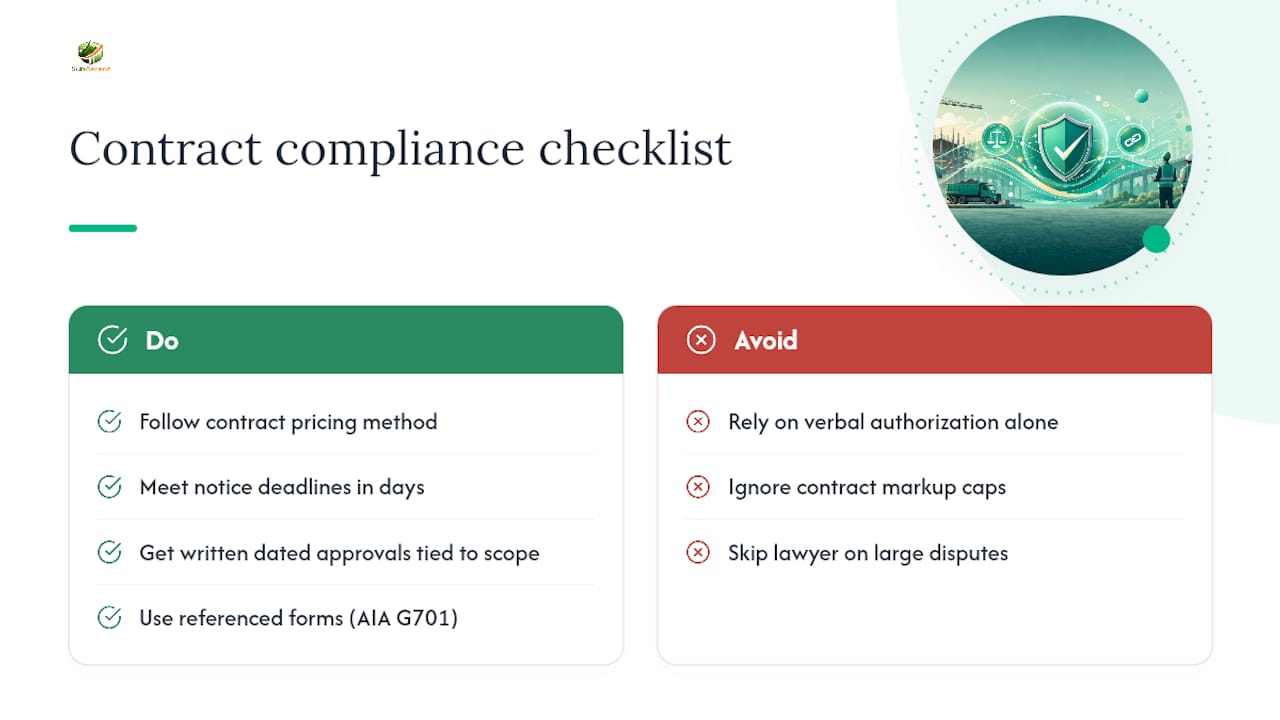
Before you price anything, read the change-order clause in your contract. Following whatever pricing method the contract prescribes matters more than any internal formula, because a proposal that ignores the contract's own rules is one of the most common causes of change-order disputes.
Look for these specific items before you submit a price:
- Prescribed pricing methods. Some contracts require unit prices for certain trades, others default to time and materials for undefined scope.
- Markup caps. A contract that caps markup at 12% overrides your usual 20% policy, full stop.
- Notice deadlines. Many contracts require written notice of a change within a set number of days or you forfeit the right to bill for it.
- AIA references. Contracts built on AIA G701 (Change Order) and G702 (Application for Payment) forms expect matching documentation formats, so structure your backup the same way.
- Required backup. Some clauses spell out exactly what documentation must accompany a priced change, down to quote format.
Cite the specific clause number in your change-order package so the reviewer doesn't have to hunt for it. If the contract says nothing about pricing method, document whatever approach you use and stay consistent across every change order on that job. Inconsistency is its own red flag.
Documentation, Approval, and Billing Workflow That Stops Unpaid Work
Never let crews start changed work on a verbal "go ahead." Require written approval first, every time, no matter how small the change looks.
For minor changes, a short field form works fine: reference document, brief scope description, and a rough cost estimate for same-day sign-off. For larger changes, build a full exhibit with these elements:
- The original triggering reference (RFI number, ASI, or email date).
- A clear, specific scope description, not "additional work as discussed."
- Line-item cost or an agreed lump sum.
- Schedule impact, stated in days.
- Payment terms for that specific change.
- A signature line with a date field.
Once signed, decide whether the change rides on your next regular invoice or goes out separately. Billing within days of approval, rather than bundling everything into month-end, cuts down on disputes because the work is still fresh in everyone's memory.
Pro Tip: Keep a change-log column labeled something like "Priced, Pending Approval" so nothing sits in limbo. A stack of unsigned change orders at project closeout is the single fastest way to lose six figures in retainage arguments.
Attach the backup package to the invoice itself, not just the change-order file. Reviewers approve faster when they don't have to dig for it.
Negotiation and Pricing Choices: T&M vs. Lump Sum, Deposits, and Defenses
Use lump-sum pricing only when the scope is genuinely clear. For discovery work, like opening a wall and finding rot, price it time and materials with agreed hourly rates and daily signed tickets.
When you present price to a GC or owner, show transparent line items with supporting quotes attached, not a single number. A bare lump sum invites a demand for a discount because there's nothing to negotiate against.
- Mirror your original bid's format and unit rates on the change order. It's harder for a reviewer to demand an arbitrary cut when your numbers match the pricing they already accepted once.
- Be ready to explain markup stacking. If your 20% is layered under the GC's 15%, say so plainly rather than letting the owner assume you're the only one marking up.
- Require a deposit or progress draw on large changes, especially ones needing upfront material purchases. Don't float a five-figure material buy on your own credit.
Practical Templates and Tools for Trade Change-Order Pricing
Every one of the steps above gets faster with the right paperwork already built. Keep these on hand:
- A short field change form for quick approvals on small scope adjustments.
- A full change-order documentation exhibit checklist for larger claims.
- A unit-price worksheet for quantity-uncertain scope.
- A sample mini-estimate showing loaded labor, materials, and markup side by side.
PDF takeoff tools speed up quantity updates when scope changes mid-job. Loaded labor rates built into your estimating workbook, plus QuickBooks sync for faster invoicing, cut the time between "scope changed" and "invoice sent."
Change-Order Cost Types: Direct, Indirect, and Consequential
Not every dollar tied to a change order belongs in the same bucket, and mixing them up is how subs underprice work without realizing it.
Direct costs are the ones you can point to immediately: labor hours, materials, equipment, and subcontractor charges tied straight to the changed work. These are the easiest costs to price and the most commonly recovered, because they show up on a quote or a timecard.
Indirect costs are your overhead: supervision time spent coordinating the change, extra trips for a foreman, additional safety oversight, or scheduling coordination that doesn't show up as a line-item receipt. These get applied as a percentage per your contract's markup rules rather than itemized individually, which is exactly why the markup conversation in the earlier section matters so much.
Consequential costs are the ripple effects: schedule delay, lost productivity from stacking trades, or acceleration costs if the GC demands you make up time caused by someone else's change. These are the hardest to price and the most likely to get disputed, because they require proving cause and effect rather than showing a receipt.
Price direct costs with confidence using your loaded rates and quotes. Price indirect costs consistently through your markup policy. Flag consequential costs early and separately, ideally before they compound, because retroactively trying to bill for three weeks of lost productivity six months later is a fight you're unlikely to win cleanly.
How Change Order Pricing Affects Schedule and Timeline
A change order rarely arrives alone. It usually drags a schedule question behind it, and pricing the cost without pricing the time is how subs end up working overtime for free.
Every change-order package needs a stated schedule impact, in days, right alongside the cost. If adding a new electrical panel location pushes your rough-in three days out, that delay needs to be documented the same way the added labor cost is documented, with the same level of specificity.
Schedule impact affects pricing in two directions. First, a change that compresses your timeline (the GC needs it done faster than originally planned) usually justifies acceleration costs: overtime premiums, extra crew, or weekend work. Second, a change that pushes your dates out can trigger remobilization costs if your crew has to leave and return later, which belongs back in your direct cost calculation.
Document the schedule impact on the change-order form itself, not in a separate email thread that gets lost. If the change adds float to your schedule without affecting the overall project completion date, say so. That's a detail that helps you later if a GC tries to blame you for an unrelated delay.
Common Change Order Disputes and How to Resolve Them
Most change-order disputes trace back to one of three problems: pricing method disagreements, scope definition arguments, or timing disputes over when notice was given.
Pricing method disputes happen when a sub applies its usual markup and the GC points to a contract clause capping it lower. The fix is reading the contract before pricing, not after the argument starts. Scope disputes happen when the change-order description is vague enough that both sides can read it differently, which is why a specific written scope description matters more than almost anything else in the package.
Timing disputes are the nastiest, because they can void your right to payment entirely if your contract has a strict notice window and you missed it. If you suspect a change is coming, send written notice immediately, even before you've fully priced it, to protect your position.
When a dispute does happen, resolution usually starts with a documentation review: whose paperwork is more complete, whose pricing traces back to a contract clause, and whose numbers match the original bid format. This is exactly why mirroring your original bid's unit rates and format on change-order pricing works so well as a defense. A reviewer comparing your change-order line items to your accepted bid line items has a much harder time arguing the numbers are inflated.
Legal Considerations and Compliance in Change Order Pricing
Change orders live inside your contract, which means contract language controls the legal exposure of every price you submit. Following the contract-mandated pricing method isn't just good practice, it's often the difference between a payable claim and a rejected one.
Watch for a few compliance issues specifically. Notice deadlines are usually spelled out in days, and missing them can forfeit your right to extra compensation even when the work itself was legitimately outside original scope. Markup caps written into the contract are enforceable regardless of what your standard company policy says, so a 25% internal markup policy means nothing against a contract that caps you at 12%.
Written approval matters legally, not just practically. Verbal authorization from a superintendent rarely holds up if the GC's office later disputes the charge, because most contracts require change orders to be documented in writing to be enforceable. Keep every approval signature dated and tied to the specific scope and price it covers.
If your contract references standard forms like AIA G701, using that format for your own change-order documentation makes your paperwork easier to defend, because it matches what courts and arbitrators are already familiar with reviewing. When in doubt about a specific legal question tied to a large or contested change, that's a conversation for your attorney, not a guess based on how the last job went.
Change Order Pricing Scenarios Across Different Trades
The mini-estimate formula stays the same across trades, but what fills it in looks different depending on the work.
An electrical contractor asked to relocate a panel mid-rough-in prices added conduit, wire, labor hours for the demo and reinstall, and possibly a permit revision fee. The consequential cost to watch is delay to trades waiting on that panel's completion.
A concrete sub facing an unexpected soil condition during footings prices additional excavation, extra material for oversized footings, and equipment time for the added dig. This is a textbook case for time and materials pricing, since the actual quantity isn't known until the crew is in the hole.
A drywall contractor asked to add fire-rated assemblies mid-project prices the material cost differential, the labor differential for taping and finishing a different assembly type, and often a schedule note if the fire-rated product has a longer lead time than standard board.
A fire protection sub adding sprinkler heads for a reconfigured ceiling grid prices the heads, pipe, fittings, and labor, but also needs to flag any impact on the hydraulic calculation that might trigger an engineering re-review, which is a cost most GCs don't anticipate until it's raised.
Every one of these follows the same skeleton: reference document, loaded labor, materials, equipment, schedule note, and markup per contract. The trade changes the line items. The formula doesn't.
Author Perspective: The One Habit That Stops Most Change-Order Leakage
Every margin-eating change order I've seen traces back to the same mistake: crews started before price was approved. Once work is done, you've lost your negotiating position entirely. The habit that fixes it isn't complicated. Require written approval and attached backup, quotes or unit rates, before anyone picks up a tool. Price first. Always.
— Dave
Subascent: Built for How Trade Subs Actually Price Change Orders
Some software alternatives help streamline change-order pricing by automating backup attachment, providing PDF takeoff tools that update quantities without a full re-measure, and integrating with QuickBooks for invoicing.

If you're an estimator, PM, or owner-operator tired of chasing signatures on stalled changes, a change log that tracks status from "priced" to "approved" to "billed" solves that without extra admin work. Payment terms and progress draws for larger changes are easier to enforce when the billing cadence is documented from the start rather than negotiated after the fact.
Try the change-order templates and see how the workflow fits your trade at Subascent.
Sources
- Fundamentals of construction contracts: pricing of change orders — Lorman
- How Do I Price Change Orders? — Shiftflow playbook
- How to Price a Change Order: Full Step-by-Step Formula — EZBilling
- Free Change Order Cost Calculator — BuildRefs
FAQ
What Is an Acceptable Change Order Markup Percentage?
Most specialty trade subs apply a combined 10-20% overhead plus 5-10% profit, landing around 15-30% total. Many prime contracts cap markup at 10-15%, and that contract cap always overrides your standard policy.
Who Pays for Change Orders in Construction?
The party that caused or requested the change typically pays, whether that's the owner (for scope additions) or the GC (for coordination issues on their end). Payment flows through the same contract chain as regular progress billing, so the change still needs signed approval before it's collectible.
What Should a Change Order Include?
A complete change order needs the triggering reference document, a specific scope description, itemized or lump-sum cost, schedule impact in days, payment terms, and a dated signature. Change-order workflow templates can help ensure these fields are included automatically.
What Is the Difference Between an RFI and a Change Order?
An RFI (Request for Information) asks a question about unclear plans or specs and doesn't authorize any cost change on its own. A change order is the priced, signed document that follows once an RFI response (or other trigger) actually alters scope, cost, or schedule.
How Do I Price a Change Order When Scope Is Uncertain?
When you can't nail down exact quantities upfront, price the change as unit rates or time and materials with agreed hourly rates, rather than guessing at a lump sum. Document daily hours and quantities as the work happens, and attach that record to your invoice for verification.