

A unit price bid is a construction pricing method where a contractor sets a fixed rate for each measurable unit of work, and final payment is calculated from actual quantities completed. The industry term is "unit price contract," and it appears across electrical, plumbing, HVAC, masonry, concrete, and fire protection work wherever scope quantities are uncertain at bid time. Unlike a lump sum bid, which locks in one total number, a unit price contract allows payment to adjust as actual quantities are verified in the field. That flexibility makes unit pricing the preferred method on projects where the owner cannot define exact quantities before work begins.
What is a unit price bid and how does it work?
A unit price bid breaks a project into individual pay items, assigns a fixed dollar rate to each, and multiplies those rates by actual installed quantities to determine final payment. The pay items are defined in the contract documents, and the owner carries the quantity risk. If the owner's estimated quantities turn out to be wrong, the contractor still gets paid at the agreed rate per unit. That is the core mechanic separating unit price bids from lump sum contracts.
The American Society of Civil Engineers and most public agency procurement standards recognize unit price contracts as the standard format for projects with variable scope. Electrical contractors bidding conduit runs in an occupied building, masonry crews pricing block by the course, or fire protection teams counting sprinkler heads all operate in conditions where final quantities shift. Unit pricing gives those trades a fair payment structure without requiring a renegotiation every time scope changes.

Pro Tip: Always confirm whether the contract documents include minimum and maximum quantity thresholds. Some owners cap how much they will pay at unit rates, which directly affects your risk exposure.
Core components of a unit price bid
Every unit price bid is built from the same structural elements. Getting each one right is what separates a profitable bid from a losing one.
- Pay item descriptions. Each line item names the specific work covered, the unit of measure (linear foot, square foot, each, ton), and the exact scope included per unit. Ambiguity here causes disputes at payment time.
- Fully loaded unit prices. Industry best practice requires that every unit price include labor, materials, equipment, overhead, and profit. Nothing gets billed separately unless the contract explicitly allows it.
- Estimated quantities. The owner provides estimated quantities in the bid documents. These are not guaranteed. They exist so bidders can compare apples to apples, but actual payment comes from field-measured quantities.
- Unit of measure definitions. A "linear foot of conduit" means something different if it includes fittings, hangers, and wire pulls versus conduit only. Define it clearly in writing before signing.
- Minimum and maximum thresholds. Many public contracts specify that unit rates apply only within a defined quantity range. Work outside that range triggers renegotiation.
Pro Tip: Build your pay item descriptions from the spec book, not from memory. Copy the exact language the owner uses, then add your own scope clarifications. That paper trail protects you when quantities get disputed.
How to calculate unit prices for a competitive bid
Calculating a unit price starts with a full cost breakdown for one unit of work, then layers in overhead and profit. The math is straightforward. The discipline required to do it accurately for every pay item is where most estimators cut corners.
- Identify the direct material cost per unit. Price the exact materials needed to complete one unit, including waste factors. A drywall estimator pricing by the square foot needs to account for cut waste, not just net area.
- Calculate the labor cost per unit. Divide your crew's hourly cost by the production rate for that unit. If an HVAC crew installs 8 fan coil units per day at a total crew cost of $1,200, the labor cost per unit is $150.
- Add equipment costs per unit. Use your equipment costing data to allocate owned or rented equipment costs across expected units. Lifts, compressors, and specialty tools all belong in the unit rate.
- Apply overhead. Divide your annual overhead by total projected revenue to get an overhead percentage, then apply it to each unit's direct cost. A typical specialty trade overhead rate runs between 10% and 20% of direct costs.
- Add profit margin. Profit sits on top of all costs. Set it based on market conditions, project risk, and your backlog. Do not let a competitive market pressure you into zero-margin unit rates.
Misestimating production rates is the most common cause of unit price losses. A masonry crew that lays 200 block per day on a clean slab will not hit that rate on a second-floor addition with limited staging. Build site-specific production assumptions into every unit rate, not just your best-case numbers.
Pro Tip: Maintain a unit cost library in a spreadsheet or estimating template that you update after every job closes. Historical actuals beat published cost databases every time.
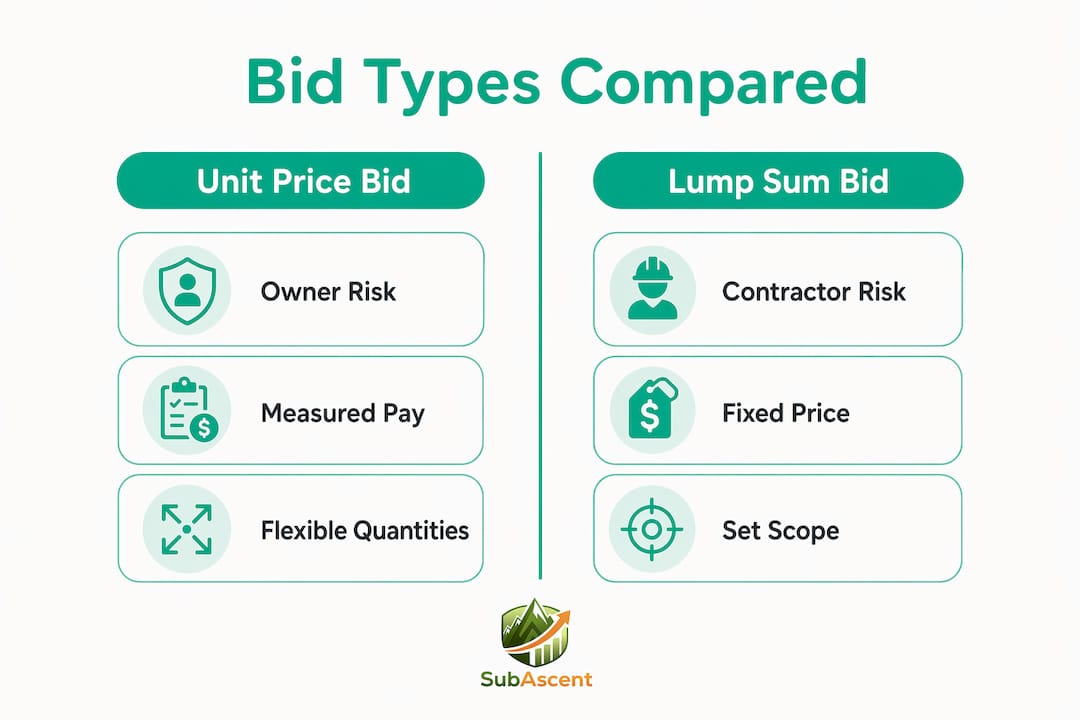
Unit price bids versus lump sum bids: what's the difference?
The choice between unit pricing and lump sum pricing comes down to who carries the quantity risk. Unit price bids transfer quantity risk to the owner. Lump sum bids transfer cost risk to the contractor. That single distinction drives everything else.
| Feature | Unit price bid | Lump sum bid |
|---|---|---|
| Quantity risk | Owner carries it | Contractor carries it |
| Final price | Determined after work is complete | Fixed at contract signing |
| Payment basis | Actual installed quantities | Agreed total regardless of quantities |
| Best for | Variable or uncertain scope | Well-defined, stable scope |
| Administrative burden | Higher (measurement and documentation) | Lower (one total to track) |
| Scope change process | Adjust quantities at existing unit rates | Formal change order required |
Owners prefer unit pricing on complex or maintenance projects because it gives them transparency into actual costs. Contractors trade the certainty of a fixed total price for the ability to get paid accurately when quantities grow. That tradeoff works well for specialty trades on projects like tenant improvements, infrastructure upgrades, or phased renovations where the owner's scope is genuinely uncertain.
Lump sum bids reward contractors who estimate accurately and execute efficiently. Unit price bids reward contractors who perform efficiently per unit. If your crew installs faster than your unit rate assumes, every extra unit of production adds margin. That productivity advantage is a real incentive built into the unit price structure.
For structured cabling and low-voltage work, unit pricing is particularly useful because scope often expands as owners add drops, devices, or access points during construction.
Common pitfalls and best practices for unit price bids
Unit price bids create specific risks that lump sum bids do not. Knowing where the traps are keeps your margins intact.
- Unbalanced bidding. Artificially skewing unit prices toward pay items you expect to overrun is called unbalanced bidding. It can improve early cash flow but raises red flags during bid review and can get your bid disqualified. Price every item at its true cost.
- Measurement risk. Payment depends on verified quantities. Delays in quantity documentation cause rejected payment claims. Track installed units daily, not at the end of the month.
- Vague pay item definitions. If the contract does not define exactly what is included in each unit, you will lose that argument in the field. Push for written clarifications before signing.
- Scope creep detection. Unit pricing actually helps here. Because every pay item is discrete, scope creep shows up early as new line items or quantity overruns. Use that structure to trigger change orders before the work is buried.
- Uncovered risks. Contractors bear costs for obstacles not covered in the unit rate, such as unexpected existing conditions or access restrictions. List your exclusions clearly in the bid. A solid bid proposal exclusions section protects you when conditions differ from what the documents showed.
Pro Tip: Set up a simple daily log in the field that records installed quantities by pay item. Your foreman does not need a complex system. A photo, a count, and a date is enough to defend a payment application.
Key Takeaways
Unit price bids transfer quantity risk to the owner and pay contractors based on actual installed work, making them the right choice for variable-scope specialty trade projects.
| Point | Details |
|---|---|
| Unit price definition | A fixed rate per measurable unit; final payment is based on actual quantities installed. |
| Fully loaded unit rates | Every unit price must include labor, materials, equipment, overhead, and profit. |
| Quantity risk transfer | The owner carries quantity risk; the contractor carries cost risk per unit. |
| Daily quantity tracking | Document installed units daily to prevent payment disputes and rejected claims. |
| Scope creep advantage | Discrete pay items make scope creep visible early, speeding up change order approvals. |
Why I think unit price bids are underused by specialty trades
Most electrical and plumbing estimators I talk to default to lump sum because it feels cleaner. One number, one signature, done. I get it. But that instinct costs money on the wrong projects.
The shift that changed how I think about unit pricing was realizing it rewards what good trade contractors already do: work efficiently. If your HVAC crew installs faster than the unit rate assumes, you make more money without doing anything extra. That is not a trick. That is the structure of the contract working in your favor. The job costing discipline required to build accurate unit rates also forces you to know your actual production costs, which makes every future bid sharper.
The administrative burden is real. Tracking quantities in the field takes discipline. But the contractors who build that habit also fight fewer payment disputes, catch scope creep before it becomes a problem, and have the data to back up every change order they submit. That is not overhead. That is protection.
— Dave
How Subascent helps specialty trades manage unit price bids
Specialty trade estimators spend too much time rebuilding spreadsheets from scratch on every bid. Subascent is built specifically for electrical, plumbing, HVAC, masonry, and other specialty trades that need to track bid invitations, build estimates, and manage jobs without using software designed for general contractors.

With Subascent, you can organize your pay items, track quantities against your estimates, and connect field data to your payment applications without switching between five different tools. The bid and job management platform keeps your unit cost library, your bid history, and your active jobs in one place. If you are ready to stop rebuilding the same workbook and start bidding unit price work with confidence, explore the tools built for specialty trades at Subascent.
FAQ
What is a unit price bid in construction?
A unit price bid sets a fixed dollar rate for each measurable unit of work, such as linear feet of conduit or square feet of drywall. Final payment is calculated by multiplying those rates by actual installed quantities.
How does a unit price bid differ from a lump sum bid?
A unit price bid pays based on actual quantities completed, so the final contract value is not known until work is done. A lump sum bid fixes the total price at signing regardless of actual quantities.
What costs must be included in a unit price?
Every unit price must include direct material costs, labor, equipment, overhead, and profit margin. Leaving any of these out means you are absorbing those costs yourself.
What is unbalanced bidding in a unit price contract?
Unbalanced bidding means artificially inflating unit prices on pay items you expect to overrun while lowering others. It can result in bid disqualification and damages your reputation with owners and general contractors.
How do I track quantities on a unit price job?
Record installed quantities by pay item daily, with photos and dates. Timely documentation prevents rejected payment applications and gives you a clear record if quantities are disputed at the end of the project.