

If you're a foreman on a plumbing, electrical, or drywall crew, you've probably been in this spot: something on the plans doesn't match what's in front of you, nobody on site has a clear answer, and work is sitting idle while you wait. The field RFI submittal process foreman teams rely on is what gets that situation resolved fast, formally, and on record. Done right, it protects your crew, keeps the project moving, and builds real credibility with the GC. This guide walks you through every step, from the tools you need to how you close one out correctly.
Table of Contents
- Key takeaways
- What foremen need before starting the RFI process
- Step-by-step guide to submitting a field RFI
- Common mistakes that slow down RFI responses
- Connecting RFIs with submittals and using technology effectively
- Verifying closure and communicating responses to your crew
- My honest take on RFI management in the field
- How Subascent helps foremen manage RFIs and submittals
- FAQ
Key takeaways
| Point | Details |
|---|---|
| Start with the right tools | A mobile RFI platform and organized register let you document issues the moment they appear on site. |
| Draft with specifics | Include drawing references, a clear question, and a suggested solution to cut average response time significantly. |
| Avoid the email trap | Managing RFIs through email creates gaps in accountability and increases legal exposure for your company. |
| Escalate before it's too late | If impacted work is within three weeks on the schedule, escalate immediately rather than waiting on a response. |
| Close the loop with your crew | Distributing the RFI response to everyone affected is just as important as submitting the RFI itself. |
What foremen need before starting the RFI process
Before you write a single RFI, make sure you have the right foundation in place. Trying to manage a construction RFI workflow without organized documentation is like doing a rough-in without the plans. You'll make mistakes that cost time.
Here's what you need ready before you start submitting field requests for information:
- Current drawing set and specs. Know which revision you're working from. Reference the correct sheet and detail number in every RFI you write.
- Submittal log. Check whether the issue is already addressed in an approved submittal. An RFI asking a question already answered in a submittal reflects poorly on your company.
- Consistent numbering system. Use a format your PM and GC both recognize. Something like "E-RFI-001" for electrical or "MECH-RFI-012" for HVAC keeps your register clean.
- A mobile platform or app. Mobile-first platforms let foremen create RFIs in the field with photo attachments, reducing submission time and improving accuracy.
- Photo, markup, and voice note capability. Visual context matters. A photo of the conflict with a markup arrow is worth three paragraphs of written description.
Here's a quick comparison of what to look for in a field RFI tool:
| Feature | Why it matters |
|---|---|
| Mobile submission | Lets you submit from the job site without going back to the office |
| Photo and markup attachments | Provides visual context that speeds up review |
| Automatic numbering | Prevents duplicate or missing RFI numbers |
| Status tracking | Shows who has the ball and when the response is due |
| Integration with submittals | Keeps RFIs and submittals linked in one audit trail |
Pro Tip: Set up your RFI register on day one of a new job, even before you need it. A blank register with numbering and categories already built is much easier to maintain than one you're building mid-project.
Step-by-step guide to submitting a field RFI
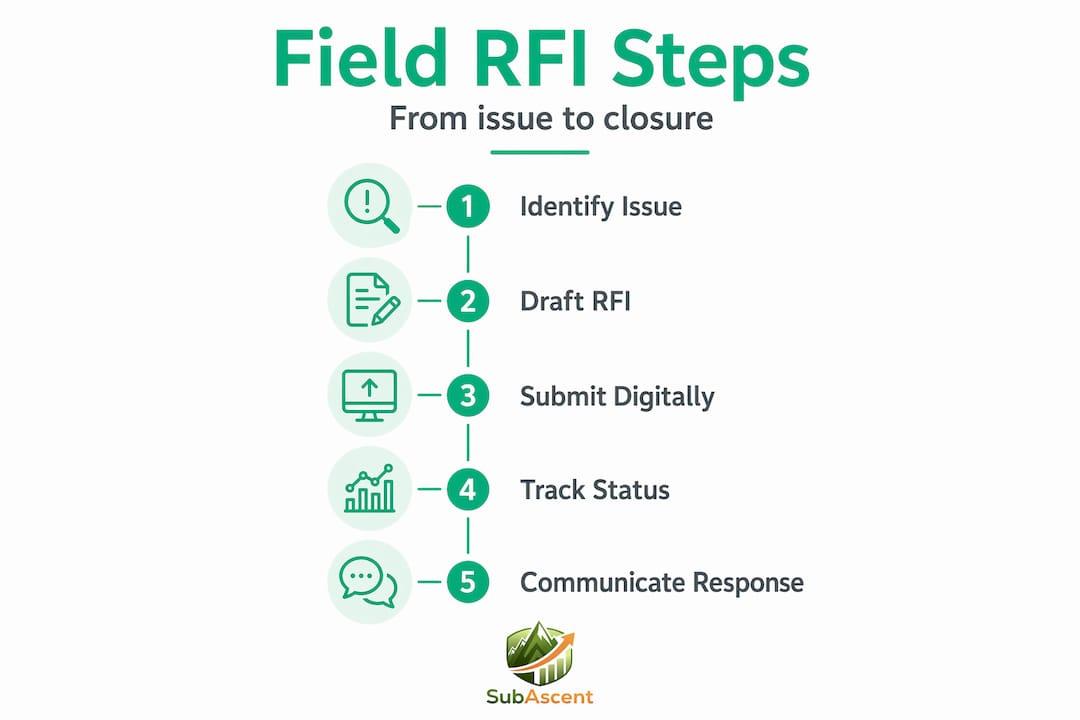
A standard RFI workflow has five to six distinct stages, and real response times average between 12 and 21 days. The faster and cleaner your submission, the faster you get back to work. Here's how to do it right.
-
Identify the issue. Not every question is an RFI. Minor clarifications you can get from a quick call with your PM are not RFIs. Use the formal site RFI submission process when the answer affects scope, schedule, cost, or requires a design decision.
-
Gather your references. Pull the relevant drawing sheet, spec section, and any related submittals. Note the exact revision number. Vague RFIs get slow responses because the engineer has to hunt for context you should have provided.
-
Draft the question clearly. Effective RFIs include a unique ID, exact drawing and spec references, and a direct question. Write one question per RFI when possible. Multi-question RFIs are harder to route and slower to resolve.
-
Include a suggested solution. This is one of the most underused moves in foreman RFI management. Suggesting a solution speeds up design review because even a rejected suggestion narrows the engineer's focus. It also signals that you're problem-solving, not just pushing work back.
-
Attach supporting photos and markups. A field photo of the actual conflict, marked up with dimensions or arrows, often reduces back-and-forth by at least one full response cycle.
-
Submit through your centralized platform. Managing RFIs solely through email creates lost context, no audit trail, and real legal risk. Use your project management system if the GC provides one. If not, use your own.
-
Set a follow-up date. Log the expected response date in your register. If you don't hear back within the agreed timeframe, follow up in writing, not just verbally.
Here's a quick timeline to benchmark against:
| Stage | Typical timeframe |
|---|---|
| Issue identified to RFI submitted | Same day, 24 hours max |
| GC routing to architect/engineer | 1 to 3 business days |
| Design team response | 7 to 14 business days |
| GC formal distribution | 1 to 2 business days |
| Total cycle | 12 to 21 days average |
Pro Tip: If your RFI is urgent because work is stopping, flag it as "Schedule Impact" in the subject line and body. This prioritizes routing and gets faster attention from the GC.
Common mistakes that slow down RFI responses
The field request for information process breaks down in predictable ways. Knowing what to avoid saves you from the frustration of RFIs that drag on for weeks or get lost entirely.
- Vague questions. "Please clarify detail 5/A-201" is not an RFI question. It's a placeholder. Write exactly what you need to know and why the existing information is insufficient.
- Missing references. If you don't cite the drawing sheet and spec section, the designer has to dig through the full document set to understand context. That adds days to the response.
- One-to-one communication. RFIs are contractual documents with lifecycle impacts on scope and schedule. They need to go through formal channels, not a text thread between you and the GC super.
- Not distributing responses to the crew. Failing to distribute RFI responses to all relevant personnel is one of the most common reasons RFI management fails in the field. Your masonry foreman knowing the answer doesn't help the framing crew two floors up.
- Letting open RFIs age without escalation. If an RFI is unresolved and the affected work is within three weeks on the schedule, escalate immediately. Waiting leads to forced field decisions that can generate non-conformance reports.
"An RFI that sits open while the schedule keeps moving is not a neutral situation. It's a ticking clock. The longer it sits, the more likely your crew makes a field call that costs twice as much to fix later."
You can go deeper on the most common RFI workflow mistakes specialty trade subs make. The patterns are consistent across electrical, sprinkler, HVAC, and low-voltage work alike.
Pro Tip: Keep a running "open RFI impact" note in your daily report. When open RFIs start showing up in daily logs, the GC feels the pressure too. It creates a paper trail and speeds up responses without you having to be pushy.
Connecting RFIs with submittals and using technology effectively
RFIs and submittals are not separate workflows. They are two parts of the same conversation with the design team. Managing both within one digital system prevents the disjointed decision-making that creates rework. For example, a submittal for a fire protection sprinkler head might reveal a conflict with the reflected ceiling plan that immediately requires an RFI. If your submittals and RFIs live in different places, that link gets broken.

Technology is making this connection easier. AI tools are starting to assist with drafting, classifying, and reviewing RFIs. Some platforms can save 15 to 45 minutes per RFI through automatic classification and suggested edits. That adds up fast on a job with 60 or 80 open RFIs.
That said, AI helps with technical comparisons but cannot replace human judgment on design intent. You still need to read the response, understand the implication for your install, and make the call on how to proceed. The tool does the admin. You do the thinking.
Here's what a good integrated system gives you:
- Linked RFIs and submittals in one searchable audit trail
- Automated reminders when responses are overdue
- Status visibility for both your PM and the GC at the same time
- Mobile access so you can check status or add photos from the job site
The real role of project management software in the trades is not to replace process. It's to make your existing process faster and harder to lose. That distinction matters when you're evaluating tools.
Pro Tip: When a submittal comes back with comments that require a design clarification, open the linked RFI the same day. Waiting to see if the comment resolves itself almost never works and creates a paper trail gap.
Verifying closure and communicating responses to your crew
Submitting an RFI is the beginning, not the end. Foreman RFI management only works when responses actually get to the people who need them on the ground. Here's how to close the loop correctly:
- Track response deadlines in writing. Log the required response date when you submit. If the GC's contract requires a 10-day turnaround, note it. You need that record if the delay causes a schedule impact.
- Confirm the response is complete. A response that says "coordinate with architect" is not a formal resolution. Push for a definitive answer before you mark the RFI closed.
- Distribute to all affected parties. This includes your PM, any other trade foremen whose work connects to the answer, and your crew leads. A direct message to your lead electrician or lead plumber confirming what the answer means for their install is not optional.
- Document the response in your daily report. This ties the RFI to a date and a condition in the field, which becomes valuable if there's a dispute later.
- Escalate unresolved items before they hit your schedule. Use your project schedule as a trigger. When impacted work is three weeks out and the RFI is still open, go to your PM and the GC in writing the same day.
Pro Tip: Create a simple two-line summary of each RFI response for your crew: what was asked, what was decided. Foremen sometimes assume crew members read the formal response. Most of the time, they don't.
My honest take on RFI management in the field
I've watched foremen on HVAC, drywall, and electrical jobs treat RFIs as paperwork someone else should handle. The attitude is that field guys build things and paperwork is the office's job. I get it. But that mindset costs real money.
In my experience, the jobs where RFI delays caused the worst rework weren't projects with bad designs. They were projects where the foreman waited too long to make the question formal. A crew runs a conduit route for three days before anyone realizes the drawing conflict was never resolved. Now you're cutting open a wall.
The foremen I've seen build the best reputations with GCs are the ones who treat every open RFI as a risk, not a nuisance. They submit fast, they document thoroughly, and they follow up without being pushed. GC supers notice that behavior. It leads to better treatment, faster approvals, and the kind of working relationship that makes a hard job easier.
The technology piece is real too. I've seen foremen resist using mobile apps for RFIs because they feel clunky at first. Push through that. Once you have a clean register with photos attached and a 48-hour submission habit, the process runs itself. You just manage the exceptions.
Treat the field RFI submittal process as a risk management tool, not a formality. It protects your crew, your schedule, and your company's reputation on every job.
— Dave
How Subascent helps foremen manage RFIs and submittals
If the process described above sounds right but your current setup makes it hard to execute, that's the gap Subascent is built to close.

Subascent is built for specialty trade subs, not general contractors. That means the RFI and submittal workflows are designed for how electrical, plumbing, HVAC, and masonry companies actually operate on job sites. Foremen can submit field RFIs with photo attachments from mobile, PMs get instant visibility on open items, and nothing lives in a scattered email thread. The system keeps RFIs and submittals linked so your office and your field are always working from the same record.
If you're managing jobs worth $500K to $10M and still tracking RFIs in a spreadsheet or email folder, the exposure is real. Explore Subascent's subcontractor platform and see how much cleaner your RFI workflow can get.
FAQ
What is the field RFI submittal process for a foreman?
It is a formal workflow where a foreman identifies a design conflict or unanswered question on site, documents it with drawing references and photos, submits it through a centralized system, and tracks the response through to distribution. The process creates an official record that protects the sub trade from disputes and delays.
How long does a construction RFI take to get a response?
Average RFI response times run between 12 and 21 days from submission to formal distribution. Submitting with complete references, photos, and a suggested solution reduces that cycle considerably.
Why shouldn't foremen manage RFIs through email?
Email lacks audit trail structure, deadlines, and status visibility. Purpose-built RFI software provides accountability and a defensible legal record that email threads cannot match.
When should a foreman escalate an open RFI?
If the work affected by an open RFI is within three weeks on the project schedule, escalate immediately to your PM and the GC in writing. Waiting longer risks forced field decisions and potential non-conformance reports.
What should a well-written RFI always include?
A strong RFI includes a unique ID, the exact drawing and spec references, a clear and specific question, supporting photos, and a suggested solution. Including a suggested solution speeds up the design team's review and demonstrates proactive problem solving.