
Skilled trade career progression is defined by structured stages that move workers from apprentice to journeyman, foreman, superintendent, and often business owner. The construction industry currently has over 500,000 unfilled skilled trade jobs, which means advancement happens faster now than at any point in the past two decades. Electricians, plumbers, HVAC technicians, and roofers who understand how skilled trade careers progress can plan their moves deliberately, not just wait to be noticed. Starting wages run $18–$25 per hour and climb steadily with each credential earned.
How do skilled trade careers progress through each stage?
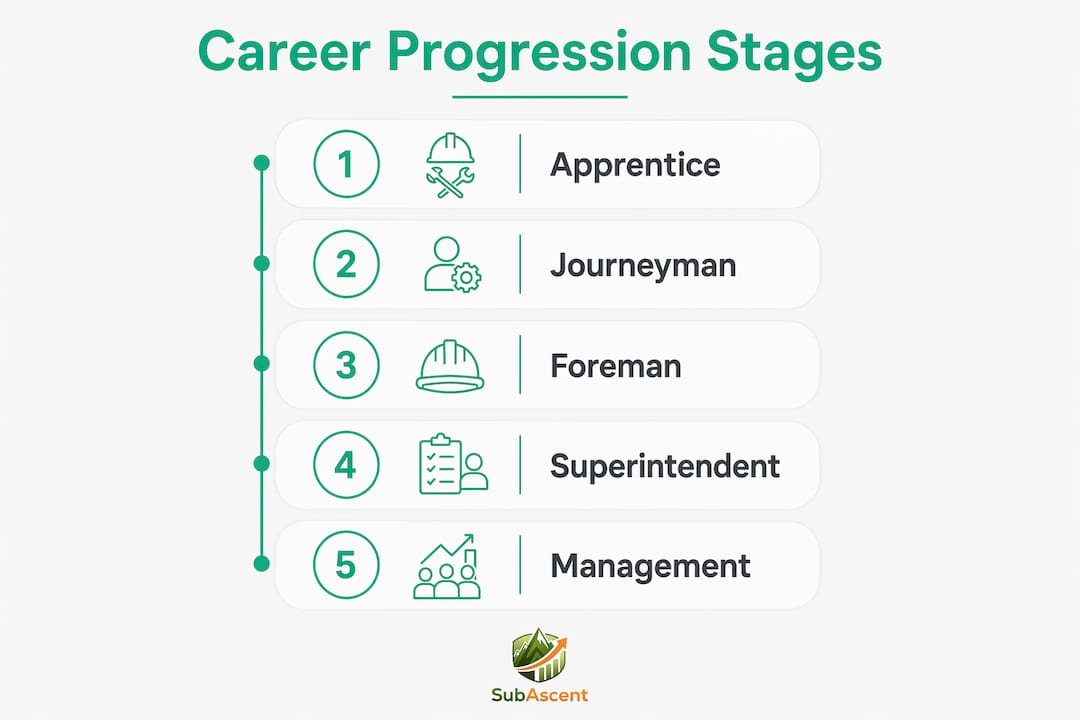
Career advancement in skilled trades follows a well-established sequence. Each stage has a typical timeline, a credential attached to it, and a clear jump in responsibility and pay.
Stage 1: Apprentice (years 1–4)
Apprenticeship is the entry point for every licensed trade. Programs typically run about four years, combining paid on-the-job hours with classroom instruction. Think of it as a college education you get paid to complete. An electrical apprentice, for example, spends days pulling wire and installing panels while attending trade school two nights a week. Wages increase every 6–12 months as hours accumulate.
Stage 2: Journeyman (years 4–8)
After completing the required hours and passing a licensing exam, an apprentice earns journeyman status. This credential is the foundation of skilled trades career development. A journeyman electrician or journeyman plumber can work independently, pull permits in most states, and take on more complex assignments. This stage is where most tradespeople spend the bulk of their working years, and it is also where specialization starts to matter.

Stage 3: Foreman (years 5–8 post-apprenticeship)
Foreman roles typically come 5–8 years after apprenticeship completion. A foreman manages a crew, coordinates daily work, handles material orders, and reports progress to the superintendent or project manager. The jump from journeyman to foreman is less about technical skill and more about reliability, communication, and the ability to keep a crew productive.
Stage 4: Superintendent and management (years 10–20)
Superintendent roles require broader project oversight and usually follow 10–20 years of experience. At this level, you are coordinating across multiple trades, managing schedules, and owning site safety. Project manager roles blend trade knowledge with planning, budgeting, and GC communication. Master tradesperson credentials, such as a master electrician or master plumber license, open the door to business ownership and the highest-paying contracts.
| Career Stage | Typical Timeline | Key Credential |
|---|---|---|
| Apprentice | Years 1–4 | Registered apprenticeship certificate |
| Journeyman | Years 4–8 | State journeyman license |
| Foreman | Years 5–8 post-apprenticeship | Experience-based promotion |
| Superintendent | Years 10–20 | Project management experience |
| Master tradesperson / Owner | Years 10+ | Master license, business license |
How do apprenticeships work and why do they matter for advancement?
Apprenticeship is the most direct path into a skilled trade, and it pays from day one. Starting wages run $18–$25 per hour, with automatic increases every 6–12 months tied to hours logged. There are no student loans. The credential you earn is recognized by the U.S. Department of Labor, which means it travels with you across employers and states.
The model combines paid on-the-job training with classroom instruction, and the hours you accumulate count directly toward your journeyman exam. A framing apprentice working for a specialty sub learns layout, structural reading, and crew coordination on real job sites, not in a simulation lab. That real-world context is what makes the credential meaningful.
The union versus non-union choice shapes your experience significantly. Union apprenticeship programs offer higher total compensation, federally portable credentials, and access to pension and health benefits. Non-union programs offer faster entry and more immediate overtime opportunities, though starting wages are often lower. Neither path is wrong. The right choice depends on your trade, your market, and how quickly you want to start earning.
Pro Tip: Treat every hour on the job site as a learning hour, not just a work hour. Apprentices who ask questions, study the plans, and watch how foremen solve problems advance faster than those who just put in the time. Active learning during apprenticeship programs is the single biggest differentiator between a journeyman who plateaus and one who makes foreman in five years.
Union total compensation packages often include pension contributions, health insurance, and annuities that raise the real value of your pay well above the hourly rate. A union HVAC apprentice earning $22 per hour may have a total compensation package worth $30 or more per hour once benefits are counted. That gap matters for long-term financial planning.
What factors influence earning potential and advancement speed?
Trade specialization is the fastest lever for income growth. Elevator installers earn a median above $106,000 annually, and construction managers in the top 10% earn over $216,000 per year. Six-figure incomes are achievable in 4–10 years in the right trade without a four-year degree. That timeline beats most college-educated career paths on both speed and debt load.
Certifications and licenses are the clearest way to unlock higher-paying roles. A master electrician license allows you to pull permits, run your own jobs, and charge accordingly. An HVAC technician with an EPA 608 certification and a state mechanical license commands significantly more than one without them. Each credential is a gate that fewer people have passed, which means less competition and more leverage at the negotiating table.
Geography and union density also shape earnings. A journeyman pipefitter in San Francisco earns more than one in rural Alabama, partly because of union scale rates and partly because of local demand. Working in high-demand markets, particularly during infrastructure build-outs or commercial construction booms, adds overtime that can push annual income well above base scale.
Pro Tip: Soft skills move you up faster than technical skills alone. Job site awareness, meaning the ability to read a situation, anticipate problems, and communicate clearly with a GC, is what separates the journeymen who get promoted from those who stay on the tools indefinitely. Work on your communication as deliberately as you work on your craft.
| Factor | Impact on advancement |
|---|---|
| Trade specialization | Higher median wages, faster six-figure timeline |
| Certifications and licenses | Access to higher-paying roles and permit authority |
| Geographic market | Union scale rates and overtime availability |
| Soft skills | Faster promotion to foreman and superintendent |
| Overtime in high-demand markets | Significant annual income increase above base rate |
What leadership and management roles exist beyond journeyman?
The trades offer a clear ladder above journeyman status, and most tradespeople underestimate how far it goes. Advancement in the trades often continues well beyond craft work into leadership roles that carry real authority and income.
Here is how that ladder typically looks for a specialty trade sub:
-
Foreman. You manage a crew of 3–10 workers, assign daily tasks, track material deliveries, and report to the superintendent. You are still on the tools part of the time, but your primary job is keeping the crew productive and on schedule. Foremen at electrical or plumbing subs often handle daily reports and field photos, which means basic documentation skills matter.
-
General foreman. On larger projects, a general foreman oversees multiple foremen and coordinates across shifts or zones. This role exists primarily on commercial and industrial jobs where a single foreman cannot cover the full scope.
-
Superintendent. Promotion to superintendent requires a mindset shift from managing a single trade to overseeing entire projects. You coordinate safety, scheduling, and logistics across all trades on site. Foremen who think ahead and manage site logistics promote faster than those who wait for direction.
-
Project manager. Project managers at specialty trade subs handle submittals, RFIs, change orders, and budget tracking. The role blends trade knowledge with office skills. A roofing or drywall PM who can read a spec book, build a schedule, and manage GC relationships is extremely valuable and hard to replace.
-
Business owner. Ownership is the top of the ladder for most tradespeople. A master electrician or master plumber with a business license can run their own specialty sub, take on their own contracts, and build a company. The labor shortage exceeding 500,000 jobs means that experienced owners with good crews are in high demand from GCs who need reliable subs.
Understanding the role of a trade helper at the entry level also helps managers build better crews, because the habits formed early determine who rises and who stays put.
Key Takeaways
Skilled trade careers progress through defined stages, and tradespeople who combine technical credentials with soft skills and strategic specialization reach leadership roles and six-figure incomes faster than those who rely on time alone.
| Point | Details |
|---|---|
| Structured progression | Careers move from apprentice to journeyman, foreman, superintendent, and owner in defined stages. |
| Apprenticeship pays from day one | Starting wages run $18–$25 per hour with increases every 6–12 months. |
| Specialization accelerates income | Elevator installers and top construction managers earn well above $100,000 annually. |
| Soft skills drive promotion | Communication, reliability, and job site awareness separate foremen from lifelong journeymen. |
| Labor shortage creates opportunity | Over 500,000 unfilled trade jobs in 2026 means faster advancement for qualified workers. |
What I've learned watching tradespeople advance (and stall)
The trades have a dirty secret that nobody talks about at career fairs: most people who stall do so at the journeyman stage, not because they lack skill, but because they never made the mental shift from "doing the work" to "owning the outcome." I have watched sharp electricians and talented plumbers spend fifteen years on the tools because they never raised their hand for a foreman role. They assumed someone would tap them on the shoulder. That is not how it works.
The tradespeople I have seen advance fastest share one habit: they treat every job site like a classroom. They watch how the superintendent sequences work. They ask the PM why a change order got denied. They study the plans on lunch break instead of scrolling their phone. That curiosity compounds over years into the kind of judgment that makes a superintendent irreplaceable.
Mentorship matters more than most people admit. Soft skill development through mentorship is often more effective than formal training for leadership. Find the best foreman on your job site and make yourself useful to them. Ask direct questions. The trades have an oral tradition of knowledge transfer that no classroom can replicate.
The other thing worth saying plainly: the income ceiling in the trades is higher than most people outside the industry realize. A master electrician running a small specialty sub with five journeymen can clear more annually than most college graduates with a decade of experience. The labor shortage is structural and accelerating. The people who position themselves now, with the right credentials and the right soft skills, will have more leverage than any generation of tradespeople before them.
— Dave
How Subascent helps trade professionals take the next step
Running a specialty trade business means managing more than just the craft. Estimating, submittals, job costing, and AR follow-up eat hours that should go toward growing your crew and your skills.

Subascent is built specifically for specialty trade subs, from electrical and plumbing to roofing and drywall. The platform helps owner-operators and PMs track bids, manage job profitability, and keep field and office connected without the overhead of GC-focused software that was never designed for subs. If you are advancing into a foreman or PM role and need tools that match how specialty trades actually work, explore Subascent and see what running a tighter operation looks like.
FAQ
How long does it take to become a journeyman tradesperson?
Most apprenticeships last about four years, combining on-the-job hours with classroom training. After completing the required hours and passing a licensing exam, an apprentice earns journeyman status.
What is the difference between a journeyman and a master tradesperson?
A journeyman can work independently within a licensed company, while a master tradesperson holds a higher license that allows them to pull permits, supervise journeymen, and operate their own business.
How do soft skills affect career advancement in skilled trades?
Communication, reliability, and job site awareness are critical for moving beyond technical roles. Tradespeople who develop these skills alongside their craft advance to foreman and superintendent roles significantly faster.
Can skilled tradespeople earn six-figure incomes without a college degree?
Six-figure incomes are achievable in 4–10 years in trades like elevator installation and construction management. The top 10% of construction managers earn over $216,000 annually.
What is the fastest way to advance from journeyman to foreman?
Foremen who think ahead, manage site logistics proactively, and communicate clearly with superintendents promote faster than those who wait for direction. Active mentorship and volunteering for crew leadership tasks accelerates the timeline.