

A trade bid scope is a comprehensive document that defines every aspect of work a specialty trade subcontractor is responsible for on a given project. Understanding what does a trade bid scope include is the difference between winning profitable work and signing up for costly disputes. The industry term for this document is the "scope of work," and it serves as the legal and operational backbone of your bid. Get it right, and your bid stands out. Get it wrong, and you're writing change orders before the first nail is driven.
What does a trade bid scope include?
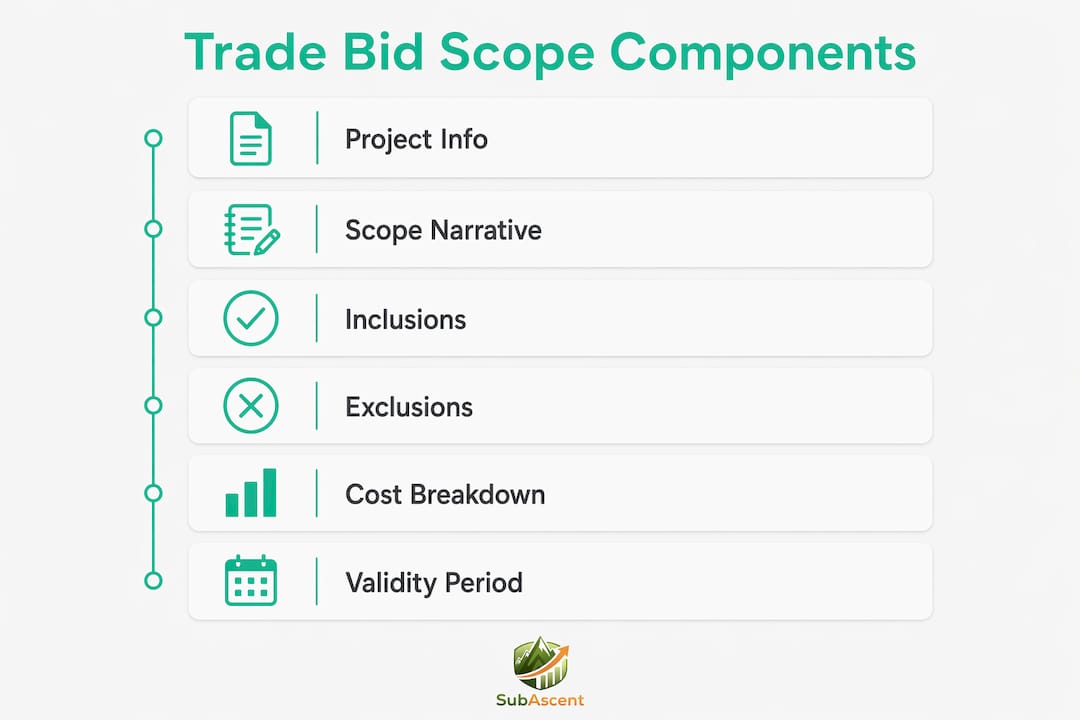
A complete trade bid scope includes six core components: project identification, a detailed scope of work narrative, explicit inclusions, explicit exclusions, a project timeline with milestones, and an itemized cost breakdown. Failure to list exclusions explicitly is the primary driver of scope creep and margin loss for specialty contractors. That single omission costs more than any other mistake in the bidding process.
The components of a trade bid work together as a system. Miss one, and the whole document becomes unreliable. Here is what each component must contain:
- Project identification: Project name, address, owner, general contractor (GC) contact, bid due date, and the specific trade package number.
- Scope of work narrative: A written description of all work your trade will perform, referencing specific drawing numbers, revision dates, and specification sections.
- Inclusions list: A line-by-line list of every item, system, or task your price covers. For an HVAC sub, this might include ductwork fabrication, equipment setting, and startup.
- Exclusions list: Every item your price does NOT cover. Site cleanup, temporary power, permits, and commissioning by others are common examples.
- Timeline and milestones: Your projected start date, key installation phases, and any schedule dependencies tied to other trades.
- Itemized cost breakdown: Labor, materials, and equipment costs listed separately so the GC can level your bid against others.
Each of these elements has a specific job. Together, they tell the GC exactly what they are buying and protect you from being held responsible for work you never priced.
How to write clear scope narratives that avoid disputes

The scope of work narrative is where most trade bids fall apart. Vague language like "per plans and specs" creates ambiguity that costs money. Clear document referencing can reduce pre-award RFIs by up to 50% for complex trade packages. That is a direct reduction in the back-and-forth that slows your award and burns estimator time.
Write your narrative by referencing specific drawing revision dates and specification sections. Instead of "furnish and install fire protection system per plans," write "furnish and install wet pipe sprinkler system per Drawings FP-101 through FP-108, Rev. 2, dated march 15, 2026, and Specification Section 21 13 13." That level of specificity removes guesswork for the GC and for your own field crew.
Your narrative should also define trade interfaces. An "Interfaces" section clearly defines connections with adjacent trades and prevents scope gaps that lead to change orders. For example, a plumbing sub should state who is responsible for the final connection to HVAC equipment. Missing interface definitions are the leading cause of scope gaps after award.
Pro Tip: Build a document control log inside your bid template. List every drawing set and spec section you priced from, including revision numbers and issue dates. When the GC issues addenda, you can immediately identify what changed and issue a revised bid or clarification letter.
Why explicit exclusions and assumptions protect your margin
Exclusions are not a sign of weakness. They are a professional boundary that protects your margin and your relationship with the GC. Exclusions lists are critical protective measures that clearly mark what work is not included in your price. A GC who understands your exclusions can plan accordingly. A GC who discovers them mid-project becomes adversarial.
Common exclusions that specialty trade subs miss include:
- Site cleanup and debris removal
- Temporary power and lighting
- Permits and inspection fees
- Cutting, patching, and painting after rough-in
- Commissioning and owner training
- Work above a certain floor or outside a defined zone
Assumptions work alongside exclusions. An explicit "Assumptions" block protects subs from claims related to unclear site or scheduling conditions. Common assumptions include standard working hours (7 a.m. to 5 p.m., Monday through Friday), unobstructed site access, and a dry, enclosed building for finish work. If the project runs a night shift or requires weekend work, your price does not cover it unless you say so.
The practical benefit of a thorough exclusions and assumptions list goes beyond self-protection. It also makes the project handoff to your foreman cleaner. When your field team can read the scope and immediately understand what is and is not their responsibility, execution disputes drop. The best bid scopes serve as the primary field reference throughout project execution, not just a document that gets filed after award.
Pro Tip: Review your last three change orders. If any of them were for work you assumed was excluded, add that item to your standard exclusions list today. Your exclusions list should grow with every project you complete.
How to present cost breakdowns, timelines, and bid validity
The way you format your pricing is as important as the number itself. Submitting bids in a standardized, line-item format by CSI division eases GC bid leveling and increases your chances of selection. When a GC can compare your electrical bid line by line against two others, your price becomes easier to defend. When your bid is a single lump sum, it gets questioned or ignored.
A strong cost breakdown separates labor, materials, and equipment into distinct line items. For a drywall sub, that means listing framing labor separately from drywall material, finishing labor, and any equipment rental. This transparency builds GC confidence and reduces the back-and-forth during leveling. Separating costs also helps you track job profitability after award, which is a separate but equally important benefit. For more on that, the job costing guide for electrical contractors covers the most common mistakes in cost tracking.
Your timeline section should include:
- Projected mobilization date
- Key installation milestones (rough-in complete, inspections, finish work)
- Schedule dependencies on other trades or GC-supplied items
- Anticipated substantial completion date for your scope
Bid validity is a component that many estimators forget entirely. Including a bid validity period of 30–90 days protects you from being held to a price after your supplier quotes have expired. State it clearly: "This proposal is valid for 60 days from the date of submission." If the project award is delayed, you have the right to reprice.
How a well-prepared scope supports bid selection and project execution
A detailed scope of work does more than protect you. It actively improves your chances of winning the job. Vague scopes cause subs to pad bids to protect margin, which makes their number look high even when it is not. A clear scope tells the GC exactly what they are getting, which reduces the contingency they need to add on their side.
The downstream benefits for project execution are just as significant. A well-written scope serves as the primary reference for your foreman on what work is included, what is excluded, and where your trade interfaces with others. That clarity reduces field disputes, RFIs, and unauthorized work. It also makes your bid proposal exclusions easier to enforce if a dispute does arise.
Common pitfalls of poorly scoped bids include:
- Change orders for work assumed to be excluded but never stated
- Disputes over who is responsible for trade interfaces
- GC contingency padding that makes your bid look uncompetitive
- Field crew performing out-of-scope work because the scope was unclear
The fix for all of these is the same: write a scope that is specific enough for your foreman to work from on day one.
Key Takeaways
A complete trade bid scope includes project identification, a detailed scope narrative with drawing references, explicit inclusions and exclusions, a timeline with milestones, an itemized cost breakdown, and a stated bid validity period.
| Point | Details |
|---|---|
| Six core components | Every bid scope needs project info, scope narrative, inclusions, exclusions, timeline, and cost breakdown. |
| Reference specific documents | Name drawing revision dates and spec sections to cut pre-award RFIs and prevent disputes. |
| Exclusions protect margin | List what is NOT included to prevent scope creep and enforce boundaries with the GC. |
| Assumptions clarify conditions | State working hours, site access, and other conditions your price depends on. |
| Standardized cost format | Break out labor, materials, and equipment by CSI division to make GC leveling faster and your bid more competitive. |
What I have learned about scopes after years in the trade
The biggest mistake I see estimators make is treating the scope of work as a formality. They write two sentences, attach a number, and call it a bid. Then they spend the next six months fighting over what was included.
The estimators who win the right jobs write scopes that read like a project plan. They name every drawing. They list every exclusion. They state every assumption. When a GC reads that scope, they know exactly what they are buying. That confidence translates directly into award decisions, especially on negotiated work where the GC has a choice.
The 2026 market has made this even more critical. Material costs are volatile, labor is tight, and GCs are under pressure to close their own budgets faster. A sub who hands them a clean, leveled scope with a clear validity period makes their job easier. That sub gets called first on the next project.
The other thing I have seen is that your scope is only as good as your document control. If you priced off an old drawing set and the GC issued an addendum you missed, your scope is wrong before the project starts. Build the habit of logging every document you price from, every time. It takes five minutes and saves five hours of argument later.
Your scope is not just a bid document. It is the first signal to the GC about how you run your business. Make it look like you know what you are doing, because you do.
— Dave
How Subascent helps trade subs build tighter bid scopes
Specialty trade subs who want to build more accurate, dispute-proof bids need a system built for the way they actually work. Subascent is built specifically for electrical, plumbing, HVAC, roofing, fire protection, and other trade subcontractors who need to move fast without missing critical scope details.

Subascent gives estimators a structured place to track bid invitations, manage scope documents, and build proposals that include every component a GC expects to see. If you are tired of rebuilding your bid template from scratch on every job, explore how Subascent supports trade bidding from the first invitation to the final submission. For a deeper look at what goes into a complete bid package, the guide for trade subs on bid packages is a practical next step.
FAQ
What is a trade bid scope of work?
A trade bid scope of work is a written document that defines all work a specialty trade subcontractor is responsible for on a project. It includes the scope narrative, inclusions, exclusions, timeline, and cost breakdown.
What should be excluded from a trade bid scope?
Common exclusions include site cleanup, temporary power, permits, cutting and patching, and commissioning. Listing these explicitly prevents scope creep and protects your margin after award.
How long should a bid validity period be?
A bid validity period of 30–90 days is standard for specialty trade bids. This protects you from being held to a price after your supplier quotes have expired.
Why do GCs prefer itemized bid formats?
GCs use itemized, line-item bids organized by CSI division to level competing bids accurately. A standardized format makes your pricing easier to compare and faster to approve.
How does a clear scope reduce change orders?
A clear scope with explicit exclusions and assumptions removes ambiguity about what work is included. When the boundaries are defined in writing before award, there is less room for dispute during execution.