
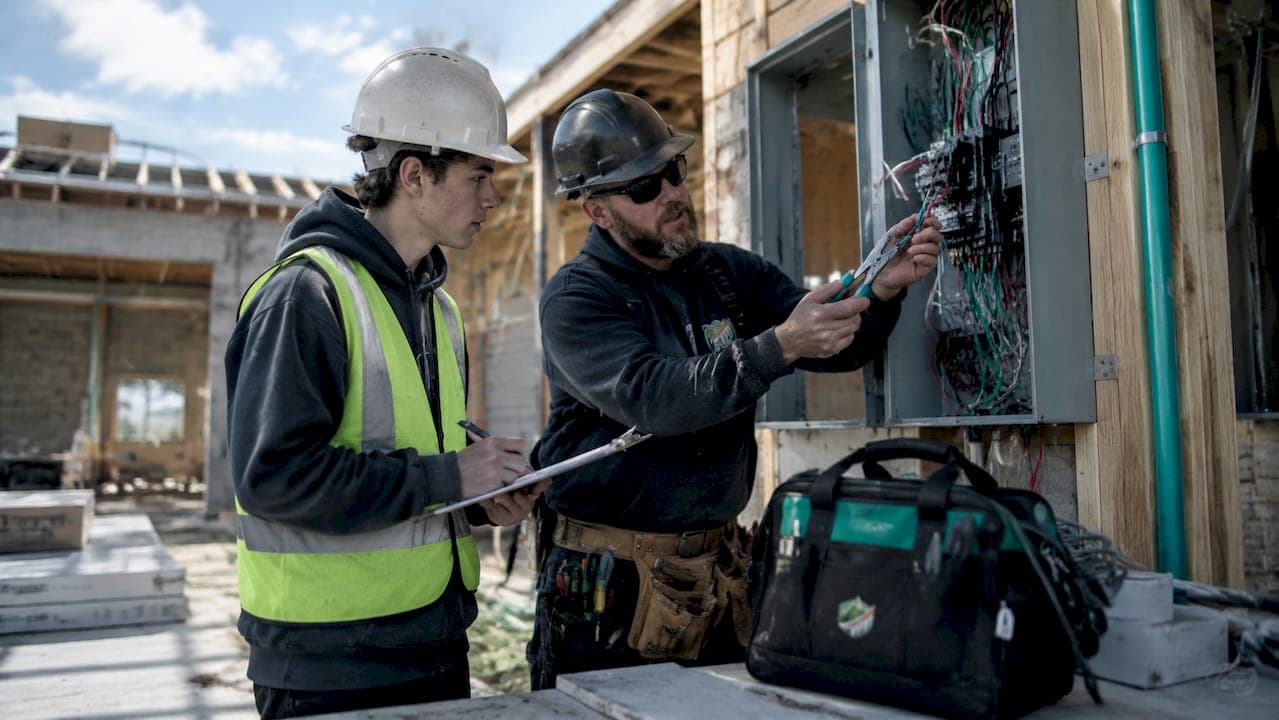
A registered apprenticeship program in the trades is a structured, paid training system that combines supervised on-the-job learning with formal classroom instruction to produce fully qualified journeyworkers. For electrical, plumbing, HVAC, masonry, and roofing businesses, understanding how apprenticeship programs work in trades is the difference between constantly scrambling for qualified labor and building a self-sustaining workforce pipeline. The U.S. Department of Labor and organizations like Jobs for the Future (JFF) have codified these programs into a federal framework that specialty trade employers can sponsor directly or access through union Joint Apprenticeship Training Committees (JATCs).
How does the structure of apprenticeship programs work in trades?
Apprenticeship programs in the trades rest on two distinct pillars: on-the-job training (OJT) and related technical instruction (RTI). These are not interchangeable. Programs require 144 hours of RTI annually, tracked and documented separately from OJT hours. That separation matters because federal compliance audits treat them as independent requirements, and failing either one puts the entire program registration at risk.
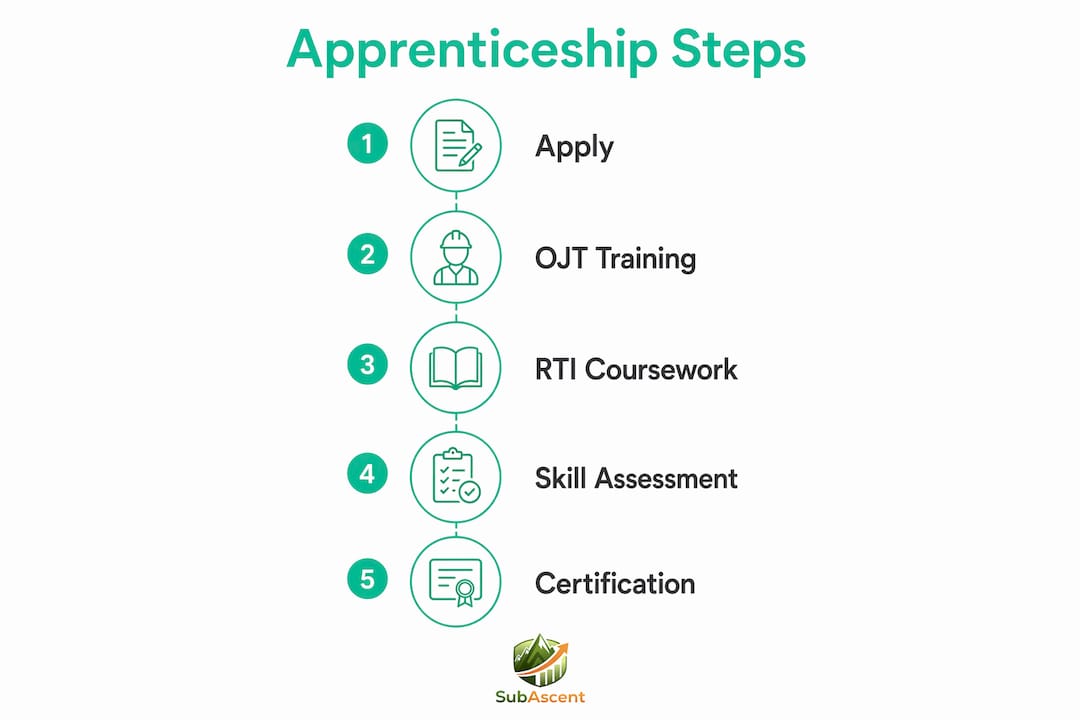
OJT is the paid, supervised work an apprentice performs on your jobsite. RTI is the classroom or online instruction that builds the theoretical foundation behind that work. An electrician's apprentice learning conduit bending on a commercial project is doing OJT. That same apprentice studying the National Electrical Code at a community college two evenings a week is completing RTI. Both must happen, and both must be documented.

Program length in construction trades typically spans 3 to 5 years, with trades like electrical requiring 8,000 to 10,000 total OJT hours. That translates to roughly 40 hours per week of paid field work across the program duration. Apprentices advance by meeting documented hour thresholds and demonstrating competency at each level, not simply by showing up long enough. Calendar time alone does not qualify an apprentice for advancement.
Here is what the core structure looks like in practice:
- OJT hours: Paid, supervised work on active jobsites, logged by task and trade area
- RTI hours: Minimum 144 hours per year, delivered through community colleges, union training centers, or approved online providers
- Wage progression: Scheduled pay increases tied to hour milestones and competency checkpoints
- Documentation: Separate logs for OJT and RTI, maintained by the sponsoring employer or JATC
- Advancement criteria: Completion of required hours plus demonstrated skill proficiency, not time alone
Pro Tip: Schedule RTI sessions at the start of a new OJT phase, not after. When apprentices learn the theory before they practice the skill on the job, retention improves and supervision time drops.
What are the key roles and responsibilities of employers in apprenticeship programs?
Employers are the cornerstone of apprenticeship programs. Without active employer participation and supervision, no apprenticeship program can function. As a sponsor, your business takes on legal and operational accountability for the apprentice's training experience from day one.
Your core responsibilities as a sponsoring employer break down into four areas:
- Supervised OJT: Assign apprentices to experienced journeyworkers who actively teach, not just tolerate. A framing apprentice shadowing a journeyworker who never explains what they are doing is wasting program hours.
- Hour tracking and validation: Program sponsors coordinate with RTI providers and maintain separate logs for OJT and classroom hours. This is non-negotiable for compliance.
- Competency verification: You must confirm that apprentices can actually perform the skills they have logged hours for, not just that they were present on the job.
- Recruitment and selection: You define the hiring criteria, run the application process, and select apprentices who fit your trade and your business culture.
Coordinating with RTI providers is where many trade businesses underestimate the workload. If you are a non-union plumbing or HVAC shop, you will likely partner with a local community college or an online RTI provider approved by your state apprenticeship agency. That relationship requires active management. You need to confirm that the curriculum aligns with the skills your apprentices are actually using on your jobs.
Record-keeping is the area that kills programs. Operational compliance typically fails in tracking apprentice attendance and progress, and centralized digital record systems improve accuracy and audit readiness substantially. A spreadsheet shared across three people with no version control is not a compliance system. It is a liability. Understanding the role of a trade helper on jobsite also helps managers distinguish between general labor tasks and the structured skill-building that counts toward OJT hours.
Embedding apprenticeship into your daily workflow means treating it as a production input, not an HR side project. Assign apprentices to specific foremen who are accountable for their progress. Build RTI scheduling into your crew calendar the same way you schedule inspections or material deliveries.
How do apprenticeship programs benefit trade businesses and workers?
Apprenticeships produce workers trained exactly to your standards, on your equipment, using your methods. That specificity is something no trade school graduate or job board hire can match on day one. The business case is direct: you reduce hiring risk, lower turnover, and build a succession pipeline without paying journeyworker wages for the full training period.
Apprentices earn wages from day one, typically starting at 40 to 50 percent of journeyworker pay, with scheduled increases as they progress. For a roofing or masonry business, this means productive labor at a lower cost during the training period, with wages rising as the apprentice's output and skill level rise. The structure removes the guesswork from pay decisions.
The retention numbers behind apprenticeship programs are compelling. Workers who complete registered apprenticeships tend to stay with their sponsoring employer at significantly higher rates than workers hired through conventional recruiting. That loyalty is not accidental. Apprentices know the employer invested in them, and that investment creates a reciprocal commitment. For a drywall or insulation business with 15 to 30 employees, losing a trained journeyworker to a competitor is a real operational hit. Apprenticeship reduces that risk.
| Benefit | Apprenticeship program | Trade school only |
|---|---|---|
| Wages during training | Paid from day one, progressive | No wages, tuition cost |
| Employer customization | High, trained to your methods | Low, general curriculum |
| Credential portability | Nationally recognized certification | Varies by school and state |
| Time to journeyworker | 3 to 5 years with OJT | 1 to 2 years classroom only |
| Retention likelihood | Higher due to employer investment | Lower, no employer bond |
After completing a registered apprenticeship, workers qualify for journeyman licensing examinations in their trade. That credential is portable across states, which matters for workers and for businesses bidding multi-state projects. A fire protection or low-voltage business operating across multiple states benefits from a workforce holding federally recognized credentials.
What are common apprenticeship models and how do they differ?
Not all apprenticeship programs are built the same way. The model you choose, or the one your JATC operates, directly affects how you manage scheduling, documentation, and advancement decisions.
| Model | How advancement works | Best fit |
|---|---|---|
| Time-based | Fixed OJT hours required at each level | Trades with standardized task sequences |
| Competency-based | Advancement after skill demonstration, regardless of hours | Trades with variable task exposure |
| Hybrid | Minimum hours plus competency verification | Most construction trades |
| Registered | Approved by DOL or state agency, nationally recognized | Businesses seeking credential portability |
| Non-registered | Employer-designed, no federal oversight | Businesses with internal training goals only |
Competency-based models allow advancement after demonstrating skills rather than fixed hours. This is a meaningful distinction for a concrete or steel/rebar business where apprentices may reach full proficiency in certain tasks faster than the hour schedule assumes. The hybrid model, which requires a minimum hour threshold plus a competency check, is the most common structure in construction trades because it satisfies federal documentation requirements while still rewarding faster learners.
Union programs, run through JATCs for trades like electrical and plumbing, almost always operate as registered, time-based programs with standardized RTI curricula. Non-union specialty trade businesses have more flexibility but also more administrative responsibility. They must design their own work process schedules, select or develop RTI providers, and manage compliance without the infrastructure a JATC provides. That is a real operational cost to factor in before deciding to sponsor independently versus partnering with an existing program.
Key takeaways
Apprenticeship programs in the trades succeed when employers treat them as structured training systems, not recruiting shortcuts, combining documented OJT with mandatory RTI and active mentorship.
| Point | Details |
|---|---|
| OJT and RTI are separate requirements | Programs require at least 144 RTI hours annually, tracked independently from jobsite hours. |
| Employers carry compliance responsibility | Sponsors must track hours, verify competencies, and coordinate with RTI providers to stay audit-ready. |
| Wage progression reduces hiring risk | Apprentices start at 40 to 50 percent of journeyworker pay, with increases tied to documented progress. |
| Model choice affects management load | Registered hybrid programs balance federal credential recognition with flexibility for faster learners. |
| Retention is the long-term payoff | Workers who complete apprenticeships with a sponsoring employer stay at higher rates than conventional hires. |
What I've learned about running apprenticeships in specialty trades
Most trade business owners I talk to think of apprenticeship as a hiring strategy. It is not. It is a production strategy. The moment you treat an apprentice like a warm body filling a labor gap instead of a worker moving through a defined skill progression, the program starts failing. You get someone who logs hours but cannot perform. That is the "busy but not skilled" problem, and it is more common than anyone admits.
The scheduling piece is where I see the most operational pain. RTI does not schedule itself. If your foremen do not know when an apprentice has class, they will book them on a pour or a rough-in and the apprentice will skip RTI. Do that enough times and you have a compliance problem, not just a training problem. RTI and OJT must be tracked separately, and scheduling misalignment creates skill gaps that show up later when you least want them, on a deadline-driven job.
The other thing I would push back on is the assumption that union programs are the only real option for smaller shops. A non-union electrical or HVAC business with 20 employees can absolutely sponsor its own registered apprenticeship through the state apprenticeship agency. The administrative load is real, but the payoff in workforce control and retention is worth it. You get to train people your way, on your equipment, to your quality standard. That is not nothing.
My honest advice: before you launch a program, get your documentation system in place first. Not after you have three apprentices in the field. The quality apprenticeship programs that survive audits and produce journeyworkers consistently are the ones where the paperwork is as disciplined as the fieldwork.
— Dave
How Subascent helps trade businesses manage workforce operations
Running an apprenticeship program adds real administrative weight to your operation. Tracking OJT hours, coordinating RTI schedules, managing crew assignments, and keeping compliance records current all compete for the same limited time your foremen and office staff already do not have enough of.

Subascent is built for specialty trade businesses, not general contractors, and that distinction matters when you are managing apprentice progress alongside active bids and job costs. The project management tools in Subascent give you a single place to track crew assignments, daily field activity, and job-level labor data, which is exactly the operational foundation an apprenticeship program runs on. If you are ready to stop managing your workforce in disconnected spreadsheets, explore Subascent and see how it fits your trade business.
FAQ
What is a registered apprenticeship in the trades?
A registered apprenticeship is a formal training program approved by the U.S. Department of Labor or a state apprenticeship agency, combining paid OJT with at least 144 hours of RTI annually. Completion earns a nationally recognized credential and qualifies the worker for journeyman licensing exams.
How long does a trade apprenticeship typically take?
Most construction trade apprenticeships run 3 to 5 years, requiring 8,000 to 10,000 OJT hours for trades like electrical. Program length depends on the trade, the model used, and how quickly apprentices meet competency requirements.
What does an employer have to do to sponsor an apprenticeship?
Sponsoring employers must provide supervised OJT, track hours and competencies separately, coordinate with an RTI provider, and maintain compliance records for state or federal review. The administrative load is real but manageable with the right systems in place.
Can non-union trade businesses run their own apprenticeship programs?
Yes. Non-union electrical, plumbing, HVAC, and other specialty trade businesses can register programs directly through their state apprenticeship agency without going through a JATC. They take on more design and compliance responsibility but gain full control over curriculum and worker selection.
How do apprentices get paid during the program?
Apprentices earn wages from day one, starting at roughly 40 to 50 percent of journeyworker pay. Wages increase at set intervals tied to documented OJT hours and competency milestones, reaching close to full journeyworker rates by the final year of the program.