

Per diem tracking comes down to one habit: record where each worker slept and worked, every day, and tie that to the right rate. Do that and the payment stays a nontaxable reimbursement. Skip it and the IRS can treat the money as wages, with payroll tax on top. For a masonry, electrical or HVAC sub sending crews out of town, the daily time record is the backbone. Our crew timesheet and daily report tools are built around that record, and everything below is built on it too.
TL;DR
- Per diem is a fixed daily allowance for lodging and meals and incidental expenses (M&IE) when a worker travels away from home on business.
- It stays nontaxable only under an accountable plan: a business connection, proof of time, place and purpose within a reasonable period, and return of any excess.
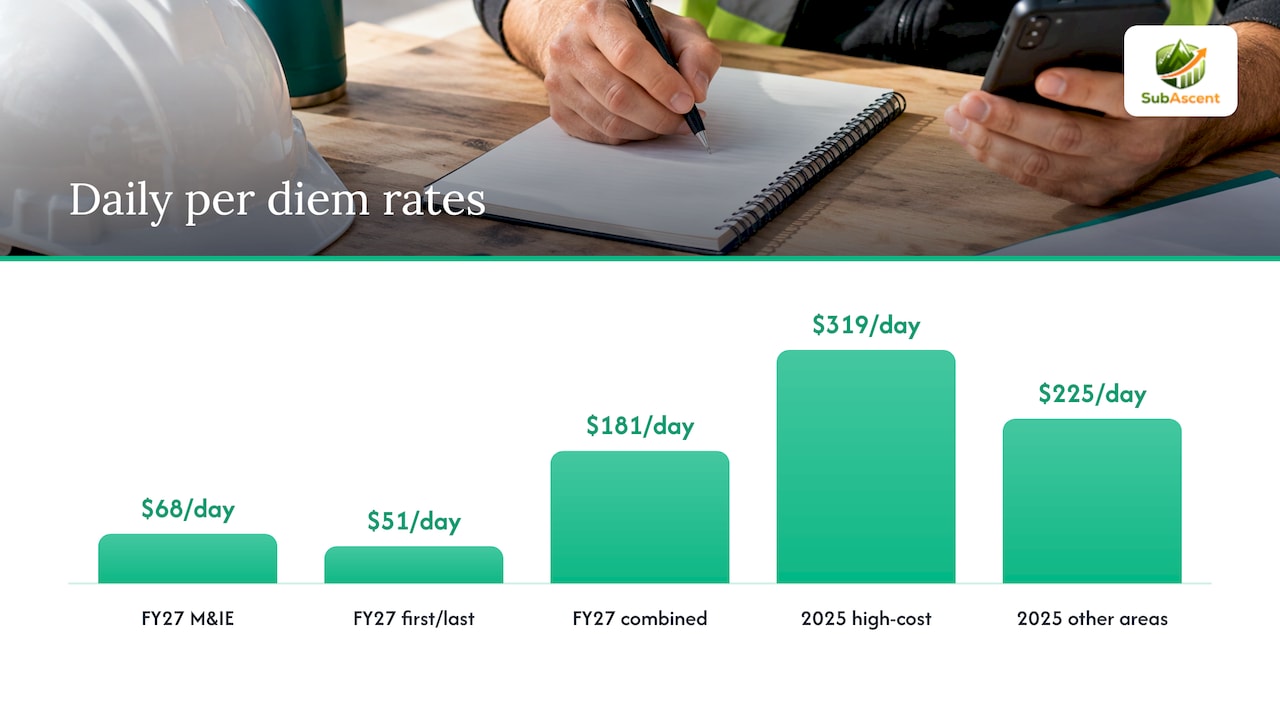
- For FY 2027 (October 1, 2026 to September 30, 2027), the standard continental U.S. rate is $113 lodging plus $68 M&IE. The first and last travel days get 75% of M&IE.
- An assignment expected to last more than one year is not temporary travel. Per diem on it becomes taxable.
- Daily jobsite hours from the foreman are the cleanest proof of where each worker was on each day.
Table of Contents
- What per diem covers for a trade crew
- The 2027 numbers, and where they come from
- When per diem is tax-free and when it turns into wages
- What per diem actually proves, and what it doesn't
- Per diem or actual expenses?
- How to track per diem, step by step
- Records to keep for each trip
- Where per diem tracking breaks down for subs
- Perspective
- Put the daily record to work
- FAQ
- Sources
What per diem covers for a trade crew
Per diem is a daily allowance an employer pays instead of reimbursing each receipt. IRS Publication 463 defines it as a fixed amount of daily reimbursement for lodging and meals and incidental expenses when an employee is away from home on business.
The two parts work differently:
- Lodging is paid per night. A Monday-to-Friday trip has four lodging nights.
- M&IE is paid per day. It covers meals, room service, laundry and dry cleaning, and tips for people like food servers and luggage handlers, according to the IRS per diem FAQ. That FAQ also says the first and last day of travel are paid at three-quarters of the M&IE rate.
There is no per diem rate for lodging alone. The IRS offers a combined lodging-plus-M&IE rate or an M&IE-only rate.
What it does not cover: the daily drive to and from the jobsite. A CPA firm that works with construction employers points out that per diem doesn't pay for transportation to each work site, and mileage reimbursed for ordinary commuting is taxable pay.
The 2027 numbers, and where they come from
The General Services Administration (GSA) sets per diem rates for official federal travel within the continental U.S. They are the benchmark most employers and the IRS use. According to GSA's rates page, FY 2027 rates became the default on October 1, 2026. One standard rate applies to most of the country, and about 300 non-standard areas have their own.
The Federal Register notice of September 10, 2026 sets the figures for FY 2027:
| Item | FY 2027 standard rate |
|---|---|
| Lodging, per night | $113 (up $3 after a freeze in FY 2026) |
| M&IE, per day | $68 (unchanged) |
| M&IE on first and last travel day (75%) | $51 |
| Combined, full day | $181 |
The 75% figure is simple arithmetic on the IRS rule above: 75% of $68 is $51.
These rates move. GSA publishes new ones every fall, and the destination rate can change by season. Check the live table for the county where your crew works, not the number in this article. A job that crosses October 1 uses old rates for the nights before and new rates after.
There is one more option. The IRS high-low method lets an employer use two flat rates instead of looking up every city. Under Publication 463, the rates effective October 1, 2025 were $319 per day for high-cost localities and $225 for all other continental U.S. localities. The IRS publishes new high-low figures each year, so confirm the ones that apply to the travel dates you are paying.
One caution on GSA rates: GSA's own FAQ says they bind federal travelers only. A private contractor uses them as the federal rate ceiling for tax purposes and sets its own company travel policy.
When per diem is tax-free and when it turns into wages
This is where trade firms get burned. The payment is a nontaxable reimbursement only under an accountable plan. Treasury's regulation 26 CFR 1.62-2 sets three tests:
- The travel has a business connection.
- The worker accounts for time, place and business purpose.
- The worker returns any excess.
The regulation's safe harbors are advances within 30 days, substantiation within 60 days, and return of excess within 120 days.
Publication 463 adds the conditions that matter day to day. The allowance can't exceed the federal rate. The employer limits payments to ordinary and necessary expenses. The worker proves time, place and purpose within a reasonable period. And the worker isn't related to the employer.
Per diem turns into taxable wages when any of these happens:
- No expense report or record is filed.
- Date, place or purpose is missing.
- A flat amount is paid with no report required.
- The payment exceeds the federal rate. The excess is wages.
- The assignment is expected to last more than a year.
- The worker has no tax home, which is typical of an itinerant worker.
The IRS per diem FAQ lists the same triggers, and says the report must be filed within 60 days.
The one-year line
The one-year rule matters more for trades than for most industries, because jobs run long. A worker's tax home is generally the regular place of business or the area around it. When a job is expected to last more than a year, the IRS treats it as indefinite, and the tax home shifts to the job site. Per diem on that job is then taxable. The CPA guidance for construction employers says the same: per diem is a reimbursement, not wages, only outside the tax home and not for periods longer than one year.
Example: a drywall sub books a 14-month hospital build 180 miles from the shop. A crew sent on day one to a job expected to last that long is on an indefinite assignment. Per diem paid to them is wages from the start. Document the expected duration when you issue the assignment, because that expectation is what counts.
What per diem actually proves, and what it doesn't
The federal rate is a substantiation shortcut. Under Rev. Proc. 2019-48, the amount deemed substantiated each day is the lesser of your allowance or the federal rate for that locality. Any excess you don't get back is subject to withholding and employment taxes. The allowance must also be reasonably calculated not to exceed actual or anticipated expenses.
So you skip the shoebox of meal receipts. You do not skip the log. Time, place and business purpose for each day still have to be documented. That's the part a crew can't hand in from memory three weeks later.
Lodging has a wrinkle. If you use the M&IE-only rate, the IRS FAQ says the expense report needs lodging receipts. Publication 463 also notes there is no standard lodging amount under the high-low method, so lodging is substantiated at actual cost.
Per diem or actual expenses?
You can reimburse actual receipts instead. Neither method is free. Actual-expense reimbursement means collecting and checking every receipt, and chasing the ones that never arrive. Per diem trades the receipts for a clean daily record and a fixed number to budget. For a crew of six on a two-week out-of-town job, that is the difference between one log per worker and a stack of receipts that someone in the office has to sort.
For most trade firms with crews moving between towns, the daily-record route is the simpler one to run. It also gives you a number you can price into the bid before the crew leaves.
How to track per diem, step by step
Here is a routine that works for a masonry, electrical, plumbing or HVAC sub with traveling crews.
1. Write a one-page policy
Put it in writing. State who is eligible, how far from the shop a job must be, what the daily rate is, and how first and last days are paid. Say how long a worker has to turn in the record. Keep the rate at or below the federal rate for the locality, or the excess is wages.
Many firms set eligibility by distance, such as 50 or 75 miles from the shop, and set rates by classification, such as foreman, journeyman and laborer. That is a company choice, not an IRS rule. Whatever you pick, the allowance must not exceed the federal rate for where they worked.
2. Assign the job and the expected duration
When you send a crew out, record the job address, start date and expected end date. This is your proof against the one-year line. If the job is expected to run past 12 months, don't pay per diem.
3. Capture each day at the jobsite
This is the step that fails most often. The foreman knows who was on site and where they slept, and that knowledge fades by Friday. Get it written daily, at the job, by the person who saw it. Our guides on how foremen track crew hours on the job site and digital timecards for trade subs cover how to make this a five-minute habit rather than a Friday scramble.
CrewTrack, the mobile app we give foremen as part of a Sub Ascent subscription, handles crew timesheets and daily reports from the field. You get a dated, job-by-job record of who worked where. That is the raw material a per diem calculation needs.
4. Look up the rate for the work location
GSA says reimbursement is based on the location of work activities, not the accommodations. Look up the rate for the county where the crew worked, for each date. Watch for seasonal lodging rates and for jobs that cross October 1.
5. Calculate lodging and M&IE separately
Lodging nights and M&IE days are not the same count. For a five-day trip: four lodging nights, three full M&IE days at $68, and two travel days at $51 if you're at the FY 2027 standard rate.
Worked example, standard rate, Monday to Friday trip for one electrician:
- Lodging: 4 nights x $113 = $452
- M&IE: 3 full days x $68 = $204
- M&IE: 2 travel days x $51 = $102
- Total at the federal ceiling: $758
You may pay less than this. You can't pay more tax-free.
6. Approve before payroll
A second set of eyes catches a worker paid for a day they were home. Tie approval to the same timecard review you already run. Our timecard approvals workflow for foremen lays out how.
7. Run it through payroll correctly
Pay up to the federal rate as a reimbursement. Anything above it goes through as wages. Per one payroll compliance source, report an allowance above the federal rate as follows: the amount up to the rate in W-2 Box 12 Code L, and the excess in Boxes 1, 3 and 5. Confirm this with your CPA or payroll provider before your first year-end.
Records to keep for each trip
For every worker and trip, keep:
- Travel dates, with departure and return times if you prorate
- The locality where the worker stopped for sleep or rest
- The business purpose, meaning the job
- The rate table and method you used
- Any advance, the date it was substantiated, and the date any excess was returned or run through payroll
- Lodging receipts if you pay the meals-only rate
Keep these as long as the related payroll tax records. A signed one-page policy plus these records answers most questions an auditor will ask.
Where per diem tracking breaks down for subs
Three patterns come up again and again on trade jobs:
- Reconstructed weeks. Hours and locations written from memory on Monday. Daily capture fixes it.
- Crews splitting between jobs. A mason on one site in the morning and a second site after lunch. Record both, because the rates can differ.
- Open-ended assignments. A "short" job that keeps growing. Track the expected duration and revisit it when the scope changes. Our guide on how foremen document delay events shows how to log the changes that stretch a schedule.
Per diem is also a real cost on a job. Put it in the estimate. Out-of-town labor with lodging and M&IE can add hundreds of dollars per worker per week, and if you bid without it, you pay it from margin.
Perspective
We have watched trade owners lose weeks to the same problem: the per diem math is easy, the daily record is not. The rate is a lookup. The proof that a person was at that job, on that day, for that purpose, is what keeps it tax-free.
That's why we start with the foreman's day, not the payroll run. If the crew's hours, job and date are captured on the site, the rest is arithmetic. If they're guessed on Friday, no spreadsheet fixes it.
Our view is simple. One system that holds the bid, the job, the crew's time and the budget gives you a record you can reuse: for per diem, for job costing, for pricing the next out-of-town bid. CrewTrack is free to foremen under the subscription, so the person who sees the day is the person who records it.
Dave
Put the daily record to work
Sub Ascent is job and bid management software for specialty trade subcontractors. Crew timesheets and daily field reports come through CrewTrack, our mobile app for foremen, included with the subscription. Plans are published at Starter $49 per month ($490 per year), Scale $99 per month ($990 per year) and Pro $179 per month ($1,790 per year). See the plans and features, or read how mobile timecards for trade subcontractors pay back.

FAQ
Is per diem a reimbursable expense?
Yes, when paid under an accountable plan. The worker must be traveling away from their tax home, the time, place and purpose must be documented, and the amount can't exceed the federal rate. Fail those tests and the payment is taxable wages.
What is the per diem rate for FY 2027?
The standard continental U.S. rate is $113 lodging and $68 M&IE, set by GSA for October 1, 2026 through September 30, 2027. About 300 areas have higher individual rates, so look up the county where your crew worked.
Do I need receipts for per diem?
Not for the meals and lodging amounts paid at or below the federal rate. You still need to document time, place and business purpose for each day. If you use the M&IE-only rate, keep lodging receipts.
Can I pay per diem on a job that lasts more than a year?
Not tax-free. An assignment expected to last more than one year is indefinite, the tax home shifts to the job site, and the per diem becomes wages. Ask your CPA before you set up a long out-of-town job.
Sources
- IRS Publication 463, Travel, Gift, and Car Expenses
- IRS per diem FAQ
- Suttle & Stalnaker PLLC, Using Per Diem for Your Employees
- GSA per diem rates
- Federal Register, Maximum Per Diem Reimbursement Rates for the Continental United States
- 26 CFR 1.62-2, Reimbursements and other expense allowance arrangements
- IRS Rev. Proc. 2019-48