

A specialty trade is a contractor or firm whose primary business is performing one specific, narrowly scoped construction activity, rather than managing an entire project. The government's own classification system, NAICS 238, covers this exact group of businesses and is what the Bureau of Labor Statistics uses to track the industry.
If you run bids, build estimates, or manage jobs for a trade contractor, you've probably used the term "specialty trade" without ever needing its formal definition. Here's the short version, plus the three trades that show up in almost every specialty trade discussion:
- Electrical — rough-in wiring, panel installation, device trim
- Plumbing — supply and waste piping, fixture installation, backflow testing
- Painting — surface prep, coatings, finish work on interior or exterior building surfaces
Each of those businesses does one thing well and gets hired specifically because of that focus. That's the entire concept behind the phrase, and it's why the classification exists at all.
Key Takeaways
Correctly classifying work as a specialty trade under NAICS 238 protects your licensing, bidding, and contract terms far more than most estimators realize until something goes wrong.
| Point | Details |
|---|---|
| Definition anchors on activity | Classification depends on what the firm actually does, not its size or revenue. |
| Building work vs. civil work | NAICS 238 covers building-related trades; heavy/civil infrastructure falls under Subsector 237 instead. |
| License checks come first | Verify license class, active status, bond, and insurance with the state board before pricing any bid. |
| Contract type follows classification | Subcontract terms and retainage differ sharply from direct-to-owner payment structures. |
| Documentation prevents disputes | Keep scope descriptions, license records, and written clarifications in every job file. |
Table of Contents
- What Does a Specialty Trade Mean Under NAICS?
- What Trades Count as Specialty Trades?
- How Do Specialty Trade Contractors Differ From General Contractors?
- Licensing and Registration: What Subs Must Check
- Is It Specialty Trade or Heavy/Civil Work?
- What Changes Once Work Is Classified as a Specialty Trade
- Is This Scope a Specialty Trade? A 60-Second Check
- Common Pitfalls When Classifying Trade Work
- Contract Types and Payment Terms Tied to Classification
- Labor Classifications and Union Affiliation in Specialty Trades
- Why Getting the Classification Right Actually Matters
- Frequently Asked Questions
- Sources
What Does a Specialty Trade Mean Under NAICS?
The Bureau of Labor Statistics defines specialty trade contractors as establishments whose primary activity is performing specific building-construction tasks: pouring concrete, site preparation, plumbing, painting, electrical work, and similar functions. That's the working definition behind NAICS 238, and it covers new construction, additions, alterations, maintenance, and repair work alike.
Note what the definition does not mention: company size, annual revenue, or number of employees. A four-person electrical outfit and a 200-person mechanical contractor both fall under the same NAICS code if their primary production activity fits the description. Classification runs on what the business actually does, not how big it is.
This matters more than it sounds like it should. NAICS 238 classification touches licensing requirements, insurance underwriting categories, tax reporting, and even which safety standards apply to a jobsite. Get the classification wrong on a bid submission or a business license application, and you can trigger downstream problems that have nothing to do with the quality of your work.
The BLS description also notes that specialty trade work is usually subcontracted from general contractors, but it doesn't have to be. A painting contractor working directly for a homeowner or a plumbing outfit contracted straight by a building owner during a renovation is still a specialty trade contractor. The label describes what the firm does, not who signs the check.
What Trades Count as Specialty Trades?
Many trades make up most of the specialty trade universe, and each one carries a scope that a bid document or subcontract should spell out clearly:
- Electrical — rough-in, device wiring, panel and switchgear installation
- Plumbing — supply/waste/vent piping, fixture sets, water heater installation
- HVAC/mechanical — ductwork, equipment installation, refrigerant piping, controls
- Masonry — block and brick laying, stone veneer, mortar work
- Framing — structural wood or metal framing, sheathing, blocking
- Drywall — hanging, taping, texture, finish coats
- Roofing — membrane or shingle installation, flashing, waterproofing details
- Painting — surface prep, priming, finish coats, specialty coatings
- Flooring — substrate prep, tile, carpet, resilient flooring installation
- Fire protection (sprinkler) — piping layout, head installation, system testing
- Low-voltage — data cabling, security systems, access control
- Glazing — curtain wall, storefront, window and glass installation
- Insulation — batt, blown, or spray foam installation, vapor barriers
- Concrete — formwork, placement, finishing, curing
- Finish carpentry — trim, casing, cabinetry installation, millwork
Most of these firms supply both materials and labor on a job, which is worth flagging because it changes how you price a bid. A glazing contractor quoting curtain wall isn't just selling installation hours; they're carrying the cost and lead time of custom-fabricated units. Some of that work happens entirely in a shop, with prefabricated assemblies trucked to site and set in place, while other trades, like drywall or masonry, do essentially all their production on-site. Knowing which model a trade uses changes your schedule assumptions as much as your price.
How Do Specialty Trade Contractors Differ From General Contractors?
A general contractor manages the whole project. A specialty trade contractor executes one piece of it. That's the entire distinction, but it plays out across several practical categories that matter every time you read a contract or a bid invitation.
| Category | General contractor | Specialty trade contractor |
|---|---|---|
| Scope of responsibility | Coordinates the entire project across all trades | Executes one defined trade scope (electrical, roofing, etc.) |
| Contract relationship | Usually holds the prime contract with the owner | Usually holds a subcontract with the GC, or sometimes contracts directly with the owner |
| Permits and inspections | Often pulls the building permit and coordinates trade inspections | Frequently pulls its own trade-specific permit (electrical, plumbing) and schedules its own inspection |
| Change order handling | Manages the overall change order process and owner approval | Prices and submits change orders for its own scope, routed through the GC |
| Warranty scope | Warrants the project as a whole per contract terms | Warrants only the trade work it installed |
Permits are where this distinction trips people up most often. In many jurisdictions, an electrical or plumbing contractor pulls their own trade permit even on a project where the general contractor holds the building permit. If your estimating team assumes the GC handles every permit line item, you can end up eating an unbudgeted fee or missing an inspection window.
Direct-to-owner work changes the equation further. On a renovation or tenant improvement job, an owner might contract a specialty trade directly with no general contractor in the picture at all, as Procore's overview of specialty contractor roles points out. When that happens, the specialty trade absorbs some general contractor responsibilities, like scheduling other trades or managing the permit process, without necessarily pricing for that added coordination work. Estimators should flag that gap before signing, not after.

Licensing and Registration: What Subs Must Check
Licensing rules vary by state, by trade, and sometimes by county or city on top of that. There's no shortcut around checking your specific jurisdiction, but there is a repeatable process that keeps you from getting burned.
- Verify the license class matches the scope. A general contractor license doesn't automatically cover electrical or plumbing work; most states require a separate trade-specific class or endorsement.
- Confirm active status, not just existence. A license can lapse, get suspended, or carry conditions. Check the state licensing board's public lookup tool before you bid, not after you win.
- Collect bond and insurance evidence up front. Many states tie license validity to an active surety bond and current general liability coverage. Missing paperwork here can hold up payment even on completed work.
- Check local permit requirements separately from state licensing. Some cities layer their own registration or permit-pull rules on top of state licensing, especially for electrical and plumbing trades.
- Watch for specialty endorsements tied to scope, not trade name. A "low-voltage" license in one state might cover security and data cabling; in another, fire alarm work requires a separate endorsement entirely.
Every state contractor licensing board runs this differently, which is exactly why step one is always the same: go check the actual board, every time, for every trade.
Pro Tip: Build a one-page license and insurance checklist for every trade you subcontract, and refresh it before every renewal cycle. A five-minute lookup on a state board's website costs a lot less than a payment dispute over an expired license discovered three weeks into the job.
One pitfall shows up more than any other: contractors treating civil or infrastructure-adjacent work as ordinary specialty trade work, when the licensing and bonding requirements for heavy/civil scope can be entirely different. Getting that wrong on a bid may mean your license class doesn't even cover the work you priced.
Is It Specialty Trade or Heavy/Civil Work?
The boundary comes down to one question: is the work part of a building, or part of infrastructure? NAICS 238 covers specialty trades performing building-related activities. Heavy and civil engineering construction, covered under Subsector 237, includes roads, bridges, utility lines, and large-scale earthwork.
A few decision cues make this call fast in practice:
- Is the work tied to a building system (electrical, plumbing, HVAC) or a linear/transportation asset (roadway, pipeline right-of-way, bridge deck)?
- Does the scope sit inside a structure's footprint, or does it run across a site, corridor, or public right-of-way?
- Is the crew using building trade tools and materials, or heavy equipment typical of earthwork and infrastructure?
The contrast NAICS itself uses is a good one: painting the interior of a building falls under specialty trade contracting, while painting lane lines on a highway falls under heavy/civil construction. Same basic skill (paint application), completely different classification, because the object being painted determines the code. Estimators who see "civil" or "infrastructure" language creeping into a building-scope invitation should treat that as a flag worth a phone call before pricing.
What Changes Once Work Is Classified as a Specialty Trade
Classification isn't just a paperwork exercise. It changes how you should build the bid itself. Once you've confirmed a scope sits inside NAICS 238, a few practical adjustments follow.
- Bid packaging tightens around one trade. You're pricing a single system, so unit rates, labor productivity assumptions, and material markups need to reflect actual trade productivity data, not generic construction averages.
- Contingency handling gets more precise. A specialty trade scope has fewer unknowns than a whole-project bid, so contingency percentages should be lower and tied to specific risk items (access constraints, lead times on custom materials) rather than a blanket markup.
- Prequalification requests get sharper. If you're the one hiring a sub for part of your scope, request license class, active bond status, and safety record specific to their trade, not a generic contractor questionnaire.
Two real scenarios show how differently this plays out. On a residential renovation, an electrical contractor might be hired directly by the homeowner with no GC involved. That contractor prices the job with retail-level markup, handles their own permit, and carries the full coordination burden of scheduling around other trades on-site. On a new commercial build, that same electrical scope gets bid as a subcontract to a general contractor, priced against a spec book with defined submittal and RFI requirements, and coordinated on a schedule the GC controls. Same trade, same license, two entirely different bidding and risk postures. Estimators who template one approach onto the other tend to under-price the coordination cost or over-price the permit and admin burden.
Tools built specifically for this kind of trade-scoped estimating, rather than whole-project management software, tend to handle these distinctions more cleanly than general contractor platforms retrofitted for subs.
Is This Scope a Specialty Trade? A 60-Second Check
Before you price anything, run the scope through a fast gut check:
- Primary activity focus: Does the scope involve one trade discipline, or does it span multiple systems and coordination duties?
- Tools and materials: Are the tools and materials typical of a single building trade, or do they look like heavy equipment and civil materials?
- Execution location: Is the work performed on-site as part of a building, or does it run along a corridor, roadway, or utility line?
- Scope breadth: Is this one system within a project, or does the scope actually cover the whole project?
If every answer points to "one trade, inside a building, using trade-specific tools," you're looking at a specialty trade scope. If answers split, especially on scope breadth or location, escalate to the GC or legal before committing a price. Borderline items are exactly where disputes start six months into a job.
When it's genuinely unclear, collect documentation before you bid: site photos, manufacturer cut sheets for any equipment involved, and a rough sketch marking where your scope starts and stops. That paper trail is worth more than memory once a change order argument starts.
Common Pitfalls When Classifying Trade Work
The most common classification mistake is treating "specialty trade" as a synonym for "small job." It isn't. A $4 million mechanical package on a hospital is still a specialty trade scope; a two-day residential paint job is too. Size has nothing to do with it, and estimators who conflate scope size with classification tend to misjudge bonding and licensing requirements on larger jobs.
A second red flag: bid invitations that blur trade boundaries by lumping site work, utility connections, and building systems into one line item. If a scope description mixes a linear infrastructure task (a utility tie-in trench) with a building system task (interior plumbing rough-in), that's often two different classifications stitched together, and possibly two different license requirements.
A third pitfall shows up in change order disputes: a GC or owner assuming a specialty trade's warranty covers adjacent work it never touched. If your drywall crew warranties their installation, that warranty doesn't extend to a paint finish applied by someone else on top of it, even though both trades worked on the same wall. Clear scope language in the original contract prevents most of these arguments before they start, which is exactly the kind of detail a well-built subcontract agreement should nail down.
Contract Types and Payment Terms Tied to Classification
How a scope gets classified shapes what kind of contract makes sense and how payment gets structured. A specialty trade working as a subcontractor typically operates under a subcontract agreement tied to the prime contract's terms, often with retainage held back (commonly 5 to 10 percent) until substantial completion or final acceptance.
A specialty trade contracting directly with an owner, by contrast, usually negotiates its own payment schedule, often progress billing tied to milestones the trade itself defines, since there's no GC pay application cycle to follow. That difference matters at bid time: a direct-to-owner electrical job might get priced with a deposit-plus-progress structure, while the same scope as a GC subcontract follows whatever pay app cycle and retainage terms the prime contract sets.
The choice between a hard bid and a negotiated bid also tends to track classification. Straightforward, well-defined specialty trade scopes with clear specifications lend themselves to hard bidding. Scopes with more coordination ambiguity, especially direct-to-owner renovation work, often get negotiated instead, since pricing has to account for unknowns a hard bid format doesn't handle well.
Labor Classifications and Union Affiliation in Specialty Trades
Labor classification adds another layer on top of contractor licensing. Many specialty trades, especially electrical, plumbing, and sheet metal, have strong union presence in certain regions and virtually none in others. Whether a job is union or open-shop affects wage rates, apprenticeship requirements, and sometimes which contractors are even eligible to bid a project with union labor agreements in place.
Prevailing wage requirements on public projects add a separate compliance layer regardless of union status. A specialty trade bidding a public school renovation may need to pay and report wages according to prevailing wage schedules specific to that trade classification in that locality, whether or not the crew is unionized. Misclassifying a worker's trade designation on a certified payroll report, even an honest mistake, can trigger audits and penalties that have nothing to do with the quality of the work performed.
This is also where OSHA's construction safety framework intersects with trade classification. Different trades carry different baseline safety requirements, from fall protection standards relevant to roofing crews to confined space rules that matter more for certain mechanical and plumbing scopes. Knowing your trade classification isn't just a licensing exercise; it determines which OSHA standards your crew needs training on before they set foot on site.
Why Getting the Classification Right Actually Matters
Every experienced estimator has a story about a bid invitation that blurred the line between specialty trade and civil work, or a contract that assumed a warranty scope nobody actually priced. The classification questions in this article aren't academic. They show up in real disputes over who pays for a change order, who's responsible for a failed inspection, and whose insurance covers a claim.
The habit that prevents most of these problems is embarrassingly simple: read the scope section of every bid invitation against your actual license class and trade classification before you build a single number. A 60-second scope scan, checking whether the described work matches what your license and NAICS classification actually cover, catches most misclassification problems before they become expensive.
Keep three things in every job file from day one: the original scope description from the bid invitation, your license and insurance documentation current as of the bid date, and any written clarification exchanged with the GC or owner about scope boundaries. When a dispute surfaces months later, that file is what settles the argument, not memory.
Frequently Asked Questions
What does a specialty trade mean in construction?
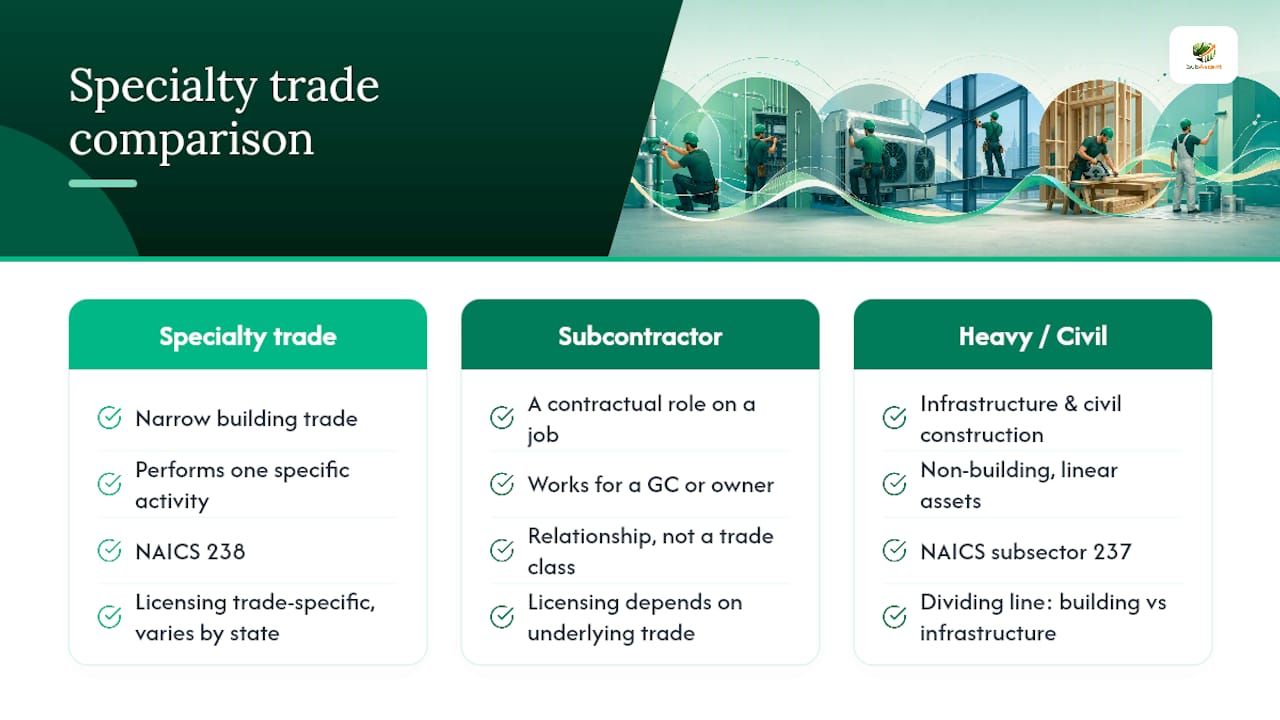
A specialty trade means a contractor whose primary business is performing one specific, narrowly scoped construction activity, such as electrical, plumbing, or roofing, rather than managing an entire project. The federal government classifies these businesses under NAICS 238.
Is a specialty trade the same as a subcontractor?
Not exactly. Specialty trade describes what a firm does; subcontractor describes its contractual relationship on a specific job. A specialty trade contractor can work as a subcontractor to a general contractor or contract directly with an owner, particularly on renovation and repair projects.
How many specialty trades are there?
There's no fixed number, but common examples include electrical, plumbing, HVAC, masonry, framing, drywall, roofing, painting, flooring, fire protection, low-voltage, glazing, insulation, concrete, and finish carpentry.
Does specialty trade classification affect licensing?
Yes. Licensing requirements are trade-specific and vary by state, so classification under NAICS 238 helps determine which license class and endorsements a contractor needs before bidding.
What's the difference between specialty trade work and heavy/civil work?
Specialty trade work (NAICS 238) covers building-related activities, while heavy and civil engineering construction (Subsector 237) covers infrastructure like roads, bridges, and large-scale earthwork. The dividing line is whether the work is part of a building or part of a linear/transportation asset.
Sources
Before you finalize a bid or sign a subcontract, run the classification and licensing questions past the actual agencies that govern them, not a secondhand summary.
- Specialty Trade Contractors: NAICS 238
- The Role & Responsibility of Specialty Contractors in Construction | Procore
- Major Group 17: Construction Special Trade Contractors
- NAICS 238 - Specialty Trade Contractors
A few practical notes worth keeping close:
Estimators who want to stop rebuilding these checks manually on every job tend to move that verification into their bid tracking workflow rather than a spreadsheet that gets forgotten between projects. Subascent's job and bid management software was built around exactly this kind of specialty trade workflow, from tracking incoming bid invitations to keeping license and insurance documentation attached to the jobs that need it. You can see how it handles that at Subascent.