

Exclusions in bid proposals are defined as the specific work items, materials, or conditions that a contractor explicitly removes from the scope of their quoted price. They are not optional language. For electrical, plumbing, HVAC, masonry, and other specialty trade estimators, the role of exclusions in bid proposals is to draw a hard line around what you are pricing so that no one can assume you included something you did not. A bid without a clear exclusions section is an open invitation for a general contractor to assign you work you never planned to do.
How exclusions shape bid leveling and competitive bidding
Bid leveling is the primary method general contractors use to compare bids accurately by normalizing inclusions and exclusions across competing proposals. It exposes the true cost differences between bids that look similar on the surface. When a GC levels bids, they add the cost of excluded work back into each bid price to create an apples-to-apples comparison.
This process changes the rankings. A roofing sub who excludes permits and temporary protection may appear $15,000 cheaper than a competitor. Once the GC prices those items back in, the apparent advantage disappears or reverses. Ignoring the exclusions column is the primary source of hidden project risk, skewing the real cost picture in specialty trade bids, especially on long projects.

Common exclusions that shift bid rankings include:
| Exclusion Type | Example | Bid Impact |
|---|---|---|
| Permits and fees | Building permit, fire alarm permit | Adds $2,000–$15,000 to true cost |
| Temporary protection | Shoring, weather barriers, hoarding | Often $5,000–$25,000 on mid-size jobs |
| Bonds and insurance riders | Performance bond, pollution liability | Can add 1–3% of contract value |
| Utility connections | Final tie-ins, metering, utility fees | Frequently $3,000–$20,000 per trade |
| Testing and commissioning | TAB reports, fire system witness tests | Varies widely by trade and jurisdiction |
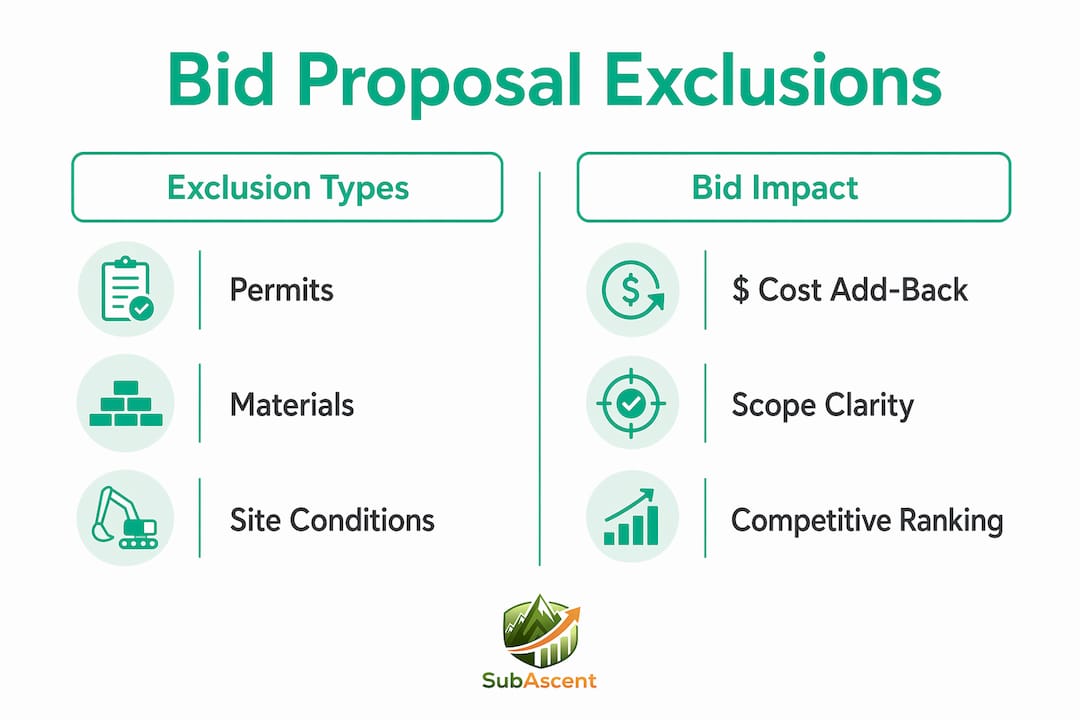
Adding excluded work back into the bid price often narrows or reverses initially apparent cost advantages. That is why a lower number on the cover page does not mean a lower real cost.
Pro Tip: Build a standard exclusions checklist for your trade and attach it to every bid. An electrical estimator, for example, should always flag whether utility coordination, load calculations, or arc flash studies are in or out. Consistency protects you and speeds up the GC's leveling process.
Exclusions vs. qualifications: what is the difference?
Exclusions and qualifications are not the same thing, and treating them as interchangeable creates real risk. Exclusions remove work from a bid. Qualifications add conditions to included work. Both affect risk, but in different ways and require separate review during bid evaluation.
Here is how to tell them apart in practice:
- Exclusion: "Concrete cutting and patching is excluded." The work is simply not in your price. The GC must assign it elsewhere or negotiate a change order.
- Qualification: "Pricing assumes existing slab is 4 inches thick. Additional cost will apply if slab exceeds 4 inches." The work is included, but only under a stated condition. If that condition fails, cost exposure follows.
- Risk exclusion: "Subsurface obstructions not shown on drawings are excluded." This one is often buried in qualification language, but it functions as an exclusion for an uncertain condition.
Qualifications create contingent cost exposure, while exclusions denote known scope gaps. Both appear commonly in specialty trade bids and must be actively managed. A fire protection estimator who qualifies their pricing based on assumed ceiling heights but never flags it as a qualification is setting up a dispute the moment field conditions differ.
Risk exclusions hidden in qualification language exclude uncertain site conditions and can represent large contingent costs if assumptions fail. They are as important to identify during bid leveling as traditional scope exclusions. Reviewing both columns, not just the price column, is what separates a thorough GC from one who gets burned post-award.
Best practices for writing exclusions in specialty trade bids
A full construction proposal includes eight core sections, and the exclusions section is non-negotiable for competitiveness and professionalism. Writing it well is a skill. Writing it poorly costs you money or credibility.
Follow these steps to draft exclusions that protect your scope without raising red flags:
- Name the specific item. Write "Electrical permit fees are excluded" rather than "Permits may not be included." Vague language creates disputes. Specific language creates clarity.
- State the scope boundary. Tell the GC exactly where your work stops. A drywall estimator might write: "Work includes framing and drywall to underside of structure. Ceiling grid and tile are excluded."
- Clarify how excluded work will be handled if directed. Valid exclusions identify cost handling mechanisms if the GC later directs the excluded work. Write: "If directed, concrete cutting will be priced as a change order at time and material rates." This converts a potential dispute into a pre-negotiated adjustment.
- Exclude true scope gaps, not standard costs. Do not exclude items that any reasonable estimator would include in your trade scope. Excluding standard labor or basic materials signals that your base price is incomplete, which raises risk flags for the GC.
- Keep the language plain. Avoid legal boilerplate. A GC reviewing 12 bids in one afternoon does not have time to parse dense contract language. Short, direct sentences get read. Long paragraphs get skipped.
A well-structured exclusions section signals professionalism and thorough scope understanding to the owner. Clear exclusions show that the contractor has reviewed the drawings and site conditions carefully. That moves your bid from "generic" to "preferred" in the GC's mind.
Pro Tip: Review the subcontract scope definition before you finalize your exclusions. The subcontract often assigns work that was not in the original bid documents. Knowing that in advance lets you write exclusions that hold up when the contract arrives.
What are the most common pitfalls with bid exclusions?
Mishandling exclusions is one of the most consistent ways specialty trade estimators lose margin after award. The mistakes fall into a predictable pattern:
- Omitting exclusions to appear competitive. Estimators who omit exclusions to appear cooperative risk absorbing the costs of undefined work as change orders, losing margin, and damaging client relationships. A $4 million project generated a $60,000 change order dispute over site utilities that were absent from the exclusions with no written record to defend the scope boundary.
- Using exclusions to hide standard costs. Excluding items that belong in your base scope does not make your bid competitive. It makes the GC nervous. Exclusions must not be used to hide predictable costs because doing so undermines bid credibility and signals higher risk to owners.
- Missing risk exclusions buried in qualifications. A low-voltage estimator might qualify pricing based on assumed conduit routing. If that routing assumption fails in the field, the cost exposure is real. Not reviewing the exclusions column during bid leveling leads to misinterpretation of bid competitiveness and potential schedule and cost overruns.
- Writing ambiguous exclusion language. Phrases like "certain site conditions may not be included" are not exclusions. They are noise. Ambiguous language does not protect you in a dispute. It just gives both sides something to argue about.
Defensive exclusion language often indicates incomplete scope definition, serving more as a risk map for ambiguous project areas rather than genuine contractor caution. If your exclusions section reads like a legal disclaimer, that is a signal to revisit your scope review process before submitting. Understanding how to read a subcontract agreement helps you catch scope gaps before they become exclusion problems.
Key Takeaways
Exclusions in bid proposals are a non-negotiable tool for specialty trade estimators. They define scope boundaries, protect margin, and signal professionalism to every GC reviewing your bid.
| Point | Details |
|---|---|
| Exclusions define scope limits | Explicitly state what is not in your price to prevent assumed inclusions and post-award disputes. |
| Bid leveling depends on exclusions | GCs add excluded costs back into bids to find the true price. A low number with many exclusions is rarely the lowest real cost. |
| Qualifications differ from exclusions | Qualifications condition included work. Exclusions remove work entirely. Both require active review during bid evaluation. |
| Write exclusions with specificity | Name the item, state the boundary, and clarify how the work will be handled if directed. Vague language does not protect you. |
| Omitting exclusions costs margin | Missing exclusions lead to change order disputes and absorbed costs. A $4M project example shows a $60,000 dispute from one undefined scope item. |
What I have learned from watching estimators get this wrong
Exclusions are where I see the biggest gap between estimators who win profitable work and those who win work they later regret. The instinct to keep the bid clean and short is understandable. Nobody wants to hand the GC a list of things they are not doing. But that instinct is expensive.
The estimators I respect most treat their exclusions section the same way they treat their takeoff. They are methodical. They go through the drawings, identify every gray area, and make a decision: in or out. If it is out, they write it down clearly. If it is conditionally in, they write a qualification. They do not leave anything to interpretation.
What surprises most people is that a thorough exclusions section does not make you look difficult. It makes you look like you actually read the plans. GCs notice that. Owners notice that. When two bids are close in price, the one with a clear, professional exclusions section often wins because it feels lower risk. That is a real competitive advantage, and it costs nothing to execute.
My advice: stop treating exclusions as defensive language and start treating them as scope communication. The GC needs to know what they are buying. Your job is to tell them clearly.
— Dave
How Subascent helps you manage bids and exclusions
Keeping your exclusions consistent across every bid is harder than it sounds when you are juggling 10 open invitations and a job in progress.

Subascent is built for specialty trade estimators and owner-operators who need to track bids, organize proposal sections, and manage job data without rebuilding their process from scratch on every project. The platform helps you manage your bids and proposals in one place, so your exclusions language stays consistent, your scope boundaries are documented, and nothing falls through the cracks between bid day and contract signing. If you run electrical, plumbing, HVAC, masonry, or any other specialty trade, Subascent gives you the structure to bid faster and protect your margin.
FAQ
What is the role of exclusions in a bid proposal?
Exclusions define what work or materials are not included in the contractor's quoted price. They prevent scope ambiguity and protect both parties from post-award disputes over assumed inclusions.
How do exclusions affect bid leveling?
GCs add the cost of excluded items back into each bid to compare true costs. A bid with many exclusions often costs more in practice than its cover price suggests.
What is the difference between an exclusion and a qualification?
An exclusion removes work from the bid entirely. A qualification conditions included work on a stated assumption. Both create risk and require separate review during bid evaluation.
Should specialty trade estimators always include an exclusions section?
Yes. A dedicated exclusions section is non-negotiable in a professional bid proposal. Omitting it leaves scope boundaries undefined and exposes you to change order disputes.
What makes an exclusion valid and enforceable?
A valid exclusion names the specific item, states the scope boundary clearly, and identifies how the work will be handled if the GC later directs it. Vague or blanket exclusion language rarely holds up in a dispute.