

Construction software gaps for subs are the specific shortcomings in estimating, bid tracking, and job management tools that prevent specialty trade subcontractors from running efficient, profitable operations. The construction sector loses $1.6 trillion annually due to poor planning, coordination failures, and workflow inefficiencies. Specialty trades carry a disproportionate share of that loss because most software is built for general contractors, not for electrical, plumbing, HVAC, masonry, or roofing crews. Understanding the types of construction software gaps for subs is the first step toward choosing tools that actually fit how your business runs.
1. What are the most common estimating software gaps for specialty subs?
Estimating is where most specialty trade subs feel the pain first. Generic estimating tools are built around broad construction categories, not the specific line items an HVAC estimator or a fire protection sub needs. The result is a tool that forces you to rebuild your workflow from scratch every bid cycle.
The most common estimating gaps include:
- No trade-specific templates. A drywall or insulation sub needs different cost assemblies than a concrete or steel/rebar contractor. Generic tools offer one-size-fits-all templates that require heavy manual customization on every bid.
- No link to job cost tracking. Estimating software that does not connect to actual job costs means you are flying blind on budget vs. actual. You build the bid in one place and track the job in another, with no automatic reconciliation.
- Poor PDF takeoff support. Most specialty subs work from PDF plans. Tools that lack built-in area, linear foot, and count takeoff capabilities force estimators back to spreadsheets or separate takeoff programs.
- No multi-GC bid documentation. Each general contractor sends bid invitations with different formats, scope requirements, and due dates. Estimating tools that cannot organize bids by GC create a documentation mess.
Trade-specific estimating templates reduce spreadsheet dependency and improve forecasting accuracy by linking bid preparation directly to job cost tracking. That connection is what separates a guess from a reliable number.
Pro Tip: Build a master template for each trade you bid regularly. A roofing sub and a low-voltage sub have almost nothing in common on a cost sheet. Separate templates cut bid prep time significantly.

2. How do bid tracking gaps affect subcontractor workflow and profitability?
Bid tracking is where missed opportunities become missed revenue. Specialty subs typically receive bid invitations from five, ten, or more GCs simultaneously. Without a system built for that volume, bids slip through.
The most damaging bid tracking gaps follow a predictable pattern:
- No centralized bid invitation log. Invitations arrive by email, phone, and GC portals. Without a single place to capture them, estimators lose track of due dates and scope changes.
- No real-time status updates. A bid that was submitted two weeks ago may have been awarded, lost, or put on hold. Tools that do not update bid status in real time leave PMs guessing about pipeline.
- Disjointed communication. When bid notes live in email threads and status updates live in a spreadsheet, the estimator and the PM are never working from the same information. That gap causes duplicate work and missed follow-ups.
- Repeated data entry across GC platforms. Many GCs require subs to enter scope, pricing, and documentation into their own portals. Managing multiple GC platforms creates redundant entry and version control problems.
Ineffective software causes version control problems, missing alerts, and no audit trails. Those failures increase project risk and erode the margins you worked hard to build into the bid.
Pro Tip: Assign every incoming bid invitation a status label the moment it arrives: active, pending, declined, or awarded. That single habit prevents the most common cause of missed bids.
3. What gaps in job management software undermine field operations?
Job management software gaps hit hardest at the crew level. Foremen think in spatial terms on-site. They need to attach a photo or a daily report to a specific location on the drawing, not to a generic project folder.
Software lacking spatial context causes data loss and inaccurate field reporting. A plumbing or fire protection foreman who cannot pin documentation to a drawing location ends up describing problems in text, which creates ambiguity and slows resolution.
The most common field-level gaps include:
- No spatial documentation. Attaching photos and reports to drawing locations is standard practice on well-run jobs. Tools that skip this force foremen into workarounds that lose context.
- Poor mobile and offline functionality. Electrical and framing crews work in areas with no cell signal. Software that requires a live connection to save a timecard or a daily report is useless in those conditions.
- No compliance automation. Manual compliance tracking misses mid-term insurance cancellations affecting 8% of policies. That is a material risk exposure that manual quarterly checks cannot catch.
- No multi-project visibility. A masonry or concrete sub running four jobs simultaneously needs a dashboard that shows all projects, all GCs, and all open items in one view. Most job management tools show one project at a time.
| Gap | Field Impact | Risk Level |
|---|---|---|
| No spatial documentation | Lost photo context, inaccurate reports | Medium |
| Poor offline mobile access | Missing timecards, delayed daily logs | High |
| No compliance automation | Undetected insurance lapses | High |
| Single-project view only | Redundant admin, missed cross-job issues | Medium |
4. How does platform sprawl create software gaps for specialty trade subs?
Platform sprawl is the condition of running multiple disconnected software systems because no single tool covers every workflow. It is the most expensive gap type that most subs never formally budget for.
Dual-platform strategies are common because no single software excels at both internal trade workflows and GC coordination. A glazing or flooring sub ends up running an internal PM platform for their own crew and logging into three or four GC portals for coordination. The cost is not just the subscription fees. It is the hours spent on duplicate data entry and the errors that come from two systems that never sync.
Platform sprawl creates significant administrative overhead and data inconsistencies. When your estimate lives in one tool, your job costs live in another, and your GC communications live in a portal, you have no single source of truth. That makes job profitability reporting nearly impossible until the job closes.
The spreadsheet is always the symptom. When subs pull data from multiple platforms into a spreadsheet to get a complete picture, the spreadsheet becomes the real system of record. That is a fragile and error-prone position to be in on a $2 million roofing or HVAC contract.
5. What features should subs prioritize to close their software gaps?
Closing gaps in subcontractor software requires choosing tools configured to match existing field processes rather than forcing workflow changes. Software aligned with trade-specific tasks increases adoption and reduces errors. That principle should drive every software evaluation.
The features that close the most common gaps are:
- Trade-specific workflow configurability. Look for tools that let you build estimating templates, cost codes, and reporting formats around your trade. An insulation sub and a steel/rebar sub have different workflows. The software should reflect that.
- Real-time compliance integrations. Compliance tracking requires real-time carrier integrations to detect insurance lapses within 24 hours. Gate control mechanisms that block non-compliant subs from starting work are the standard to look for.
- Multi-project and multi-GC coordination. The tool should show all active bids, all active jobs, and all open submittals or RFIs across every GC relationship in a single dashboard.
- Integrated estimating and job management. When the estimate feeds directly into the job budget, you can track budget vs. actual in real time. That is the feature that tells you whether a painting or low-voltage job is making money before it closes.
- Mobile functionality that works offline. Field crews need to log timecards, photos, and daily reports without a cell connection. Any tool that fails this test will be abandoned by foremen within weeks.
Resolving scheduling conflicts across multiple GCs also depends on having a single platform that surfaces conflicts before they become delays. That visibility is a direct function of integration quality.
Pro Tip: Before signing any software contract, run a live test with your foreman on a real job. If they cannot complete a daily report in under three minutes on their phone, the tool will not get used in the field.
Key takeaways
Specialty trade subcontractors face the most costly software gaps in estimating, bid tracking, and job management because most construction tools are built for general contractors, not for the specific workflows of electrical, plumbing, HVAC, or masonry crews.
| Point | Details |
|---|---|
| Estimating gaps cost bids | Generic templates and no PDF takeoff force manual workarounds that slow bid prep and reduce accuracy. |
| Bid tracking gaps lose revenue | Without a centralized bid log and real-time status updates, subs miss due dates and lose pipeline visibility. |
| Field gaps increase risk | Missing spatial documentation and no compliance automation expose subs to reporting errors and insurance lapses. |
| Platform sprawl is the root cause | Running multiple disconnected systems creates duplicate data entry, version errors, and no single source of truth. |
| Integration is the fix | Software that connects estimating, bid tracking, and job management in one platform closes the most damaging gaps. |
What I have learned about software gaps after years in the trades
The honest truth is that most specialty subs do not have a software problem. They have a workflow alignment problem. The software they are using was built for someone else, and they have been bending their processes to fit it for years.
I have seen electrical contractors running four separate tools because each GC required a different portal, plus a spreadsheet to tie it all together. That is not a technology failure. That is a purchasing decision made without asking the right question: does this tool fit how my crew actually works, or does it fit how a GC wants to see data?
The dual-platform approach is sometimes the pragmatic answer. Separating your internal trade workflows from GC coordination tools is not a failure. It is a recognition that GC platforms are built for GCs. The mistake is accepting that sprawl without pushing back on the cost it creates.
My recommendation is to evaluate software by starting in the field, not in the office. Sit with your foreman. Watch how they document a day's work. Then ask whether the tool you are considering fits that reality. If it does not, no amount of office-side features will save the adoption rate.
— Dave
Subascent is built for the gaps subs actually face
Specialty trade subs spend too much time working around software that was never designed for them. Subascent is built specifically for the estimating, bid tracking, and job management workflows that electrical, plumbing, HVAC, masonry, roofing, and other specialty trades run every day.
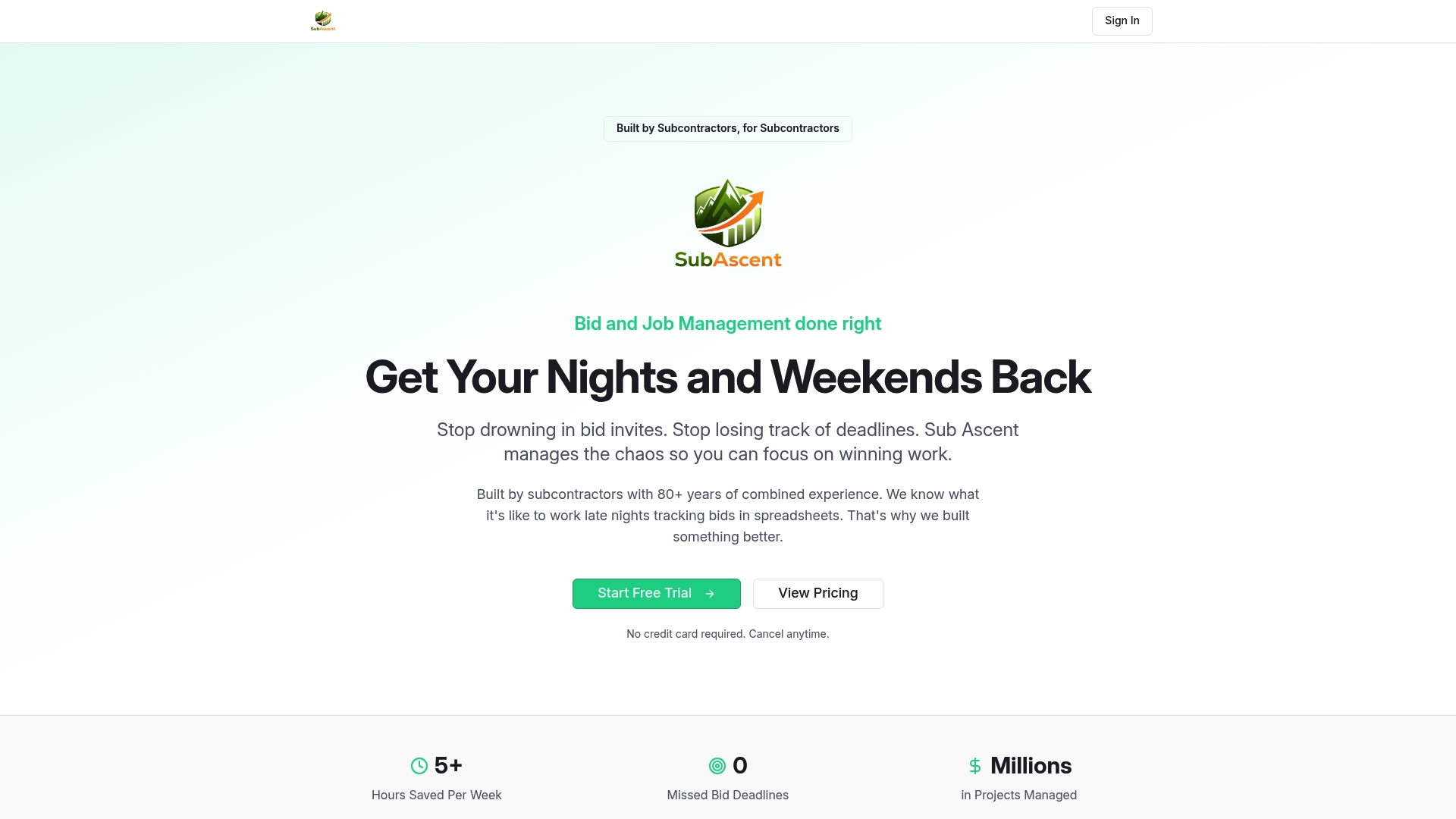
Subascent connects your bid pipeline to your job budgets so you can see profitability in real time, not just at job close. The platform is configured for multi-GC coordination, trade-specific estimating, and field reporting that foremen will actually use. If you are ready to close the gaps that are costing you margin, see what Subascent does for specialty trade subs like yours.
FAQ
What are the main types of construction software gaps for subs?
The main types are estimating gaps, bid tracking gaps, job management gaps, and platform sprawl. Each one creates a different category of workflow failure that erodes profitability.
Why do most construction software tools fail specialty trade subs?
Most tools are built for general contractors and prioritize GC coordination over trade-specific workflows. That mismatch forces subs to use spreadsheets and manual workarounds to fill the gaps.
How does platform sprawl affect subcontractor profitability?
Platform sprawl creates duplicate data entry, version control errors, and no single source of truth for job costs. Those inefficiencies make it impossible to track budget vs. actual in real time.
What is the most dangerous job management software gap for subs?
Missing compliance automation is the highest-risk gap. Manual tracking misses mid-term insurance cancellations on 8% of policies, leaving subs exposed to liability and work stoppages.
What should subs look for when choosing construction software?
Prioritize trade-specific configurability, integrated estimating and job management, real-time compliance tracking, and mobile functionality that works without a cell connection.