

What are the best SubHQ.app alternatives for specialty trades?
The six platforms worth your time are Buildertrend, Procore, Knowify, CoConstruct, Fieldwire, and HeavyBid. Each one covers a different slice of what electrical, plumbing, HVAC, roofing, and other specialty subs actually need: estimating, job costing, field data, RFIs, and QuickBooks sync. The right pick depends on your trade, your crew size, and whether your foremen will actually open the app on a jobsite.
| Tool | Best for | Project management | Field data collection | AI features | QuickBooks integration |
|---|---|---|---|---|---|
| Buildertrend | Trade estimating + full project workflow | Strong | Good | Basic automation | Yes |
| Procore | Large sub teams, RFIs, submittals | Enterprise-grade | Excellent | Advanced | Yes |
| Knowify | Job costing, contract management | Solid | Moderate | Limited | Yes, native |
| CoConstruct | Client communication + budgeting | Good | Moderate | Basic | Yes |
| Fieldwire | On-site task and plan management | Task-focused | Excellent | Moderate | Limited |
| HeavyBid | Complex bid creation, specialty scopes | Estimating only | Minimal | Limited | Partial |
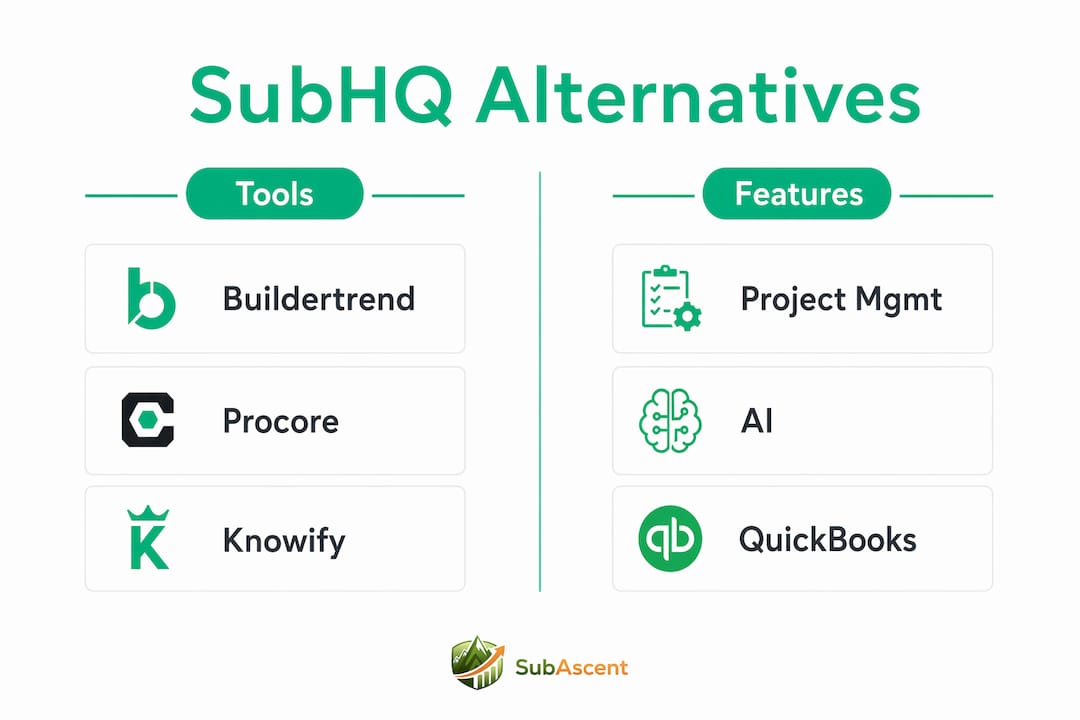
Buildertrend covers the full project lifecycle, from bid to closeout, with scheduling, daily logs, and a QuickBooks sync that actually works for most subs. It fits electrical or framing crews that need one place for estimates and field updates without running two separate systems.

Procore is built for bigger operations. If you run a fire protection or mechanical sub with 20-plus people in the field, its RFI and submittal workflows are hard to beat. The tradeoff is cost and setup time. Construction executives prioritize real-time field data collection over office-only tools, and Procore delivers on that, but it takes real onboarding effort.
Knowify is the tightest fit for subs who live in job costing. It handles contracts, change orders, and QuickBooks natively, without the bloat of a GC-oriented platform. Painting, drywall, and insulation contractors running $1M–$8M books tend to get the most out of it.
CoConstruct leans toward client-facing communication and budget tracking. It suits remodeling subs or specialty trades that deal directly with owners, not just GCs.
Fieldwire is the field-first option. Foremen can pull up plans, assign tasks, and log photos without a training session. The mobile app works offline, which matters on sites with spotty signal. Its accounting integration is limited, so pair it with a separate billing tool.
HeavyBid is a pure estimating tool. Masonry, concrete, and steel subs doing complex bid packages will find its takeoff and labor-cost features detailed enough to replace a spreadsheet. It is not a project management platform.
Table of Contents
- How to choose the right construction software for your trade
- Subascent gives specialty subs a faster path to the right tools
- Key Takeaways
How to choose the right construction software for your trade
Field teams abandon software when it does not fit their daily routine, regardless of how capable the back-office features are. That is the single biggest reason subs waste money on platforms they stop using after 60 days.
Pro Tip: Before you buy, have two foremen test the mobile app on an actual jobsite. If they can log a daily report and a photo quickly without help, you have a usable tool.
Practical criteria to run through before committing:
- Trade-specific workflows. Generic home service platforms rarely handle submittals, RFIs, or trade-specific takeoff without expensive customization.
- Estimating fit. Does it support your unit costs, labor rates, and bid formats, or will you rebuild everything?
- QuickBooks sync. Job costing and invoicing accuracy depend on a clean, two-way sync, not a one-way export.
- Mobile and offline access. Roofing and glazing crews often work without reliable signal.
- AI claims. Vet them. Real AI automation generates quotes or flags RFI deadlines. Marketing AI just rebrands a dashboard.
- Total cost. Training and support add to the sticker price. Factor both in.
- Cultural fit. Software that wraps existing workflows gets adopted. Software that demands new ones usually does not.
Subascent gives specialty subs a faster path to the right tools
Most of the platforms above are built with GCs in mind first. Subascent is built specifically for specialty trade subs: electrical, plumbing, HVAC, roofing, framing, and the rest. You get bid tracking, crew hour tracking, and job costing without the enterprise overhead.
No long implementation. No features you will never touch. If you run a sub trade between $500K and $15M and want software that fits how your business already works, see what Subascent does and start a free trial today.
Key Takeaways
The strongest SubHQ.app alternatives for specialty trade subs are purpose-built tools that prioritize field usability and trade-specific workflows over generic feature breadth.
| Point | Details |
|---|---|
| Field usability decides adoption | If foremen cannot use it on-site in minutes, the platform will be abandoned within weeks. |
| Trade-specific tools beat generic ones | Platforms built for specialty subs handle submittals, RFIs, and job costing without costly customization. |
| QuickBooks integration is a baseline | A clean two-way sync keeps job costing and invoicing accurate without manual re-entry. |
| Vet AI claims before buying | Real automation generates quotes or flags deadlines; marketing AI just relabels existing features. |
| Subascent fits subs from $500K–$15M | Built for specialty trades, it covers bid tracking, crew hours, and job costing without GC-oriented bloat. |