

A conditional lien waiver is a document you sign before payment arrives, stating that you will give up your right to file a mechanic's lien once the specified payment actually clears your bank account. The single rule every electrical, plumbing, HVAC, masonry, and roofing sub must memorize: the waiver has no legal effect until the funds clear. Sign it before payment, yes. But it only becomes binding when the money lands and stays. That distinction is what separates a protected subcontractor from one who signed away lien rights and never got paid. The standard templates most PMs encounter are the G901 and G903 AIA-style forms and the California CSLB conditional and unconditional waiver and release forms, both covered in detail below.
Key Takeaways
A conditional lien waiver only becomes legally effective when payment clears the claimant's bank account, making it the right form to submit with every pay application before funds arrive.
| Point | Details |
|---|---|
| Conditional before payment | Submit a conditional waiver (G901 or state form) with every pay app; sign unconditional only after funds clear. |
| Four waiver types | Conditional/unconditional × progress/final; conditional progress is the most common and lowest-risk form. |
| Clearance is the trigger | Signature alone does not activate a conditional waiver; collected bank balance is the only reliable trigger. |
| Check state forms | California CSLB and other states prescribe statutory forms; a non-compliant form may be unenforceable. |
| Track every waiver | Log through-date, amount, waiver type, and cleared date for every pay app in your project folder. |
Table of Contents
- The four types of lien waivers and how they compare
- How a conditional waiver actually becomes effective
- What a conditional lien waiver does and does not do
- When to submit a conditional waiver and how to do it right
- Red flags and mistakes that strip you of lien protection
- State forms and variations you need to check
- Who fills out and signs a conditional waiver
- Your pay-app waiver checklist and sample language
- The part most subs get wrong
- Sources
The four types of lien waivers and how they compare
Lien waivers in the U.S. break down along two axes: conditional versus unconditional, and progress (partial) versus final. That gives you four combinations, each with a different risk profile.
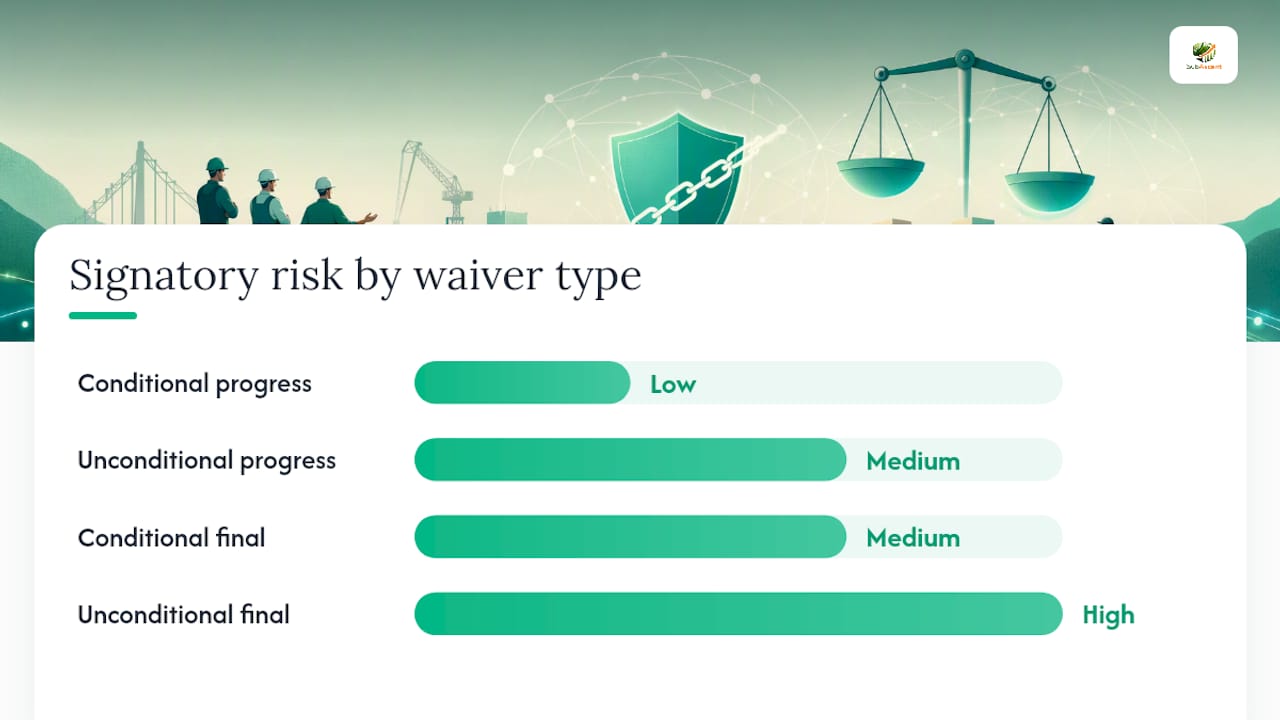
| Waiver Type | When It Becomes Effective | Rights/Money Waived | Signatory Risk | Best Timing |
|---|---|---|---|---|
| Conditional progress | When payment clears claimant's account | Lien rights for the current pay period only | Low | Submit with each pay app |
| Unconditional progress | On signature | Lien rights for the current pay period | Medium | Only after funds confirmed cleared |
| Conditional final | When payment clears claimant's account | All lien rights for the entire contract | Medium | Submit with final pay app |
| Unconditional final | On signature | All lien rights for the entire contract | High | Only after final payment fully cleared |
The conditional progress waiver is the most common form exchanged in a healthy GC–subcontractor relationship. It protects both sides: the GC gets the waiver document in hand, and the sub keeps lien rights intact until the check actually clears. The G901 (Generic Conditional Waiver and Release on Progress Payment) is the widely recognized template for this type. The G903 covers the conditional final. Both are commonly attached to pay applications as standard practice.
The unconditional final waiver is the highest-risk document on this list. Once signed, it wipes out all lien rights for the entire job, regardless of whether payment ever arrives. Never sign one until every dollar, including retainage, has cleared your account.
How a conditional waiver actually becomes effective
The trigger is not your signature. A conditional waiver becomes effective only when funds actually clear the claimant's bank account, not when the check is written, not when it is mailed, and not when it is deposited. Clearance is the operative fact.
That matters because payment can fail in several ways after you deposit:
- Bounced checks: A check clears provisionally, then returns unpaid days later. Your bank may show the funds briefly before pulling them back.
- Stopped payments: A GC or owner can call their bank and stop a check after you deposit it, sometimes within the same business day.
- ACH reversals: Electronic payments can be reversed within a window (typically two banking days for standard ACH). The funds appear, then disappear.
- Wire returns: Less common, but wires can be recalled if the sending bank initiates a return request before the receiving bank releases the funds.
In each scenario, if you already signed an unconditional waiver, you have waived your lien rights even though you never actually received the money. A conditional waiver protects you because the waiver language itself says it is only effective upon actual receipt and clearance of funds.
Pro Tip: Wait for your bank's "collected balance" confirmation before treating a payment as cleared. Provisional credit is not cleared funds. For checks over a certain threshold, call your bank directly to confirm the item has settled, not just posted.
Recordkeeping matters here. Keep a dated note in your job folder showing when funds cleared, which account they landed in, and the payment method. If a dispute arises later, that record is your evidence.
What a conditional lien waiver does and does not do
A lien waiver waives future mechanic's lien rights for the specified dollar amount and time period. It is a promise: "If you pay me this amount, I will not file a lien for this portion of the work." A lien release is a different instrument entirely, used to remove a lien that has already been recorded against a property. Confusing the two causes real problems at closeout, especially when a title company or lender is waiting on documentation.
The conditional language changes the trigger for the waiver, not the contract's binding nature. You are still bound by your subcontract. The waiver simply says your lien rights for this payment period are contingent on the payment clearing.
Scope matters as much as timing. A waiver covers only the dollar amount and the "through-date" stated on the form. Sign a waiver with the wrong through-date and you may accidentally release rights for work you have not yet been paid for.
Statutory forms in some states add another layer. California's CSLB, for example, prescribes specific conditional and unconditional waiver and release forms. Using a non-compliant form in those states can affect enforceability, so always check whether your state requires a specific format before accepting a GC's custom template.
When to submit a conditional waiver and how to do it right
The practitioner rule is simple: submit a conditional waiver with your pay application, and sign an unconditional waiver only after funds have cleared. Industry best-practice guidance warns that signing unconditional waivers before funds clear is a major financial risk, and a GC who routinely demands them before payment is a red flag worth taking seriously.
Here is how to build this into your pay-app workflow:
- Prepare the conditional waiver before submission. Fill in the correct through-date, the exact dollar amount on the invoice, and the project name. Use a G901 template or your state's statutory form.
- Attach it to the pay app package. The package should include the invoice, any required photos or daily reports, a signed work confirmation if required, and the conditional waiver. Pay-app workflows commonly require the conditional waiver attached to the pay application, not sent separately.
- Track the submission date. Note when you sent the pay app and when the GC acknowledged receipt.
- Wait for funds to clear before signing anything unconditional. When the GC sends an unconditional waiver for signature, confirm your bank shows collected balance first.
- File the signed waiver copy in the job folder. Keep a copy of every waiver you sign, with the payment amount, through-date, and date funds cleared.
When a GC pressures you to sign an unconditional waiver before payment, you have options. Offer a conditional waiver with the same dollar amount and through-date instead. If they push back, ask why they cannot wait for the payment to clear. Acceptable alternatives include a conditional waiver with holdback language, a joint-check arrangement, or a verified ACH confirmation before you sign anything unconditional. See the lien waiver process guide for a full walkthrough of these negotiations.
Pro Tip: Never let a GC's payment schedule pressure you into signing an unconditional waiver on a Friday afternoon. ACH reversals and returned checks can hit over the weekend. Wait until Monday and confirm collected balance before signing.
Red flags and mistakes that strip you of lien protection
The most dangerous request in construction finance is "sign this now and we'll pay you next week." That is a request for an unconditional waiver before payment, and it should stop you cold.
Beyond that obvious trap, watch for these specific mistakes:
- Mismatched through-dates. The through-date on the waiver should match the period covered by your invoice. A through-date that extends past your invoice period releases rights for work you have not yet billed.
- Signing a "final" waiver mid-project. "Final" on a waiver refers to the scope described on the form, not necessarily the entire project. But if the scope language is broad, you may be releasing rights for work still in progress.
- Not tracking partial releases. On a long job with multiple pay apps, it is easy to lose track of which periods have been released. A gap in your waiver log can leave you unable to prove which rights you still hold.
- Accepting a GC's custom form without reading it. Some custom forms include unconditional language buried in the body, even if the header says "conditional." Read every word.
If you are being pressured and the GC will not accept a conditional waiver, that is a signal worth escalating. Involve your bonding agent or construction attorney before signing anything that waives rights you have not been paid for. For more on the cash flow warning signs that often accompany these requests, that guide covers the financial patterns to watch.
State forms and variations you need to check
State statutes and statutory forms affect waiver enforceability. Some states require specific form language or evidence of payment before a conditional release becomes effective. Using the wrong form can make a waiver unenforceable or, worse, enforceable in a way you did not intend.
The most widely referenced templates are:
- G901 (Generic Conditional Waiver and Release on Progress Payment): The AIA-style template for conditional progress waivers, designed to be paired with pay apps. The conditional language makes it effective only upon payment clearance.
- G903 (Generic Conditional Waiver and Release on Final Payment): The AIA-style template for conditional final waivers. Use this when submitting your final pay app, not before.
- California CSLB forms: California prescribes four specific statutory forms (conditional/unconditional × progress/final). Using a non-statutory form in California can void the waiver's enforceability. The CSLB forms are available directly from the California Contractors State License Board.
When reviewing any state form, check these four things:
- Required signatures: Who must sign, and does the form require an authorized officer or can any employee sign?
- Notary language: Most conditional waivers do not require notarization, but some states or lenders add that requirement. Check before assuming.
- Evidence-of-payment wording: Some statutory forms include a recital that payment has been received. On a conditional form, that recital should be conditional, not absolute.
- Through-date and scope language: Confirm the period covered matches your invoice exactly.
Terminology also varies. Older templates and some state statutes use "waiver of lien" rather than "lien waiver." They are functionally the same instrument. Check your state's statutory language before assuming a differently named form has a different legal effect.
Who fills out and signs a conditional waiver
The claimant signs the waiver. In a typical sub-to-GC payment chain, that is the subcontractor or their authorized agent, not the GC, not the owner. The person signing must have authority to waive the company's lien rights.

For a sole proprietor or small electrical or plumbing shop, the owner typically signs. For a larger framing or concrete sub with a PM handling paperwork, the PM can sign if they have written authorization, such as a corporate resolution or a power of attorney on file. If a dispute ever arises, the GC or their title company may ask for proof of signatory authority. Keep a copy of any authorization document in your project files.
Notarization is generally not required for a conditional waiver to be effective. The conditional language, not the notary stamp, is what makes the waiver contingent on payment. That said, some lenders, bonding companies, or state statutes do require notarization on final waivers. Check your subcontract and your state's lien statute before assuming notarization is optional on a final release.
Electronic signatures are widely accepted on conditional waivers. The operative fact that triggers the waiver is payment clearance, not the format of the signature. A digital waiver workflow can handle the signing and storage, but the clearance confirmation still needs to come from your bank, not the signing platform.
Your pay-app waiver checklist and sample language
Use this checklist every time you submit a pay app. It takes two minutes and protects every dollar you are owed.
- Confirm the through-date matches your invoice period exactly. For an electrical sub billing through March 31, the waiver through-date should read March 31, not April 1 or "project completion."
- Verify the dollar amount matches the invoice. A waiver for $47,500 on a $50,000 invoice leaves a $2,500 gap. Match them exactly.
- Use conditional waiver language. The trigger sentence should read something like: "This waiver and release is conditioned upon and effective only upon actual receipt and clearance of the payment described herein in claimant's bank account."
- Attach the waiver to the pay app package. Include the invoice, field photos, and any required daily reports in the same submission.
- Keep a signed copy in the job folder. File it with the payment amount, through-date, and the date funds cleared.
- Log the waiver in your waiver tracker. A simple spreadsheet with pay-app number, through-date, amount, waiver type, and cleared date is enough.
Trade-specific scope language matters. A masonry sub billing for block work on floors 1–3 should write the scope as "masonry work, floors 1–3, through [date]," not "all masonry work." A plumbing sub completing rough-in on Building A should specify "rough-in plumbing, Building A, through [date]." Broad scope language on a conditional waiver is low risk because the waiver only activates on payment, but it becomes a problem if that conditional waiver is later replaced by an unconditional one with the same broad language.
For final waivers, a concrete or framing sub should confirm that "final" means final for their scope, not for the entire project. If retainage is still outstanding, do not sign a final waiver that covers retainage until that money clears. See masonry retainage release practices for a trade-specific example of how retainage affects final waiver timing.
The part most subs get wrong
The conditional lien waiver system works well when everyone follows the rules. The problem is that "sign now, pay later" pressure is common enough that some subs treat it as normal. It is not normal. It is a transfer of risk from the GC to you, and it happens one unconditional waiver at a time.
The conditional waiver is not a bureaucratic formality. It is the mechanism that keeps your lien rights alive until the money is real. A check in the mail is not real. A deposit that has not cleared is not real. Collected funds in your account are real.
The other thing worth saying plainly: a lien waiver and a lien release are not the same document, and mixing them up at closeout creates title problems that delay final payment for everyone. Waiver before payment, release after the lien is recorded. Keep those two straight and you will avoid most of the closeout headaches that plague electrical, drywall, and fire protection subs on large commercial jobs.
If your current pay-app process does not include a waiver log, build one this week. A spreadsheet with six columns takes twenty minutes to set up and will save you from signing the wrong form under pressure.
Sources
The primary sources below are worth bookmarking. Each one covers a specific piece of the lien waiver process, and having the official form language on hand before a GC sends you something to sign is always better than reviewing it under deadline pressure.
- Conditional waiver of lien. The 2026 guide for GCs
- Construction Lien Waivers: Conditional vs Unconditional Explained | Corpay
- Lien Waivers and Releases: A Practical Guide to Managing Payment Risk
- Lien Waiver Essentials: Types, Timing & Best Practices for Subcontractors
This article is general information, not a substitute for advice from a qualified lawyer. Consult a qualified legal professional about your own circumstances before acting on anything here.