

You can run a profitable electrical or plumbing business and still miss payroll. That's not a warning from a textbook. That's Tuesday for a lot of specialty trade contractors who confuse a healthy income statement with a healthy bank account. Understanding why cash flow matters for subcontractors comes down to one brutal reality: you pay your crew, your material supplier, and your insurance long before a GC cuts you a check. The gap between those two events is where businesses go sideways.
Table of Contents
- Key takeaways
- Why cash flow matters differently for subcontractors
- The cash flow challenges hitting subcontractors hardest
- Practical cash flow management strategies that actually work
- Cash flow discipline and your long-term business health
- My perspective on why this problem is so fixable
- How Subascent helps you stay on top of the numbers
- FAQ
Key takeaways
| Point | Details |
|---|---|
| Profit and cash flow are not the same | You can show net income on paper while running dry on cash needed to pay labor and materials. |
| Retainage traps working capital for months | A 10% retainage hold on an $8M contract locks up $800,000 until well after project closeout. |
| Billing discipline drives cash timing | Incomplete pay applications delay approval and push your cash receipt back by weeks or more. |
| Forecasting gives you a decision window | A rolling 13-week cash forecast creates 4 to 6 weeks of visibility to act before a shortfall hits. |
| Cash flow discipline enables growth | Without working capital discipline, rapid growth can accelerate a cash crisis instead of solving it. |
Why cash flow matters differently for subcontractors
Profit is what your accountant shows you. Cash flow is what you actually have to spend. For roofing, masonry, and HVAC contractors, that distinction hits harder than it does for most businesses.
Here is why. You pay labor every week. You buy materials before installation. Your insurance, equipment leases, and overhead run on their own schedule. But your revenue? That arrives according to a billing cycle the GC controls. You submit a pay application. It goes through approval. The GC gets paid by the owner. Then, sometimes, you get paid. That chain can take 45 to 90 days per draw, sometimes longer.
Profit on income statements can be completely disconnected from cash because of delayed receivables and retainage. Your books might show a $200,000 margin on a concrete or drywall job while your checking account is sitting at $18,000. That is not a hypothetical. That is the standard billing structure of commercial construction.
The specific items that create this timing mismatch include:
- Labor costs: Crews get paid weekly regardless of where the GC is in their approval process.
- Material purchases: Suppliers expect payment in 30 days, often before you've submitted your first pay app.
- Retainage holdbacks: Most contracts hold back 5 to 10% of every draw until project completion, which can be months or years out.
- Billing cycle lag: Monthly pay application windows mean you can miss a cycle and wait another 30 days before your clock even starts.
- Change order delays: Approved scope changes often do not get billed or paid on the same schedule as base contract work.
Understanding the importance of cash flow is not about being conservative. It is about understanding the timing mechanics of how money actually moves on a construction project.
The cash flow challenges hitting subcontractors hardest
Retainage is the biggest structural problem. Most subcontractors know it exists and treat it as a minor inconvenience. It is not. For an $8M contract with 10% retainage, $800,000 may be delayed well beyond project completion, sometimes 14 to 18 months after the project started. That is money you earned, documented, and are owed. But it is not accessible. You still had to finance the labor and materials it represents from your own pocket.

Retainage functions like a delayed payables challenge, requiring you to finance your own cash flow until contract closeout releases it. A framing or insulation contractor on a 12-month project might complete their scope by month eight and wait until month fourteen to collect the final 10%. The money is real. The timing is brutal.
Pay application mechanics compound the problem significantly. Here is a typical failure pattern:
- Electrical contractor completes work through the end of the month.
- Pay application is submitted three days late, missing the GC's cutoff window.
- Application comes back with a missing lien waiver and an unapproved change order included.
- Revised application is resubmitted. GC processes it in the next cycle.
- Payment arrives six weeks after the original submission deadline.
Incomplete or missing documents in pay applications delay approvals and cash receipt, causing cash flow issues that have nothing to do with the quality of your work or the health of your contract. The approval mechanics matter more than most trade contractors realize.
Compare the cash impact of these two billing scenarios on a $500,000 fire protection contract:
| Scenario | Billing behavior | Days to payment | Cash impact |
|---|---|---|---|
| Disciplined billing | On-time, complete pay apps every month | 45 days average | Predictable, plannable |
| Reactive billing | Late submissions, missing docs, rework | 75 to 90 days average | 30 to 45 extra days of cash tied up |
On a $500,000 job drawing $50,000 per month, that 30-day difference means carrying an extra $50,000 out of your own pocket every single cycle. Over a 10-month job, those gaps compound into a serious liquidity problem.
Practical cash flow management strategies that actually work
The subcontractors who stay liquid through growth and through slow periods treat cash flow as an operating system, not a report they pull once a month. Here is what that looks like in practice.
Build a rolling 13-week cash flow forecast. A rolling 13-week forecast modeling expected receipt timing, retainage releases, and obligations creates 4 to 6 weeks of visibility for decisions like accelerating billing or negotiating vendor terms. You track every job, every expected draw, every retainage release date, and every major outflow. Update it weekly. It sounds like a lot of work. It takes about an hour once you have the template.
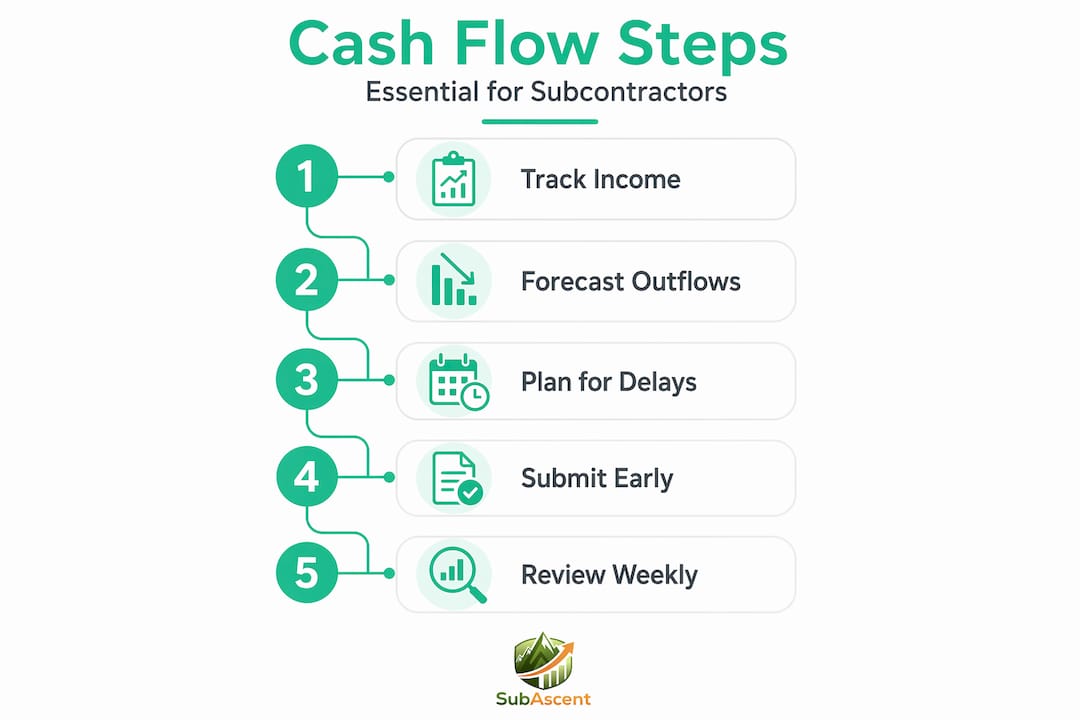
Bill on time, every time, with complete documentation. Billing discipline is the single highest-leverage activity in cash flow management. Know the GC's cutoff date. Submit before it. Include every required document: lien waivers, certified payroll if required, change order backup, stored materials documentation. Invoice approval mechanics tied to complete documentation and lien waivers impact cash timing more than invoice volume does.
Align your own payments with incoming cash where legally permitted. Pay-when-paid clauses, used carefully and transparently with your material suppliers and lower-tier subs, can reduce the cash gap you carry. Aligning subcontractor payment timing with expected cash inflows is a recognized strategy when handled with clear communication to avoid disputes.
- Use business lines of credit strategically for timing gaps, not to fund ongoing losses.
- Pay estimated taxes on the right schedule so a $40,000 quarterly payment does not blindside you in the middle of a slow billing month.
- Maintain a working capital reserve equal to at least 4 to 6 weeks of average project costs, especially if you are growing fast.
- Track retainage by project in a separate column, not just in your overall AR aging, so you always know exactly what is locked and when it is expected to release.
Pro Tip: Set a firm internal pay app submission deadline two to three days before the GC's cutoff. That buffer absorbs documentation problems, accounting questions, and last-minute scope additions without costing you an entire billing cycle.
Cash flow discipline and your long-term business health
Cash shortages build gradually due to billing delays, collection timing, retainage, growth, and tax structure. They do not show up as emergencies. They show up as a slow tightening that makes you hesitant to bid the next job, skip equipment purchases you need, or struggle to make payroll during a transition between projects.
The share of small business owners who described themselves as "very comfortable" with their cash flow dropped to 20% in Q1 2026, down from 31% in Q3 2025. For trade contractors, that number likely skews even lower. The environment is getting harder, not easier.
Consistent cash flow management supports subcontractor financial health in several specific ways:
- Payroll confidence: You bid jobs and hire crews without second-guessing whether the next draw will arrive in time.
- Bonding capacity: Bonding companies look hard at working capital ratios. Thin cash position limits the size of jobs you can bond and bid.
- Material purchasing power: Suppliers offer better pricing and terms to contractors who pay reliably. Cash flow discipline earns that relationship.
- Decision-making clarity: When you know your 13-week cash position, you can decide to take on a fast-growth opportunity or pass on it with actual data, not gut instinct.
Rapid growth without cash flow discipline is one of the most common ways a specialty trade business fails. A glazing or flooring contractor that doubles revenue in 18 months can find itself cash-negative because retainage on the new projects outpaces collections from older work. The benefits of cash flow analysis are most visible exactly when a business is scaling, not when it is stable.
My perspective on why this problem is so fixable
I have watched skilled, hardworking trade contractors nearly lose businesses they built over 15 years. Not because the market turned or because they lost a big job. Because they let billing slip two weeks, let the retainage tracking go loose, and never built a forward-looking cash model.
What I've learned is that this problem is almost always internal, not external. The GC is slow, yes. The approval process is bureaucratic, yes. But in my experience, the contractors who stay liquid are the ones who treat billing and forecasting as core operational functions, not accounting chores. They build the 13-week forecast. They track retainage by project. They know their cutoff dates and they submit on time.
The deeper issue is cultural. A lot of owners see financial management as something that happens after the work, handled by the bookkeeper or the CPA. That mindset is expensive. Cash flow management is best treated as an ongoing operational process. When the owner or PM treats billing and cash visibility as production metrics, not back-office tasks, the whole business runs differently. I have seen it change companies.
The good news is that the fixes are not complicated. Discipline beats cleverness every time in this arena.
— Dave
How Subascent helps you stay on top of the numbers
Running a tight billing process and keeping your jobs organized are not separate problems. They feed each other. When your pay apps are late, it is usually because the documentation is scattered. When the documentation is scattered, it is usually because job management is happening in spreadsheets, texts, and email threads.

Subascent is built specifically for specialty trade contractors: electrical, plumbing, HVAC, masonry, roofing, drywall, and the rest. It is not a GC tool retrofitted for subs. It is designed for the way your business actually operates, from bid and job management through to tracking what is outstanding and what is on deck. If you are tired of rebuilding spreadsheets and chasing down paperwork before every pay app, take a look at what Subascent can do for your operation. You can also explore software built for specialty trades to see the tools that fit your workflow directly.
FAQ
What is the difference between profit and cash flow for subs?
Profit is revenue minus expenses on paper. Cash flow is actual money available in your account. A subcontractor can show strong profit while being cash-negative because receivables, retainage, and billing delays mean the money has not been collected yet.
How long can retainage stay locked up?
Retainage on commercial projects is commonly held for 14 to 18 months after project start, and often releases only after final completion, punch list approval, and sometimes lien waiver submission. On a 12-month project, that can mean waiting six months post-completion for your final 10%.
What is a 13-week cash flow forecast?
It is a rolling weekly projection of all expected cash inflows and outflows over the next 13 weeks. For subcontractors, it models each pay app draw, expected retainage releases, payroll, material costs, and other obligations to reveal shortfalls before they happen.
Why do incomplete pay apps hurt cash flow so much?
A pay application with missing lien waivers, unapproved change orders, or incomplete backup gets rejected or held for revision. That pushes your cash receipt back by an entire billing cycle, which on a monthly schedule means waiting another 30 days or more.
How much working capital reserve should a sub keep?
A practical starting point is four to six weeks of average monthly project costs held as liquid reserve. This buffer covers payroll and materials during payment gaps between projects and protects you when a GC payment runs late.