

Bid leveling for subs means tracking every incoming bid invitation, locking down scope with the GC, and turning that into a clean, auditable quote before it goes out the door. It has nothing to do with a GC comparing subcontractors against each other. Your first move: open a Go/No-Go checklist and log a central project row with the due date, plan links, and addenda status the moment an invitation lands.
TL;DR:
- Subcontractors must normalize scope and exclusions across quotes to accurately compare prices and avoid misleading differences caused by inconsistent treatment of allowances and scope zones.
- Running a detailed Go/No-Go checklist before estimating helps ensure the project fits capacity, licensing limits, margin goals, and site proximity, saving time on unviable bids.
- Centralizing bid invitations and maintaining detailed project data sheets with addenda, RFI, and deadline logs reduces missed opportunities and keeps bid information organized.
- Fully verifying quantities through dual passes and trade-specific templates prevents gaps caused by unaccounted-for scope items like flashing, blocking, or fire-stopping on plans.
- Final bid submissions should include updated addenda, risk calculations, and sign-offs from bonding authorities to prevent costly scope omissions or margin erosion.
Table of Contents
- Run a Go/No-Go Before You Invest Estimating Hours
- Centralize Bid Invitations: What a Project Data Sheet Must Capture
- Compare Quotes Like-for-Like: Align Scope, Inclusions, and Exclusions
- PDF Takeoff and Quantity Verification Best Practices
- Final QA, Bid-Day Adjustments, and the Submission Checklist
- Author Dave: Field Notes That Actually Stick
- How Subascent Fits Into Your Bid Leveling Workflow
- Sources
- FAQ
Run a Go/No-Go Before You Invest Estimating Hours
Estimating a bid you were never going to win, or never should have chased, is the fastest way to burn a week for nothing. A standardized Go/No-Go checklist strips out the emotional "we need the work" reflex and forces a cold look at fit before anyone opens a spec book.
Run through this before committing estimating time:
- Do you have crew capacity for the schedule window, or would this bid steal labor from a job you already have?
- Does the project size fit your license and bond limits?
- Is the job site within a travel radius that doesn't eat your margin in fuel and per diem?
- Does the target margin on a job this size make sense for your overhead?
- Do you actually have plan-holder access, or are you working from a forwarded PDF with no addenda feed?
That last point is a gating question, not a footnote. If you can't confirm you're on the official plan-holder list, you're flying blind on revisions. Other red flags worth an automatic pause: scope described in a single vague line item, or an RFI window that closes in 48 hours on a job with unclear specs.
Log every "no" with a one-line reason. Six months from now, that log tells you which project types you keep passing on and whether that's a capacity problem or a pricing problem.
Pro Tip: Keep a running tally of "no" decisions by reason code. If "travel distance" shows up 40% of the time, that's a service-area problem worth fixing, not a coincidence.
Centralize Bid Invitations: What a Project Data Sheet Must Capture
Every bid invitation that doesn't land in one place becomes a due date you'll eventually miss. Central project data sheets cut down on incomplete or late bids that get eliminated before anyone even reads the price.
A usable data sheet needs these fields for every opportunity:
- Due date and exact submission method (portal upload, email, sealed envelope)
- Plan and spec links, with a version number
- Addenda log, updated the same day a new one drops
- RFI deadline, separate from the bid due date
- GC contact name and direct line
- Bid form type required (AIA, GC's own template, lump sum letter)
- Bond and insurance requirements
Addenda are where most subs get burned. Save each plan revision and tag it directly to the project row instead of relying on a folder full of "final_v3_REAL_final" file names. When an addendum changes a spec section, note which page and which line item it touches.
Build a question log tied to that same row. Every clarification you need from the GC gets a line, a document page reference, and a status (asked, answered, still open). This forces ambiguity into the open before bid day instead of after you've already signed a fixed price.
Set clear ownership: one person updates the sheet, checks it daily during active bid windows, and archives it once the bid is submitted. Filing unsuccessful quotes matters too. That history becomes your benchmarking data for the next similar job. A source-linked tracking habit also protects against the risk that comes from pulling invitations off free public bid boards, where addenda updates rarely push to you automatically.
Compare Quotes Like-for-Like: Align Scope, Inclusions, and Exclusions
Two subcontractor quotes on the same job can look nothing alike, even when they're bidding identical scope, because every trade writes exclusions differently. The fix is mapping every quote to the same standard line groups, usually a spec division or a simple work breakdown structure, before you compare a single number.
Pull inclusions and exclusions out of each proposal and slot them into that shared structure. A written scope of work that spells out boundaries in plain terms makes this step faster, because you're not guessing what "complete per plans" actually covers.
Watch for these normalization traps:
- One electrical quote includes conduit as a hard price; another carries it as an allowance. Those aren't comparable until you convert both to the same basis.
- Masonry flashing responsibility often sits in a gray zone between masonry and roofing scope. If one quote assumes the other trade handles it, that's a gap, not a savings.
- Contingency treatment varies wildly. Some subs bury it in unit pricing; others break it out. Strip it to a consistent line so you're comparing base price to base price.
Keep a one-line clarifications log for every item that needed a judgment call, with a reference back to the specific plan page or spec paragraph that resolved it. That log is also your defense if a GC challenges your number later. Prequalifying suppliers and lower-tier subs as part of this comparison, checking insurance and references before you rely on their number, cuts down on the risk of a quote that looks great and falls apart at execution.
PDF Takeoff and Quantity Verification Best Practices
Run two separate passes on every set of plans: a full-scope pass and a quantity pass. Skipping the full-scope pass is the single most common way estimators create gaps between trades, because blocking, flashing, and fire-stopping items often sit unassigned on drawings, technically nobody's scope until someone claims them.
The quantity pass is where you count: square footage, linear feet, unit counts, assemblies. Cross-check counts two ways when the stakes justify it, once by hand and once against a digital measurement, especially on irregular shapes where a rounding error compounds fast.
Deciding whether to buy a takeoff tool comes down to volume. If you're bidding two or three jobs a month, a disciplined spreadsheet and a highlighter work fine. Once you're running takeoffs weekly across multiple trades, the time saved on tool-assisted measurement usually justifies the add-on cost, especially when the tool also gives you an audit trail.
That audit trail is the real value. Tag every takeoff line to a specific plan sheet and spec reference as you go. When a GC pushes back on a number three weeks later, you pull up the exact sheet instead of reconstructing your logic from memory.
Pro Tip: Never eyeball a takeoff on a scanned or low-resolution PDF. Blow up the plan first. A misread scale on one sheet can throw off every linear-foot calculation that follows it.
Trade-specific patterns repeat. Masonry crews often catch flashing and control-joint quantities that generic takeoff checklists miss entirely, which is why trade-specific templates beat generic ones.

Final QA, Bid-Day Adjustments, and the Submission Checklist
A complete bid proposal includes the project description, a clear inclusions and exclusions list, your price structure, start and end dates, and the documents you used to build the quote. Keep exclusions brief and specific. Vague exclusions invite disputes after the contract is signed.
Before you submit, run through this final sequence:
- Confirm every addendum issued after your initial takeoff has been priced in, not just acknowledged.
- Run a quick what-if on your top two or three cost-risk line items. What happens to margin if material pricing moves 10% before the job starts?
- Set alternate pricing priority so the GC knows which alternates you'd push if budget gets tight.
- Get sign-off from whoever holds bonding authority before the bid leaves the building.
- Confirm delivery logistics: portal upload confirmation, sealed envelope drop time, or email receipt.
The stakes on that first step are higher than most estimators assume. One missed scope item on a lump-sum job can cost between $10,000 and $100,000 depending on job size, wiping out a typical 2 to 4% margin entirely. That's not a rounding error. That's the difference between a profitable quarter and a loss on a single job.
File the submitted package, every unsuccessful quote you collected along the way, and a short post-bid debrief noting what you'd do differently. That debrief is worth more six months later than it feels worth the day you write it.
Author Dave: Field Notes That Actually Stick
Monday mornings, someone on the team runs a source sweep across every bid portal before anything else happens that day. It's a 20-minute habit, and it's the difference between catching an addendum on Monday versus discovering it Thursday, after you've already priced the old scope.
I watched a masonry sub eat a $40,000 loss because a flashing detail got added in an addendum nobody logged against the project row. It wasn't a skill problem. It was a filing problem. After that, every addendum got tagged to the project sheet the same day it landed, no exceptions.
If you're bidding two jobs a month, a spreadsheet with one clear owner will carry you. Add tools only once volume forces the issue, not before.
— Dave
How Subascent Fits Into Your Bid Leveling Workflow
Subascent is built to replace the scattered spreadsheet-and-email approach with one central place for every bid you're tracking. Every feature above maps to something in the platform: a project row for each opportunity, an addenda log tied to that row, a question log for RFIs, and a PDF takeoff add-on when your volume justifies it. QuickBooks sync can help carry winning bids into job costing without re-entering numbers.
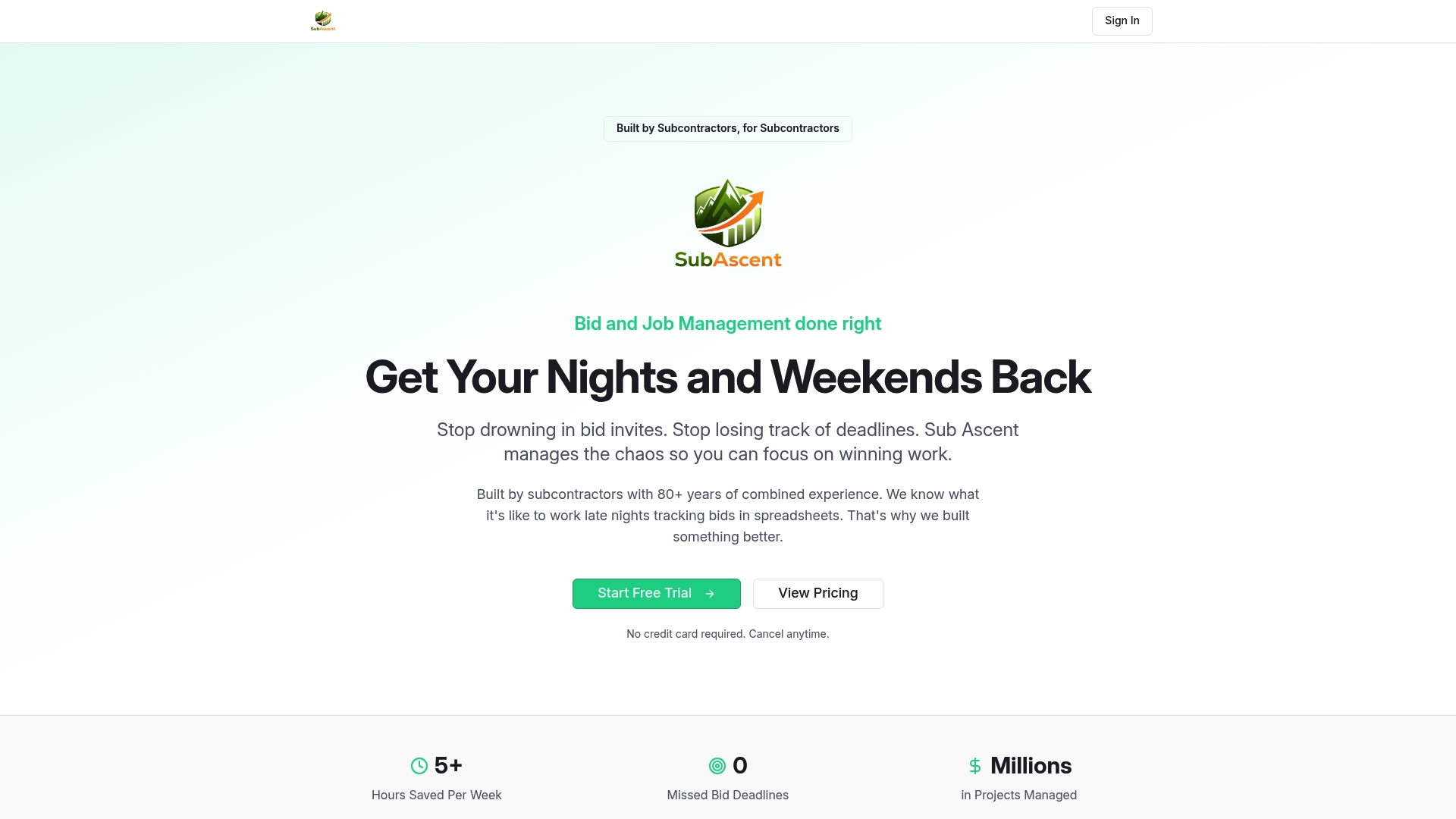
Many small trade teams start with a trial, get their active bids into a system, then add a takeoff module once they are running quantity passes weekly. There's no need to overhaul your process on day one. Move your current bid list in, run your next Go/No-Go inside the system, and see whether the addenda tracking alone saves you a missed deadline. Check out Subascent's bid and job management platform to start a trial and see the project data sheet in action.
Sources
Pair your own checklist with the AGC's owner communications guide and ABC's bidding guide for proposal structure. For trade-specific scope breakdowns, see how to write clean exclusions and define standard scope elements.
- Owner Communications (Part II): The RFP/RFQ is released, now what? | AGC
- ABC Estimating webinar materials
- Constructionbids
FAQ
What Is Bid Leveling for Subs, Exactly?
For a subcontractor, bid leveling means organizing your own incoming bid invitations, aligning scope with the GC's documents, and producing a clean, comparable quote to submit. It's an internal estimating discipline, not a comparison of competing subs.
How Do I Start a Bid Leveling Process With No Software?
A spreadsheet with one owner and consistent fields (due date, addenda log, RFI status) covers most small teams fine. The habit matters more than the tool: a documented, source-linked tracking sheet beats a fancy platform used inconsistently.
What's the Biggest Mistake Subs Make Comparing Quotes or Bids?
Comparing prices before normalizing scope. If one supplier's quote treats conduit as an allowance and another prices it hard, the numbers aren't comparable until both are mapped to the same line groups.
How Much Can a Missed Scope Item Actually Cost?
On a lump-sum job, one missed item can run from $10,000 to $100,000 depending on project size, often erasing the entire margin on the job. That's why a full-scope takeoff pass, not just a quantity pass, matters.
Does Subascent Handle PDF Takeoff and Bid Tracking?
Subascent centralizes bid invitations, addenda, and RFIs in one project record, with PDF takeoff available as an add-on. Current pricing and plan details are listed on the Subascent website.