

Bid due date tracking is the process of organizing every critical deadline, project detail, and submission milestone into one centralized workflow so specialty trade subcontractors never miss a bid. For electrical, plumbing, HVAC, roofing, and other trade businesses, understanding how bid due date tracking works is the difference between a full pipeline and a slow month. An effective bid tracking system records project name, bid due date and time, assigned estimator, current status, and links to project documents, with automated reminders triggered five and one day before each deadline. The system does not just log dates. It creates accountability, surfaces bottlenecks, and keeps your whole estimating team moving in the same direction.
How bid due date tracking works: core components
Bid due date tracking is built around a single source of truth for every active bid opportunity. Without it, details scatter across email inboxes, sticky notes, and individual spreadsheets, and information scatter leads to missed deadlines and costly errors. The industry term for this centralized record is a bid log or bid register, and every field in it serves a specific purpose.
The core fields every bid log must include are:
- Project name and number — ties every document, quote, and note to the right job
- Client or owner name — identifies the GC or owner sending the invitation
- Project type and estimated value — helps you score the opportunity before committing estimating hours
- Bid due date and time — the primary scheduling driver for all internal milestones
- Assigned estimator — creates clear ownership so nothing falls through the cracks
- Current status — tracks where the bid sits, from invitation received through submitted
- Links to drawings, specs, and addenda — keeps documents attached to the record, not buried in email
The bid due date and time field is the anchor for everything else. Every internal milestone, reminder, and review meeting is scheduled backward from that date. A masonry contractor juggling five active bids across different GCs cannot rely on memory. The log makes the deadline visible to everyone on the team, not just the estimator who opened the invitation email.
| Field | Purpose |
|---|---|
| Project name and number | Identifies the job across all documents and communications |
| Bid due date and time | Drives all internal milestone scheduling |
| Assigned estimator | Creates accountability for bid completion |
| Status or stage | Shows pipeline position at a glance |
| Linked documents | Keeps drawings, specs, and addenda accessible |

Pro Tip: Add an "estimated contract value" field from day one. It lets you filter your pipeline by opportunity size and avoid spending 20 hours estimating a job that will never move the needle.
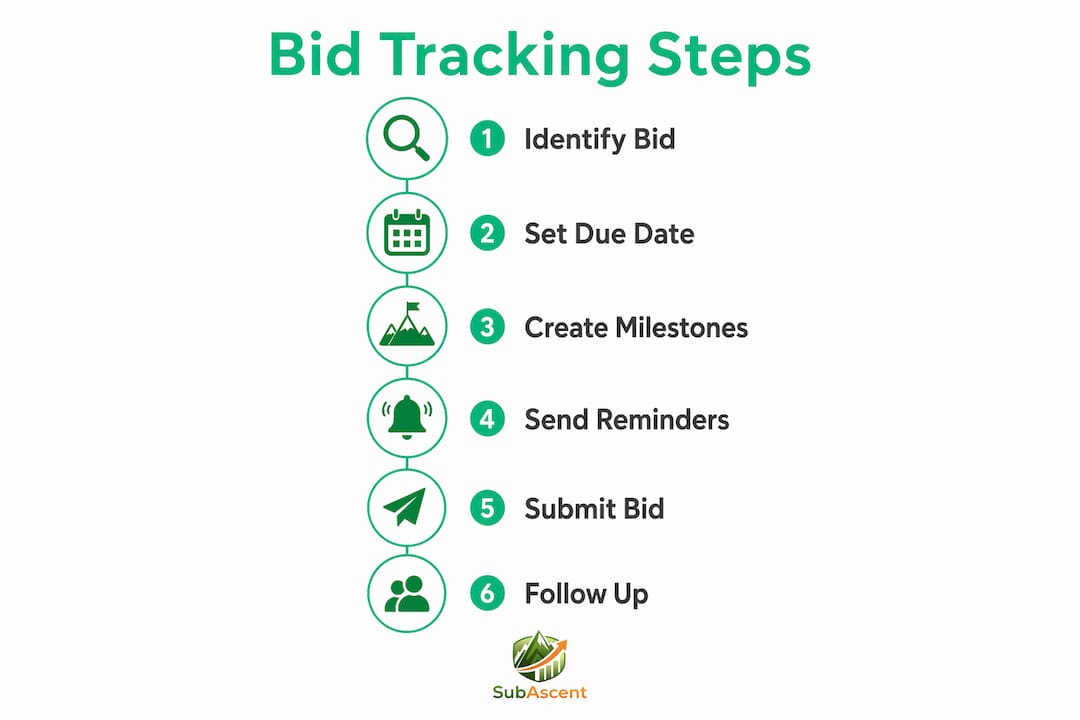
How does the bid tracking process incorporate internal milestones?
The biggest mistake trade estimators make is treating the GC's due date as their own target. Top-performing estimators set internal submission targets 24–48 hours before the absolute deadline to accommodate addenda, last-minute quote changes, and unexpected issues. That buffer is not optional. It is what separates a clean, reviewed bid from a rushed one that costs you the job or, worse, wins it at the wrong number.
A structured bid timeline for a roofing or fire protection contractor typically runs through four internal stages:
- Document review — confirm scope, read the spec book, flag exclusions and clarifications needed
- Subcontractor and supplier quoting — send RFQs and set a hard return deadline at least 48 hours before your internal target
- Pricing finalization — apply labor rates, material costs, overhead, and markup
- Internal bid review — owner or PM reviews the number before submission
Automated reminder systems fire SMS and email alerts at five days and one day before the deadline. That five-day alert is your signal to confirm that quoting is underway. The one-day alert is your final check that the number is ready. If a bid is still marked "In Progress" one day out, escalation notifications go to the project manager or owner via email, SMS, and team chat, making the risk visible before it becomes a miss.
Synchronizing bid due dates with Outlook or Google Calendar that your team already uses reduces missed deadlines caused by workflow friction. The bid log holds the official record. The calendar keeps the deadline in front of everyone, every day.
Pro Tip: Never submit a bid in the final hour before the GC's deadline. Bid portals go down. Addenda get issued at 4:45 PM. Build your internal deadline around 2:00 PM the day before, and you will never scramble again.
What frameworks do estimators use to prioritize bid opportunities?
Not every bid invitation deserves an estimate. Specialty trade subcontractors who chase every opportunity spread their estimating capacity thin and end up winning jobs they should have passed on. The industry standard for managing this is a bid/no-bid scoring framework, which evaluates each opportunity before a single hour of estimating time is committed.
A typical bid/no-bid scorecard rates each opportunity across five criteria:
- Project fit — does the scope match your trade's core capabilities?
- Client relationship — have you worked with this GC before, and did it go well?
- Estimating capacity — do you have the bandwidth to build a competitive number right now?
- Profit potential — does the project type and size align with your margin targets?
- Competitive position — are you likely to be one of two bidders or one of ten?
A recommended minimum score of 15 out of 25 filters out low-probability bids before they consume resources. Passing on 30–50% of incoming invitations keeps your estimating team focused on work you can actually win and execute profitably. That is not leaving money on the table. It is protecting your capacity for the right jobs.
Maintaining a dynamic bid pipeline means updating scores as conditions change. A concrete contractor who just landed a large parking structure job has less capacity for another complex pour. The pipeline should reflect that reality in real time, not at the end of the month when the estimator is already buried.
Pro Tip: Log your bid/no-bid decision and the reason every time. Six months of that data will show you exactly which project types, GCs, and market segments you win. That is your real bidding strategy.
How to maintain and update a centralized bid log
A centralized bid log is the single source of truth for every active, pending, and recently closed bid in your pipeline. Daily updates by the whole team prevent deadline drift and give owners and project managers an accurate snapshot of workload and upcoming submissions. A log that gets updated once a week is already out of date.
The recommended fields for a complete bid log are:
- Project name and owner
- Bid due date and time
- Assigned estimator
- Current status or stage
- Submitted amount (once sent)
- Final award result and reason
Update the log after every stage change, not just at submission. When a drywall contractor moves a bid from "Quoting" to "Pricing," that status change tells the PM that subcontractor quotes are in and the number is being built. When the bid is submitted, log the amount. When the award comes back, log the result and the reason if you can get it.
Manual spreadsheets work for small teams managing fewer than ten active bids. Automated bid management software provides real-time updates, email and SMS reminders, and calendar sync that spreadsheets cannot match. The right tool depends on your volume. A glazing contractor sending 30 bids a month needs automation. A two-person insulation shop sending eight bids a month can run a tight spreadsheet if the discipline is there.
| Tracking method | Best for | Key limitation |
|---|---|---|
| Spreadsheet | Teams with low bid volume | No automated reminders or alerts |
| Dedicated bid software | High-volume or multi-estimator teams | Requires consistent data entry discipline |
Pro Tip: Use color-coded status tags in your bid log. Green for submitted, yellow for in progress, red for overdue. A PM can read the whole pipeline in 10 seconds without opening a single record.
Why is structured follow-up after bid submission critical?
Submitting the bid is not the end of the process. Following up 3–5 business days after submission confirms receipt, signals continued interest, and opens the door to questions the GC may have about your number. Most trade subs skip this step entirely. The ones who do it consistently win more work.
Structured follow-up serves four specific purposes:
- Confirms receipt — bid portals and email systems fail. A quick call confirms your submission landed.
- Clarifies scope questions — GCs often have questions about exclusions or alternates that never get asked if you wait.
- Signals professionalism — a low-voltage contractor who follows up looks more reliable than one who disappears after submitting.
- Opens the door to feedback — even on losses, a brief conversation often reveals whether you were close on price or miles off.
Logging win and loss reasons after every bid outcome builds market intelligence that improves future decisions. If you lose three consecutive bids to the same GC on price, that is data. If you win every bid where you have a prior relationship, that is also data. Both findings should change how you score future opportunities on your bid/no-bid framework.
Treat follow-up as a formal pipeline stage, not an afterthought. Add a "Follow-Up Date" field to your bid log and set it automatically to three business days after submission. That one field closes the loop on the entire bid submission tracking process.
Pro Tip: When you call to follow up, ask one specific question: "Is there anything in our bid you'd like us to clarify?" That question alone has reopened conversations that turned into awarded contracts.
Key Takeaways
Effective bid due date tracking requires a centralized bid log, internal milestone deadlines set 24–48 hours before submission, automated reminders, and structured follow-up to close the full bid lifecycle.
| Point | Details |
|---|---|
| Centralize all bid data | A single bid log with daily updates prevents deadline drift and keeps the team aligned. |
| Set internal deadlines early | Build internal submission targets 24–48 hours before the GC's absolute deadline to absorb last-minute changes. |
| Use a bid/no-bid framework | Score every opportunity before committing estimating hours to protect capacity for profitable work. |
| Automate reminders and escalations | Trigger alerts at five days and one day out, with escalation to owners if bids remain incomplete. |
| Follow up after every submission | Contact the GC 3–5 business days after submitting to confirm receipt and capture feedback. |
What I've learned from watching trade subs lose bids they should have won
The most overlooked step in the entire bid process is the internal hard deadline. Every trade owner I have talked to knows their GC's due date. Almost none of them have a formal internal target set 24–48 hours earlier. They plan to submit the morning of, and then an addendum drops at 7:00 AM that changes the scope, or a supplier quote comes in 20% higher than expected, and suddenly the bid goes out late or wrong.
The second most overlooked step is the follow-up call. I have seen electrical and plumbing estimators spend 15 hours building a bid and then never pick up the phone after submitting. That follow-up call takes five minutes. It shows the GC you are serious. It sometimes catches a scope question that would have killed the award.
The discipline to update the bid log daily is where most small trade businesses fall apart. The log only works if everyone treats it as the official record, not a backup. That means the estimator updates it when a quote comes in, not at the end of the week. It means the PM checks it every morning, not when a deadline is already close.
You do not need expensive software to run a tight bid process. A well-maintained spreadsheet with clear status tags and a follow-up date column beats a fancy platform that nobody updates. Start with the discipline. Add the technology when the volume demands it. And always, always build in that 48-hour buffer.
— Dave
Subascent keeps your bid pipeline organized and on time
Running a tight bid process across multiple GCs and project types is hard when your tracking lives in email threads and shared spreadsheets. Subascent is built specifically for specialty trade subcontractors, covering electrical, plumbing, HVAC, roofing, masonry, and more.

With Subascent, you assign bid owners, track status through every pipeline stage, and attach drawings and addenda directly to each bid record. Automated reminders fire before your deadlines, and escalation alerts go to the right person when a bid is at risk. If you are ready to move your bid and job management off spreadsheets and into a system built for trade subs, Subascent is worth a close look.
FAQ
What is a bid due date in construction?
A bid due date is the absolute deadline set by a GC or owner by which a specialty trade subcontractor must submit their completed bid. Missing this date typically disqualifies the submission entirely.
How far in advance should I set internal bid deadlines?
Set internal submission targets 24–48 hours before the GC's absolute deadline. This buffer protects against last-minute addenda, supplier quote changes, and technical issues with bid portals.
What fields should a bid log include?
A complete bid log includes project name, client name, bid due date and time, assigned estimator, current status, submitted amount, and final award result. Updating every field after each stage change keeps the pipeline accurate.
How does a bid/no-bid framework help trade estimators?
A bid/no-bid framework scores each opportunity on project fit, client relationship, capacity, and profit potential before estimating begins. A minimum score threshold filters out low-probability bids and protects estimating capacity for work you can win.
When should I follow up after submitting a bid?
Follow up 3–5 business days after submission to confirm receipt and express continued interest. This step is skipped by most trade subs but consistently separates high-performing estimating teams from the rest.