

A contractor license exam is a mandatory, state-administered test that verifies a contractor's competency in both trade-specific skills and business law before they can legally operate. The exam exists because states need proof that contractors understand construction methods, safety codes, contracts, and financial obligations. Passing it is the gateway to legal licensure for electrical, plumbing, HVAC, roofing, masonry, and other specialty trade contractors across the United States. State licensing boards and third-party testing vendors oversee the process, and requirements differ significantly from one state to the next.
What is a contractor license exam testing?
A contractor license exam consists of two distinct sections: a trade knowledge exam and a Business and Law exam. Each section tests a different set of competencies, and most states require candidates to pass both independently.
The trade knowledge section covers the technical side of the work. Topics typically include:
- Construction methods and materials
- Building codes and safety standards (including OSHA regulations)
- Blueprint reading and plan interpretation
- Project estimating and cost calculations
- Electrical, plumbing, or HVAC systems (depending on your trade)
The Business and Law section is where many candidates are caught off guard. It covers contracts, lien laws, insurance requirements, state licensing statutes, and basic financial management. Business and law content often comprises 40–50% of total exam questions. That proportion surprises most tradespeople who assume the test is mostly technical.
Pro Tip: Read the Business and Law section of your state's Candidate Information Bulletin before you study anything else. It tells you exactly which statutes and codes appear on the exam.
The table below shows typical question distribution across subject areas:
| Subject Area | Approximate % of Exam Questions |
|---|---|
| Trade knowledge and methods | 50–60% |
| Business and law | 40–50% |
| Safety and OSHA standards | Included in trade section |
| Contracts and lien laws | Included in B&L section |
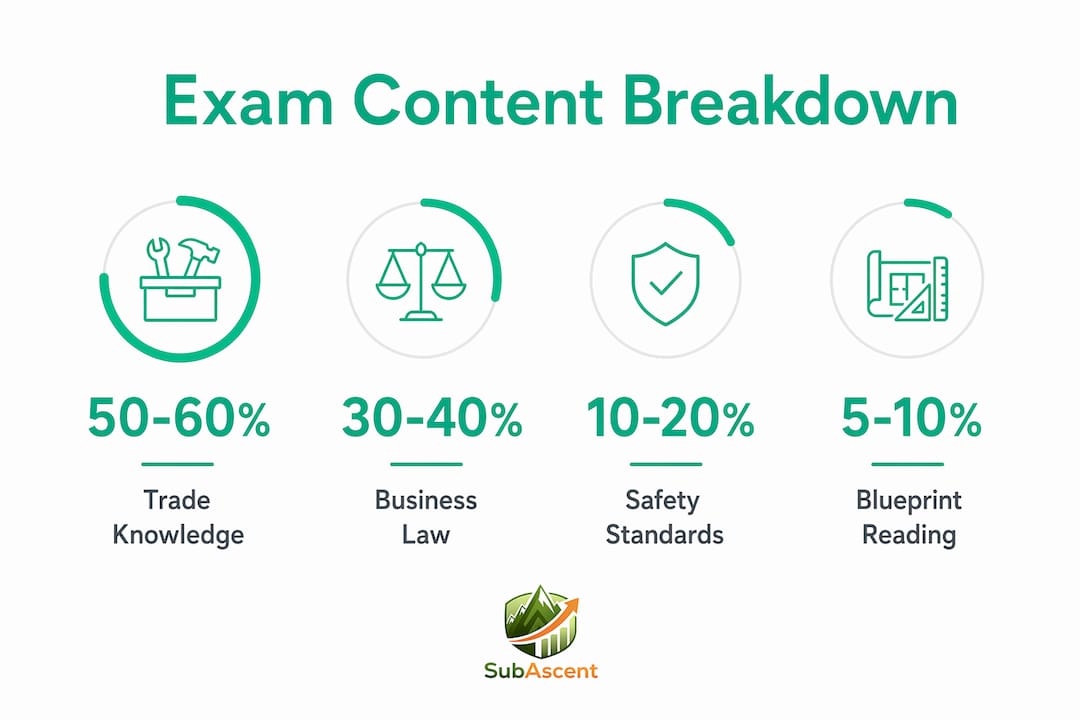
Knowing this breakdown changes how you allocate your study time. Spending 80% of your prep on trade knowledge and ignoring business law is the fastest path to a failing score.
How do state requirements and exam formats vary?
No federal contractor license exists in the United States. Every state sets its own contractor licensing requirements, exam format, passing score, and experience prerequisites. That means a license earned in Florida does not automatically transfer to Georgia or Texas.

Most states require candidates to complete 2–4 years of verified journeyman-level work experience before they can even sit for the exam. States also typically require proof of liability insurance and a surety bond as part of the full licensing process. The total cost of obtaining a license, including exam fees, bonds, and application costs, ranges from $2,500 to $8,000 or more depending on the state.
Exam formats vary too. Most states use multiple-choice, computer-based tests with time limits ranging from two to four hours per section. Passing scores typically fall between 70% and 75%, though some states set the bar higher for certain trades.
One significant development in contractor testing procedures is the NASCLA (National Association of State Contractors Licensing Agencies) accredited exam. Several states accept the NASCLA exam for reciprocity, meaning a candidate who passes it can apply for licensure in multiple participating states without retesting. For roofing, framing, or drywall contractors who work across state lines, this is worth investigating before you register for a state-specific test.
| State Feature | Typical Range or Standard |
|---|---|
| Experience required | 2–4 years verified journeyman work |
| Passing score | 70–75% |
| Exam format | Multiple-choice, computer-based |
| Exam sections | Trade knowledge + Business and Law |
| NASCLA reciprocity | Available in select participating states |
| Total licensing cost | $2,500–$8,000+ |
Pro Tip: Check whether your target state accepts the NASCLA-accredited exam. If you plan to work in multiple states, passing one accredited exam can save you months of repeated testing.
What are the most effective strategies for passing the contractor exam?
Passing the contractor license test requires a structured plan, not just experience. Candidates typically dedicate 4–10 weeks to preparation, studying 10–15 hours per week. Cramming the week before the exam does not work for most people. Consistent, spaced study sessions produce better retention.
Start with the Candidate Information Bulletin (CIB). The CIB is the definitive guide for your state's exam. It lists the exact code books, reference materials, and rules you need. Studying from outdated materials or the wrong code edition wastes weeks of effort.
Top study strategies for the contractor exam:
- Take timed practice exams from the first week of prep, not just the last
- Review every wrong answer and understand why it is wrong, not just what the right answer is
- Build familiarity with your reference book indexes so you can find answers quickly
- Focus extra time on business and law topics, especially lien laws and contract provisions
- Use official prep courses or state-approved study guides, not generic construction textbooks
- Study the specific state statutes referenced in your CIB, not general business principles
For open-book exams, speed with your reference materials is the real skill being tested. Quick look-up drills are as important as knowing the content. Practice finding key formulas and code sections in under 30 seconds. If you cannot locate information quickly during the exam, you will run out of time.
One rule that trips up candidates every year: over-tabbing reference books or adding personal notes to them can get your materials rejected at check-in. Use only publisher-provided index tabs and follow the exam center's rules exactly. Losing your reference books at the door is an automatic disadvantage you cannot recover from.
Pro Tip: Do a full dress rehearsal the week before your exam. Sit down with your reference materials, set a timer, and complete a full practice test under real conditions. It removes the surprise factor on exam day.
What challenges do candidates face and how do you fix them?
First-time pass rates hover around 40–50% for contractor license exams. That number reflects a specific, recurring problem: experienced tradespeople underestimate the business and law section.
A plumber with 15 years in the field knows pipe sizing and pressure testing cold. But the exam does not ask how to fix a leak. It asks about lien filing deadlines, contract termination clauses, and workers' compensation requirements. Applying job-site logic instead of legal and statutory knowledge is the most common reason candidates fail. The exam rewards knowledge of what the law says, not what you would do on the job.
Time management is the second major failure point. Candidates who spend too long on difficult trade questions run out of time before finishing the business and law section. Practice tests solve this directly. They train you to move on when you are stuck and return to hard questions later.
For candidates retaking the exam, the fix is not more hours of the same study. Changing study methods boosts retake success rates more than simply increasing time spent. Analyze your score report, identify the specific subject areas where you lost points, and rebuild your study plan around those gaps.
Steps for handling a retake effectively:
- Request your score breakdown from the testing vendor immediately after failing
- Identify the two or three subject areas with the lowest scores
- Reread the relevant sections of your CIB and update your reference materials if needed
- Shift at least 60% of your remaining study time to your weakest areas
- Take three to five full timed practice exams before rescheduling your retake
Pro Tip: Treat the retake as a different exam, not a second attempt at the same one. Your study plan should look meaningfully different from the first time.
Key Takeaways
A contractor license exam tests both trade knowledge and business law, and candidates who underestimate the business and law section account for the majority of first-time failures.
| Point | Details |
|---|---|
| Two-section structure | Every exam covers trade knowledge and business and law as separate scored sections. |
| Business law weight | Business and law content makes up 40–50% of exam questions in most states. |
| State-specific rules | No federal license exists; each state sets its own passing score, format, and prerequisites. |
| Structured prep works | Study 10–15 hours weekly for 4–10 weeks using your state's CIB as the primary guide. |
| Retake strategy matters | Changing study methods, not just adding hours, is what improves retake outcomes. |
The part most candidates get wrong
Most tradespeople walk into a contractor license exam thinking their years on the job will carry them through. I understand that instinct. If you have spent a decade running electrical rough-ins or framing walls, the trade section feels manageable. The business and law section is where that confidence becomes a liability.
The exam does not care how many jobs you have completed. It cares whether you know the statutory deadline for filing a mechanics lien in your state, or what the law requires when a contract is terminated for convenience. Those are not things you pick up on a job site. They require deliberate study of specific legal references.
The candidates I have seen succeed are not necessarily the most experienced. They are the ones who treat the exam like a new skill to learn, not a formality to get through. They use the CIB as their north star, they practice with timed tests from week one, and they spend more time on business law than feels comfortable. That discomfort is the point. Knowing a subcontract agreement inside and out, understanding how contractor bonding works, and being fluent in lien law are not just exam topics. They are the foundation of running a trade business that does not get burned.
— Dave
Resources for contractors building their business knowledge
Passing the exam is step one. Running a profitable trade business after licensure is the longer game.
Subascent publishes practical guides built specifically for specialty trade contractors, including electrical, plumbing, HVAC, roofing, and other sub trades. The content covers the business side of contracting: bonding, subcontract agreements, job costing, and the administrative work that keeps a trade business running. If you are preparing for your license exam and want to build real business knowledge alongside your test prep, explore Subascent's resources for guides written by people who have actually run trade businesses.
FAQ
What is a contractor license exam?
A contractor license exam is a state-required standardized test that assesses a contractor's trade knowledge and business law proficiency before granting a license to operate legally. Most states require passing both a trade section and a Business and Law section independently.
How hard is the contractor license exam to pass?
First-time pass rates hover around 40–50%, primarily because candidates underestimate the business and law content. Structured preparation over 4–10 weeks significantly improves pass rates.
What subjects are covered on the contractor license exam?
The exam covers construction methods, building codes, safety standards, blueprint reading, contracts, lien laws, insurance, and state licensing regulations. Business and law content typically makes up 40–50% of total questions.
Do contractor license requirements differ by state?
Yes. No federal contractor license exists, so each state sets its own exam format, passing score (typically 70–75%), experience requirements, and approved reference materials. Some states accept NASCLA-accredited exams for multi-state reciprocity.
Can you use reference books during the contractor license exam?
Many states allow open-book exams, but candidates must follow strict rules about tabbing and personal notes. Over-tabbing or adding unauthorized notes can result in your reference materials being rejected at check-in.