

A subcontract agreement is a legally binding contract between a primary contractor and a subcontractor that delegates a specific portion of work, defines the scope, sets payment terms, and establishes timelines to prevent disputes. If you run an electrical, plumbing, HVAC, masonry, or any other specialty trade business, this document is the legal foundation of every job you take on. Without it, you have no enforceable protection when a general contractor disputes your invoice, changes your scope, or simply stops paying. Understanding what a subcontract agreement contains and how to use it correctly is one of the most practical skills a trade owner or project manager can have.
What is a subcontract agreement and why does it matter
A subcontract agreement is the formal written record of the deal between you and the GC. It is distinct from the prime contract, which is the agreement between the GC and the project owner. Your agreement flows down from that prime contract and governs exactly what you are responsible for delivering, when, and for how much.
Most specialty trade contractors have operated on handshake deals at some point. Written agreements protect subs from non-payment risks and scope disputes that are common in construction trades. That protection disappears the moment the relationship sours and there is nothing signed to reference.

The subcontract agreement definition, at its core, covers three things: what work you will perform, what you will be paid, and when both sides must deliver. Every other clause in the document exists to protect those three commitments. For a roofing or fire protection contractor managing multiple GC relationships, a well-drafted agreement is the difference between a profitable job and a costly legal fight.
What are the essential elements of a subcontract agreement
Effective construction agreements must include clear party identification, project details, scope of work, contract value, payment schedule, timeline, dispute resolution, and termination clauses. Each element serves a specific function, and missing even one creates a gap that the other party can exploit.
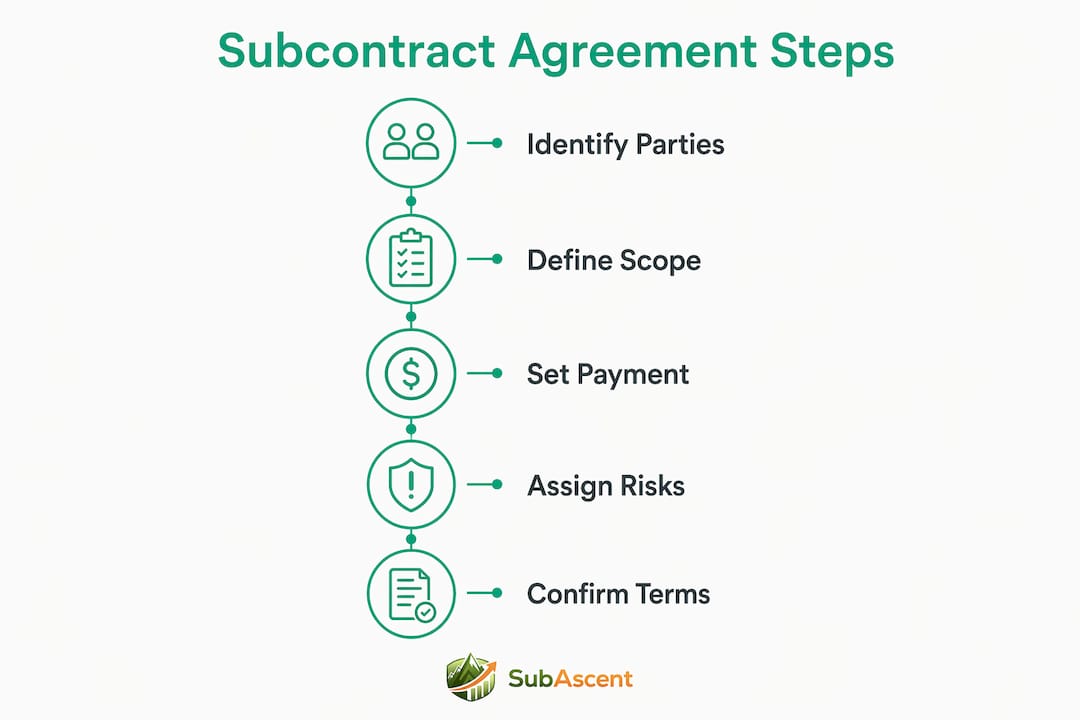
Here is what every subcontract agreement needs to cover:
- Party identification: Full legal names, license numbers, and contact details for both the contractor and the subcontractor. For trades like electrical or low-voltage, include license classifications where required by state law.
- Scope of work: A precise description of what you are doing, what materials you are supplying, and what is explicitly excluded. Ambiguity in scope boundaries frequently leads to project disputes, so meticulous detail about deliverables prevents costly conflicts.
- Contract value and payment schedule: The total price, draw schedule or milestone payments, invoicing procedures, and any retainage terms. For a drywall or framing contractor, knowing exactly when draws are released keeps cash flow predictable.
- Project timeline: Start date, key milestones, and substantial completion date. Include provisions for weather delays or owner-caused delays that affect your schedule.
- Change order procedures: How scope changes are requested, approved, and priced. This clause directly protects your profit margin.
- Dispute resolution: Whether disputes go to mediation, arbitration, or litigation, and which state's law governs.
- Termination clauses: Conditions under which either party can exit the agreement and what compensation is owed.
- Insurance and licensing requirements: Minimum coverage amounts for general liability, workers' compensation, and any trade-specific requirements.
- Independent contractor clause: A statement confirming you are not an employee of the GC and are responsible for your own taxes and benefits.
Pro Tip: Before you sign, run the agreement against a subcontract review checklist to confirm every element is present. A five-minute review can prevent a six-month dispute.
How subcontract agreements address independent contractor classification
The IRS uses a right-to-control test to determine whether a worker is an employee or an independent contractor. The test evaluates three categories: behavioral control (does the hiring party direct how the work is done), financial control (does the hiring party control business aspects like invoicing and expenses), and the type of relationship (are there employee benefits or a permanent arrangement). Misclassification risk is high when GCs control how subcontractors perform their work rather than just the results.
For trade contractors, the consequences of misclassification are serious. The GC could face liability for unpaid payroll taxes, benefits, and workers' compensation premiums. Your business could lose its independent contractor status, which affects how you bid, invoice, and operate.
The independent contractor clause in your subcontract agreement is the first line of defense. It should explicitly state:
- You are an independent contractor, not an employee.
- You are solely responsible for federal and state taxes on your earnings.
- You carry your own insurance and are not entitled to employee benefits.
- You retain the right to control the methods and means of completing your work.
"The right-to-control test remains the most critical hurdle for correctly classifying workers and avoiding tax liabilities." — LegalClarity
This is not just legal boilerplate. If a dispute arises and the IRS or a state labor agency investigates, this clause is evidence of the intended relationship. For HVAC, insulation, or glazing contractors who work with multiple GCs simultaneously, maintaining clear independent contractor status across all agreements protects your business model.
Common risks in subcontract agreements and how to avoid them
Construction subcontracting carries specific financial and legal risks that a well-drafted agreement can address directly. Here are the most common ones and how to handle them:
-
Non-payment risk. Written agreements give you legal recourse when a GC withholds payment without cause. Without a signed contract, you have almost no standing to pursue payment through lien rights or litigation.
-
Pay-when-paid clauses. These clauses make your payment contingent on the GC receiving funds from the owner. Pay-when-paid enforceability varies by state, and some states prohibit them entirely. Verify local law before you agree to this term, especially on larger commercial projects.
-
Scope creep. Failing to address change order workflows in the initial agreement causes profitability to decline on otherwise well-priced jobs. Your agreement must specify that no additional work is authorized without a written, signed change order.
-
Unverified project funding. Reviewing the master contract between the GC and the owner lets you confirm project funding and the GC's payment ability before you mobilize. This step is critical before signing any subcontract agreement on a new GC relationship.
-
Unclear lien rights. Know your state's preliminary notice requirements and lien deadlines. Your subcontract agreement should not waive lien rights before you have been paid.
Pro Tip: Ask to see the master contract details before you sign. A GC who refuses to share basic payment terms from the prime contract is a red flag worth taking seriously.
How subcontract agreements compare to other construction contracts
Understanding the difference between contract and subcontract types prevents confusion about your legal position on any project.
| Contract type | Who signs it | What it governs | Payment source |
|---|---|---|---|
| Prime contract | GC and project owner | Entire project scope and delivery | Owner pays GC |
| Subcontract agreement | GC and specialty trade sub | Specific trade scope within the project | GC pays sub |
| Purchase order | GC or sub and supplier | Material or equipment supply only | Buyer pays supplier |
| Vendor agreement | GC or sub and service vendor | Ongoing services, not project-specific work | Buyer pays vendor |
The key distinction is that a subcontract agreement creates a prime contract relationship that flows down from the GC's obligations to the owner. A purchase order, by contrast, is a transactional document for materials. A concrete or steel/rebar contractor supplying and installing rebar needs a subcontract agreement, not a purchase order, because the work involves labor, supervision, and performance obligations.
Vendors and suppliers operate outside the subcontract chain and typically do not carry the same lien rights or performance obligations as trade subs. Knowing which document applies to your role protects you from signing the wrong type of agreement and losing rights you would otherwise have.
How to create and enforce an effective subcontract agreement
Drafting a subcontract agreement does not require a lawyer for every job, but it does require discipline and attention to detail. These steps apply whether you are a painting contractor reviewing a GC's standard form or a flooring sub drafting your own template.
- Start with a clear scope narrative. Write the scope of work in plain language. Describe what you are installing, where, using what materials, and what is explicitly not included. For a fire protection contractor, that means specifying sprinkler system type, coverage area, and whether commissioning is in scope.
- Define payment triggers precisely. Tie each payment to a specific milestone or date, not vague language like "upon satisfactory completion." Vague payment terms are the most common source of subcontractor payment disputes.
- Negotiate change order language before you sign. The agreement should require written authorization before any additional work begins. A stop-work notice clause gives you the right to halt work if a change order is not approved within a defined period.
- Document everything after signing. Keep records of all communications, approvals, and field decisions. Emails and photos are evidence. Many trade PMs now use job management software to log daily reports and change order requests in real time.
- Review the agreement against your bid. Confirm that the scope in the contract matches exactly what you priced. Discrepancies between your estimate and the contract scope are a common source of underbilling.
- Verify insurance requirements before mobilizing. Some GCs require additional insured endorsements or specific coverage limits that take time to add to your policy. Missing this step can delay your start date or void your contract.
Pro Tip: Use a subcontract agreement template built for your trade as a baseline, then customize it for each GC relationship. Starting from scratch on every job wastes time and increases the chance of missing a critical clause.
Key takeaways
A subcontract agreement is the single most important document protecting a specialty trade contractor's scope, payment, and legal standing on any construction project.
| Point | Details |
|---|---|
| Core definition | A subcontract agreement is a legally binding contract delegating specific work scope, payment, and timelines from a GC to a trade sub. |
| Essential elements | Every agreement needs scope, payment schedule, timeline, change order procedures, dispute resolution, and an independent contractor clause. |
| Classification risk | The IRS right-to-control test determines worker status; your agreement must explicitly establish independent contractor status. |
| Payment protections | Verify pay-when-paid enforceability in your state and always confirm project funding by reviewing the master contract before signing. |
| Enforcement discipline | Document all approvals and changes in writing; a signed change order before work begins is the only reliable protection against scope creep. |
What I've learned from watching trade subs sign the wrong agreements
I have seen electrical and HVAC contractors lose tens of thousands of dollars on jobs they performed perfectly, simply because the contract they signed had a pay-when-paid clause the GC could hide behind while the owner disputed a change order two tiers up. The work was done. The invoice was correct. The contract made it almost impossible to collect.
The most common mistake I see is treating the subcontract agreement as a formality rather than a negotiation. Trade owners sign GC-provided forms without reading the payment terms, the dispute resolution clause, or the indemnification language. Then they are surprised when the rules of the game turn against them.
Worker classification is also tightening. The IRS and several state labor agencies have increased scrutiny on construction subcontracting arrangements, particularly in trades like drywall and framing where the line between employee and sub can blur. If your agreement does not clearly establish your independent contractor status, you are exposed.
The good news is that most of these risks are addressable before you sign. Read the payment terms. Check the change order clause. Ask for the master contract. Use job management software to track approvals and communications so you have a paper trail if a dispute arises. The trade contractors who protect their margins are the ones who treat the contract review as part of the estimating process, not an afterthought.
— Dave
Manage your subcontract agreements with Subascent

Subascent is built specifically for specialty trade contractors, including masonry, electrical, plumbing, HVAC, and roofing businesses managing multiple GC relationships at once. The platform helps you track bid invitations, organize job documents, and maintain a clear record of change orders and approvals across every active project. Instead of hunting through email threads to find a signed scope change, everything lives in one place. If you are tired of losing margin to disorganized contract workflows, explore Subascent's job and bid management tools to see how trade-specific software handles the paperwork so you can focus on the work.
FAQ
What is the subcontract agreement definition in construction?
A subcontract agreement is a legally binding contract between a general contractor and a specialty trade subcontractor that defines the scope of work, payment terms, and project timeline. It flows down from the prime contract between the GC and the project owner.
What are the key elements of a subcontract agreement?
Every subcontract agreement should include party identification, a detailed scope of work, contract value, payment schedule, project timeline, change order procedures, dispute resolution terms, insurance requirements, and an independent contractor clause.
What is the difference between a contract and a subcontract?
A prime contract is between the project owner and the general contractor covering the full project. A subcontract agreement is between the GC and a specialty trade sub covering a specific portion of that work, with payment flowing from the GC rather than directly from the owner.
Are pay-when-paid clauses enforceable for subcontractors?
Pay-when-paid clauses are enforceable in many states but restricted or prohibited in others. Trade contractors must verify local law before agreeing to this term, as it can delay or prevent payment even when work is completed correctly.
How do I protect myself from non-payment as a trade sub?
Always sign a written subcontract agreement before starting work, confirm the GC has received project funding by reviewing the master contract, and know your state's preliminary notice and mechanics lien deadlines to preserve your payment rights.