

Yes, subs should track earned value, but only on the line items where percent complete is easy to verify. The payoff is a single set of numbers, EV, PV, AC, and the CPI ratio, that tells you a job is losing money three or four weeks before the invoice pile or your gut feeling would. Skip full EVMS overhead. Watch CPI and SPI on your five biggest cost buckets per job, and you'll catch overruns while there's still time to fix them.
TL;DR:
- Tracking earned value on verifiable line items helps identify job overruns three to four weeks early, especially when CPI drops below 0.95.
- Focus on measuring percent complete through reliable methods like units, hours, milestones, or quantity progress, and keep the method consistent.
- Daily cost capture from existing documents like timecards, invoices, and schedules ensures accurate inputs for CPI and SPI calculations.
- Avoid overcomplicating EVM by applying it only to high-risk or labor-heavy cost codes rather than the entire project.
- Using software that integrates scheduling, field data, and accounting simplifies data collection and improves the accuracy of earned value metrics.
Table of Contents
- What Is Earned Value for Subs, and What Do PV, EV, and AC Mean?
- A Worked Example: $120,000 Mechanical Rough-In
- How Do You Measure Percent Complete on a Trade Job?
- Where Do the Numbers Actually Come From?
- What Mistakes Do Subs Make With Earned Value, and How Do You Fix Them?
- How Do You Start Using Earned Value Management This Month?
- Field Notes: What Earned Value Actually Catches
- Keep It Small, Keep It Honest
- Let Subascent Handle the Data Capture Behind Your EVM Numbers
- Sources
- FAQ
What Is Earned Value for Subs, and What Do PV, EV, and AC Mean?
Earned value management, or EVM, is a method for comparing what you planned to spend, what you've actually earned by finishing work, and what you've actually spent. For a subcontractor, that means tying dollars to a schedule of values instead of just watching a bank balance. The NASA earned value tutorial frames it simply: EV, sometimes called BCWP (budgeted cost of work performed), is the value of work actually completed, measured against your original budget, not what you billed.
Three numbers drive everything else:
- Planned value (PV): the budget you scheduled to spend by this point in the job, time-phased against your baseline schedule.
- Earned value (EV): the budgeted value of the work you've actually finished, calculated as percent complete multiplied by the budget at completion (EV = % Complete × BAC).
- Actual cost (AC): what you've really spent so far, pulled from timecards, material invoices, and subcontract costs.
From those three, you get four more numbers that do the real work:
- Schedule variance (SV): EV minus PV. Negative means you're behind schedule.
- Cost variance (CV): EV minus AC. Negative means you're spending more than the work is worth.
- Cost performance index (CPI): EV divided by AC. Below 1.0 means you're losing money on every dollar spent.
- Schedule performance index (SPI): EV divided by PV. Below 1.0 means you're behind pace.
A CPI of 0.85 is not a rounding error. It means every dollar you spend is only returning 85 cents of earned value, and if that ratio holds for the rest of the job, you'll blow the budget by roughly 15%. That's the moment to pull job-cost reports, check labor productivity, and figure out whether it's a pricing problem, a crew problem, or scope creep nobody documented. An SPI under 0.9 tells a different story: you're behind pace, which might mean nothing if the GC's schedule slipped too, or might mean your crew count is wrong for the remaining scope.
A Worked Example: $120,000 Mechanical Rough-In
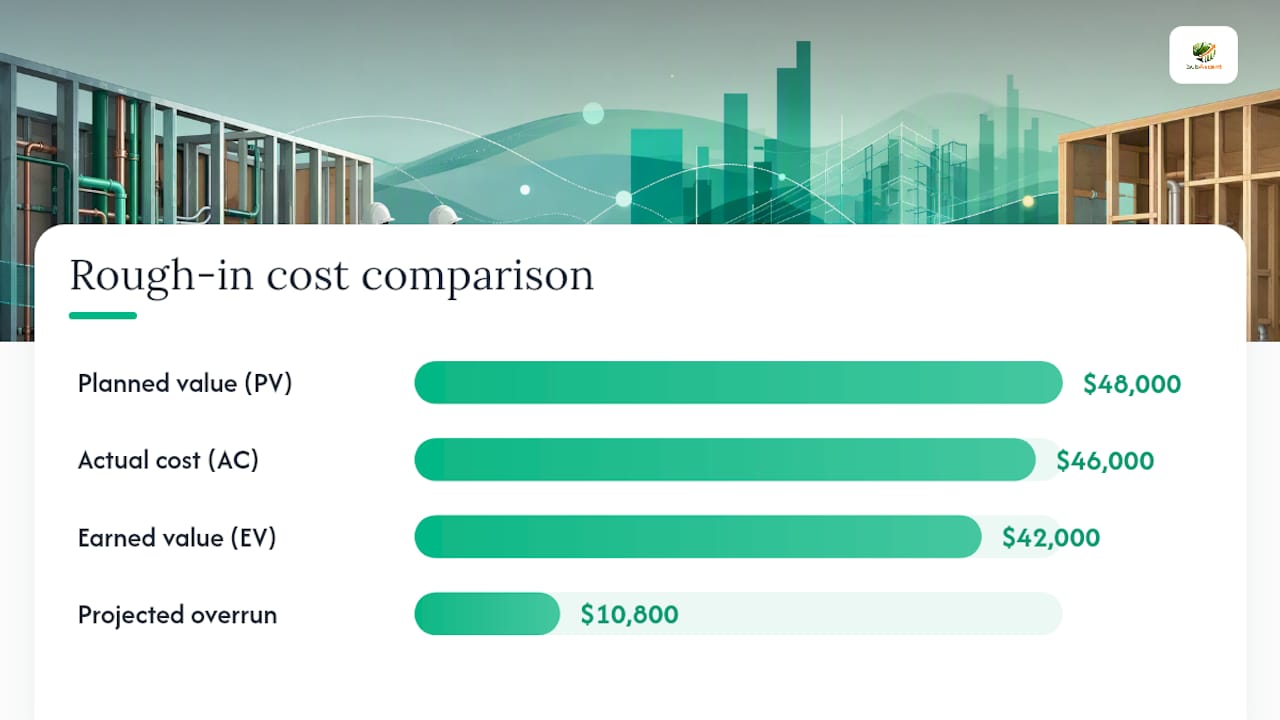
Numbers make this concrete faster than definitions do. Say you've got a $120,000 mechanical rough-in package with a four-month schedule.
At that status date, your foreman reports the crew has actually finished 35% of the scoped work, verified against the takeoff. That gives you EV = 0.35 × $120,000 = $42,000. Meanwhile, job cost pulls show you've spent $46,000 in labor, material, and equipment. That's your AC.
Now the formulas do their job:
- SV = EV − PV = $42,000 − $48,000 = −$6,000 (behind schedule)
- CV = EV − AC = $42,000 − $46,000 = −$4,000 (over budget)
- CPI = EV ÷ AC = $42,000 ÷ $46,000 = 0.91
- SPI = EV ÷ PV = $42,000 ÷ $48,000 = 0.875
Pro Tip: If your billing that month shows 40% complete because that's what the schedule says you "should" be at, but EV says 35%, you've just found the overbilling trap. Billings track the contract schedule; EV tracks what's actually in the wall. Practical field guides call this out as a real cash timing risk, because when a GC's owner audits progress against retention later in the job, the gap between what you billed and what you earned has to reconcile somehow, and it rarely reconciles in your favor. A Struvia field guide on construction EVM walks through this exact pattern.
A CPI of 0.91 on a $120,000 package projects to roughly $10,800 in overrun if nothing changes. That's a phone call to the foreman today, not a conversation with your accountant in six weeks.
How Do You Measure Percent Complete on a Trade Job?
The whole system falls apart if percent complete is a guess. Subs have four reliable ways to measure it, and the right one depends on what your foreman can actually verify without extra paperwork.
- Units or count method: Best for repetitive, countable work. Count fixtures installed, outlets trimmed, or doors hung against the total scope.
- Labor-hours method: Compare hours burned against hours estimated for the scope. Works well when the work isn't easily counted but hours are tracked closely.
- Milestones or inspection method: Assign percent complete at defined checkpoints, rough-in passed, cover-up complete, final trim, rather than continuous tracking. Good for phases where partial credit doesn't make sense.
- Quantity progress from takeoffs: Measure installed quantity against the original takeoff, square footage, linear feet, cubic yards, and calculate percent complete directly.
Here's how that plays out by trade. Electrical subs often use circuits energized or devices trimmed against the panel schedule. Drywall crews track sheets hung and taped separately, since hanging and taping earn value at different rates. Concrete measures cubic yards poured against the total pour schedule, which is about as clean a quantity metric as construction offers. Roofing tracks square footage installed against the total roof area from the takeoff.
Pro Tip: Pick one method per line item and stick with it for the whole job. Switching between "we're about 60% done" eyeball estimates and actual counts halfway through a job destroys the trend line, and the trend line is the entire point of tracking CPI and SPI over time. The method should match what your foreman can verify in the field without extra forms, not what looks most precise on paper.
Where Do the Numbers Actually Come From?
EVM only works if the inputs come from documents you already generate, not a separate reporting exercise nobody has time for. Here's the mapping:
- Planned value comes from your schedule of values (SOV). Take the SOV, break it into your project schedule's timeline, and you have a time-phased baseline. If you bid $120,000 for mechanical rough-in over four months, your baseline should show planned spend by week or month, not just a lump total.
- Actual cost comes from four places you're probably already tracking: payroll and timecards for labor, material receipts and vendor invoices, subcontract or sub-tier invoices if you're subbing part of the scope, and equipment hours if you're renting or running owned equipment against the job.
- A single job-cost sheet should hold all of it. Don't split labor tracking in one spreadsheet and material costs in another. If PV, EV, and AC live in different places, nobody will reconcile them consistently, and the numbers will drift apart from reality within a month.
- QuickBooks sync closes the loop on AC. If your job costing already flows into QuickBooks, make sure labor and material postings are tagged to the specific cost code or line item, not lumped into a general job total. That's the difference between a usable AC figure and a number you have to manually untangle every Friday.
- Pick a status date cadence and hold to it. Weekly works for most trade packages. Monthly is too slow to catch a CPI slide before it compounds; the LibreTexts EVM chapter notes that EV analysis is only as good as the status date discipline behind it.
Getting job costing set up correctly the first time matters more than any formula. A closer look at job costing basics for trade contractors covers the WIP structure that makes EVM data trustworthy instead of a monthly guessing exercise.
What Mistakes Do Subs Make With Earned Value, and How Do You Fix Them?
Most EVM failures for subs aren't math errors. They're process gaps that corrupt the inputs before the formulas ever run.
- Inconsistent percent-complete rules. One foreman eyeballs 70%, another counts fixtures. Fix it by locking a single method per line item and writing it down so it survives a foreman change.
- Late AC posting. If material invoices sit in a folder for three weeks before data entry, your CPI is always stale by the time you see it. Fix it with a weekly cost-capture routine, even if it's just twenty minutes every Friday pulling receipts and timecards into the job-cost sheet.
- Equating billings to progress. As the worked example above showed, what you bill the GC and what you've earned are two different numbers. Keep them separate columns on the WIP report, not one blended figure.
- Ignoring change orders. An approved CO that isn't reconciled into your BAC (budget at completion) throws off every downstream calculation. Practical guides on construction EVM recommend adding an EV column directly to the WIP and folding change orders into the baseline the moment they're signed, not at job close.
Once the inputs are clean, use CPI and SPI to triage, not panic. A CPI between 0.95 and 1.05 is normal drift. Below 0.90 on a package worth real money is a trigger to pull labor productivity reports that week. If SPI is dragging because the GC's overall schedule slipped, and it's not your crew's pace, that's a documented conversation with the general contractor about schedule impact, not an internal fire drill.
How Do You Start Using Earned Value Management This Month?
You don't need software or a certification to run a basic version of this on one job. Here's the sequence:
- Pick one job and one package, ideally $50,000 or more, where percent complete is genuinely measurable.
- Build a time-phased baseline from your SOV, spread across the schedule week by week.
- Write down your percent-complete rule for that package and share it with the foreman.
- Set a status-date cadence. Weekly is the sweet spot for most trade work.
- Capture actual costs weekly: labor, material, equipment, sub-tier invoices, all in one job-cost sheet.
- Compute EV, SV, CV, CPI, and SPI at each status date and log the trend, not just the snapshot.
- Take corrective action on anything with CPI or SPI outside your comfort band, then write down what triggered it and what fixed it.
Pro Tip: Give yourself four weeks before judging whether this is worth continuing. One data point tells you nothing. A trend across three or four status dates tells you everything. Once you've run it clean on one package, standardize the method and roll it into your next bid without reinventing the wheel.
Field Notes: What Earned Value Actually Catches
A drywall sub running a 40,000 square foot commercial job used sheets-hung-and-taped as the percent-complete rule, split into two separate tracking lines since hanging and taping earn value differently. Three weeks in, CPI dropped to 0.88 on the taping line while hanging held steady near 1.0. The fix was a labor swap, not a schedule fight with the GC, and CPI climbed back to 0.97 within two weeks.

The low-effort version of this discipline comes down to three habits: foreman signoff on percent complete each week, timestamped photos as backup documentation, and a fixed weekly slot for cost capture instead of catching up at month end.
Keep It Small, Keep It Honest
The mistake I see subs make isn't skipping EVM. It's trying to run it on every line item of every job from day one, burning out on paperwork, and quitting after six weeks. Start with the two or three cost codes that carry the most risk on your current bid, labor-heavy line items usually deserve the attention first, and get comfortable with the rhythm before you scale it. Full EVMS compliance, the kind that DFARS mandates on large government contracts, is overkill for a $2 million-a-year electrical sub. A tight version, applied consistently, beats a comprehensive version applied for one job and abandoned.
— Dave
Let Subascent Handle the Data Capture Behind Your EVM Numbers
Running earned value by hand means chasing timecards, reconciling QuickBooks entries, and building a time-phased SOV baseline every time you bid new work, all before you get to the formulas. Job and bid management software maps directly to that workflow: your schedule of values becomes the baseline, field crews log hours through a mobile app instead of a paper timecard nobody can read, and job-cost data syncs to accounting software without a manual re-entry step.

That means the percent-complete and actual-cost numbers behind your CPI and SPI are already sitting in one place instead of scattered across three spreadsheets and a shoebox of receipts. Pair it with PDF takeoff tools for quantity-based percent complete, and the fixes for QuickBooks job-cost accuracy covered above become part of your daily workflow instead of a monthly cleanup project. If equipment hours factor into your actual costs, a tool tracking pilot program closes that gap too. Visit the website of a job and bid management software provider to start a free trial and see your first job's earned value numbers inside a week.
Sources
FAQ
How Do I Calculate Earned Value?
Multiply percent complete by the budget at completion: EV = % Complete × BAC.
How Do You Calculate CPI and SPI?
CPI equals EV divided by AC, and it tells you cost efficiency; a CPI under 1.0 means you're spending more than the work is worth. SPI equals EV divided by PV and measures schedule pace the same way, both defined in InEight's construction EVM guide.
Do I Need to Get Certified in EVM to Use It?
No. Formal EVM certification and full ANSI/EIA-748 compliance matter mainly for contractors on large government contracts where DFARS thresholds require it. A small trade sub can track PV, EV, AC, CPI, and SPI on a spreadsheet or through software like Subascent without any credential.
What's the Difference Between Billings and Earned Value?
Billings reflect what you've invoiced the GC based on the payment schedule; earned value reflects what work is actually finished, verified against percent complete. The gap between them is exactly what exposes the overbilling trap covered earlier in this guide.
Which Line Items Should a Small Sub Track First?
Start with the two or three highest-dollar or highest-risk cost codes on a job, not the entire scope. That gives you a strong read on job health without turning EVM into a full-time administrative task.