

Getting into subcontract trade bidding means mastering a multi-channel approach that combines digital bidding platforms, strong general contractor relationships, and precise estimating. The industry term for this practice is the subcontract bidding process, and specialty trades including electrical, HVAC/mechanical, masonry, plumbing, and fire protection operate within it every day. Tools like BuildingConnected, iSqFt, and USASpending.gov form the digital backbone of a modern bid pipeline. Subcontractors who treat bidding as a system rather than a reaction consistently outperform those who chase every invitation without a filter. This guide gives you the exact framework to build that system.
What platforms and tools do specialty trade subcontractors need for bidding?
The foundation of any subcontractor bidding strategy is knowing where opportunities live before your competitors do. Bid rooms and platforms like BuildingConnected and iSqFt serve as primary sources for identifying subcontracting opportunities early. BuildingConnected, owned by Autodesk, dominates commercial construction in the United States and gives electrical, drywall, and roofing subs access to GC invitation lists. iSqFt targets mid-market commercial work and is widely used by concrete, framing, and masonry trades.
For federal and public work, USASpending.gov and the SBA SubNet portal are non-negotiable starting points. USASpending.gov lets you monitor prime contract awards in real time, so you can identify which GCs just won contracts and approach them before their subcontracting plan is locked. SBA SubNet posts subcontracting opportunities directly from federal prime contractors. Procore's bid management module is also worth noting, though it functions more as a GC-facing tool that subs interact with reactively.
BIM software adds another layer. Autodesk Revit and Navisworks are the two platforms GCs most commonly reference in subcontract agreements. If your trade does not have in-house BIM capability, outsourced BIM coordination services give you access to coordinated models without the overhead of a full VDC team.
| Platform | Best for | Primary users |
|---|---|---|
| BuildingConnected | Commercial GC invitations | Electrical, HVAC, drywall, roofing |
| iSqFt | Mid-market commercial bids | Concrete, masonry, framing |
| USASpending.gov | Federal prime contract monitoring | All trades pursuing public work |
| SBA SubNet | Federal subcontracting postings | DBE, 8(a), SDVOSB certified subs |
| Autodesk Revit | BIM coordination and takeoff | HVAC, fire protection, low-voltage |
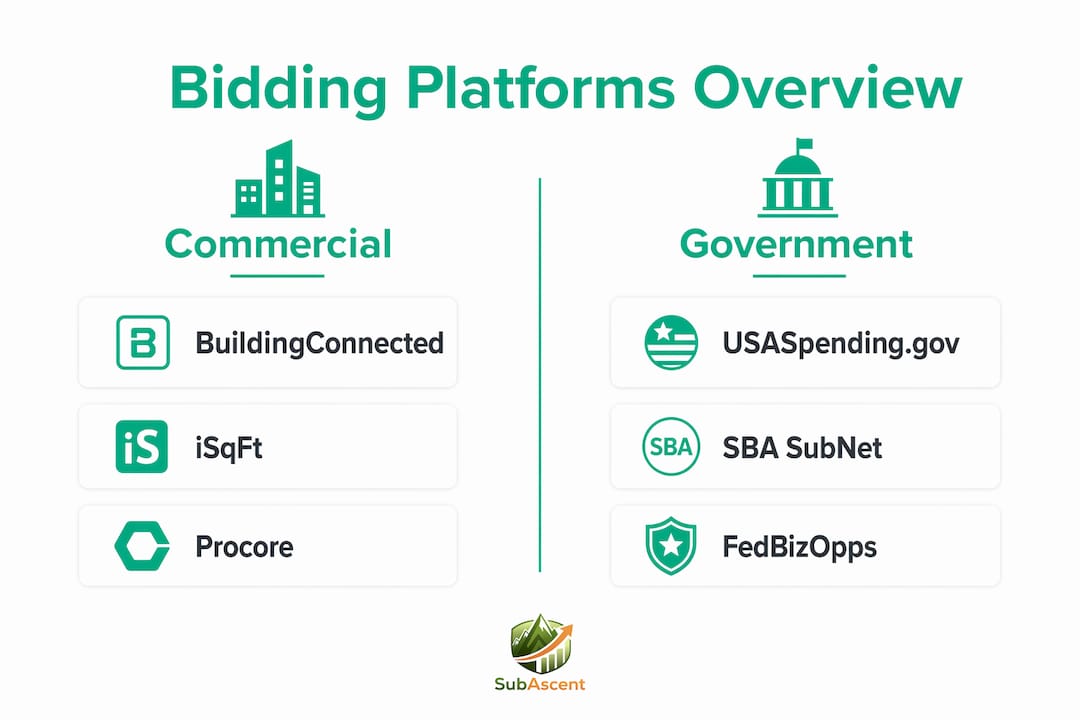
Pro Tip: Pick two platforms maximum when starting out. Electrical and low-voltage subs get the most volume from BuildingConnected. Masonry and concrete trades often find better-fit projects on iSqFt or regional plan rooms.
How do specialty trade subs build relationships that generate bid invitations?
Relationships are the highest-return investment in the subcontract bidding process. Subcontractors with focused relationship-heavy strategies consistently achieve hit rates between 25 and 35%, compared to 12 to 18% for subs who bid indiscriminately. That gap represents real revenue. A roofing or glazing sub winning one in three bids versus one in eight is a fundamentally different business.
Before you invest time in any bid, apply a three-factor qualification test: relationship status, scope alignment, and schedule feasibility. If you answer no to two of the three, pass on the bid. This single filter saves estimating hours and focuses your energy on work you can actually win.
To build the relationships that make that test easier to pass, follow this sequence:
- Research target GCs. Use USASpending.gov for federal work and local bid history databases for commercial projects. Identify GCs who regularly award work in your trade and geography.
- Prepare a capability statement. One page. Your trade specialty, bonding capacity, key projects, safety record, and certifications. Electrical and fire protection subs should include license numbers and jurisdictions.
- Make direct contact. Call the preconstruction manager or estimator, not the main office line. Reference a specific project they recently won or bid.
- Attend industry events. AGC chapter meetings, SMACNA events for HVAC/mechanical subs, and local ABC chapter gatherings put you in the same room as the people who send out bid invitations.
- Follow up quarterly. Send a short note with something useful: a value engineering idea, a material lead time update, or a project reference. This is not a sales call. It is a professional check-in.
Subcontractors on a GC's trusted list receive early bid invitations and better project communication. Getting on that list takes six to twelve months of consistent outreach. Staying on it takes reliability and responsiveness on every job.
Pro Tip: Value engineering recommendations sent before bid day signal that you understand the project and want the GC to win. A plumbing or insulation sub who identifies a spec substitution that saves $40,000 gets remembered.
What is the step-by-step process for preparing and submitting a strong bid?
A disciplined bid preparation workflow separates subs who win work from those who fill out bid boards. Here is the sequence that works for specialty trades across electrical, HVAC, masonry, and similar scopes.
- Review the invitation to bid and documents. Read the full spec section for your trade before touching the drawings. Spec books define quality standards, substitution procedures, and submittal requirements that directly affect your price.
- Complete a site visit. For renovation and occupied-building work, a site visit is not optional. Conditions in the field rarely match what is shown on drawings.
- Perform quantity takeoff. PDF takeoff tools like Bluebeam Revu work well for linear and area measurements. If BIM models are available, pre-bid BIM quantity extraction reduces errors and produces more competitive, defensible bids.
- Price the work. Apply current labor rates, material costs, and equipment. Build in your overhead and margin. Do not guess at interface costs with other trades. Define them explicitly.
- Write clear inclusions and exclusions. This is where most subs lose money. Spell out exactly what your bid covers and what it does not. Drywall subs should state whether metal framing is included. Fire protection subs should define the tie-in point.
- Submit on time with a cover letter. A one-paragraph cover letter referencing the project, your bid total, and your key differentiators takes five minutes and sets you apart from subs who submit a bare number.
After submission, follow a three-touch communication model: confirm receipt immediately, send a value-add note mid-cycle (a value engineering option or lead time update), and check final status three to five days before award. This sequence moves you from the pile to the preferred column.
Common mistakes to avoid:
- Bidding without reading the full spec section for your trade
- Leaving interface scope undefined between your work and adjacent trades
- Submitting a number with no backup or clarifications
- Going silent after submission and waiting for a call that never comes
- Ignoring subcontract agreement terms until after award, when it is too late to negotiate
How can specialty trade subs use government contracts to expand their bid pipeline?
Federal subcontracting is an underused channel for electrical, HVAC, masonry, and steel/rebar trades. When a federal agency awards a prime contract above $750,000, the prime contractor is typically required to submit a subcontracting plan with goals for small and disadvantaged business participation. That plan creates direct demand for qualified subs.
Subcontractors should monitor prime contract awards on USASpending.gov to proactively identify GCs with active subcontracting goals. Filter by NAICS code for your trade and geography. When you find a relevant award, contact the prime's small business liaison officer directly.
Certifications accelerate this process significantly. Federal certification programs including DBE, 8(a), SDVOSB, and HUBZone increase your attractiveness to primes who need to meet mandated subcontracting goals. Key points on each:
- DBE (Disadvantaged Business Enterprise): State-administered, required on federally funded transportation and infrastructure projects. Relevant for concrete, masonry, and steel/rebar trades.
- 8(a) Business Development: SBA-administered program for socially and economically disadvantaged firms. Provides access to sole-source and set-aside contracts.
- SDVOSB (Service-Disabled Veteran-Owned Small Business): VA and DoD contracts carry specific SDVOSB goals. Electrical and low-voltage trades are well-positioned here.
- HUBZone: Geographic-based certification for businesses in historically underutilized zones. Primes in urban redevelopment projects actively seek HUBZone subs.
Beyond certifications, contact Agency OSDBU (Office of Small and Disadvantaged Business Utilization) offices directly. They maintain lists of primes with open subcontracting plans and will connect you with the right contacts. Document every subcontract you perform for federal primes carefully. That past performance record becomes your most valuable asset for winning the next federal opportunity.
How does BIM capability give specialty trade subs a competitive edge?
BIM is no longer a bonus skill for HVAC, fire protection, and electrical subs. General contractors increasingly require BIM compliance written directly into subcontract agreements. A sub who cannot participate in model coordination meetings is disqualified before the bid is even reviewed.
The four BIM use cases that matter most for specialty trade subs are:
- Pre-bid quantity takeoff: Extract linear footage, equipment counts, and area measurements directly from the model. This is faster and more accurate than PDF takeoff for complex MEP and fire protection scopes.
- Coordination meetings: Clash detection in Navisworks catches conflicts between HVAC ductwork, plumbing, and structural elements before they become field RFIs. Subs who show up to coordination meetings prepared reduce GC headaches.
- Shop drawing production: BIM-generated shop drawings are faster to produce and easier for GCs to approve than hand-drafted submittals.
- 4D scheduling: Linking your BIM model to the project schedule demonstrates schedule awareness and helps GCs plan sequencing.
Outsourcing BIM services is a practical entry point for smaller subs who cannot justify a full-time VDC coordinator. Several firms specialize in trade-specific BIM coordination for electrical, plumbing, and HVAC subs on a per-project basis. The cost is recoverable in reduced RFIs and faster submittal approvals.
Subs who deliver accurate as-built BIM models and structured closeout data reduce GC administrative burden at project end, which directly translates into repeat bid invitations. BIM skills transition from a technical requirement into a business development tool when you use them to secure negotiated work ahead of open bidding.
Pro Tip: Train your project managers to navigate BIM models in Autodesk Viewer, which is free. They do not need to model. They need to read the model, catch conflicts early, and communicate them to the GC before the RFI clock starts.
Key takeaways
Specialty trade subcontractors who combine targeted platform use, disciplined bid qualification, consistent GC relationship-building, and BIM capability win at rates two to three times higher than those who bid reactively.
| Point | Details |
|---|---|
| Platform selection matters | Start with BuildingConnected or iSqFt based on your trade and project type, not both at once. |
| Qualify before you bid | Apply the three-factor test (relationship, scope fit, schedule) to every invitation before committing estimating hours. |
| Follow up after submission | Use a three-touch model: receipt confirmation, value-add note, and final status check before award. |
| Certifications open federal doors | DBE, 8(a), SDVOSB, and HUBZone certifications directly help primes meet subcontracting plan goals. |
| BIM is a business development tool | Subs with BIM capability get invited to negotiate work before it goes to open bidding. |
What I have learned after years of watching subs win and lose bids
The subs who struggle with bidding almost always have the same problem: they are trying to win through volume. They chase every invitation, build estimates on projects they have no relationship on, and wonder why their hit rate sits at 10%. The math does not work. You cannot estimate your way to profitability if you are winning one in ten bids.
The subs who grow consistently do something different. They pick fewer bids and go deeper on each one. They know the GC's estimator by name. They have walked the site. They have already had a conversation about value engineering options before the bid is due. By the time they submit, they are not competing on price alone. They are competing on trust, and GCs prefer subs they know will perform even when the price is slightly higher.
BIM changed the game for the subs I have seen use it well. An HVAC or fire protection sub who shows up to a preconstruction meeting with a coordinated model is not just technically capable. They are signaling to the GC that this project will run smoothly. That signal is worth more than a 2% price difference.
The last thing I will say: track your bids. Know your hit rate by GC, by project type, and by trade scope. If you are not tracking, you are guessing. And guessing is not a subcontractor bidding strategy. It is just hope.
— Dave
How Subascent helps specialty trade subs manage their bid pipeline
Subascent is built specifically for specialty trade subcontractors, not general contractors. The platform lets electrical, plumbing, HVAC, masonry, and roofing subs track every incoming bid invitation, manage due dates, and organize their bid history in one place without rebuilding a spreadsheet every week. You can see your hit rate by GC, monitor which projects are active, and keep your estimating team aligned on what is in the queue. For subs who want to improve their bid management workflow, Subascent removes the administrative drag that costs estimators hours every week. Start a free trial at subascent.com and see how much time your team gets back.
FAQ
What is subcontract trade bidding?
Subcontract trade bidding is the process by which specialty trade contractors, such as electrical, plumbing, or HVAC firms, submit priced proposals to general contractors for specific scopes of work on a construction project. It includes identifying opportunities, preparing estimates, and submitting bids through platforms like BuildingConnected or iSqFt.
What hit rate should a specialty trade sub expect?
Subcontractors using focused relationship-based strategies achieve hit rates between 25 and 35%. Subs who bid indiscriminately without qualifying opportunities average 12 to 18%. Tracking your hit rate by GC and project type is the fastest way to identify where to focus your bidding effort.
How do I get on a GC's bid list?
Send a capability statement directly to the GC's preconstruction manager, reference a specific project they are working on, and follow up consistently every quarter. Attending AGC or ABC chapter events in your region accelerates the process by creating face-to-face contact before a formal outreach.
Do certifications like DBE or 8(a) help with subcontract bidding?
Yes. Federal certifications including DBE, 8(a), SDVOSB, and HUBZone make your firm more attractive to prime contractors who must meet mandated subcontracting goals on federal projects. These certifications are free to obtain and directly map to subcontracting plan requirements.
Is BIM required for specialty trade subcontractors to bid on commercial projects?
BIM compliance is increasingly written into subcontract agreements for commercial and federal projects, particularly for HVAC, fire protection, electrical, and low-voltage trades. Subs without BIM capability can access outsourced BIM coordination services on a per-project basis as a practical starting point.