

If you run electrical, plumbing, HVAC, roofing, or any other specialty trade, you already know the problem. Bid invitations come at you from every direction. One GC sends an invite through Procore, another uses Bid Clerk, a third just emails a PDF. Understanding the types of subcontractor bid invitations you receive is not just administrative housekeeping. It determines which jobs you chase, how much prep work you do, and whether you even have a realistic shot at winning.
Table of Contents
- Key takeaways
- Criteria for evaluating bid invitations before you respond
- Types of subcontractor bid invitations explained
- Comparing bid invitation types at a glance
- Best practices for tracking and responding to bid invitations
- My take on managing the bid invitation mess
- How Subascent keeps your bid pipeline organized
- FAQ
Key takeaways
| Point | Details |
|---|---|
| Know your invitation type first | Open, selective, negotiated, and serial bids each require a different strategy and level of effort. |
| Compliance kills bids fast | Missing a bond requirement or skipping a mandatory site visit gets you disqualified before anyone reads your price. |
| Centralize your bid tracking | A single log that captures invite date, due date, and status prevents missed deadlines and lost revenue. |
| Selective bids have the best odds | Curated invite lists favor known subs, so winning those relationships matters more than chasing every open bid. |
| Software closes the gap | Tools that capture invites from email and multiple GC platforms automatically are the only practical fix at scale. |
Criteria for evaluating bid invitations before you respond
Before you spend three hours on a takeoff, take five minutes to vet the invitation itself. Most electrical and mechanical estimators skip this step and burn time on bids they were never going to win.
Here is what to check immediately when an invite lands:
- Scope and trade fit. Does the scope actually match what your crew does? A fire protection company that specializes in wet systems should not be pricing dry-pipe suppression in a cold-storage facility unless they have done it before.
- Bid due date and review window. A 7 to 14-day minimum review period is standard on formal public invitations. If an invite drops with 48 hours to bid, that is a red flag about how the GC manages their jobs.
- Mandatory pre-bid conferences. If a site visit is required and you miss it, your bid gets thrown out. Non-attendance means automatic disqualification on many public projects.
- Bond and security requirements. Public works bids frequently require bid bonds around 10% of total bid value, accepted as a certified check, cashier's check, or formal bid bond. Know this before you commit.
- Prevailing wage and license compliance. On public works over $25,000, prevailing wage compliance and valid contractor registration are required by law. Failure to meet either one disqualifies you.
- GC credibility. Is this a GC you have worked with before? Check their payment history. A low-margin masonry bid is not worth it if you are going to chase payment for six months.
Pro Tip: Create a one-page go/no-go checklist your estimator runs through before opening the plans. If a bid fails three or more criteria, decline it in writing and move on.
Types of subcontractor bid invitations explained
Not every invitation is the same. Treating them all the same way wastes time and warps your win rate. Here are the four main types you will encounter in the field.
Open invitations to bid
Open bidding is public and accessible to any qualified subcontractor. You see this most on government buildings, schools, and municipal projects. Anyone who meets the minimum qualifications can submit a price.
The upside is transparency. The downside is volume. You are competing against every concrete, framing, or insulation sub in your region who saw the same posting. Open tendering is widely considered a volume game, and winning requires sharp pricing, clean documentation, and a strong compliance package. Margin pressure is real.
Selective invitations to bid
This is where most commercial work lives. A GC has a curated list of subs they trust and sends invites directly to that group. If you are not on the list, you do not know the job exists.

Selective tendering favors subs with established relationships and proven track records. For a roofing or glazing company, getting onto a GC's approved vendor list is more valuable than any single bid win. The competition is smaller and the GC already has some confidence in the subs they invited.
Negotiated invitations to bid
In a negotiated scenario, the GC reaches out to a single sub to work out price and terms directly. No competition. This typically happens with specialized scopes, repeat clients, or when schedule is too tight for a formal bid process.
A low-voltage contractor with a niche specialty, or a steel/rebar sub that a GC has used on multiple data center jobs, is a prime candidate for negotiated work. Your pricing power is higher, but so is the expectation that you deliver without hand-holding.
Serial or framework bid invitations
Some GCs and owners run ongoing programs where subs bid to be on a standing list for a category of work, then get called off that list repeatedly. This is common in retail rollout programs, school district maintenance contracts, and multi-site commercial builds.
Once you win the framework, individual job orders come through without a full re-bid each time. For a painting or flooring company with consistent crews, framework agreements create predictable revenue and lower sales cost per job. The initial bid requires careful pricing because that rate structure locks in for the duration.
Statistic to know: Public works projects exceeding $25,000 typically require full registration and bonding compliance regardless of invitation type. That threshold applies to open and selective formats alike.
Comparing bid invitation types at a glance
Different invitation types carry different risk profiles, prep burdens, and win probabilities. Here is how they stack up:
| Invitation type | Competition level | Win probability | Bond/compliance burden | Prep effort |
|---|---|---|---|---|
| Open | Very high | Low | High (especially public work) | High |
| Selective | Moderate | Moderate to high | Moderate | Moderate |
| Negotiated | None | Very high | Low to moderate | Low |
| Serial/framework | Low (initial bid only) | High once awarded | Varies | High upfront, low ongoing |
A few things stand out when you look at it this way. Negotiated bids have the best immediate return on estimating effort. You put in a few hours and you either get the job or you do not, with no competitors undercutting you by two percent.
Open bids look attractive because of their frequency and public visibility, but the compliance burden alone eats time. An HVAC or fire protection sub bidding a public school project needs a full bond, prevailing wage documentation, and sometimes a certified payroll setup before a single sheet of plans gets reviewed.
Pro Tip: Track your win rate by invitation type for six months. Most estimators are shocked to find they win far more selective and negotiated bids relative to effort than open bids. That data should drive your bid calendar.
Best practices for tracking and responding to bid invitations
Here is where most specialty trade businesses bleed money without realizing it. The estimating skills are fine. The tracking is broken.
A centralized bid log that records every incoming invite, due date, GC contact, bid status, and addenda history is the foundation. Without it, you are relying on memory and email search, which fails at scale. An insulation or drywall company fielding 40 bids per month cannot manage that in their head.
Here is a practical workflow:
- Log every invite the same day it arrives. Record the GC name, project name, trade scope, due date, and source platform. Do this before you open the drawings.
- Confirm your intent to bid within 24 hours. GCs notice who responds and who goes dark. Confirming intent keeps you on their radar and often gets you addenda and RFI answers faster.
- Set a calendar reminder three days before the due date. Not the day of. Three days out, so you have time to finish the estimate if something slipped.
- Note the submission format required. Electronic bids are often rejected on formal public projects that require sealed submissions. Submit in the wrong format and your price never gets read.
- Track proposal delivery and follow up. After you send your number, record that you sent it. Know whether your email was opened. Follow up within 48 hours if you hear nothing.
The real problem is that GCs are using a dozen different platforms, and none of those platforms were designed with the sub in mind. Procore sends a portal notification. Another GC emails a PDF from Outlook. A third uses iSqFt or Bid Clerk. You end up checking five different inboxes and still miss something.
"Bid day chaos is not caused by the day itself but by poor front-end organization." Poor invite management on your end has the same effect.
The best way to fix this is software built specifically for subs. Tools that pull invites from your email automatically, regardless of what platform the GC used, and drop them into a single tracked list. From there you manage the full cycle in one place: invite to estimate to sent proposal, with open-tracking on every email you send.
Pro Tip: If a bid invitation arrives with an addendum already issued, that means the original drawings had errors or gaps. Flag that job for extra scope review before you price it.
My take on managing the bid invitation mess
I have talked to estimators at electrical and plumbing shops who are genuinely great at their craft. Their takeoffs are tight. Their pricing is competitive. And they still miss opportunities constantly because the front-end tracking is chaos.
In my experience, the biggest performance gap for specialty trade businesses is not estimating ability. It is bid management. Subs waste time chasing bids they will not win because they do not recognize what type of invitation they received or how the GC plans to award the work.
I have also seen the opposite problem. A masonry or concrete company gets so buried in open bids that they never build the GC relationships that would get them onto selective invite lists. Those are the jobs with real margin.
My read is this: the subs who are winning right now are not bidding more. They are bidding smarter. They know which invitation types fit their strengths, they have a system for tracking the pipeline, and they use tools that do the administrative heavy lifting. A good estimating software setup is not a luxury for a $3M roofing or framing shop. It is the difference between a functional bid operation and one held together with spreadsheets and hope.
The invitation process is only going to get more fragmented as GCs add more platforms. The subs that build a system now will handle that without blinking. The ones who do not will keep losing bids they never knew they had.
— Dave
How Subascent keeps your bid pipeline organized
If you forward bid invites or let AI capture them automatically, Subascent drops every invitation into a single tracked list the moment it arrives, no matter what platform the GC used. From there, you move the job from invite to estimate to sent proposal without switching tools or rebuilding your workflow from scratch.
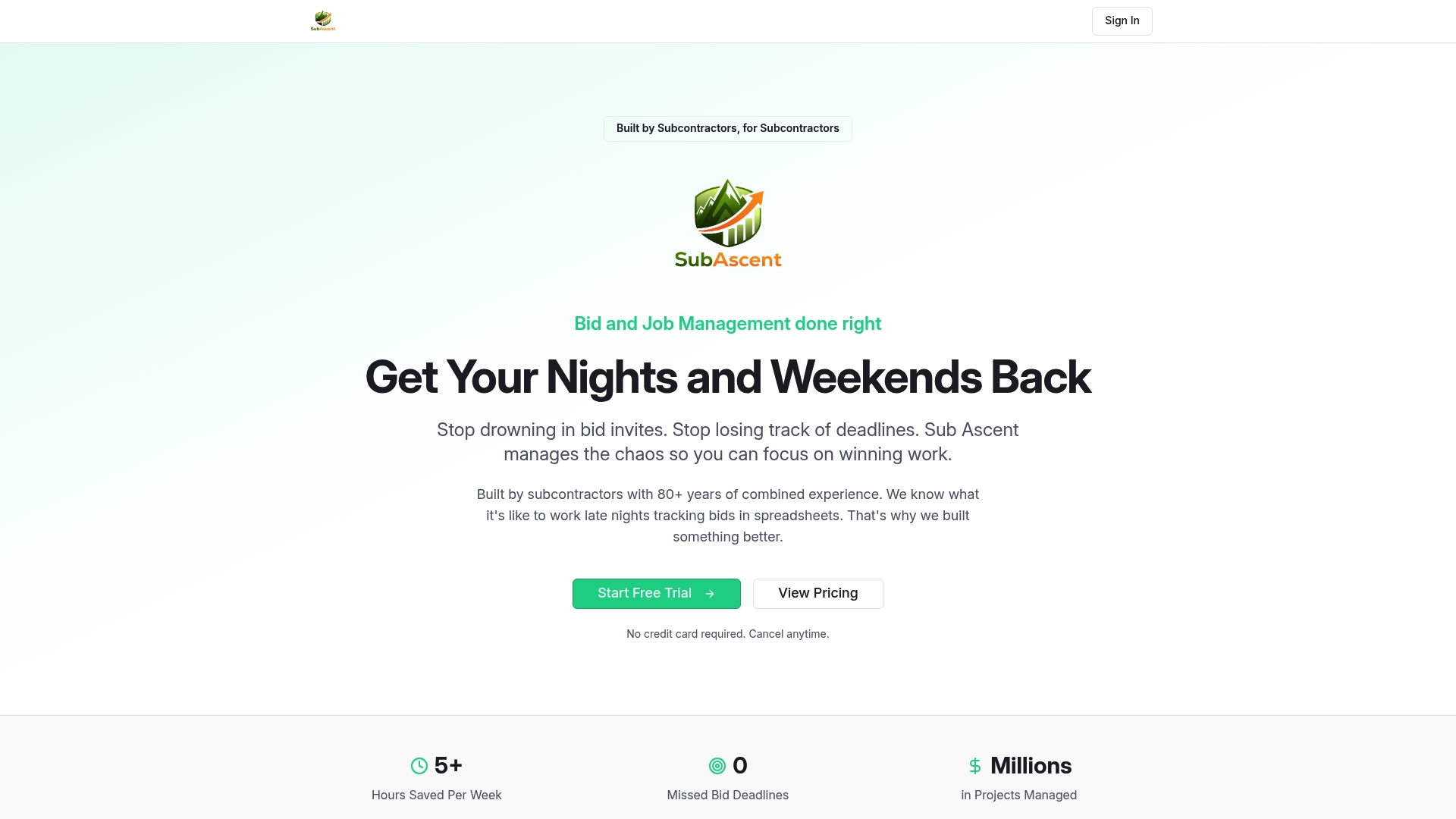
Subascent is built for specialty trade businesses like electrical, plumbing, HVAC, roofing, and masonry shops in the US, UK, and Australia. It is not a GC platform repurposed for subs. It tracks whether your proposal email was opened, sends you reminders before due dates, and keeps your whole bid list in one place. If your current process involves checking multiple email accounts and updating a spreadsheet by hand, there is a better way. See what Subascent's bid management software does for estimators who are done losing bids to disorganization.
FAQ
What are the main types of subcontractor bid invitations?
The four main types are open, selective, negotiated, and serial or framework invitations. Each carries different competition levels, compliance requirements, and preparation demands.
How do I know if a bid invitation is worth pursuing?
Check scope fit, bid due date, mandatory attendance requirements, bond and license compliance, and the GC's payment reputation before committing any estimating time.
What happens if I miss a mandatory pre-bid site visit?
Missing a required pre-bid conference or site visit typically results in automatic disqualification. Your bid will not be considered regardless of your pricing.
How should I track incoming bid invitations?
Use a centralized bid log that records invite date, GC contact, scope, due date, and current status. Software that captures invites from email automatically reduces manual entry and missed deadlines.
What is the difference between open and selective bid invitations?
Open invitations are publicly available to all qualified subs and carry high competition. Selective invitations go to a curated list based on qualifications or prior relationships, giving invited subs a significantly better shot at winning.