

A bid alternate is a separately priced scope option included in a construction bid that allows an owner to add, remove, or substitute parts of the project after bids are received. For estimators at electrical, HVAC, masonry, roofing, and other specialty trade firms, understanding bid alternates is the difference between pricing a job cleanly and walking into a contract dispute. The three primary types are additive, deductive, and substitution alternates, each with distinct cost impacts and strategic implications for how you build your number.
What is a bid alternate in construction bidding?
A bid alternate, sometimes called an alternate bid, is a defined scope item priced separately from the base bid. The base bid covers the core project scope. The alternate covers something the owner may or may not want, depending on what the bids come in at. Owners use this structure to defer scope decisions until they see real market pricing. That flexibility is the entire point.
Owners use alternates to gain pricing flexibility and adjust project scope after bid submissions, balancing budget realities against desired project features. This means your alternate price gets evaluated independently, and the owner can accept or reject it without affecting the base bid award. As a specialty trade estimator, you need to price each alternate as if it could stand alone.

The three types of bid alternates
There are three primary types of bid alternates, and each one moves the contract value in a different direction.
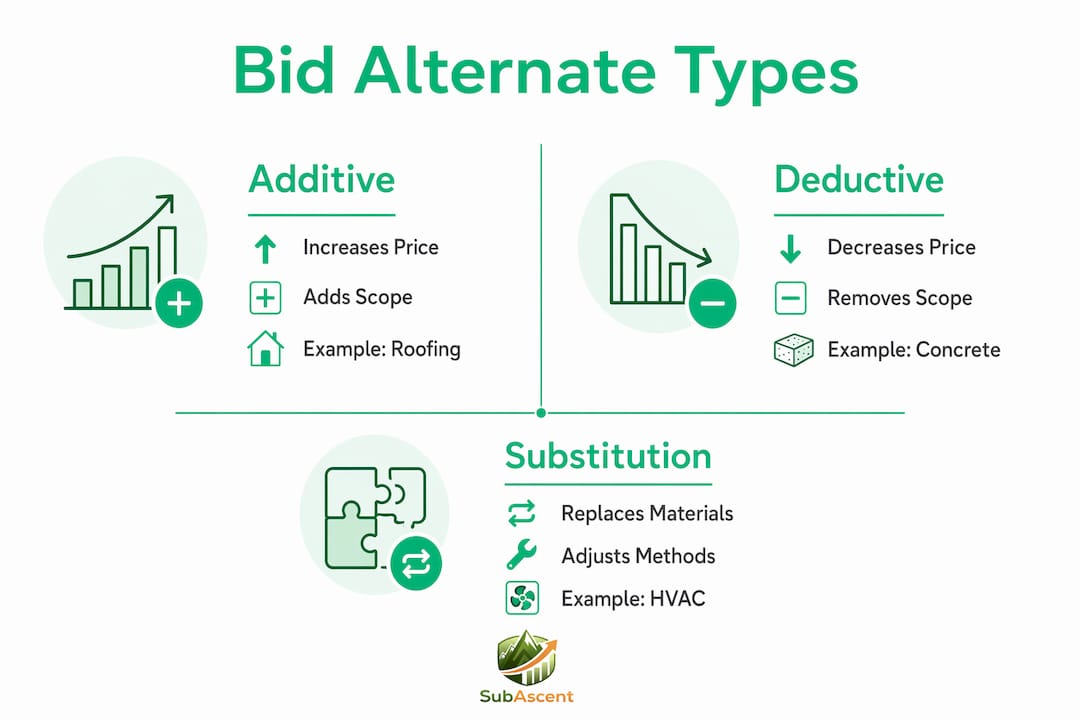
Additive alternates add scope to the base bid and increase the contract price. A roofing sub might price a base bid for a standard TPO membrane system, with an additive alternate for a fully adhered system with an upgraded R-30 insulation package. The owner accepts the alternate if the budget allows.
Deductive alternates remove scope from the base bid and reduce the contract price. A concrete sub might include a deductive alternate to omit a decorative stamped concrete plaza if total bids exceed the owner's budget. The owner pulls the alternate to bring the number down.
Substitution alternates replace one material or method with another. An HVAC sub might price a standard split system as the base bid, with a substitution alternate for a variable refrigerant flow (VRF) system. The cost impact can go either direction depending on the trade and the spec.
| Alternate Type | Effect on Price | Common Trade Example |
|---|---|---|
| Additive | Increases contract value | Roofing: upgraded insulation package |
| Deductive | Decreases contract value | Concrete: omit decorative plaza |
| Substitution | Varies by scope | HVAC: VRF system vs. standard split |
How bid alternates help owners control project scope and costs
Owners build alternates into bid documents because they rarely know exactly what their budget will support until real bids land on the table. Alternates let them defer those decisions without going back out to bid. For a specialty trade sub, that means the GC is handing you a bid package that requires more pricing work than the base scope alone.
The practical benefit for owners is real. A school district bidding a new gymnasium might set a base bid for standard flooring, with an additive alternate for a premium hardwood court. If the base bids come in under budget, they accept the alternate. If bids run high, they skip it. The alternate allows deferring scope decisions until true market prices are known, which protects the owner from committing to scope they cannot fund.
For flooring, painting, and low-voltage subs, this creates a specific challenge. You may price three or four alternates on a single bid package, each requiring its own takeoff and material pricing. That work takes time, and there is no guarantee any alternate gets accepted. Prioritize the alternates the GC flags as most likely to be accepted, and ask directly if you are not sure.
- Alternates give owners a structured way to add or cut scope without re-bidding the project.
- They help reconcile final contract value with funding constraints, especially on public projects.
- For specialty trades, accepted alternates often represent profitable add-on work with lower overhead than a standalone contract.
- Rejected alternates still cost you estimating time, so price them efficiently using your base bid unit costs as a starting point.
Pro Tip: Ask the GC or owner's rep which alternates are "priority" before you invest heavy takeoff time. On public jobs, the bid documents sometimes list alternates in priority order. On private work, a quick phone call saves hours.
What are best practices for pricing and managing bid alternates?
Pricing alternates correctly protects you from two problems: underpricing work you end up doing, and creating confusion that leads to contract disputes. The core rule is straightforward. Price alternates independently from the base bid. Do not assume shared mobilization, shared equipment, or shared labor with the base scope unless the alternate explicitly states it.
Here is how to approach the process:
- Read the alternate description in full before pricing. Bid documents define what is included and excluded. A masonry sub pricing an additive alternate for a decorative brick veneer needs to confirm whether the structural backup wall is in the base bid or the alternate. Missing that detail costs money.
- Use your base bid unit costs as a foundation. If you have already priced the base scope, your labor rates, material costs, and crew productivity are established. Build alternate pricing from those same inputs rather than starting from scratch.
- Price each alternate to stand on its own margin. Do not subsidize an alternate with base bid overhead. If the alternate gets accepted and the base bid gets cut, you need the alternate to carry its own weight.
- Avoid mixing additive and deductive alternates in a single bid. Mixing alternate types complicates the objective determination of the lowest apparent bidder and increases the risk of bid protests and disputes. Standardizing as all-additive or all-deductive reduces that risk for everyone involved.
- Flag items that are too small to alternate. Avoid making small-cost items bid alternates if they are integral to core project scope. Items under $50,000 that are tightly connected to base scope create contract ambiguity and coordination headaches in the field.
The order of priority for alternate acceptance must be clearly listed in bid documents. On public projects, the "A" alternate is typically the highest priority. Understanding that order tells you which alternates are most likely to be accepted and where to focus your pricing effort.
Pro Tip: Keep a separate line item in your estimate for each alternate. Never bury alternate scope inside your base bid line items. When the GC calls to discuss the number, you need to pull the alternate cost instantly without recalculating.
Contractors who underbid construction projects often do so because they treat alternates as an afterthought. Pricing them with the same discipline as the base bid is what separates a competitive number from a losing one.
Examples of bid alternates in specialty trade subcontracting
Concrete examples make the concept real. Here is how bid alternates show up across the specialty trades you work in every day.
Common trade-specific alternates include rooftop solar additions, HVAC system substitutions, flooring upgrades, and omitting landscaping to manage costs. Each of these appears in bid documents as a defined scope item with its own pricing line.
- Roofing: Base bid covers a standard 60-mil TPO system. Additive alternate prices a green roof assembly with drainage mat, growing medium, and sedum coverage.
- Flooring: Base bid specifies luxury vinyl tile throughout. Additive alternate prices polished concrete in the lobby and corridors.
- HVAC/mechanical: Base bid covers a conventional split system. Substitution alternate prices a VRF system with individual zone control.
- Masonry: Base bid covers standard CMU block construction. Additive alternate prices a full-height brick veneer on the building exterior.
- Electrical: Base bid covers standard LED fixtures. Additive alternate prices a building-wide lighting control system with occupancy sensors and daylight harvesting.
- Fire protection (sprinkler): Base bid covers a standard wet pipe system. Substitution alternate prices a dry pipe system for unconditioned spaces.
In specialty trades like concrete cutting and demolition, alternates enable proposing functionally equivalent methods that can optimize schedules, safety, and costs. A concrete sub might offer a wire saw method as a substitution alternate to conventional core drilling, demonstrating technical expertise while giving the owner a cost comparison.
| Trade | Alternate Type | Scope Description |
|---|---|---|
| Roofing | Additive | Green roof assembly over base TPO |
| Flooring | Additive | Polished concrete in lobby vs. LVT |
| HVAC/mechanical | Substitution | VRF system vs. conventional split |
| Masonry | Additive | Full-height brick veneer on exterior |
| Electrical | Additive | Lighting control system with sensors |
| Fire protection | Substitution | Dry pipe system for unconditioned areas |
Understanding the types of bid invitations that come with alternates attached helps you recognize which packages need extra estimating time before you commit to a response.
Key takeaways
Bid alternates are separately priced scope options that give owners post-bid flexibility, and specialty trade subs who price them independently, accurately, and with clear documentation win more work and avoid contract disputes.
| Point | Details |
|---|---|
| Three alternate types | Additive, deductive, and substitution alternates each move contract value differently. |
| Independent pricing | Price every alternate on its own margin, never subsidized by base bid overhead. |
| Avoid mixing types | Mixing additive and deductive alternates in one bid increases protest risk and evaluation complexity. |
| Priority order matters | Public bid documents list alternates by acceptance priority; focus effort on the top-ranked items. |
| Alternates show expertise | In specialty trades, well-priced substitution alternates demonstrate technical knowledge and can win work. |
Why alternates are worth taking seriously
I have reviewed hundreds of bid packages across electrical, HVAC, and masonry trades, and the pattern is consistent. Estimators who treat alternates as a quick add-on at the end of the bid process are the same ones who get surprised when an alternate gets accepted and the margin is not there. Alternates are not bonus work. They are contract scope with real cost and real risk.
The other thing I see regularly is subs who skip alternates entirely because they seem unlikely to be accepted. That is a mistake. Alternate bids demonstrate contractor expertise and innovation in specialty trades. A well-priced substitution alternate for a VRF system or a wire saw method tells the GC and owner that you know your trade at a deeper level than the sub who just filled in the base bid line. That reputation compounds over time.
The communication piece matters too. If you have questions about what an alternate includes, call the GC before bid day. Do not guess. A wrong assumption on an alternate scope can cost you as much as a wrong assumption on the base bid. The risk of contract disputes from ambiguous alternate scope is real, and it is avoidable with one phone call.
— Dave
How Subascent helps you manage bid alternates without the chaos

Tracking base bids is hard enough. Tracking base bids plus three alternates per package, across a dozen active bid invitations, is where things fall apart for most specialty trade estimating teams. Subascent is built specifically for electrical, plumbing, HVAC, masonry, roofing, and other specialty trade subs who need to manage that complexity without rebuilding a spreadsheet every time.
The platform lets you price alternates as separate line items within the same bid, switch between base bid and alternate scenarios instantly, and keep a clean record of what was submitted. When the GC calls to discuss the number, you have the answer in seconds. Estimating software built for small subs reduces errors and improves bid competitiveness, and Subascent delivers that without the overhead of GC-focused platforms like Procore or BuilderTrend. See how it works at subascent.com.
FAQ
What is a bid alternate in simple terms?
A bid alternate is a separately priced scope option in a construction bid that an owner can accept or reject after bids are received. It gives owners flexibility to adjust project scope based on actual bid prices without re-bidding the project.
What are the three types of bid alternates?
The three types are additive (adds scope and increases cost), deductive (removes scope and decreases cost), and substitution (replaces one material or method with another, with variable cost impact).
Should I price alternates the same way as my base bid?
Price each alternate independently using the same unit costs and labor rates as your base bid, but do not share overhead or assume shared mobilization unless the documents explicitly allow it. Each alternate needs to carry its own margin.
How do I know which alternates to prioritize?
On public projects, bid documents list alternates in priority order, with the "A" alternate typically being the highest priority for the owner. On private work, ask the GC directly which alternates are most likely to be accepted before investing heavy takeoff time.
Can alternates help me win more work as a specialty trade sub?
Yes. A well-priced substitution alternate demonstrates technical expertise and gives the owner a meaningful cost comparison. In trades like HVAC, concrete, and electrical, alternates are one of the clearest ways to show a GC or owner that you understand the work at a deeper level than your competitors.