

Job profitability measures how much money a single project truly earns after accounting for every cost involved, including labor, materials, subcontractors, and allocated overhead. The industry term for this process is job costing, and it is the financial backbone of every well-run specialty trade business. Without it, an electrical contractor or HVAC firm can stay busy all year and still lose ground. Understanding how job profitability works is the difference between growing a business and slowly draining it.
How job profitability works: the core mechanics
Job profitability is calculated as job revenue minus all direct costs and allocated overhead assigned to that project. Direct costs include field labor, materials, and any subcontractors you hire for that specific job. Allocated overhead covers the share of your office rent, insurance, vehicle costs, and owner salary that each project must absorb to keep the business running. Specialty trade businesses should target gross profit margins of 50–65% for service work and 35–50% for installation work, with net margins of 10–20% for healthy growth. Businesses consistently below 10% net margin need urgent pricing or cost adjustments.
Job costing is the method that makes this calculation possible. It differs from process costing because it requires detailed per-job tracking of labor, materials, and overhead due to the unique nature of each project. A roofing contractor replacing a commercial membrane and a drywall crew finishing a tenant improvement are doing completely different scopes at different sites. Process costing averages costs across a production run, which works for manufacturing but destroys accuracy in trade work.

What costs make up a job's total expense?
Every job carries three categories of cost: direct labor, direct materials, and allocated overhead. Getting all three right is what separates a real profit number from a guess.
Direct costs are the easiest to track:
- Labor: The hours your crew works on a specific job, priced at their loaded labor rate
- Materials: Everything purchased or pulled from inventory for that job
- Subcontractors: Any specialty work you hire out, such as a low-voltage crew on a plumbing project
The loaded labor rate is where most trade owners undercount. It is not just the hourly wage. It includes payroll taxes, workers' compensation, health benefits, and a share of overhead. Direct labor typically represents 20–35% of total job revenue. Labor costs above that range often signal inefficiencies or underpriced bids.
Overhead allocation is the step most owners skip. Failing to include proportional overhead in job estimates leads to a false sense of profitability and capital erosion when net margin falls below 10%. A common allocation method is to divide total annual overhead by total billable labor hours to get an overhead rate per hour. Every hour billed to a job then carries that overhead burden. For a deeper look at how this works in practice, the overhead allocation guide from Subascent walks through real examples for trade contractors.
Pro Tip: Build your loaded labor rate once per year, then bake it into every estimate template. If your rate changes mid-year due to a wage increase or insurance renewal, update it immediately and flag any open bids.
How to calculate job profitability step by step
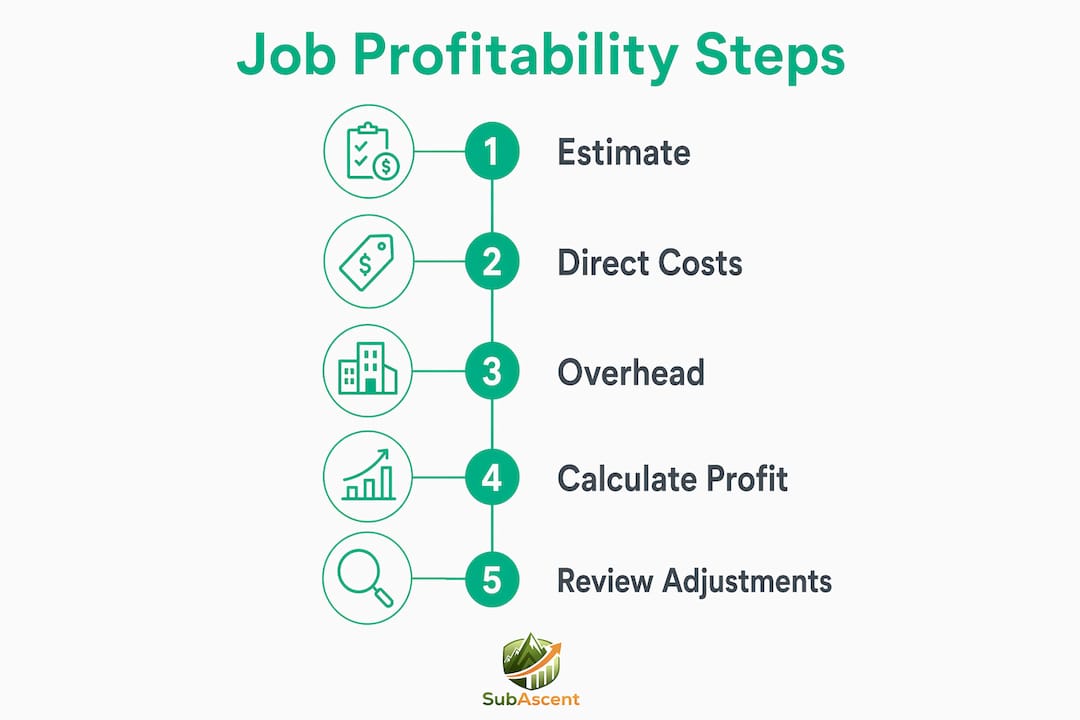
The formula is straightforward: Job Profit = Job Revenue – (Direct Costs + Allocated Overhead). The hard part is gathering accurate numbers for each variable. Here is a practical sequence for any trade contractor:
- Set the budget at bid time. Your estimate becomes the budget. Record estimated labor hours, material costs, subcontractor costs, and overhead allocation before the job starts.
- Track actuals in real time. Capture crew hours per job daily, post material invoices to the job as they arrive, and log subcontractor invoices immediately.
- Calculate contribution margin. Subtract direct costs from revenue to get the contribution margin. This shows how much each job contributes toward overhead and profit before overhead is applied.
- Apply overhead allocation. Subtract the overhead burden from the contribution margin to arrive at net job profit.
- Compare budget to actual. Run a budget vs. actual report at job completion, and at key milestones on longer projects.
Minimum quoted contribution margins are often set at 30–40% to ensure delivered margins cover break-even points after slippage. That buffer matters because field execution rarely matches the estimate perfectly.
| Stage | What to measure | Why it matters |
|---|---|---|
| Bid | Estimated margin % | Sets the profit floor before work starts |
| Mid-job | Labor hours vs. budget | Catches overruns while you can still act |
| Completion | Actual net margin % | Confirms true profit and informs future bids |
Pro Tip: On jobs longer than four weeks, run a budget vs. actual check at the halfway point. Catching a labor overrun at 50% complete gives you time to adjust crew size, request a change order, or accelerate the schedule.
What factors affect job profitability most?
Several patterns consistently erode margins on trade jobs. Knowing them in advance lets you build defenses into your estimating and project management process.
- Labor inefficiency. When crews take longer than estimated, every extra hour costs you the loaded rate without adding revenue. Accurate labor tracking per project is the single most effective tool for identifying jobs that are harming profitability.
- Uncharged change orders. Extra work performed without a signed change order is pure cost with no revenue. Jobs can be profitable on paper yet lose cash due to missed change orders or inefficiencies.
- Underpriced bids. Estimating labor at straight wages instead of loaded rates means every hour worked costs more than the bid assumed.
- Ignored overhead. Many contractors mistake "staying busy" for making money. True profit assessment includes indirect overhead and hourly cost recovery.
- Year-end-only reviews. Monthly monitoring of actual performance against budgets allows contractors to catch cost overruns while projects are active. Year-end reviews alone are too late to fix anything.
The most overlooked factor is overhead neglect. A masonry contractor running $2M in revenue with $300,000 in annual overhead needs to recover $150 per billable hour if the business runs 2,000 billable hours per year. If that overhead load never makes it into the estimate, the job looks profitable right up until the bank account runs dry.
Best practices to improve job margins
Improving margins requires discipline in three areas: estimating, field tracking, and financial review. Here is what the best-run trade businesses do consistently.
Build estimates with loaded rates, not bare wages. Every labor hour in your estimate should carry the full loaded rate including taxes, benefits, and overhead. This is the foundation of job costing for specialty trades.
Track crew hours by job, not by week. A timecard that says "40 hours" tells you nothing. A timecard that says "18 hours on Job 1042, 22 hours on Job 1087" tells you everything. Subascent's foreman hour tracking guide covers practical methods for getting this data out of the field without adding paperwork.
Use contribution margin to guide pricing decisions. Separating overhead allocation and contribution margin measurement from individual job metrics avoids distorted performance and improves pricing accuracy. Successful firms calculate contribution margin per job and test overall overhead recovery at the business level separately.
Run monthly budget vs. actual reports. Pick a date each month, pull actuals for every active job, and compare them to the original budget. This single habit catches problems early enough to act on them.
Audit completed jobs. Post-job audits reveal hidden profit bleeds that repeat across multiple projects. If your insulation jobs consistently run 15% over on labor, that is an estimating problem, not a field problem.
Pro Tip: Set a contribution margin floor for every job type you bid. Service calls might require 55%, while large installation contracts might clear at 38%. Knowing your floor prevents you from accepting work that cannot cover overhead.
Key Takeaways
Job profitability requires tracking direct costs, loaded labor rates, and allocated overhead against actual revenue on every project, not just at year-end.
| Point | Details |
|---|---|
| Use the full formula | Job Profit = Revenue minus direct costs and allocated overhead, not just materials and wages. |
| Load your labor rate | Include taxes, benefits, and overhead in every labor hour you estimate to avoid hidden losses. |
| Track hours by job | Per-job timecard data is the fastest way to catch labor overruns before they close out. |
| Set a margin floor | Define minimum contribution margins by job type so underpriced bids never make it out the door. |
| Review monthly, not annually | Monthly budget vs. actual reports catch overruns while you can still correct them. |
The uncomfortable truth about "profitable" jobs
I have talked with dozens of electrical and HVAC owners who were genuinely confused about why their bank account was flat after a record revenue year. The answer was almost always the same: they were measuring the wrong thing. They tracked revenue and direct material costs, then assumed the rest was profit. Nobody had ever built a loaded labor rate into their estimate templates. Overhead was a number that showed up on the tax return, not a cost that lived inside every job.
The shift that changes everything is treating overhead as a pricing floor, not an afterthought. When you know your overhead rate per billable hour, every estimate either clears that floor or it does not. There is no ambiguity. The jobs that look thin on paper actually are thin, and you can decide whether to sharpen the pencil or walk away.
Monthly financial reviews feel like a burden until the first time one saves you from a $40,000 loss on a job you thought was running fine. After that, they become non-negotiable. The trade owners who grow past $5M in revenue are almost always the ones who treat job-level financial data the same way they treat safety: not optional, not delegated, and reviewed on a schedule.
— Dave
Subascent helps you track what actually matters
Knowing the formula for job profitability is one thing. Having the data to run it accurately on every active job is another.

Subascent is built specifically for specialty trade subcontractors, including electrical, plumbing, HVAC, roofing, and framing businesses in the US, UK, and Australia. The platform connects your estimates to your field labor tracking and your actual costs, so budget vs. actual reports are always current. You can see which jobs are running hot on labor, which change orders are still unsigned, and where your margins are slipping, all before the job closes. Visit Subascent's job management platform to see how it fits your trade business.
FAQ
What is job profitability in construction?
Job profitability is the net financial result of a single project, calculated as job revenue minus all direct costs and allocated overhead. It is the most accurate measure of whether a project made or lost money.
How do I calculate profit margin on a job?
Divide net job profit by job revenue and multiply by 100. Specialty trade businesses should target net margins of 10–20% for healthy growth, with gross margins of 35–65% depending on whether the work is service or installation.
What is the difference between job costing and process costing?
Job costing tracks costs individually for each unique project, while process costing averages costs across a production run. Specialty trade contractors use job costing because every project has different labor, materials, and scope.
Why do my jobs look profitable but my cash is low?
Jobs can appear profitable on paper while losing cash due to uncharged change orders, untracked labor overruns, or overhead that was never included in the estimate. Running a full budget vs. actual report with loaded labor rates reveals the real number.
How often should I review job profitability?
Monthly reviews of active jobs against their original budgets are the minimum standard. Year-end reviews alone are too late to correct overruns or adjust pricing on jobs still in progress.