
Mortar wet volume equals net wall area times joint thickness times unit face-to-thickness ratio, minus zero (mortar volume is calculated directly from joint geometry, not by subtracting brick volume, unless you're using the modular-wall method). For a fast bid check, use: wet mortar volume (cu ft) = net wall area (sq ft) × 0.058 for a standard brick wall with 3/8-inch joints, then divide by bag yield to get bag count.
Before you run any masonry mortar material calculation, collect these inputs: net wall area or exact unit count, unit dimensions (modular face size and thickness), number of wythes or leaves, joint thickness and depth, your coverage factor (face-shell versus full bedding), the mortar type required by spec, fresh-mortar yield per bag, and your waste allowance.
Quick example: A 160-square-foot single-wythe brick wall with 3/8-inch joints needs roughly 9.3 cubic feet of wet mortar, which rounds to about fifteen bags of premixed mortar based on typical yield.
- Net wall area or unit count
- Unit face dimensions and thickness
- Joint thickness and depth
- Coverage factor and mortar type
- Fresh-mortar yield per bag and waste allowance
Key Takeaways
Accurate mortar estimating comes down to picking the right calculation method, using fresh-mortar yield instead of bag weight, and applying trade-tested waste allowances before you order.
| Point | Details |
|---|---|
| Pick the right method | Use modular-wall subtraction for area takeoffs, known-unit-count for unit schedules or prefab panels. |
| Convert by yield, not weight | Always divide wet volume by the manufacturer's fresh-mortar yield per bag, not bag weight. |
| Match mix type to spec | Default to Type N above grade and Type S below grade when the spec is silent. |
| Build in waste correctly | Use a waste allowance generally ranging from ten to fifteen percent for new masonry work and a higher allowance of fifteen to twenty percent for repointing or irregular masonry. |
| Automate the repeat work | Subascent's estimating tools include built-in mortar calculators and yield libraries so estimators skip rebuilding spreadsheets on every bid. |
Table of Contents
- Masonry Mortar Material Calculation Guide: Two Core Methods
- How Do You Convert Wet Mortar Volume to Bags?
- Common Bag Yields for Bricks and Block: Quick Reference
- Which Mortar Type Should You Use for the Job?
- What Is the Estimator's Workflow for Turning a Takeoff Into an Order?
- Should You Buy Premixed Bags or Mix Mortar on Site?
- Worked Example: 500 Square Feet of Brick Veneer
- Sources
Masonry Mortar Material Calculation Guide: Two Core Methods
Every reliable mortar quantity estimator relies on one of two calculation methods, and picking the wrong one for your takeoff style wastes time and invites errors.
Method 1: Modular-wall subtraction. This works from area measurements. You calculate the gross volume of the wall cavity, then subtract the solid volume the masonry units occupy, leaving the void mortar fills.
- Calculate net wall volume: net wall area × unit depth × number of leaves.
- Estimate the solid volume the units occupy based on modular dimensions and unit count per square foot.
- Subtract solid volume from wall volume to isolate the mortar void.
- Apply your coverage factor (face-shell bedding typically runs lower than full bedding).
Method 2: Known-unit-count. This works better when you're pricing off a unit schedule or a prefabricated panel drawing. You calculate mortar per single unit first, then multiply by total units.
- Mortar per unit = modular unit volume minus solid unit volume
- Total mortar = unit count × mortar per unit × coverage factor
- Best suited to CMU schedules, precast panels, or veneer counts pulled straight from a takeoff sheet
Use modular subtraction for area-based bids where you're working off elevation drawings. Switch to known-unit-count when a supplier schedule or block count is already in hand. CalculatorCore's methodology confirms both approaches, and notes that bag counts must come from fresh-mortar yield, never bag weight alone.
Pro Tip: If the plans call for grouted cores or full-depth bedding on CMU, pull those quantities out as a separate grout line item immediately. Grout and mortar are different products with different yields, and blending them into one number is the fastest way to blow a bid.
How Do You Convert Wet Mortar Volume to Bags?
Converting wet volume into an order sheet takes three steps, whether you're buying premixed bags or mixing on site.
- Compute total wet volume using the modular-wall or known-unit-count method above, then add your waste allowance.
- For site-mix jobs, apply a dry-volume factor (typically 1.25 to 1.33) to account for the volume loss when dry cement, lime, and sand combine with water, then split that volume using ASTM C270 mix parts.
- For premixed bags, divide total wet volume by the manufacturer's fresh-mortar yield per bag, then round up to the nearest whole bag.
ASTM C270 gives you the ratios once you know the mix type. Type N typically runs 1 part cement, 1 part lime, and 6 parts sand by volume. Type S tightens that to 1 part cement, 1/2 part lime, and roughly 4.5 parts sand for higher compressive strength. HardHatCalc uses this exact proportioning to split wet volume into cement, lime, and sand bag counts.
Bag yields vary by product. Most 80-pound bags of premixed mortar yield between 0.45 and 0.9 cubic feet of wet mortar, and 60-pound bags scale down proportionally. One cubic yard equals 27 cubic feet, and one cubic foot equals roughly 28.3 liters if you're cross-checking a metric spec sheet.
Don't order bags based on weight alone. A 60-pound bag from one manufacturer and an 80-pound bag from another can yield nearly the same wet volume depending on formulation and admixtures. Always pull the fresh-mortar yield figure straight off the product data sheet before you commit to an order quantity.
Common Bag Yields for Bricks and Block: Quick Reference
Before you run a full geometric calculation, this table gives you a ballpark to sanity-check your numbers against.
These ranges hold up against Gera Tools' rule of thumb of roughly 7 cubic feet per 100 square feet for standard brickwork with 3/8-inch joints.
- Yields shift with slump, admixtures, and manufacturer formulation, not just bag weight
- Full bedding on CMU always costs more mortar than face-shell bedding
- Treat this table as a sanity check, never as your final order number
Pro Tip: Always confirm the exact yield on the supplier's current product data sheet before locking in an order. Formulations change, and a yield printed on last year's bag may not match this year's mix.
Which Mortar Type Should You Use for the Job?
ASTM C270 defines four mortar types, and the type you pick changes both the strength and the component ratio you'll order.
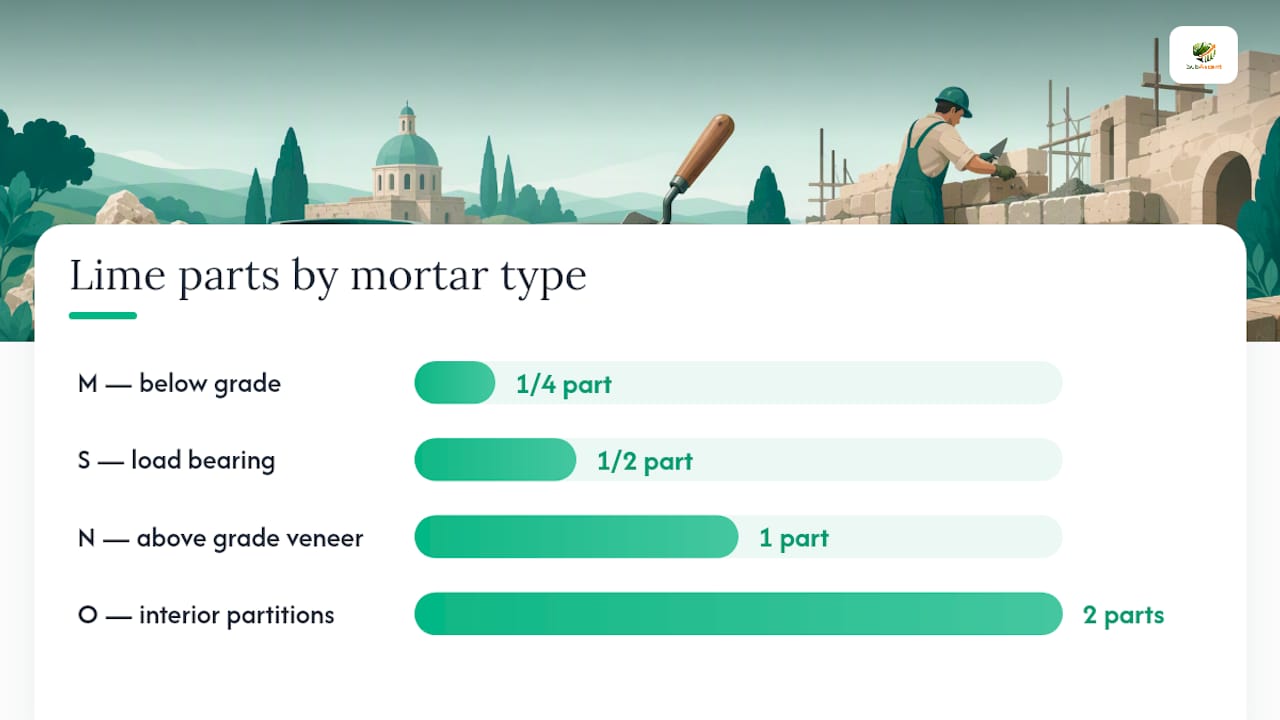
- Type M — highest compressive strength, used for below-grade and heavy structural loads; mix runs roughly 1 part cement, 1/4 part lime, 3 parts sand.
- Type S — high strength for load-bearing walls and below-grade work; roughly 1 part cement, 1/2 part lime, 4.5 parts sand.
- Type N — general-purpose, most common for above-grade veneer and non-load-bearing work; roughly 1 part cement, 1 part lime, 6 parts sand.
- Type O — lower strength, used for interior non-load-bearing partitions; roughly 1 part cement, 2 parts lime, 9 parts sand.
Autodesk's masonry materials guide confirms Type M sits at the top of the strength range with Type O at the bottom, and each type's proportions directly determine how you split your dry-component order.
| Type | Cement : Lime : Sand | Typical Use |
|---|---|---|
| M | 1 : 1/4 : 3 | Below-grade, heavy loads |
| S | 1 : 1/2 : 4.5 | Load-bearing, below-grade |
| N | 1 : 1 : 6 | Above-grade veneer |
| O | 1 : 2 : 9 | Interior partitions |
Pro Tip: When the spec is silent or ambiguous, default to Type N above grade and Type S below grade. Check the drawings carefully for the transition point at grade. That's the line where estimators most often get the mix type wrong.
What Is the Estimator's Workflow for Turning a Takeoff Into an Order?
A dependable mortar requirement calculator is only as good as the workflow feeding it. Here's the sequence experienced estimators follow, start to finish.
- Confirm actual unit dimensions and modular sizing against the spec, not assumed nominal sizes.
- Measure net wall area for each wall separately, then subtract door, window, and other openings.
- Choose your coverage factor: face-shell bedding for standard CMU work, full bedding when specified.
- Set joint thickness and depth per the drawings, typically 3/8 inch unless noted otherwise.
- Apply waste and extra allowance per 1,000 units.
- Compute wet mortar volume using the modular-wall or known-unit-count method.
- Convert to bags or dry components based on your ordering method.
- Confirm minimum supplier order quantity and pallet sizing before finalizing the number.
Waste allowances aren't guesswork. New brick or block construction typically runs 10% to 15% waste. Repointing or repair work on irregular historic masonry needs 15% to 20%, since raking out old joints to the ASTM-recommended 3/4-inch depth wastes more material per linear foot than fresh coursework. Building this discipline into your scope review process keeps grout and mortar quantities from getting tangled together on mixed-scope jobs.
Pro Tip: Log actual mortar consumption per 1,000 units on the first full day of a job and compare it against your estimate. That number becomes your calibration factor for every future bid using the same unit and joint spec.
Should You Buy Premixed Bags or Mix Mortar on Site?
The choice between premixed bagged mortar, site-mix components, and ready-mix delivery comes down to job size, crew availability, and how tightly you need to control quality.
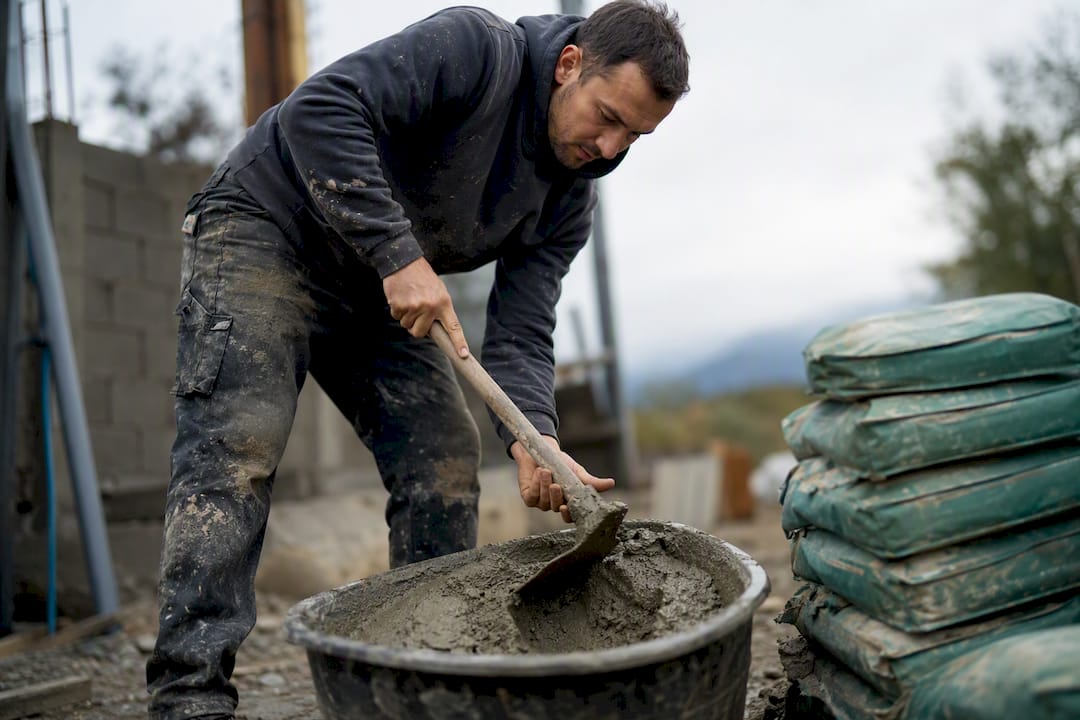
Premixed bags cost more per cubic foot but eliminate proportioning errors and speed up small jobs. OmniCalculator's cost comparison notes premixed bags make sense for jobs under about 5 cubic yards, where the labor savings outweigh the material premium. Site-mix, buying separate cement, lime, and sand, gets cheaper as volume climbs, but it demands a consistent batching process to avoid strength variation between batches.
For batching: a typical half-bag mixer batch using Type N proportions takes roughly 1 bag of masonry cement, 1 bag of hydrated lime, and 18 shovels of sand, yielding close to 4 cubic feet of wet mortar. CMHA's batching guidance puts sand needs at roughly 1 ton per 8 bags of masonry cement for standard proportions.
- Confirm batch size against your mixer capacity before the crew starts.
- Keep sand covered and cement palletized off the ground in wet weather.
- In cold weather, use heated mixing water and protect fresh mortar from freezing for at least 48 hours.
- Never retemper mortar past the manufacturer's working-time window
- Wear gloves and eye protection when handling dry cement and lime, both are caustic to skin and eyes
Pro Tip: Time pallet drops to match your daily pour rate. A yard stacked with more mortar than the crew can use in two days is a yard with rain-damaged bags and wasted cash.
Worked Example: 500 Square Feet of Brick Veneer
Start with a 500-square-foot single-wythe brick veneer wall, 3/8-inch joints, Type N mortar, face-shell bedding is not applicable since this is solid brick.
- Net wall volume factor: using the 0.058 cu ft per sq ft rule for standard brick with 3/8-inch joints, base wet volume = 500 × 0.058 = 29 cu ft.
- Add a 12% waste allowance for new construction: 29 × 1.12 = 32.5 cu ft.
- Convert to bags: at a 0.6 cu ft yield per 80-pound bag, 32.5 ÷ 0.6 = 54.2, rounds up to 55 bags.
- For site-mix instead, apply a 1.3 dry-volume factor: 32.5 × 1.3 = 42.25 cu ft dry volume, split at Type N ratio (1:1:6, or 8 parts total): cement ≈ 5.3 cu ft, lime ≈ 5.3 cu ft, sand ≈ 31.7 cu ft.
Write these directly into your estimate notes so anyone reviewing the bid later can trace the math.
- Record the yield source (product data sheet, not memory)
- Note the waste percentage applied and why
- Flag any grout quantities separately if cores are grouted
A Practical Note From the Field
Every yield number on a bag looks precise until you mix it on a hot, dry day and watch it drink water faster than the sheet predicted. Log real yields on day one, cross-check the data sheet every time a product changes, and don't trust last quarter's numbers blind.
Pro Tip for foremen: Set a daily mix quantity limit per batch and enforce retemper cutoffs. Mortar retempered past its working window loses strength even if it still looks workable.
Estimating Software Built for This Exact Math
Running these calculations by hand works fine for a single wall. It falls apart fast when you're pricing a 40,000-square-foot commercial job with mixed unit types, multiple mortar specs, and a bid due tomorrow morning. Subascent's estimating tools give masonry estimators built-in mortar calculators tied to a library of unit yields, so you're not rebuilding the same formula in a spreadsheet every time a takeoff changes.

The platform includes takeoff integration, a batch-sizing helper for site-mix jobs, order and pallet planning so you hit supplier minimums without over-ordering, and crew logging so foremen can record actual consumption against your estimate in real time. If you're tired of rebuilding the same mortar workbook for every masonry bid breakdown, start a free trial at Subascent and run your next mortar takeoff through a calculator that already knows the yields.
Sources
- Estimating Concrete Masonry Materials - CMHA
- Masonry construction: Materials, methods and uses — Autodesk
- Mortar calculator — CalculatorCore
- Mortar Mix & Volume Calculator — Gera Tools
- Mortar Calculator — HardHatCalc