
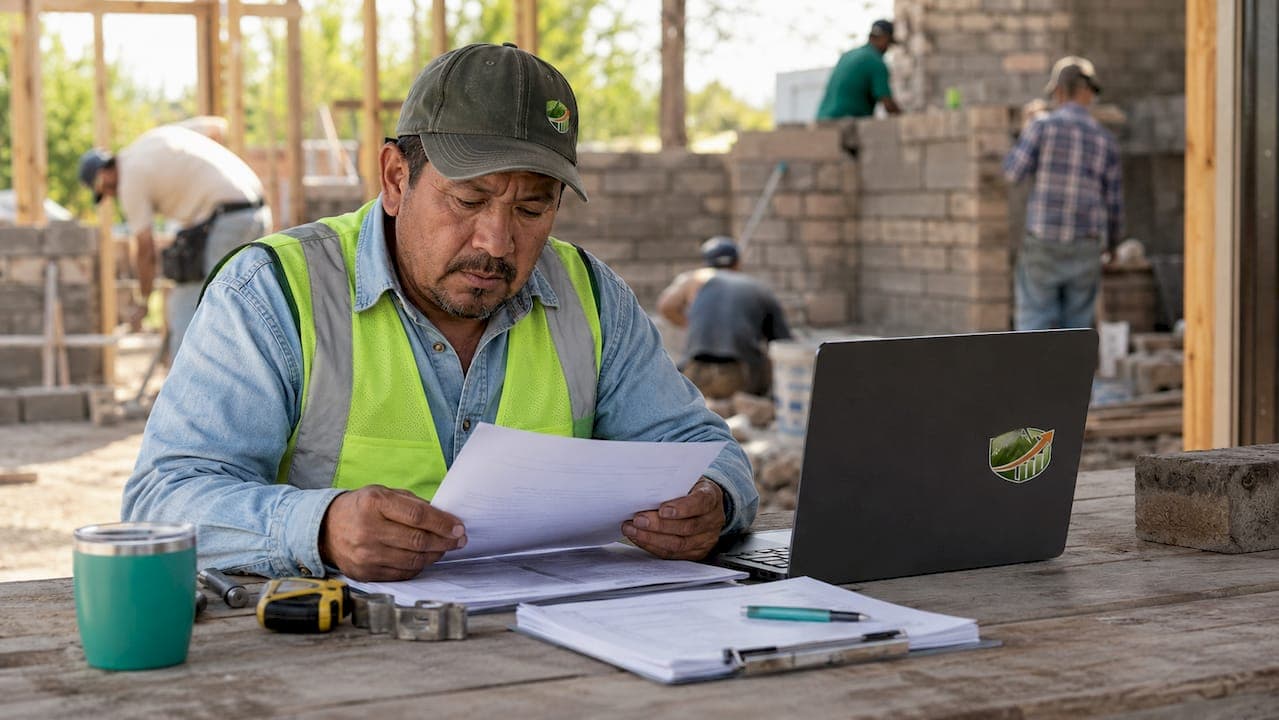
A masonry subcontractor bid invitation checklist is the structured document that guides your estimating team through every required step before submitting a bid response to a general contractor. Without one, you miss fields, skip documents, and lose bids you should have won. The best masonry subs treat this checklist the same way a foreman treats a safety walkthrough: non-negotiable, every time. This guide covers the essential checklist items, how to track and manage bid invitations, what bonding requires, and the mistakes that get masonry subs disqualified before a GC even reads the number.
1. What belongs on every masonry subcontractor bid invitation checklist
The bid invitation checklist, known in the industry as a bid response checklist or bid compliance checklist, covers every document and decision point between receiving an invitation and submitting your number. Missing one item can disqualify an otherwise competitive bid.
Bid form completion

The bid form is the definitive source of truth. Leaving fields blank instead of marking "N/A" triggers automatic disqualification by GC software or administrators. Every line gets filled. Every non-applicable field gets "N/A." No exceptions.
Scope clarity with CSI divisions
Your bid must state exactly what you are including and what you are not. Tie every inclusion and exclusion to the relevant CSI division, such as Division 04 for masonry work. Accurate scope descriptions prevent costly gaps and keep your bid comparable to others the GC receives.
Bid bond submission
Many commercial and public projects require a bid bond. Confirm whether one is required, what percentage applies, and what form the GC accepts. Check the bid bond requirements section of the invitation carefully before contacting your surety.
Insurance certificates and licensing
Attach current certificates of insurance showing the required coverage limits. Confirm your masonry contractor's license is active and matches the state where the project is located. A lapsed license or wrong coverage limit kills a bid instantly.
Submission deadline: date, time, and format
Bid submission deadlines must be exact, including date, time, and submission method. A bid emailed at 2:05 PM when the deadline was 2:00 PM is a disqualified bid. Confirm whether the GC accepts email, a bidding portal, or hard copy.
Pre-bid walkthrough attendance
When a walkthrough is listed as mandatory, attend it. Document your attendance and take photos. Missing a required walkthrough is grounds for disqualification on most public projects.
Final number verification
Your cover letter bid amount and your bid form number must match exactly. A mismatch between the two is one of the most common reasons masonry bids get rejected.
Clarifications and exclusions disclosure
List your exclusions clearly, but keep them short. Attach them as a separate page rather than burying them in the bid form. Vague or overly long exclusion lists confuse GCs and reduce your chances of being called for clarification.
Pro Tip: Before you hit send, read the entire checklist out loud with a second person. Dual-person reviews catch number mismatches and missing documents that a solo review misses every time.
2. How to track and manage bid invitations effectively
Masonry estimators juggle multiple bid invitations at once. A solid masonry bid invitation tracking process keeps you from missing deadlines or submitting incomplete responses.
- Start 30–45 days out. Beginning bid preparation 30–45 days before the submission date gives you time to gather insurance documents, bonding, and project-specific scope details without rushing.
- Log every invitation immediately. When a bid invitation arrives, enter it into your tracking system the same day. Record the project name, GC contact, bid due date, bond requirement, and submission format.
- Use a dedicated tracking tool. A spreadsheet works for one or two bids. Once you are managing five or more active invitations, a purpose-built bid tracking system reduces the risk of a missed deadline to near zero.
- Set a midpoint follow-up reminder. Schedule a check-in at the halfway point between receiving the invitation and the due date. Review document status, confirm your scope, and flag any addenda.
- Call three days before the deadline. A phone call three days before a bid deadline significantly improves response rates and confirms the GC still expects your number.
- Manage addenda in real time. Every addendum changes the project. Log each one, update your estimate, and confirm the addendum number on your bid form.
- Send a no-bid reply when you pass. Non-responsiveness removes subs from future bid lists. A short, polite no-bid email with a reason keeps you in the GC's database for the next project.
Pro Tip: Document every communication with the GC in writing, including phone call summaries. This record protects you if a scope dispute arises after award.
3. Understanding masonry bid bond requirements
A bid bond is a financial guarantee that you will honor your bid price if selected. Most masonry subs encounter bid bonds on public school, municipal, and federal projects.
Typical bond amounts
Bid bond requirements for commercial and public projects range from 5% to 20% of the total bid value. Federal projects cap the bond at 20% of the bid or $3 million, whichever is less. Know which threshold applies before you contact your surety agent.
What surety underwriters review
Surety underwriters evaluate your financial statements, tax returns, project history, and credit. They compare the size of the project you are bidding against the largest project you have successfully completed. A masonry sub bidding a $4 million job for the first time needs a stronger financial file than one with three similar projects on record.
Documents to prepare
Gather the following before approaching a surety agent:
- Two to three years of business financial statements
- Most recent business and personal tax returns
- A current work-in-progress schedule showing active jobs
- A project history list with contract values and completion dates
- Bank reference letter or line of credit documentation
Choosing a licensed surety agency
Use a surety agent licensed in your state. The bond form the GC requires must match exactly. A bond on the wrong form is treated as no bond at all. Review the bonding process for small contractors before your first application to avoid surprises.
Timeline
Allow at least five to ten business days for bond approval on a first application. Established relationships with a surety agent cut that to one to two days. Build that relationship before you need it urgently.
4. Common bid submission mistakes masonry subs make
These are the errors that kill otherwise competitive masonry bids. Most are preventable with a disciplined checklist review.
- Blank fields on the bid form. Every blank field reads as an error or omission. Mark "N/A" on every line that does not apply to your scope.
- Number mismatch between cover letter and bid form. If your cover letter says $487,000 and your bid form says $478,000, the GC has two different numbers. Most will disqualify rather than call for clarification.
- Vague or overlong exclusions. A two-page exclusion list signals that you do not understand your own scope. Keep exclusions specific and tied to CSI divisions. Three to five clear lines outperform a legal disclaimer page every time.
- Missing or unsigned bid security. A bid bond submitted without a signature from the surety agent is invalid. Check the bond form for all required signatures and seals before attaching it.
- Late submission. Portals close at the deadline. Email servers time-stamp on receipt. Submit at least two hours early to account for technical issues.
- Skipping a mandatory pre-bid meeting. On public projects, attendance is often a condition of bid acceptance. Missing it is an automatic disqualification regardless of your price.
- No confirmation of receipt. After submitting, confirm the GC received your bid. A quick email asking for confirmation takes 30 seconds and prevents a lost-in-transit disqualification.
Review the masonry scope review guide to tighten your scope before finalizing any bid.
Key Takeaways
A complete masonry bid invitation checklist, applied consistently, is the single most reliable way to increase bid acceptance rates and avoid preventable disqualifications.
| Point | Details |
|---|---|
| Fill every bid form field | Mark "N/A" on non-applicable lines to prevent automatic disqualification. |
| Start preparation early | Begin 30–45 days before the deadline to gather bonds, insurance, and scope documents. |
| Match all bid numbers | Your cover letter and bid form must show the identical dollar amount. |
| Keep exclusions concise | Tie exclusions to CSI divisions and limit them to three to five clear lines. |
| Send no-bid replies | A polite no-bid email preserves your place on the GC's future invitation list. |
What I've learned from watching masonry subs win and lose bids
The checklist is not the boring part of bidding. It is the part that separates the subs who win work from the ones who wonder why they keep getting passed over.
The most consistent mistake I see is treating the bid form as a formality. Estimators spend hours on their takeoff and then rush through the form in ten minutes. That is backwards. The GC reads the form first. If the form has blank fields, mismatched numbers, or a missing bond, your takeoff never gets looked at.
The second thing I have seen cost masonry subs real money is a poorly written exclusion list. Long, generic exclusions read as a warning sign to GCs. They signal that the sub does not know what they are pricing. A short, CSI-referenced exclusion list does the opposite. It tells the GC you know your scope cold and you are not hiding anything.
The third thing is the no-bid. Subs who go silent when they pass on a project lose their spot on bid lists quietly. A two-sentence no-bid email takes less time than a coffee break and keeps you in the rotation for the next project that fits your capacity.
Bid management is a discipline. The subs who treat it that way, with a real checklist, a real tracking system, and a real relationship with their surety agent, win more work at better margins. The ones who wing it wonder why their close rate is low.
— Dave
Subascent helps masonry subs manage every bid invitation
Masonry estimators who track five or more active bid invitations at once need more than a spreadsheet. Subascent is built specifically for specialty trade subs, including masonry, and gives you a single place to log invitations, track deadlines, store bond and insurance documents, and manage addenda.
The platform is designed for the way masonry estimators actually work, not for GCs or developers. You get deadline alerts, document storage, and a bid log that does not require rebuilding every time a new invitation arrives. Visit Subascent's bid management tools to see how it fits your workflow, or check out the shop page for trade-specific plans built for masonry and specialty subs.
FAQ
What is a masonry subcontractor bid invitation checklist?
A masonry subcontractor bid invitation checklist is a structured list of every document, form, and verification step required to submit a complete and compliant bid response to a general contractor. It covers bid forms, bonds, insurance, scope statements, and submission deadlines.
How early should masonry subs start preparing a bid response?
Start at least 30–45 days before the submission deadline. That lead time gives you enough runway to secure bonding, gather insurance certificates, and finalize your scope without cutting corners.
What bid bond percentage do masonry subs typically need?
Bid bonds for commercial and public projects typically range from 5% to 20% of the total bid value. Federal projects cap the bond at 20% of the bid or $3 million, whichever is less.
What happens if a masonry sub leaves bid form fields blank?
Blank fields on a bid form often trigger automatic disqualification by GC software or administrators. Mark every non-applicable field with "N/A" to keep your bid in the running.
Should masonry subs respond when they are not bidding a project?
Yes. A short, polite no-bid reply with a reason keeps you active on the GC's invitation list. Going silent risks removal from future bid solicitations entirely.