

A masonry subcontract scope review is the process of verifying that every scope document accurately defines the work, materials, exclusions, and responsibilities before you price or sign anything. For masonry subcontractors and estimators, this review is the single most effective way to protect job profitability. Construction net profit margins run 2%–4%, which means one missed scope item can erase the profit on an entire project. Standards like ASTM C270 for mortar specifications and prime contract flow-down provisions must appear in the scope document before your bid goes out the door.
What should a masonry subcontract scope document include?
A complete scope document is the foundation of every accurate masonry bid. Without it, you are pricing assumptions, not facts. The industry term for what you are reviewing is the "scope of work," and a valid masonry quote must include detailed scope, ASTM-based material specs, exclusions, warranty terms, and payment schedules. Missing any one of these creates a gap that a GC can exploit after award.
The core elements every masonry scope of work must address:
- Work description. Specify wall assemblies, CMU block, brick veneer, mortar type, and anchor systems. Generic language like "masonry as shown" is not sufficient.
- Material specifications. Reference ASTM standards by number. ASTM C270 governs mortar mix proportions. ASTM C90 covers CMU unit requirements. Named standards remove interpretation.
- Ancillary items. Lintels, shelf angles, flashing, and weep holes must be explicitly included or excluded. Omitting these leads to costly post-award change orders.
- Exclusions. Every item your price does not cover must be listed. Vague exclusions invite scope creep.
- Warranty language. Define the warranty period, what it covers, and who bears the cost of remediation.
- Payment terms and schedule. Include milestone payments, retainage percentage, and conditions for final payment.
- Flow-down provisions. Prime contract obligations that pass to your sub must be identified and accepted in writing.
Pro Tip: Read the prime contract's general conditions before you finalize your scope. Flow-down clauses can impose insurance limits, dispute resolution procedures, and indemnification language that changes your risk exposure significantly.
Coordination interfaces also belong in the scope document. Masonry work touches storefronts, structural steel, waterproofing, and roofing. Each of those boundaries needs a clear owner. If the scope is silent on who installs through-wall flashing at the masonry-to-storefront joint, you will find out who owns it during a dispute, not before.

How do you perform a masonry subcontract scope review for competitive bidding?
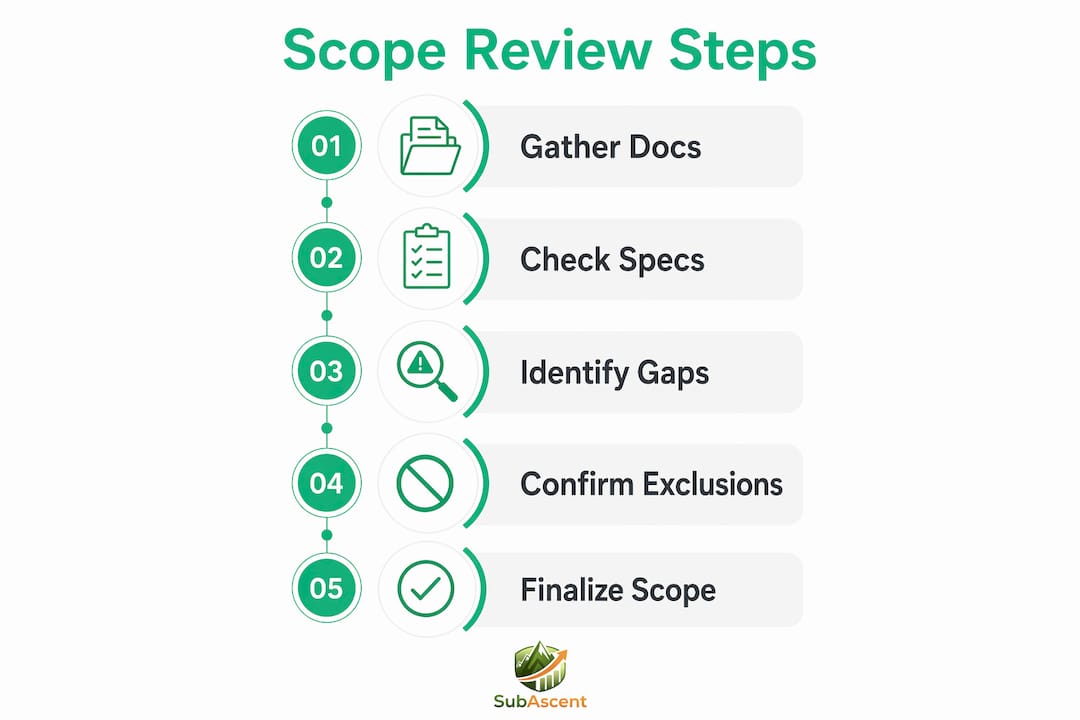
A systematic review process separates accurate bids from guesswork. Follow these steps in order before you submit any number to a GC.
- Gather all documents. Collect the invitation to bid, drawings, project specifications, all addenda, and any prior estimates or RFI logs. Missing an addendum is one of the most common causes of scope gaps.
- Read the specification sections. Division 04 covers masonry. Read it fully, not just the summary. Pay attention to submittals required, mock-up requirements, and cold-weather installation provisions.
- Cross-reference scope items to drawing details. Every line item in your scope should tie to a specific drawing number and detail reference. General "plans and specs" references are weak language that allows interpretation and change orders.
- Flag ambiguous language. Phrases like "repoint brick as needed" or "patch as required" are red flags. Quantify or exclude them.
- Verify ancillary items. Check whether lintels, shelf angles, control joints, weep holes, and flashing are in your scope or another trade's scope. Confirm in writing.
- Validate subcontractor qualifications. Confirm licenses, insurance coverage, and bonding. A certificate of insurance alone is not enough. Verify coverage specifics directly with the carrier before issuing a bid invitation.
- Document your findings. Write a scope clarification letter or use a leveling sheet. Every assumption you make during the review should be documented before bid day.
Pro Tip: Build a bid leveling sheet that lists every scope item in a column, then marks each sub's inclusion or exclusion. This makes apples-to-apples comparison fast and defensible.
The table below shows the difference between weak and strong scope language for common masonry items.
| Scope Item | Weak Language | Strong Language |
|---|---|---|
| Mortar type | "Mortar per specs" | "Type S mortar per ASTM C270, Section 3.2" |
| Repointing | "Repoint as needed" | "Repoint 1,200 LF of bed joints per Detail A-7" |
| Flashing | "Flash per drawings" | "Furnish and install through-wall flashing at all shelf angles per Detail 4/A-11" |
| Lintels | Not mentioned | "Furnish and install steel lintels per structural drawings S-3, S-4" |
What common scope issues cause disputes and how do you spot them early?
Most masonry disputes trace back to gaps that were visible in the scope document before the job started. Catching them early costs nothing. Catching them during construction costs real money.
The highest-risk areas in any masonry scope review:
- Interface gaps. The boundary between masonry and adjacent trades is where disputes live. Interface gaps at masonry-storefront, steel, and waterproofing boundaries cause most construction disputes and unplanned costs. Define the owner of every interface in writing.
- Vague specification references. "Per plans and specs" with no drawing or detail number is an open door for the GC to assign you work you did not price.
- Missing ancillary items. Flashing, weep holes, control joints, and shelf angles are frequently omitted from scope documents. Each one is a potential change order.
- Inconsistent exclusions. If your exclusion list does not match your inclusion list, you have a gap. Review both together, not separately.
- No submittal or mock-up requirement. On restoration projects especially, professional submittals correlate strongly with quality fieldwork. A scope that does not require submittals before mobilization is a scope that invites workmanship disputes.
"Vague language like 'repoint brick as needed' is a red flag protecting contractors over project budget. Every scope item that cannot be measured or counted is a scope item that will be disputed." This principle applies across all masonry work, from new construction CMU to historic brick restoration.
The most overlooked gap in masonry scopes is cold-weather provisions. Mock-up panels, cold-weather controls, and ASTM C270 mortar specifications should be defined early. A scope that is silent on cold-weather installation shifts all the risk to the masonry sub when work continues in freezing temperatures.
Understanding bid proposal exclusions is one of the fastest ways to tighten your scope language and reduce the chance of a post-award dispute.
What tools and best practices improve masonry scope reviews?
The right process and tools cut review time and reduce errors. Here is how high-performing masonry estimators and project managers approach scope analysis.
Standardized checklist templates
A written checklist tied to drawing numbers and specification sections is the most reliable way to avoid missing scope items. The checklist should cover every item in Division 04, every interface trade, and every ancillary item. Update it after every project where a dispute or change order occurred.
Scope and takeoff software
Modern scope software can generate complete packages in under 60 minutes, replacing up to 40 hours of manual effort and reducing RFIs. That time savings matters most when you are managing multiple bid invitations with overlapping due dates. Digital takeoff tools also let you link scope line items directly to drawing references, which eliminates the "plans and specs" problem at the source.
Version control and document management
Scope documents should be version-controlled and dated, incorporating all prime contract flow-downs consistently. A scope document without a version number and date is a liability. When a dispute arises six months after award, you need to know exactly which version of the scope governed the work.
Pro Tip: Apply the "PM test" to every scope you write or review. Ask: could a project manager with no prior knowledge of this job resolve a field dispute solely by reading this document? If the answer is no, the scope needs more specificity.
Subcontractor prequalification workflows
Prequalification is not a one-time event. Routine requalification and upfront vetting prevent subcontractor-related project risks better than reactive contract enforcement. For masonry subs, prequalification should verify state licensing, bonding capacity, insurance coverage limits, and references from comparable projects. In states like California, verifying state licenses and bonding over applicable project thresholds is a legal requirement, not a best practice.
Learning how to read a subcontract agreement gives estimators and project managers the legal literacy to catch flow-down risks before they sign.
Key Takeaways
A thorough masonry subcontract scope review requires specific drawing callouts, documented exclusions, verified qualifications, and version-controlled documents to protect bid accuracy and job profitability.
| Point | Details |
|---|---|
| Anchor scope to drawing details | Reference exact drawing numbers and detail callouts for every scope line item. |
| List all ancillary items explicitly | Include or exclude lintels, shelf angles, flashing, and weep holes in writing. |
| Verify qualifications beyond the COI | Confirm insurance coverage specifics with the carrier, not just the certificate. |
| Use the PM test for scope clarity | A scope passes only if a PM can resolve field disputes from the document alone. |
| Version-control every document | Date and version all scope documents to prevent contradictory language after award. |
What I have learned from years of masonry scope reviews
The biggest mistake I see masonry estimators make is treating the scope review as a formality. They skim the drawings, pull quantities, and submit a number. Then the job starts and the GC points to a detail they never priced. That conversation never goes well.
The detail that separates profitable masonry jobs from money-losers is specificity. Not just "brick veneer per plans," but "brick veneer per Elevation A-3, Detail 5/A-11, including all shelf angle connections and through-wall flashing as shown." That level of detail takes an extra hour during the bid. It saves days of argument during construction.
Early communication with the GC and other trades matters just as much as the document itself. I have seen masonry subs catch storefront interface gaps in a pre-bid meeting that would have cost $40,000 to resolve after award. That conversation costs nothing. The role of scope of work documents is not just to define work. It is to create a shared record that protects everyone.
Treat scope review as a process you revisit throughout pre-construction, not a box you check before bid day. Every addendum, every RFI response, and every pre-bid meeting is an opportunity to tighten your scope and reduce your risk.
— Dave
How Subascent helps masonry subs manage scope reviews
Masonry estimators and project managers who want tighter scope documents and faster bid cycles use Subascent to manage the process from bid invitation to award.

Subascent is built for specialty trade subs, not general contractors. The platform helps masonry teams track bid invitations, organize scope documents, and flag missing items before they become disputes. You can link scope line items to drawing references, manage submittal workflows with GCs, and keep version-controlled scope documents in one place. For masonry businesses running $500K to $15M in annual revenue, that kind of organization directly protects profit margins. Visit Subascent to see how the platform fits your estimating and project management workflow.
FAQ
What is a masonry subcontract scope review?
A masonry subcontract scope review is the process of verifying that a scope document accurately defines all work, materials, exclusions, and responsibilities before bidding or signing. It protects masonry subcontractors from scope gaps that erode the 2%–4% profit margins typical in construction.
What should a masonry scope of work include?
A masonry scope of work must include a detailed work description, ASTM-based material specifications, explicit ancillary items like lintels and flashing, exclusions, warranty terms, and payment schedules. Missing any of these creates gaps that lead to disputes or change orders.
How do you spot weak language in a masonry scope?
Phrases like "repoint as needed," "per plans and specs," or "patch as required" are weak language because they cannot be measured or enforced. Replace them with specific quantities, drawing references, and detail numbers.
Why does subcontractor prequalification matter in scope review?
Prequalification confirms that a masonry sub has the licenses, bonding, and insurance to perform the work legally and safely. A certificate of insurance alone is insufficient. Verify coverage specifics directly with the carrier before issuing a bid invitation.
How often should masonry scope documents be updated?
Scope documents should be updated and version-controlled after every addendum, RFI response, or pre-bid meeting. A dated version history prevents contradictory scope language and protects all parties if a dispute arises after award.