

Aim for under 7 business days on a standard RFI. Under 5 is excellent, 5 to 10 is normal, 10 to 14 signals a problem worth escalating, and anything over 14 business days is a critical risk to your schedule and your margin. Complexity moves those numbers around: a simple field clarification on a small commercial job should close faster than a coordination issue on a hospital renovation, and your expectations should shift accordingly.
TL;DR:
- RFI closure times vary significantly by project size and complexity, ranging from 5 days for small commercial jobs to over 20 days on large, complex projects.
- The main delays stem from routing and review processes, with poorly formed RFIs and inbox pile-up being the largest contributors to slow response times.
- Tracking metrics such as response time and open RFIs weekly helps prevent delays and manage potential schedule slips effectively.
- Standardized templates, clear response deadlines, and quick triage procedures are low-cost measures that can significantly improve RFI turnaround.
- Using dedicated RFI management platforms with analytics and enforcing response SLAs can further accelerate responses and protect project margins.
Table of Contents
- Understanding RFI turnaround times: the real industry benchmarks
- What actually slows down an RFI response
- Building RFI response times into your subcontract and SLAs
- How to write RFIs that get faster answers
- Tracking RFI response time: the metrics that actually protect your margin
- Cutting RFI turnaround time: what actually moves the needle
- What we've seen slow down RFIs across different trades
- Dave's three non-negotiables for faster RFI answers
- How Subascent keeps RFI response times visible and enforceable
- Sources
Understanding RFI turnaround times: the real industry benchmarks
Most subs have a gut feeling for what "too slow" looks like, but the published numbers back it up with real weight. AIA benchmark data drawn from more than 400 projects puts average RFI resolution at 9.7 days, and that same data ties unresolved RFIs to 37% of all schedule overruns. That's not a rounding error. That's more than a third of the delays on a typical job traced back to a question sitting in someone's inbox.
Vendor and industry surveys land in a similar band. Reports from Procore and Dodge-adjacent studies generally put average RFI closure between 9 and 13 days, with smaller projects closing faster and larger, more complex ones dragging longer. A study of 168 construction projects covering more than 53,000 RFI events found the same pattern: as project complexity goes up, RFI frequency goes up, and turnaround stretches with it. Bigger jobs generate more questions, and each question takes longer to route through more layers of review.
There's a distinction worth nailing down here, because it changes how you should read your own numbers: time-to-first-response is not the same as time-to-closure. First response is when someone acknowledges the RFI and starts working it. Closure is when you get an answer you can actually build to. A designer might "respond" in two days by asking a clarifying question, then the real answer doesn't land for another nine. If you're only tracking first response, you're missing the number that actually affects your crew's schedule.
Expected ranges also shift by project type and size:
- Small commercial (under $2M): 5 to 8 business days is typical for closure on standard RFIs.
- Mid-size commercial ($2M to $20M): 7 to 12 business days, with more review layers involved.
- Healthcare and institutional: 10 to 15 business days, driven by regulatory review and multiple stakeholder sign-offs.
- Large complex or public projects: 12 to 20+ business days, especially where design teams are spread across multiple firms.
| Project type | Typical closure range | Primary driver of delay |
|---|---|---|
| Small commercial | 5–8 business days | Single-reviewer sign-off |
| Mid-size commercial | 7–12 business days | Multiple trade coordination |
| Healthcare/institutional | 10–15 business days | Regulatory and stakeholder review |
| Large/complex/public | 12–20+ business days | Multi-firm design coordination |
One more thing worth locking down before you compare your own numbers to any of these ranges: business days versus calendar days. A contract that says "10 days" without specifying which kind is a trap. Ten calendar days over a holiday week can shrink to six working days of actual review time, but if your internal tracking counts calendar days, you'll think the designer blew the deadline when they didn't. Track business days internally, always. It's the only apples-to-apples way to compare your project against these benchmarks or against your own historical average.
What actually slows down an RFI response
When an RFI sits open for two weeks, it's rarely because someone is deliberately stalling. It's usually death by a thousand small delays stacked on top of each other, and most of them are predictable once you know where to look.
Routing typically eats up the biggest single chunk of elapsed time, often a large share of the total, which can be better managed using AI construction project controls software to reduce routing delays and improve triage. This is the RFI sitting in a shared inbox, waiting for someone to notice it, forward it, and assign an owner. Helonic's benchmark research identifies notification lag and inbox pile-up as the single largest drag on RFI speed, ahead of the actual technical review.
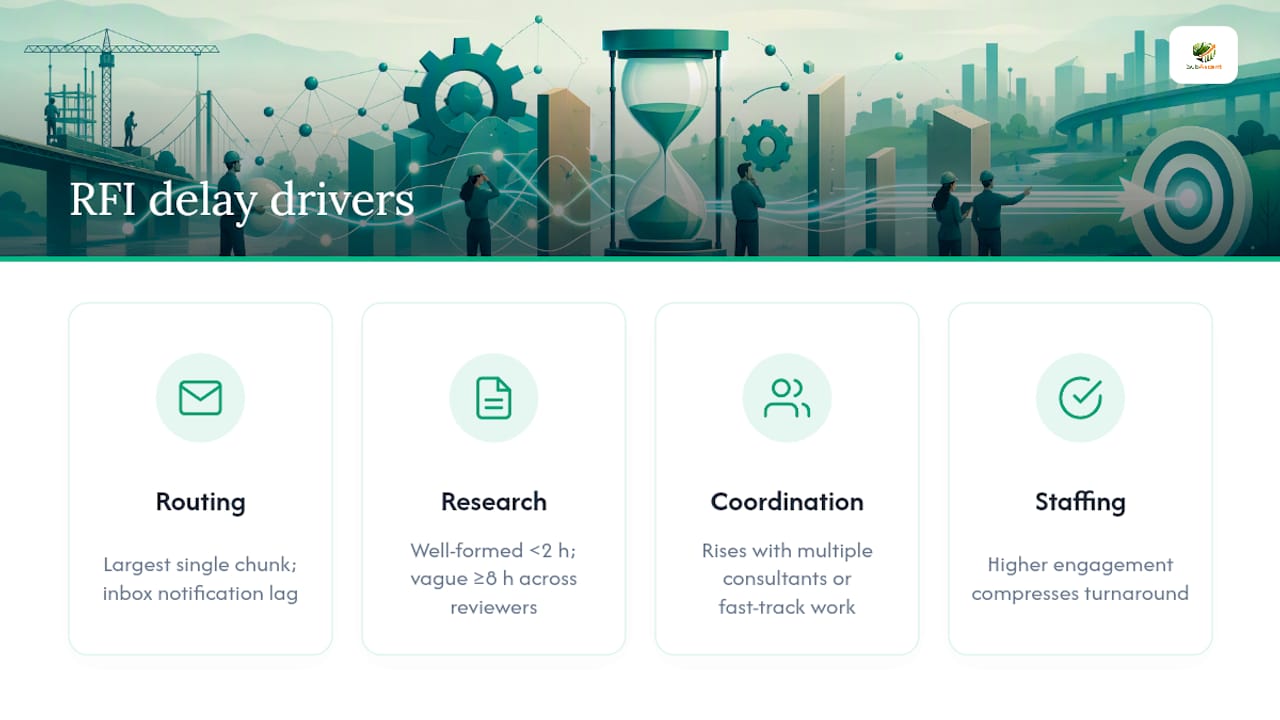
Research and technical review account for a significant portion, and this is where vague RFIs cause the most damage. One field study on RFI cycle time found that a well-formed RFI with a clear question and a proposed solution can be answered in under two hours, while a vague or poorly documented one can consume eight or more hours spread across multiple reviewers who each have to reconstruct context from scratch.
Coordination between parties, architect to engineer, engineer to owner, owner back to GC, typically claims a substantial portion of the remaining time, and it grows fastest on projects with multiple design consultants or fast-track delivery methods where drawings aren't fully coordinated when work starts.
The staffing effect nobody talks about: projects with more active users engaging in the RFI platform, meaning more people logged in, checking status, and pushing for answers, tend to close RFIs faster. Engagement itself seems to compress turnaround, independent of project size. A design team that knows people are watching moves faster than one that assumes nobody's counting the days.
Building RFI response times into your subcontract and SLAs
Verbal expectations don't hold anyone accountable. Written response windows do, and they're easier to negotiate into a subcontract than most subs assume, especially if you propose specific language rather than a vague ask for "faster responses."
A few tiers that work in practice:
- Standard RFIs: 5 to 7 business days from submission to an actionable answer.
- Schedule-critical RFIs: 48 to 72 hours, flagged at submission with a reason the timeline is tight.
- Interim status requirement: if an RFI isn't closed within 3 business days, the responding party owes a status update, not silence.
- Escalation clause: unanswered RFIs past the SLA window automatically route to a named project executive, not back into the same inbox.
Define what actually counts as an "answer" in the contract language itself. Procore's guidance on RFI management is blunt about this: an acknowledgment is not a response. A real answer gives the field something they can build to, whether that's a dimension, a detail, or an approved substitution. If the reply just asks another question, the clock should keep running.
If your contract states response windows in calendar days, convert mentally before you commit. A "10 calendar day" clause is roughly 7 business days in a normal week, but that shrinks fast around holidays, so push for business-day language wherever you can.
How to write RFIs that get faster answers
The single biggest lever you control isn't the contract, it's the quality of the RFI itself. A tight, well-documented RFI removes almost all the research time a designer would otherwise burn trying to figure out what you're actually asking.
Build every RFI around these fields, in this order:
- Location reference — sheet number, grid line, or room name. Don't make anyone hunt for where this applies.
- Short issue statement — one or two sentences, no backstory.
- Proposed solution — your best guess at the fix. Even a wrong guess gives the reviewer something to confirm or correct instead of starting from zero.
- Attachments — photos, markups, or a marked-up detail sheet.
- Referenced spec section or drawing — the exact citation, not "somewhere in Division 26."
- Priority and needed-by date — tied to an actual schedule milestone, not "ASAP."
Batch related questions into a single RFI when they hit the same wall or the same drawing conflict. Separate them when they touch different trades or different design disciplines, since bundling unrelated issues just means the whole RFI waits on the slowest piece. A quick pre-check with the GC's project engineer before formal submission catches the questions that already have an answer sitting in an addendum somewhere, which saves everyone a week.
Pro Tip: A single photo with a red-line markup often does more work than three paragraphs of description. Designers and engineers process a marked-up image faster than they process prose, and it removes the back-and-forth of "can you clarify what you mean by."

Tracking RFI response time: the metrics that actually protect your margin
You can't manage what you don't measure, and most subs are flying blind on this because they never built the habit of tracking it project by project.
Track these four numbers, minimum:
- Time-to-first-response — early warning signal, useful for triage but not the whole story.
- Time-to-closure — the number that actually matters for your schedule.
- Open-RFI count — how many are sitting unanswered right now, across all active jobs.
- RFIs per $1M of contract value — normalizes volume so you can compare a $500K job to a $5M one fairly.
Set your thresholds around the same benchmarks the industry already validated: a portfolio average under 7 business days is healthy. Once that average creeps past 14 business days, you're looking at a systemic risk that correlates strongly with real schedule slippage, not just an annoying outlier.
| Metric | Healthy | Watch | Critical |
|---|---|---|---|
| Time-to-closure (avg) | Under 7 business days | 7–14 business days | Over 14 business days |
| Open-RFI count (active project) | Under 5 | 5–10 | Over 10 |
Review active-project numbers weekly. Roll up portfolio trends monthly, and use that rollup to benchmark specific architects and engineers against each other. Tracking response times by designer gives you real leverage in prequalification conversations, because you can point to a pattern instead of a complaint.
Cutting RFI turnaround time: what actually moves the needle
Fixing turnaround isn't one big initiative, it's a stack of small changes, and the order you tackle them in matters.
Start immediately with things that cost nothing:
- Standardize your RFI template across every project, with photos and a needed-by date required, not optional.
- Set SLA tiers by RFI severity so schedule-critical questions get flagged differently than routine clarifications.
- Run a weekly triage on every open RFI across active jobs, five minutes, just checking what's stuck.
Near-term, over the next month or two:
- Negotiate SLA language into your next few subcontracts using the tiers above.
- Add a GC pre-check step before formal submission on complex jobs. Coordinating this through the submittals workflow catches redundant questions early.
Long-term, over a quarter or two:
- Move to a dedicated RFI tracking platform with dashboards instead of a shared inbox and a spreadsheet.
- Build analytics into staffing decisions, since engagement itself seems to speed up designer response.
Trade-specific quick wins help too. Electrical crews get faster answers by photographing the conduit chase before asking about a routing conflict. HVAC crews should tag the exact duct run and cite the spec section, not just describe it. Masonry RFIs move faster with an elevation photo and a mockup callout attached, since the reviewer can see exactly what doesn't line up. Delayed RFIs don't just cost schedule days, they ripple into crew remobilization and scheduling conflicts that cost real money on top of the delay itself.
What we've seen slow down RFIs across different trades
Patterns repeat across trades more than most subs expect. Electrical crews lose the most time on RFIs missing a photo of the actual conduit routing conflict, forcing the engineer to guess at field conditions. Plumbing RFIs stall when they reference a fixture without citing the spec section, sending the reviewer hunting through submittals. HVAC and masonry show the same story: vague location references cost more time than any technical complexity in the actual question.
Common breakdowns worth avoiding are covered in detail in RFI workflow mistakes subcontractors should avoid, and field crews looking for a repeatable process should check the Field RFI Submittal Process for Foremen guide for a step-by-step breakdown foremen can use on site.
- Electrical: photo-first submissions cut research time noticeably.
- Plumbing: citing spec sections up front reduces back-and-forth.
- HVAC: tagging the exact duct run prevents misidentification.
- Masonry: mockup photos resolve elevation questions faster than text alone.
Dave's three non-negotiables for faster RFI answers
If I had to strip this whole topic down to three rules, they'd be these: every RFI needs a photo, every RFI needs a proposed fix, and every RFI needs a needed-by date tied to a real schedule milestone. Skip any one of those and you're gambling on someone else's inbox habits.
The one metric worth checking every single week is your portfolio average response time. Not per job, across everything you've got open. Pick that one number, watch it move, and you'll catch a slowdown before it costs you a week of crew time standing around.
— Dave
How Subascent keeps RFI response times visible and enforceable
Subascent gives specialty trade subs a way to log every RFI with the fields that actually matter, location, photos, proposed fix, needed-by date, and priority tier, instead of chasing answers through email threads and shared drives.
The dashboard tracks time-to-first-response and time-to-closure automatically, so you always know your portfolio average without building a spreadsheet by hand. SLA fields let you flag schedule-critical RFIs the moment they're submitted, and portfolio analytics make it easy to spot which designers or GCs are consistently slow, useful ammunition the next time you're negotiating a subcontract. It syncs with QuickBooks too, so the RFI delays that push a job past budget show up where your numbers actually live. If you're tired of guessing how many RFIs are sitting open across your active jobs, start a trial at Subascent and see your real numbers this week.
Sources
- Construction RFI Response Time Benchmarks: What the Data Shows | Helonic
- RFI Response Time: The Metric That Predicts Project Delays | CloudPath Data