

A subcontract scope is the contractually binding description of every task, material, piece of equipment, and service a specialty trade contractor is obligated to deliver on a construction project. It is the single document that separates a profitable job from a money-losing dispute. For electrical, plumbing, HVAC, masonry, and drywall contractors, understanding what does a subcontract scope mean is not optional. It is the foundation of every bid you price and every contract you sign.
The industry standard term is "scope of work," and it appears in subcontract agreements governed by forms like AIA A401. What makes a subcontract scope distinct from a general scope of work is its legal weight. Every word in it either protects your margin or exposes it.
What does a subcontract scope mean and what goes in it?
A subcontract scope specifies the exact labor, materials, equipment, and services the subcontractor must provide, guided by drawings, specifications, and BIM versions named in the agreement. AIA A401 Article 8 defines this structure explicitly, making it the most widely referenced framework for specialty trade subcontracts in the United States.
The core elements of a well-written subcontract scope include:
- Labor: The specific trades performing the work, crew qualifications, and supervision requirements
- Materials: Product specifications, approved substitutions, and supply responsibilities
- Equipment: Who provides scaffolding, lifts, hoisting, and temporary power
- Services: Coordination, testing, commissioning, and closeout deliverables
- Drawings and specifications: The exact revision numbers and BIM versions that govern the work
- Inclusions and exclusions: A clear list of what is and is not part of your price
- Assumptions: Conditions your bid relied on, such as unobstructed access or existing rough-in
- Attendances: Who provides utilities, access, and temporary facilities during your work
The inclusions and exclusions section is where most trade contractors underinvest their attention. A roofing contractor who lists "supply and install TPO membrane" without excluding flashings, penetrations, and edge metal will find themselves installing all three at no additional cost when the GC points to the word "roofing" in the contract.
Pro Tip: Before signing any subcontract, build a two-column checklist: left column lists every item in your bid, right column confirms where each item appears in the scope language. Any gap is a scope gap you are about to fund.
How the subcontract scope functions within the contract framework
A subcontract scope is not a standalone document. It is a legally binding component of the full subcontract agreement, and that agreement connects directly to the prime contract between the general contractor and the owner.
The four layers of obligation that flow from the scope are:
- Payment terms: Your scope defines what triggers progress billing. If the scope is vague, the GC can dispute whether a milestone is complete and hold your payment.
- Schedule requirements: Subcontract agreements define scope, payment terms, schedule expectations, and change order requirements, meaning your scope language directly determines whether a delay claim holds up.
- Change order thresholds: Work outside the scope is a change order. Work inside the scope is your problem. The clearer the scope, the easier it is to price and defend change orders.
- Dispute resolution: When a dispute goes to arbitration or litigation, the scope document is exhibit one. Judges and arbitrators read it literally.
"Flow-down clauses impose the prime contract responsibilities onto subcontractors, including scope, schedules, payment, change orders, and dispute resolution." AIA B101 + C401
Flow-down clauses are the mechanism that ties your subcontract scope to the prime contract. If the GC's contract with the owner requires a specific fire protection system commissioning process, that obligation flows down to your sprinkler subcontract whether or not the scope exhibit mentions it. Treating flow-down obligations as integral to your scope during estimating is the only way to price the job correctly.
Approved submittals also function as scope evidence. Approved submittal records demonstrate contract requirements before installation, which means the submittal log you maintain throughout the project becomes your primary defense if a scope dispute arises at closeout.

Common risks and pitfalls in subcontract scopes
Scope gaps are the most expensive problem specialty trade contractors face. A scope gap is defined as the difference between priced and actual work required in the subcontract, and it arises from three sources: omission during estimating, scope expansion beyond the original tender, and ambiguous language in the contract documents.
The most common pitfalls by trade include:
- Electrical contractors pricing a panel schedule from schematic drawings, then discovering the issued-for-construction set added 40 circuits
- Plumbing contractors excluding fixture trim but signing a scope that says "complete plumbing systems"
- HVAC contractors missing that "mechanical" in the scope definition includes controls and BAS integration
- Framing contractors assuming blocking is excluded when the spec section says "all blocking required for finish work"
- Concrete contractors not accounting for saw-cutting, curing compounds, and joint sealants that appear in Division 03 specs but not in the scope exhibit
Vague scopes leave room for interpretation and are among the most common causes of scope disagreements on commercial projects. The GC's project manager will always read ambiguous language in the GC's favor. That is not bad faith. That is contract administration.
Pro Tip: Never rely on the GC's scope exhibit as your only reference. Pull the relevant spec sections yourself and compare them line by line against what the scope exhibit says. Discrepancies you find before signing cost nothing to resolve. Discrepancies you find after installation cost everything.
A related risk is the latent obligation. Subcontract scope can be broader than the explicit scope of work exhibit due to definitions embedded in the subcontract conditions. The defined term "Works" or "subcontract documents" may pull in obligations that never appear in the titled scope section. Low-voltage and fire protection contractors are particularly exposed here because their work intersects with multiple specification divisions. Learning to read a subcontract agreement from front to back, not just the scope exhibit, is the skill that separates contractors who win disputes from those who fund them.
Underbidding driven by scope misreads is also a documented pattern in construction. Contractors frequently underbid because they price from incomplete scope documents and discover the full obligation only after mobilizing. The fix is not faster estimating. It is more disciplined scope review before the bid goes out.
How to read and interpret subcontract scope language
Reading a subcontract scope effectively requires a structured approach. The table below outlines the four-step method used by experienced trade PMs and estimators.
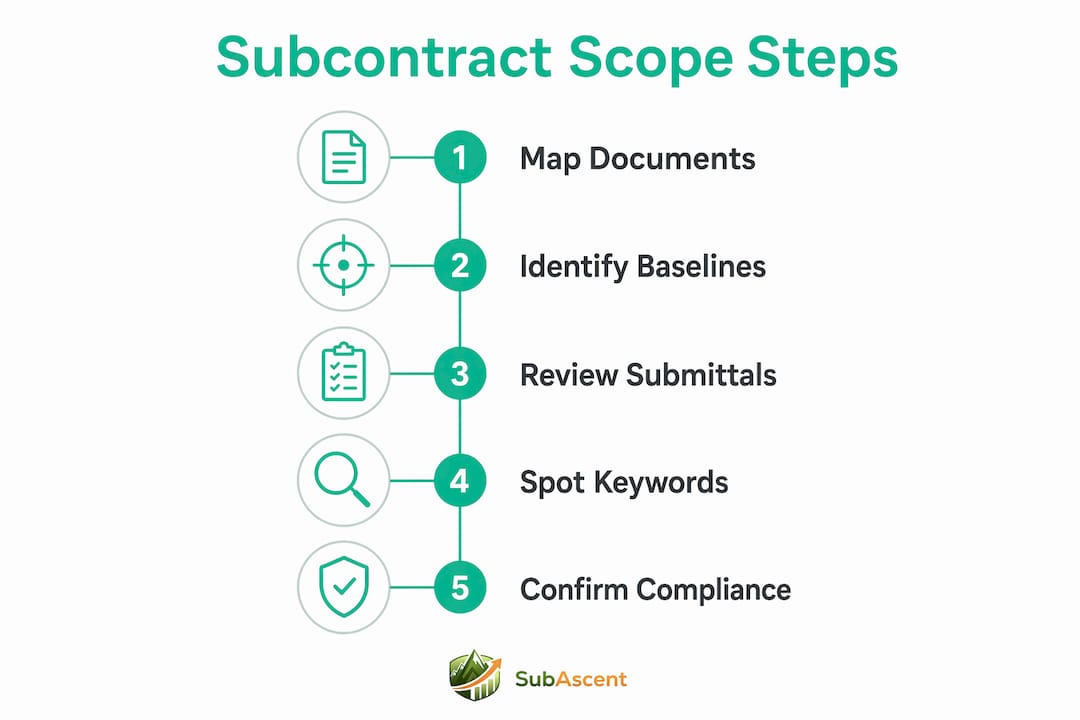
| Step | Action | What to look for |
|---|---|---|
| 1. Map the document hierarchy | Identify which documents govern in case of conflict | Order of precedence clause, usually in the general conditions |
| 2. Audit the drawing and spec references | Confirm revision numbers and BIM versions named in the scope | Outdated revisions create gaps between priced and required work |
| 3. Cross-check inclusions and exclusions | Compare scope exhibit against your bid breakdown line by line | Items in your bid but not in the scope, and vice versa |
| 4. Hunt for latent obligations | Read all defined terms and flow-down provisions | "Works," "subcontract documents," and "prime contract obligations" |
Disputes commonly center on baseline documents and governing drawing or BIM versions, making explicit naming of these references one of the highest-value actions you can take before signing. If the scope says "per plans and specifications" without naming revision numbers, you are exposed to scope expansion every time the GC issues an updated drawing set.
Submittals are your second line of defense. Maintaining a rigorous submittal documentation workflow is critical for demonstrating scope compliance and avoiding disputes at project closeout. Every approved submittal is a timestamped record of what the contract required at the time of installation. Glazing and flooring contractors, whose product selections are heavily submittal-driven, have the most to gain from treating the submittal log as a scope compliance record rather than a paperwork exercise.
One more reading strategy: look for the word "including but not limited to" anywhere in the scope. That phrase converts a specific list into an open-ended obligation. If you see it, negotiate it out or add a corresponding exclusion list that limits your exposure. Common subcontractor contract disputes trace directly back to that four-word phrase appearing in a scope exhibit that nobody questioned at signing.
Key takeaways
A subcontract scope is a legally binding document that defines every obligation a specialty trade contractor carries, and scope gaps, vague language, and unread flow-down clauses are the primary drivers of cost overruns and disputes.
| Point | Details |
|---|---|
| Core scope elements | Labor, materials, equipment, services, drawings, inclusions, exclusions, and assumptions must all appear explicitly. |
| Flow-down exposure | Prime contract obligations pass to subcontractors automatically; factor them into your estimate before bidding. |
| Scope gaps cost money | Gaps between priced and required work arise from omission, ambiguity, and scope expansion after tender. |
| Submittals as evidence | Approved submittals are the primary record of what the contract required; maintain them rigorously. |
| Read beyond the exhibit | Latent obligations in defined terms can expand your scope far beyond the titled scope of work section. |
The scope review habit that actually protects your margin
I have reviewed hundreds of subcontracts across electrical, HVAC, and masonry trades, and the pattern is consistent. The contractors who lose money on scope disputes are not the ones who missed the work. They are the ones who priced the work correctly but signed a scope that described something broader.
The most expensive lesson I have seen a framing contractor learn was on a mid-rise wood-frame project where the scope said "complete framing per structural drawings." The structural drawings referenced a shear wall schedule that was issued two weeks after the bid date. The contractor had never seen it. The GC's position was that "per structural drawings" meant all structural drawings, including future revisions. The contractor installed $180,000 in additional shear panels with no change order because the scope language gave the GC that argument.
The fix is not complicated. It is discipline. Review the scope before you bid, not after you sign. Name the drawing revisions you priced. List every exclusion you assumed. Get the GC to acknowledge your clarifications in writing before the contract is executed. If they will not, price the risk into your number or walk away.
The contractors I have seen build profitable, repeatable businesses treat scope review as a billable activity, not an afterthought. They assign it to a senior estimator or PM, they use a checklist, and they track scope clarifications the same way they track RFIs. That discipline compounds over time into fewer disputes, faster change order approvals, and GCs who trust that your numbers mean what they say.
— Dave
How Subascent helps you manage scope from bid to closeout

Subascent is built specifically for specialty trade subcontractors, not general contractors. The platform gives electrical, plumbing, HVAC, masonry, and drywall contractors a single place to track bid invitations, attach scope documents to estimates, and carry scope clarifications through to the executed contract. When a change order comes in, your original scope language is right there, not buried in an email thread from six months ago.
For estimators who spend their day building bids and PMs who manage submittals and RFIs, Subascent removes the friction between winning a job and running it profitably. Explore subcontractor bid and job management at Subascent, or see the tools built specifically for mason and specialty trade contractors to manage scope, bids, and job tracking in one place.
FAQ
What does a subcontract scope mean in construction?
A subcontract scope is the contractually binding description of all labor, materials, equipment, and services a specialty trade contractor must deliver on a project. It defines the boundaries of the subcontractor's obligations and forms the basis for payment, change orders, and dispute resolution.
What are the key elements of a subcontract scope?
A complete subcontract scope includes inclusions, exclusions, assumptions, attendances, referenced drawing and specification revisions, and any flow-down obligations from the prime contract. Missing any of these elements creates scope gaps that are costly to resolve after work begins.
What is a scope gap in a subcontract?
A scope gap is the difference between the work a subcontractor priced and the work the subcontract actually requires. It arises from omission, ambiguous language, or scope expansion after the original bid, and it typically results in unpriced work the subcontractor must perform at their own cost.
How do flow-down clauses affect a subcontract scope?
Flow-down clauses attach the general contractor's prime contract obligations directly to the subcontractor, expanding the effective scope beyond what the scope exhibit alone describes. Subcontractors must read the prime contract, not just the scope exhibit, to understand their full obligation.
Why do approved submittals matter for scope compliance?
Approved submittals are timestamped records of what the contract required at the time of installation, making them the primary evidence in scope disputes. Contractors who maintain a complete submittal log are far better positioned to defend their scope compliance than those who treat submittals as routine paperwork.