

Most electrical, plumbing, and HVAC firms sign whatever contract the GC hands them and move on. That approach works until it doesn't. Understanding what is a master subcontract agreement, and how it differs from a one-off project contract, can change how you operate, how fast you mobilize, and how much legal exposure you carry across every job. This guide breaks down the definition, the key clauses that protect you, and how to put one to work in your business.
Table of Contents
- Key takeaways
- What is a master subcontract agreement
- Legal and operational benefits for specialty trades
- Critical legal clauses you cannot ignore
- How to create and implement an effective MSA
- Common challenges and how to handle them
- My take on MSAs in the real world
- Get more control over every job you run
- FAQ
Key takeaways
| Point | Details |
|---|---|
| MSA separates governance from scope | The MSA sets fixed legal terms once; Work Orders define each project's specific scope. |
| Faster project starts | Pre-negotiated terms mean you skip contract review every time a new job kicks off. |
| Critical clauses demand attention | Indemnity, insurance limits, and pay-when-paid language can make or break your protection. |
| State law affects enforceability | Pay-when-paid clauses and other payment triggers vary by state and must be reviewed locally. |
| Technology amplifies the benefit | Software built for specialty trades helps you manage Work Orders and compliance documents under an MSA. |
What is a master subcontract agreement
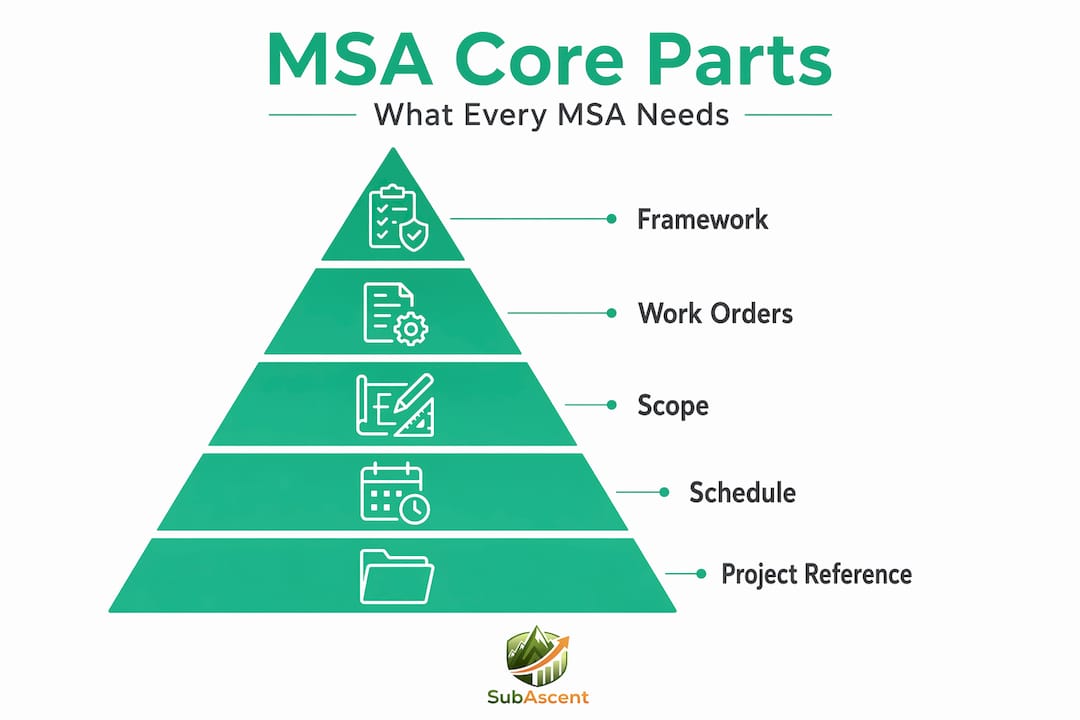
A master subcontract agreement (MSA) is not a project contract. It is a governance framework. Think of it as the legal backbone that covers every job you do with a particular GC, without you needing to renegotiate the core terms each time. The definition of a subcontract agreement at the MSA level is this: a standing set of legal and commercial rules that applies across multiple projects, activated through simpler, project-specific documents called Work Orders or Statements of Work (SOWs).
That separation is the entire point. The MSA holds the hard stuff. Work Orders handle the specifics.
Core components every MSA should include
A well-drafted MSA typically covers these provisions:
- Indemnification. Who is responsible if someone gets hurt or property gets damaged? This clause defines your liability exposure and should be mutual where possible.
- Insurance requirements. General liability limits, workers' compensation, umbrella coverage, and any trade-specific requirements. The 30-day cancellation notice clause is a standard inclusion.
- Payment terms. Net-30, net-45, retainage percentages, and what triggers final payment release.
- Change order procedures. How changes to scope get documented, priced, and approved before work begins.
- Dispute resolution. Mediation or arbitration requirements, venue, and governing law.
- Termination rights. Conditions under which either party can exit the agreement.
The Work Order sits on top of this framework. It names the project, describes the scope, sets the schedule, and references the MSA for everything else. You get a lean, fast document to execute without reopening the legal debate every time.
Pro Tip: When you receive a master subcontract agreement template from a GC, do not assume their default indemnity clause is mutual. Most are not. Read it, mark it up, and push back before you sign.
Legal and operational benefits for specialty trades
Once you understand what subcontractor agreements like this actually do, the business case becomes obvious. Here is what changes when you operate under an MSA with a regular GC.
-
You mobilize faster. Because the MSA acts as a constant framework, you are not waiting on contract review before crews can start. A roofing or fire protection firm working with the same GC on three projects a year saves weeks of back-and-forth.
-
Your legal costs drop. Negotiating a new contract for every project adds up. An attorney reviewing a $200K drywall scope every time a new job lands is expensive and slow. With an MSA in place, your lawyer reviews it once and you use Work Orders from that point forward.
-
Contract disputes become less frequent. Consistency in key terms across projects reduces the gray areas where disputes grow. When your masonry crew shows up to a job site and the payment terms, change order process, and liability rules are already agreed upon, there is less room for misunderstanding.
-
You gain negotiating leverage. Mature GCs who work with MSAs understand the structure. If you walk into a negotiation knowing your indemnity limits, insurance requirements, and payment triggers cold, you look like a serious operation. That matters when GCs are deciding which subs they want on their roster long-term.
-
Risk is better distributed. Clearly defined indemnity and insurance clauses prevent situations where your plumbing firm absorbs liability for a problem caused by another trade. Clarity in subcontract agreements significantly reduces costly legal exposure and the operational delays that follow.
The importance of subcontract agreements of this type compounds over time. The more recurring GC relationships you build on a solid MSA foundation, the more predictable and profitable your project pipeline becomes. Good MSA discipline also makes it easier to avoid common contract disputes before they reach the job site.
Critical legal clauses you cannot ignore

This is where most specialty trade owners skim when they should be reading carefully. The following clauses carry the most risk and deserve close attention.
Indemnification and liability caps
Broad indemnity language can obligate your framing or glazing firm to cover the GC's legal costs even when the problem had nothing to do with your work. Push for mutual indemnification and, where possible, a cap tied to the contract value. Without a cap, your exposure on a $150K insulation scope could theoretically exceed what you were paid.
Insurance requirements and "follow form" coverage
| Coverage Type | Typical Minimum | Key Watch Point |
|---|---|---|
| General Liability | $1M per occurrence / $2M aggregate | Additional insured endorsement required |
| Workers' Compensation | Statutory limits | Employer's liability often required at $1M |
| Umbrella / Excess | $5M or more on large projects | Must follow form to avoid coverage gaps |
The "follow form" provision in umbrella policies is often overlooked. It means your umbrella coverage mirrors the terms of your underlying policies, preventing a gap where a claim falls between the two layers. If your umbrella does not follow form, you may think you have coverage when you do not. This matters especially for concrete, steel, or structural trades where large claims are a real possibility. For a deeper look at how default protection works alongside your policy, the subcontractor default insurance guide from Subascent is worth reading.
Pay-when-paid clauses and state law
Pay-when-paid clauses in MSAs are subject to state-level legal constraints and may be unenforceable if generic templates are used without jurisdictional consideration. Some states treat them as an absolute defense for the GC; others treat them as a timing provision only. If you are a low-voltage or painting firm working across multiple states, this is not a clause you can copy-paste and forget.
Pro Tip: Before signing any MSA with pay-when-paid language, send it to a construction attorney licensed in your state. One hour of legal time now beats a $40K collection fight later.
Federal project flow-down clauses
If you work on federally funded projects, the rules change. Federal prime contractors must flow down mandatory clauses into subcontracts, including certified cost or pricing data requirements. Subcontracts over $2M require specific certified cost or pricing data clauses per FAR regulations. Beyond dollar thresholds, functional screening matters too. If you are providing essential services, your label as a "vendor" does not exempt you from flow-down compliance. The function determines the obligation.
How to create and implement an effective MSA
You do not need to start from scratch. Here is a practical sequence for building and deploying an MSA in your specialty trade firm.
- Start with a master subcontract agreement template. Several industry associations publish starting-point templates for specialty trades. Review one as a baseline, but do not use it as-is. Your trade, your state, and your typical GC relationships all require adjustments.
- Identify your non-negotiables. Before you sit across from a GC, know what you will not sign. Broad indemnity, waiver of consequential damages, and no-damages-for-delay clauses are the three most common landmines.
- Define your Work Order format. The Work Order should reference the MSA by name and date, then cover scope, schedule, contract value, and any trade-specific scope exclusions. Keep it to one or two pages.
- Get legal review once. Pay an attorney to review your standard MSA and Work Order templates. That investment covers every project you run under that framework. For guidance on how subcontractor payment structures typically work, the trade owner's payment guide from Subascent is a useful reference.
- Store and track documents centrally. Every executed MSA, Work Order, insurance certificate, and amendment needs to live somewhere your PM can find it in two minutes. Not in someone's email inbox.
- Review annually. Insurance limits change, state laws update, and your trade may take on new project types. Set a calendar reminder to review active MSAs each year.
Hiring without a written agreement is a costly mistake. Contractual clarity on payment triggers, change order processes, and insurance is non-negotiable for protecting your business.
Common challenges and how to handle them
Even with a solid MSA in place, execution is where things go sideways. Watch for these patterns.
- Change orders that bypass the MSA process. A GC field super asks your HVAC foreman to add work verbally. The Work Order never gets updated. Now you are doing extra scope with no paper trail and no payment path. Train your foremen: nothing starts without a written change order tied to the MSA process.
- Stale insurance certificates. MSAs require current certificates. If yours lapse and a claim comes in, your GC may argue the MSA terms were not in effect. Build certificate renewal into your annual workflow.
- Generic templates used in multiple states. A flooring or insulation firm working in Texas, Colorado, and Illinois cannot use the same template for all three. State-specific clauses, particularly around lien rights and pay-when-paid, require local adjustment.
- Retention confusion. Your MSA may say retainage releases at substantial completion, but the GC's internal billing system may define that differently. Lock down the definition in writing before the job starts.
- Weak communication at handoff. When a new PM or estimator takes over a project, they need to know the MSA exists and where to find it. MSAs only help if the people running jobs actually use them. Good project management software for trades makes this handoff far less risky.
My take on MSAs in the real world
I have seen electrical and plumbing firms hand-sign GC contracts at the tailgate of a pickup truck without reading them. Those same firms end up eating back-charges, fighting over retention for 18 months, and wondering why their profitable jobs never seem to close profitable.
The truth is, most specialty trade firms skip the MSA because it feels like extra work upfront. It is not. The work is going to happen regardless. The only question is whether you do it once under a well-structured agreement or dozens of times across disputes, renegotiations, and collection calls.
What I have found is that the firms who invest in getting their MSA right early, usually with one good attorney review and a clear Work Order format, report two things consistently. First, they mobilize faster with GCs they know. Second, they stop dreading contract conversations because the rules are already set.
Separating governance from scope is not a legal formality. It is how experienced trade contractors protect their margins and their time. If you are running multiple projects a year for the same GC and you do not have an MSA in place, you are leaving both money and legal protection on the table.
— Dave
Get more control over every job you run
Understanding the MSA structure is one side of the equation. The other side is having systems that let you actually execute against it. Subascent is built specifically for specialty trade subcontractors, not general contractors, not developers. It helps your team track bids, issue Work Orders, manage submittals, and stay on top of compliance documents without rebuilding spreadsheets from scratch on every job.

When your MSA is solid and your job management software keeps everything in one place, you spend less time chasing paperwork and more time running profitable work. Whether you are an electrical firm with five crews or a masonry operation managing eight concurrent projects, the right tools make contract compliance less of a burden and more of a habit. See how Subascent works for specialty trades and find out why it fits the way sub trades actually operate.
FAQ
What is a master subcontract agreement?
A master subcontract agreement is a standing legal framework between a GC and a specialty trade subcontractor that governs all projects between them. Project-specific details are handled through separate Work Orders rather than new contracts each time.
How does an MSA differ from a standard subcontract?
A standard subcontract covers one project. An MSA covers the ongoing relationship and applies its legal terms to every project through simpler Work Orders, reducing negotiation time and legal cost.
What clauses matter most in an MSA?
Indemnification, insurance limits and "follow form" umbrella requirements, pay-when-paid language, change order procedures, and dispute resolution are the clauses that carry the most financial and legal risk for specialty trade subs.
Are pay-when-paid clauses enforceable?
It depends on your state. Some states treat them as an absolute GC defense; others treat them as a timing mechanism only. Always have a construction attorney review pay-when-paid language before you sign.
Do I need a lawyer to create an MSA?
You do not need a lawyer for every Work Order, but you should have legal counsel review your master subcontract agreement template at least once before you use it. That one-time review covers every project that runs under that framework.