

A bid package is the complete set of documents issued by a general contractor or project owner to solicit accurate, competitive pricing from specialty trade subcontractors. It includes drawings, specifications, scope sheets, bid forms, and contract terms. Electrical, plumbing, HVAC, masonry, and roofing estimators all depend on these documents to build a number they can stand behind. Without a complete bid package, you are pricing blind. This guide breaks down every component, explains why quality matters, and gives you a practical process for working with bid packages efficiently.
What is a bid package in construction?
A bid package is defined as the full collection of project documents a GC assembles before soliciting subcontractor pricing. The industry term you will also hear is "invitation to bid" or ITB, though the bid package is the broader document set that the ITB references. Think of the ITB as the cover letter and the bid package as the entire file folder behind it.
The bid package serves as the single source of truth for every trade bidding the job. That means every electrical estimator, every drywall sub, and every fire protection contractor prices from the same baseline. When that baseline is clear and complete, the bids you get back are accurate and comparable. When it is vague, every bidder fills in the gaps differently, and your comparison becomes meaningless.

Legally, the bid package carries real weight. It is often incorporated into the final contract, which means ambiguous language in the package can become a dispute trigger after award. That is why GCs who run tight projects treat bid documentation as seriously as the contract itself.
What components are included in a typical bid package?
A complete bid package contains both technical documents and administrative requirements. Missing either category produces incomplete bids.
Technical documents form the core of the package:
- Cover sheet. Project name, location, bid due date, and GC contact information.
- Scope of work. A trade-specific description of exactly what work is included and excluded. A concrete sub and a framing sub each get a scope written for their trade, not a generic description.
- Architectural and engineering drawings. The full drawing set, or at minimum the sheets relevant to the trade being bid.
- Specifications. Division-level specs from the project manual that govern materials, installation methods, and quality standards.
- Bill of quantities. Where provided, a pre-measured takeoff that gives bidders a quantity baseline.
- Project schedule and milestones. Start dates, phase dates, and substantial completion targets.
Administrative and contract documents complete the package:
- Instructions to bidders. Submission format requirements, whether lump sum or unit price, and how to handle alternates.
- Bid form. A standardized template every trade fills out the same way.
- Contract terms. Master Subcontract Agreement, payment terms, retainage rates, and liquidated damages clauses.
- Insurance and bonding requirements. Minimum coverage limits and bond thresholds.
- Safety requirements. Site-specific safety plan expectations and any required certifications.
Pro Tip: Include company and team information, site logistics maps, and a project overview narrative. Soft elements like team bios and site access details build trust with top trade partners and increase the quality of bids you receive back.
The soft elements are the part most GCs skip. A glazing or low-voltage sub deciding whether to invest time in your bid will look at more than the scope. They want to know who they are working with and whether the job is set up to run well.
How does a well-prepared bid package improve bid quality?
The quality of a bid package directly determines the quality and completeness of the bids you receive. That is not an opinion. It is the most consistent pattern experienced estimators and project managers observe across hundreds of bid cycles.
"Ambiguous scopes cause incomplete bids and force guesswork or unpriced risk. The result is either a padded number that kills your budget or a low number that kills the sub's margin." — Bidicontracting
Clear scope sheets eliminate the guesswork problem entirely. When a drywall estimator knows exactly which partitions are in scope, which ceilings are excluded, and what fire rating is required, they price what is actually there. When the scope is vague, they either assume the worst and pad, or assume the best and miss something.
Standardized bid forms speed up bid comparisons by 50–80%. That figure reflects the time difference between comparing five bids that all use the same line items versus five bids where every sub structured their number differently. Standardization is not bureaucracy. It is the only way to do a real apples-to-apples comparison.
A well-prepared package also reduces scope creep after award. When the scope sheet is specific and the contract terms reference it directly, there is no room for a sub to claim they did not know a particular item was included. That clarity protects both sides.
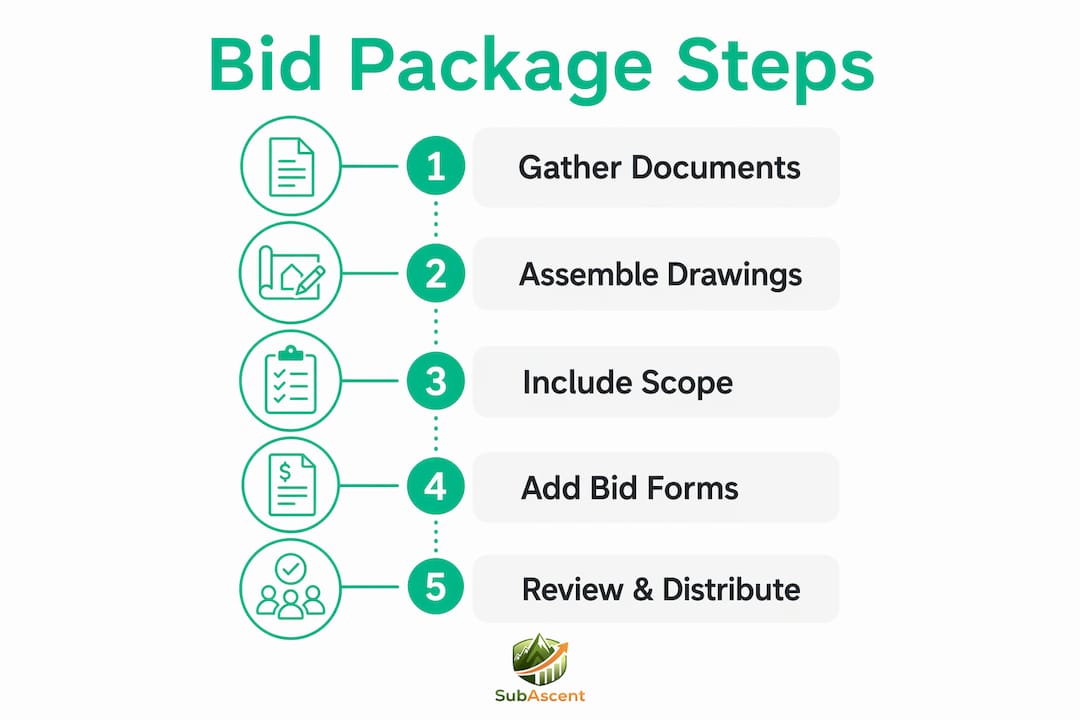
How to create an effective bid package step by step
Building a bid package is a process, not a one-time document dump. Follow these steps to produce a package that generates accurate, competitive bids.
-
Write a personalized invitation to bid. Address the specific trade and reference the project by name. A generic blast email to 50 subs produces lower response rates than a targeted note to the five best insulation or painting contractors in your market. Learn more about structuring your ITB before you send.
-
Organize your document folder logically. Group files by category: drawings, specs, scope, forms, and contract documents. Name files clearly. A roofing estimator should not have to open six PDFs to find the relevant drawing sheet.
-
Write trade-specific scope sheets. Do not copy and paste the full spec book. Write a one to two page scope that tells the trade exactly what they are pricing. Reference the drawing sheets and spec sections by number.
-
Use a standardized bid form. Require every bidder to submit pricing on the same template. Specify whether you want lump sum, unit prices, or both. Require alternates on separate lines.
-
Set a clear deadline with a hard cutoff. Include the date, time, and time zone. State what happens to late bids. Ambiguity about deadlines creates last-minute confusion and unfair advantages.
-
Build a bid tracking system. A simple spreadsheet or a purpose-built tool can track four stages: package sent, invitation accepted, follow-up completed, and bid submitted. Without tracking, bids fall through the cracks.
-
Conduct a quality control review before distribution. Check that every drawing reference in the scope sheet matches an actual sheet in the drawing set. Confirm the bid form matches the scope. One person who did not write the package should review it cold.
Pro Tip: Add a logistics map showing site access, laydown areas, and parking. Including site logistics details signals to trade partners that the project is well-managed and reduces pre-bid questions by a significant margin.
Estimating templates that mirror your bid form structure also cut your own review time. When your estimating templates match the bid form you issue, comparing incoming numbers against your own budget takes minutes, not hours.
What happens when bid packages are incomplete?
Incomplete bid packages do not just produce bad bids. They produce project risk that compounds from award through closeout.
The most common problems caused by poor bid documentation:
- Vague scope descriptions. When the scope for a mechanical or HVAC sub does not specify equipment responsibilities, every bidder draws the line differently. You end up with bids that cover different scopes of work, and you cannot tell until you are already in contract.
- Missing drawings or outdated revisions. A framing or steel sub who prices from an old drawing set will miss changes. The delta shows up as a change order after mobilization.
- No standardized bid form. Without a required format, one concrete sub gives you a lump sum, another gives you a unit price schedule, and a third gives you a narrative paragraph. Comparing them is guesswork.
- Unclear submission deadlines. Late bids create fairness issues and slow down the award process. If your deadline is ambiguous, expect to receive bids at all hours and face pressure to accept late submissions.
- No insurance or bonding requirements listed. Finding out a low-voltage or fire protection sub does not carry the required coverage after you have awarded the job is an expensive problem.
Poorly defined scopes and inconsistent bid forms result in bids where coverage varies, forcing proposal padding or unpriced assumptions. Both outcomes increase project risk. The fix is quality control before the package goes out, not after the bids come back.
Key Takeaways
A bid package is the single most important document set in the subcontractor bidding process. Its quality directly determines the accuracy, comparability, and completeness of every bid you receive.
| Point | Details |
|---|---|
| Bid package definition | A complete set of drawings, specs, scope sheets, bid forms, and contract terms issued to solicit trade pricing. |
| Standardization saves time | Standardized bid forms speed up bid comparisons by 50–80%, making award decisions faster and more defensible. |
| Scope clarity reduces risk | Trade-specific scope sheets prevent padding, unpriced assumptions, and post-award disputes. |
| Soft elements build partnerships | Including team bios, site logistics maps, and company information attracts higher-quality trade partners. |
| Track every bid stage | A tracking system covering package sent, acceptance, follow-up, and submission prevents missed bids and missed deadlines. |
Why I think most bid packages are still built wrong
Most bid packages I have seen from GCs are technically complete but practically useless. They include the drawings. They include the specs. They do not include a trade-specific scope sheet, a standardized bid form, or any indication of how the project is actually going to run.
The result is predictable. Electrical estimators call with the same five questions every time. HVAC subs price a different scope than what was intended. Roofing and insulation bids come back in formats that cannot be compared side by side. The GC spends two weeks chasing clarifications that a well-written scope sheet would have answered in two minutes.
The part that surprises people is how much the soft elements matter. A site logistics map and a one-page project overview do not just answer logistical questions. They signal that the GC runs an organized job. Top trade contractors, the ones you actually want bidding your work, choose their bids carefully. They favor jobs that look well-managed because those jobs are more profitable to build.
The subcontract trade bidding environment is competitive. The GCs who consistently attract the best bids are the ones who make it easy for good subs to say yes. A complete, clear, well-organized bid package is the first signal you send about how the job will run. Make it count.
— Dave
How Subascent helps you manage bid packages and proposals
Subascent is built specifically for specialty trade subcontractors, not general contractors. It handles the full bid cycle from receiving an invitation to bid through tracking your proposal status and managing awarded jobs.

Estimators at electrical, plumbing, masonry, and drywall shops use Subascent to track incoming bid packages, organize documents by project, and never miss a submission deadline. The platform keeps every bid stage visible so owners and project managers always know where each opportunity stands. If you are spending time chasing bid invitations in your email or rebuilding tracking spreadsheets for every job, Subascent's bid management tools replace that manual work with a system built for how trade businesses actually operate.
FAQ
What is the bid package definition in construction?
A bid package is the complete set of documents issued by a GC or project owner to solicit pricing from trade subcontractors. It includes drawings, specifications, scope sheets, bid forms, and contract terms.
What should be included in a bid package?
A complete bid package includes a cover sheet, trade-specific scope of work, architectural and engineering drawings, project specifications, a standardized bid form, contract terms, insurance requirements, and a project schedule.
Why does bid package quality matter?
The quality of a bid package directly determines the accuracy and completeness of the bids you receive. Vague scopes force bidders to guess, which produces padded or incomplete numbers that increase project risk.
How do standardized bid forms help?
Standardized bid forms require every trade to submit pricing in the same format. This speeds up bid comparisons by 50–80% and makes it possible to do a true apples-to-apples evaluation across multiple bidders.
What is the difference between a bid package and an invitation to bid?
An invitation to bid is the formal notice sent to subcontractors announcing the project and requesting pricing. The bid package is the full document set attached to or referenced by that invitation, containing all the technical and administrative information needed to prepare a bid.