

A bid invitation is a formal solicitation document issued by a project owner or general contractor requesting qualified contractors to submit competitive price proposals for a specific, defined scope of work. The industry standard terms are invitation to bid (ITB) and invitation for bid (IFB), and you will see both used interchangeably across public and private construction projects. Understanding the bid invitation process is not optional for electrical, plumbing, HVAC, masonry, or roofing contractors who want to win work consistently. Miss a requirement, skip a form, or misread the scope, and your bid gets thrown out before anyone looks at your price.
What is a bid invitation in construction?
An invitation to bid is a formal solicitation requesting contractors to submit competitive price bids for a defined project scope, enabling fair comparisons across all respondents. The ITB format is most common when the scope is fixed, the specs are complete, and the owner wants to award based on price rather than technical approach. A concrete contractor bidding a parking garage slab, a fire protection sub quoting a sprinkler system from completed drawings, or a drywall crew pricing a tenant improvement package are all classic ITB scenarios.
The bid invitation definition matters because it tells you what kind of process you are entering. Owners use ITBs to encourage fair competition and receive comparable offers from vetted contractors, which reduces procurement risk and keeps the process defensible. When you receive an ITB, you are not being asked to propose a solution. You are being asked to price one that has already been designed.

What does a bid invitation typically include?
ITBs typically include a project description, scope of work, specifications, location, contractual terms, submission deadline, and evaluation criteria. Each element serves a specific purpose, and ignoring any one of them is how good bids get disqualified.
Here is what you will find in most bid invitation documents:
- Project description and location. The name, address, and general nature of the work. For a glazing or insulation contractor, this tells you immediately whether the project fits your crew size and geography.
- Scope of work and specifications. The technical detail of what is being bid. This section references the spec book divisions, drawing sets, and material standards. Read it carefully before you build a single line item.
- Submission deadline and format. The exact date, time, and method for delivering your bid. Late bids are rejected automatically, no exceptions.
- Required forms and attachments. Bid bonds, acknowledgment of addenda, pricing schedules, and subcontractor lists. Missing one form is enough to get you thrown out.
- Evaluation criteria. Most ITBs award to the lowest responsive, responsible bidder. Some include experience and compliance scoring alongside price.
- Contractual terms. Payment terms, liquidated damages, insurance minimums, and bonding requirements. Review these before you price, not after you win.
For a deeper look at how different bid documents are structured, the Subascent guide on subcontractor bid types breaks down the field clearly.
Pro Tip: Print the submission checklist from the ITB and physically check off each item before you submit. One missing signature on a notarized bid bond has cost contractors jobs they priced correctly.
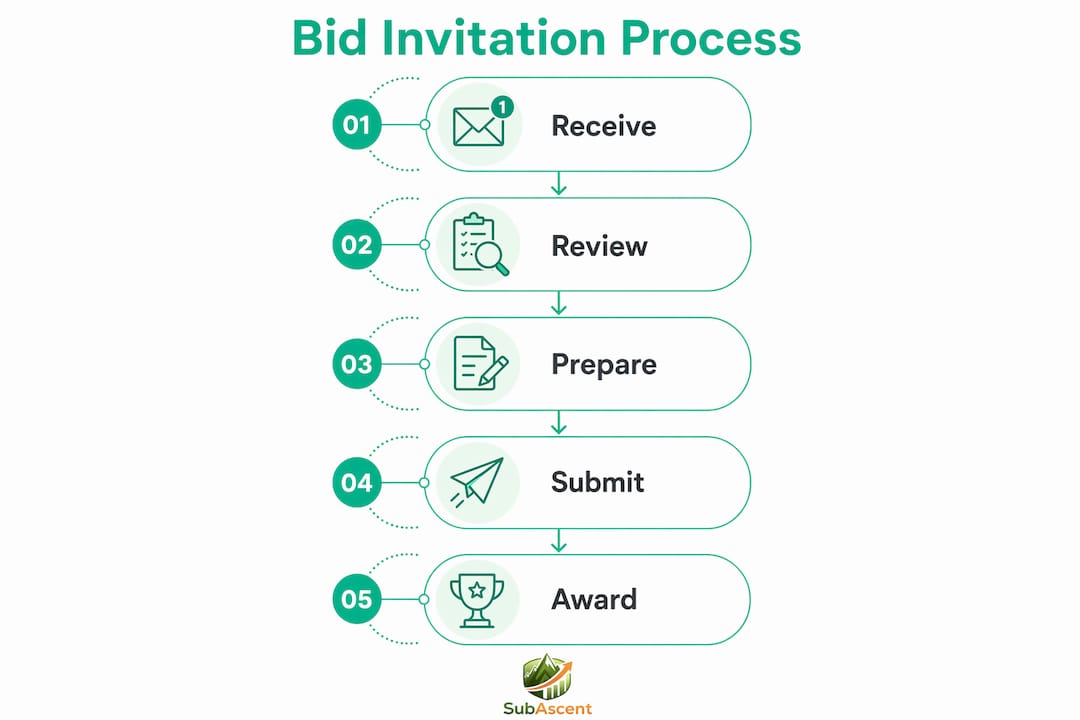
How does the bid invitation process lead to a contract award?
Government procurement uses a sealed bidding method where all bids are submitted sealed by a deadline and opened publicly at a set time. The contract goes to the lowest responsive, responsible bidder without negotiation. Private owners often follow a similar process, though they retain more discretion in the award decision.
Two terms define whether your bid survives evaluation:
- Responsive means your bid complies with every instruction in the ITB. Right forms, right format, right signatures, submitted on time. A bid that is non-responsive gets rejected regardless of price.
- Responsible means your company has the capacity, financial standing, insurance, and track record to perform the work. A GC or owner can reject a low bid if the contractor cannot demonstrate responsibility.
The contrast with a request for proposals (RFP) is significant. Under an IFB, once bids are opened, there is no negotiation. Your number is your number. Under an RFP, the owner can negotiate scope, price, and approach with multiple respondents. For framing, roofing, or low-voltage contractors used to hard-bid work, the ITB process is familiar. For trades entering design-assist or value-engineering conversations, the RFP is a different game entirely.
Key rule: If your bid is non-responsive, the owner is legally required to reject it in most public procurement processes, even if your price is the lowest on the board. Administrative compliance is not a formality. It is the entry fee.
ITB vs. RFP vs. RFQ: what is the difference?
Estimators at specialty trade businesses regularly receive all three solicitation types, and confusing them leads to wasted effort or a disqualified submission. Here is how they compare:
| Solicitation type | Award basis | Negotiation allowed | Scope flexibility |
|---|---|---|---|
| ITB / IFB | Lowest responsive, responsible price | No | Fixed scope, complete drawings |
| RFP | Best value (technical + price) | Yes | Variable, design input possible |
| RFQ | Price quote only | Sometimes | Standard services or commodities |
ITBs focus exclusively on price and responsiveness, awarding to the lowest qualified bidder without technical scoring. An RFP scores technical merit, management approach, and price together. An RFQ is typically used for commodity pricing or unit-rate schedules, not full project bids.
For a painting or flooring contractor, the practical implication is this: if you receive an ITB, your competitive advantage is price accuracy and bid compliance. If you receive an RFP, your competitive advantage includes your team's qualifications, your approach to the work, and your ability to write a persuasive technical response.
Pro Tip: Pursue ITBs when the scope is completely defined and you can price it confidently. If the drawings are 30% complete or the spec says "design-build," push for an RFP process or ask clarifying questions before you invest estimating hours.
ITBs are most profitable to pursue when the scope is clearly defined and can be competitively priced without negotiation. Chasing ITBs with incomplete drawings is a fast way to leave money on the table or win a job you cannot build at the price you quoted.
How to submit a bid that actually wins
Winning an ITB is not just about having the lowest number. Bid responsiveness means strict compliance with the solicitation's instructions, and non-compliant bids are rejected even when the price is the lowest submitted. Here is a practical sequence for submitting a bid that survives the compliance check and competes on price:
- Read the entire ITB before you start estimating. Scope exclusions, alternates, and unit prices buried in the back half of the document change your number significantly. HVAC and mechanical contractors especially need to check equipment allowances and controls scope before building a takeoff.
- Download every addendum. Addenda modify the original ITB. Bidding off superseded drawings is a common and costly mistake. Most portals require you to acknowledge each addendum on a separate form.
- Use the required pricing forms exactly as provided. Do not reformat the bid schedule or substitute your own spreadsheet. Owners and GCs reject bids that do not use the prescribed format, even when the numbers are correct.
- Check every signature line. Unsigned bid bonds, unsigned acknowledgment forms, and missing notarizations are the most common reasons for disqualification. Have a second person review the package before submission.
- Submit early. Digital portals like PlanHub and BuildingConnected have submission cutoffs that are enforced to the minute. A bid uploaded at 2:01 PM for a 2:00 PM deadline is a rejected bid.
- Keep a copy of everything you submitted. If there is a bid protest or scope dispute, your submitted package is your record.
Common pitfalls that eliminate otherwise competitive bids include missing subcontractor disclosure forms, failing to list required MBE/WBE subs on public work, and submitting a bid bond from an unlicensed surety. For steel/rebar and concrete contractors working on public projects, these requirements are non-negotiable.
For a related look at how administrative errors affect your standing with GCs beyond the bid stage, the Subascent article on RFI workflow mistakes covers the same compliance mindset applied to project execution.
Pro Tip: Build a bid submission checklist specific to each owner or GC you work with regularly. Their standard requirements rarely change between projects, and a saved checklist cuts your review time in half.
Who issues bid invitations and how do you get on the list?
Project owners shortlist qualified contractors based on capacity, insurance, and past performance before issuing bid invitations. Getting invited is not automatic. It requires deliberate positioning.
Here is how bid invitations reach specialty trade contractors:
- Direct GC invitation. General contractors maintain approved sub lists. If you are on a GC's list for electrical or plumbing work, you receive their ITBs directly via email or through platforms like BuildingConnected or SmartBid.
- Public bid portals. Government and institutional owners post ITBs on public procurement portals. Any licensed contractor can download and respond. State and municipal projects, school districts, and hospital systems use this method.
- Plan rooms and bid services. Dodge Data and Analytics, ConstructConnect, and similar services aggregate bid opportunities. Subscribing puts you in front of projects you would otherwise miss.
- Relationship-driven invitations. Owners and developers who know your work will invite you directly. This is the most reliable pipeline for masonry, glazing, and specialty finish trades where the owner has a strong preference for specific contractors.
To qualify for bid invitations, contractors typically need current general liability and workers' compensation certificates, a completed prequalification form, references from comparable projects, and in some cases a financial statement. Getting prequalified with five to ten GCs who work in your market is worth more than responding to every open bid you find online.
Key takeaways
A bid invitation is a formal, price-based solicitation requiring full compliance with submission requirements, and winning depends as much on administrative accuracy as on competitive pricing.
| Point | Details |
|---|---|
| ITB definition | A formal solicitation requesting competitive price bids for a fixed, defined scope of work. |
| Responsiveness is mandatory | Non-compliant bids are rejected regardless of price, even in sealed government bidding. |
| ITB vs. RFP distinction | ITBs award on price only with no negotiation; RFPs score technical merit and allow discussion. |
| Submission discipline | Use required forms, acknowledge all addenda, and submit before the deadline without exception. |
| Getting invited | Prequalify with GCs, maintain current insurance, and register on public procurement portals. |
What I have learned from watching good bids get thrown out
The most expensive mistake I see specialty trade estimators make is treating bid compliance as an afterthought. They spend three days building a tight number on a drywall or insulation package, then lose the bid because someone forgot to sign the bid bond or used their own price format instead of the owner's schedule. The price never even gets read.
The second mistake is chasing every ITB that lands in the inbox. Not every bid invitation is worth your estimating hours. If the scope is vague, the drawings are incomplete, or the GC has never awarded you work before, your probability of winning is low and your risk of pricing incorrectly is high. I have seen roofing and fire protection contractors win jobs on poorly scoped ITBs and spend the next six months fighting over what was included. A clear scope is not just convenient. It is the condition that makes an ITB worth bidding.
The contractors who win consistently on ITBs do two things well. They build a repeatable submission process so compliance is never an issue, and they are selective about which invitations they pursue. Bid fewer jobs, bid them right, and your win rate goes up. That is not a theory. It is what the numbers show when you track it.
— Dave
Stop losing bids to paperwork errors

Subascent is built specifically for specialty trade businesses, including electrical, plumbing, HVAC, masonry, and roofing contractors who need to track incoming bid invitations, manage submission deadlines, and keep their estimating process organized without rebuilding a spreadsheet every time. The platform gives estimators a single place to log ITBs, track addenda, store required documents, and monitor due dates across multiple active bids. If your team is managing bid invitations out of email threads and shared drives, you are one missed deadline away from a costly disqualification. Explore how Subascent's bid management tools can cut the administrative load and keep your submissions compliant.
FAQ
What is the difference between an ITB and an IFB?
An ITB (invitation to bid) and an IFB (invitation for bid) refer to the same type of solicitation document. ITB is more common in private construction, while IFB is the standard term in federal and government procurement.
What makes a bid non-responsive?
A bid is non-responsive when it fails to comply with the ITB's submission requirements, including missing forms, unsigned documents, incorrect pricing formats, or late delivery. Non-responsive bids are rejected before the price is evaluated.
How do specialty trade contractors get invited to bid?
Contractors get invited by prequalifying with general contractors, registering on public procurement portals, and subscribing to bid services like Dodge Data and Analytics or ConstructConnect. Maintaining current insurance certificates and a strong project reference list is the baseline requirement.
When should an estimator pursue an ITB versus an RFP?
Pursue an ITB when the scope is fully defined and you can price it accurately from complete drawings. Choose an RFP process when the project requires design input, value engineering, or scope flexibility that a fixed-price bid cannot accommodate.
Can a low bid be rejected on an ITB?
Yes. A low bid can be rejected if the contractor is deemed non-responsible, meaning they lack the capacity, insurance, or financial standing to perform the work. In public procurement, a non-responsive bid is also automatically rejected regardless of price.