
A daily production report is a structured, contemporaneous record of every significant event on a construction site during a single workday, covering workforce activity, work completed, equipment used, deliveries received, delays encountered, and site conditions. For electrical, plumbing, HVAC, masonry, drywall, roofing, and other specialty trade subcontractors, this document is the official account of what happened and when. It protects your business in disputes, keeps the office aligned with the field, and gives project managers the data they need to catch problems before they become expensive. If your foremen are still texting updates or filling out paper logs from memory at the end of a shift, this article will show you exactly what you are missing and how to fix it.
Why are daily production reports important for specialty trade subcontractors?
A daily production report is the closest thing your business has to a legal record of the workday. Contemporaneous documentation carries evidentiary weight years after a project closes because it captures facts at the moment they occurred, not weeks later when memories have faded and details have blurred. Attorneys, judges, and inspectors treat the daily report as evidence. That matters when a GC disputes your change order, a delay claim goes to arbitration, or an OSHA inspector asks what happened on a specific date.
Beyond legal protection, the daily report solves a communication problem that every specialty trade sub knows well. Your project manager is in the office. Your foreman is on the third floor of a commercial building pulling wire or hanging duct. Without a structured report, the office gets a phone call, a text, or nothing at all. Structured daily records make sure the office and field share the same version of reality by documenting work performed, crew activity, site conditions, deliveries, and decisions in one place. That eliminates the fragmented updates and reduces the back-and-forth that eats up time on both ends.
Daily reports also function as an early warning system. When a foreman documents that a concrete crew was not ready and your framing crew lost four hours waiting, that delay is on record. When it happens three days in a row, you have documented grounds for a schedule impact claim. Without the report, you have a complaint. With it, you have evidence.
"If it isn't documented in the daily report, later disagreements become harder to resolve because the report functions as the contemporaneous memory of the day for delay, change order, and safety situations."
The importance of daily production reports compounds over time. A single report is useful. Thirty reports from a job tell a complete story of productivity, interference, and progress that no invoice or schedule alone can tell.
What should you include in a daily production report?
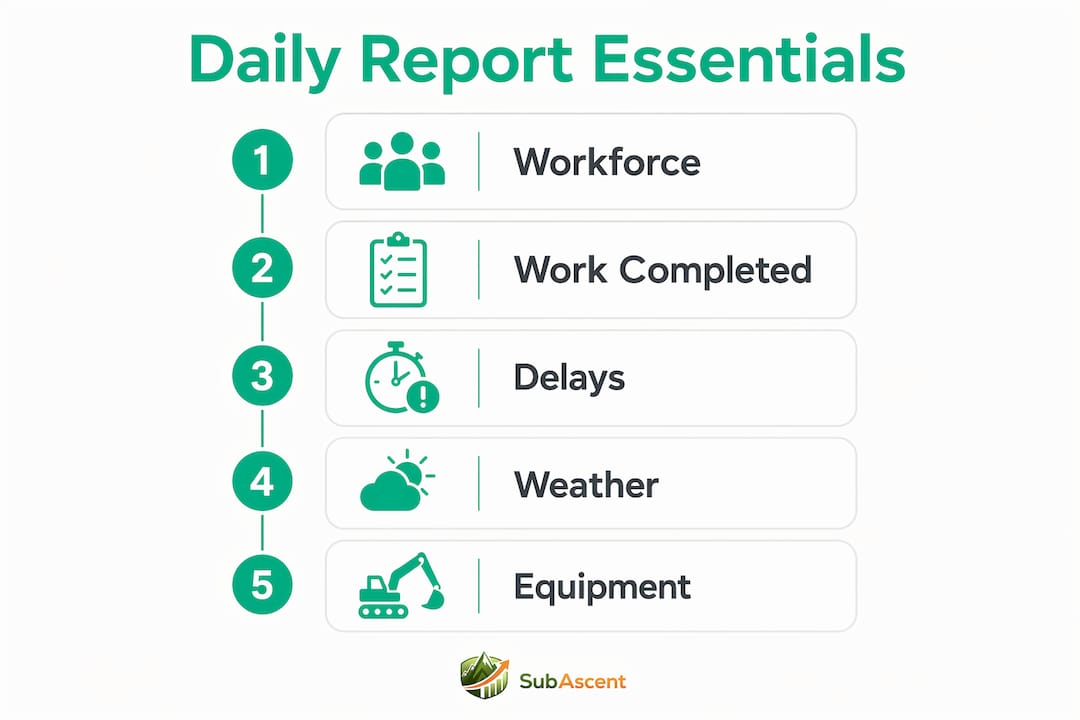
The value of a daily production report depends entirely on what goes into it. A log that only records hours worked misses the details that matter most when a dispute arises or a schedule slips. Key content for daily reports includes workforce headcount by trade, hours worked including overtime, equipment on site, work completed with quantities and locations, material deliveries, safety observations, delays with causes and durations, and site photos.
Here is a practical checklist of what every specialty trade daily report should capture:
- Workforce: Names or crew count by trade, start and end times, overtime hours, and any subcontractors or vendors on site
- Equipment: What equipment was on site, hours of operation, and any breakdowns or idle time
- Work completed: Specific tasks finished with measurable quantities (linear feet of conduit run, square feet of drywall hung, number of sprinkler heads installed) and exact locations within the building
- Material deliveries: What arrived, what was short-shipped, and what is still pending
- Safety: Any incidents, near-misses, toolbox talks conducted, or inspections performed
- Delays: Who or what caused the delay, how long it lasted, and which crew was affected
- Photos: Timestamped images with GPS tags showing work in progress, completed work, and any site conditions relevant to the day
- Directives and RFIs: Any verbal or written instructions from the GC, field RFI submissions, or change order activity that affected the day's work
Pro Tip: Document delays caused by others with the same rigor you apply to your own work. Note the specific crew affected, the duration, and the name of the GC superintendent or trade foreman responsible. That detail is what turns a vague complaint into a recoverable claim.
| Category | What to capture |
|---|---|
| Workforce | Headcount by trade, start/end times, overtime |
| Work completed | Task, quantity, and specific location in the building |
| Delays | Cause, duration, crew affected, and responsible party |
| Photos | Timestamped, GPS-tagged images tied to specific work areas |
| Directives | Verbal instructions, RFIs, and change order activity |
Subcontractor teams lose value in daily reporting when they only record work done without noting what hurt productivity, specific quantities and locations, and received directives affecting plans. Dispute-winning details fade quickly unless documented the same day.
Manual vs. digital daily production reports: which works better?
Paper logs and spreadsheets are still common on specialty trade job sites, and they are better than nothing. The problem is reliability. A foreman filling out a paper form at 5:00 PM is working from memory of events that happened at 7:00 AM. Details get compressed, delays get omitted, and quantities get estimated rather than measured. Spreadsheets shared by email introduce version control problems and delay the office's access to field data by hours or days.
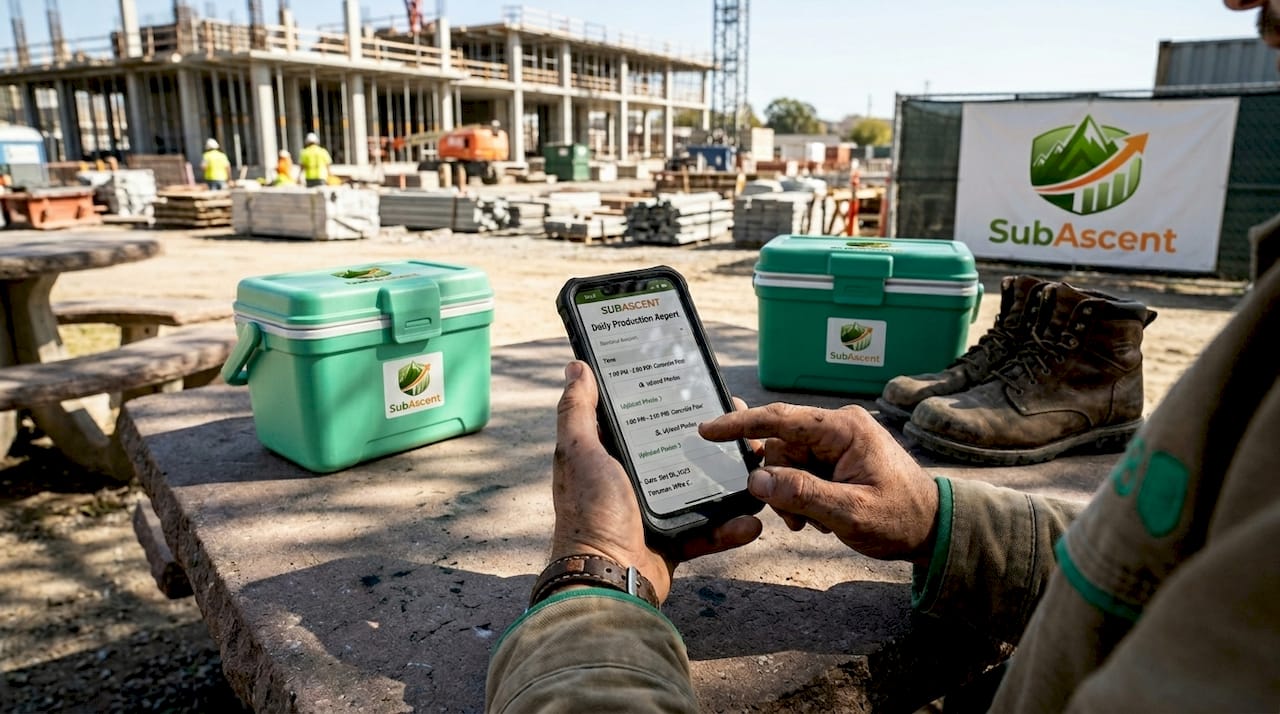
Digital tools change the equation by moving data capture to the moment the event occurs. A foreman using a mobile app can log morning headcount at 7:15 AM, record a delivery at 10:30 AM, photograph a delay at 1:00 PM, and submit the completed report before leaving the site. Capturing data at multiple event moments during the day is more effective than relying on end-of-day memory notes, and contemporaneous capture increases reliability significantly.
| Method | Strengths | Weaknesses |
|---|---|---|
| Paper forms | Low cost, no tech required | Memory-dependent, slow to reach office, hard to search |
| Spreadsheets | Familiar format, customizable | Version control issues, no real-time access, no photo integration |
| Digital apps | Real-time entry, photo upload, GPS tags, instant office access | Requires adoption and training |
Digital tools enhance report accuracy by enabling photo uploads, timestamps, GPS tags, and real-time entries that paper simply cannot replicate. For a plumbing or fire protection sub managing multiple active jobs, that real-time visibility is the difference between catching a problem on Tuesday and finding out about it on Friday.
Pro Tip: If your crew is resistant to digital reporting, start with one mandatory field: the end-of-day photo of work completed. Once that habit is established, adding headcount and delay fields takes less than two minutes per day.
How to create consistent, actionable daily production reports
Consistency matters more than perfection. A repeatable format with timely entry turns daily logs into dependable accountability tools. A report that uses different categories every week is nearly impossible to review across a job's timeline. One that uses the same fields every day becomes a searchable record of the entire project.
Follow these steps to build a reporting process that actually sticks:
-
Choose a fixed daily production report template. Whether you use a digital platform or a PDF, every report should have the same mandatory fields. Workforce, work completed, delays, and photos are non-negotiable. Add trade-specific fields as needed, such as circuit counts for electrical or linear footage for insulation.
-
Train your foremen to capture data in real time. The morning headcount should be logged before the first tool is picked up. Deliveries should be logged when the truck pulls up. Delays should be logged when they start. Waiting until the end of the day to fill in everything from memory defeats the purpose.
-
Make photos a non-negotiable part of every report. A timestamped photo of a blocked access point, an incomplete concrete pour, or a missing material delivery is worth more than three paragraphs of written description. Photos are the fastest way to establish what conditions looked like on a specific date.
-
Focus on measurable data, not narrative. Structured fields that capture headcount, equipment, progress quantities, and issues enable comparisons over time. Structure matters more than narrative for consistent review. A foreman who writes "worked on electrical" gives you nothing. One who writes "pulled 240 LF of EMT conduit on floors 3 and 4, crew of 4, 8 hours" gives you a production rate you can track.
-
Review reports in weekly project meetings. A daily report that nobody reads is just paperwork. Pull the week's reports into your project meeting, flag any documented delays or directives, and use them to drive conversations about schedule and cost. That review loop is what turns daily reporting into a management tool. You can also use them to resolve scheduling conflicts before they escalate.
Pro Tip: Assign one person in the office to review submitted reports within 24 hours. If a foreman documents a delay caused by another trade and nobody in the office acts on it, you have lost the window to issue a timely notice to the GC.
Key takeaways
A daily production report is only as valuable as the consistency and timeliness of the data captured in it. Specialty trade subcontractors who treat the daily report as a legal record, not just a log, build the documentation foundation that protects their business and drives better project decisions.
| Point | Details |
|---|---|
| Legal weight of daily reports | Contemporaneous records carry evidentiary weight in disputes, claims, and arbitration. |
| What to include | Capture workforce, quantities, locations, delays, photos, and directives every single day. |
| Real-time capture beats memory | Logging events as they happen is far more reliable than end-of-day recollection. |
| Consistency over perfection | A repeatable format used daily is more valuable than a detailed report filed inconsistently. |
| Review closes the loop | Reports only become management tools when reviewed regularly in project meetings. |
The most underused tool in your job management stack
I have worked with dozens of specialty trade subs, and the pattern is almost always the same. The foreman is sharp, the work is good, and the daily log is a half-filled paper form sitting in a truck. When a dispute comes up six months later, nobody can remember exactly when the delay started or which GC superintendent gave the verbal directive to change the scope. The claim gets settled for less than it should, or it gets dropped entirely.
The daily production report is not bureaucracy. It is the closest thing a specialty trade sub has to a black box recorder for the job. The businesses that treat it that way, and that track crew hours with the same discipline they apply to their estimates, are the ones that win change order disputes and actually know their job costs in real time.
The shift from paper to digital is not about technology for its own sake. It is about getting accurate data out of your foreman's head and into a format your office can act on the same day. If your current process relies on a foreman's memory at 5:00 PM, you are not running a reporting system. You are running a guessing game.
Start with a fixed template. Train your foremen to log in real time. Review the reports weekly. That is the entire system. The trades that do this consistently are the ones that have documentation when it counts.
— Dave
How Subascent helps you run tighter daily reporting
Subascent is built specifically for specialty trade subcontractors, not general contractors. The platform gives electrical, plumbing, HVAC, masonry, and other trade subs a single place to manage daily logs, crew hours, field photos, and job progress without the complexity of GC-focused software.

Foremen can submit reports from the field using the mobile app, with photo uploads and real-time entries that reach the office instantly. Project managers get a clear view of every active job without chasing texts or waiting for end-of-day calls. Daily reporting connects directly to your broader job and bid management workflows, so the data you capture in the field actually feeds the decisions you make in the office. If you are ready to replace the paper log with something that works, Subascent is built for exactly that.
FAQ
What is a daily production report in construction?
A daily production report is a structured, contemporaneous record of a single workday on a construction site, documenting workforce, work completed, equipment, deliveries, delays, and site conditions. It serves as both a project management tool and a legal record for dispute resolution.
What should be included in a daily production report?
Every daily production report should include workforce headcount by trade with hours worked, specific work completed with quantities and locations, equipment on site, material deliveries, safety observations, delays with causes and durations, and timestamped photos. Directives and RFI activity that affect the day's work should also be recorded.
How often should a daily production report be completed?
A daily production report should be completed every working day on site, without exception. Consistency is what turns individual reports into a reliable project record that supports claims, change orders, and schedule impact documentation.
Why do specialty trade subcontractors need daily production reports?
Specialty trade subcontractors need daily production reports to document delays caused by others, support change order and delay claims, keep the office aligned with field conditions, and create a legal record that protects the business if disputes arise months or years after the work is done.
Is a digital daily production report better than a paper one?
Digital daily production reports are more reliable because they support real-time data entry, photo uploads with timestamps and GPS tags, and instant office access. Paper forms filled out from end-of-day memory introduce errors and delays that reduce the report's value as both a management tool and legal documentation.