

Estimating templates are structured tools that give subcontractors a repeatable, defensible framework for pricing work accurately and consistently across every bid. For electrical, plumbing, HVAC, masonry, and roofing estimators, the importance of estimating templates shows up most clearly when a scope gap turns into a change order dispute three weeks after award. Templates enforce scope discipline and consistent documentation, reducing scope mistakes and speeding responses to bid invitations. Without them, you are rebuilding the same workbook under deadline pressure every single time.
Why estimating templates matter for subcontractors
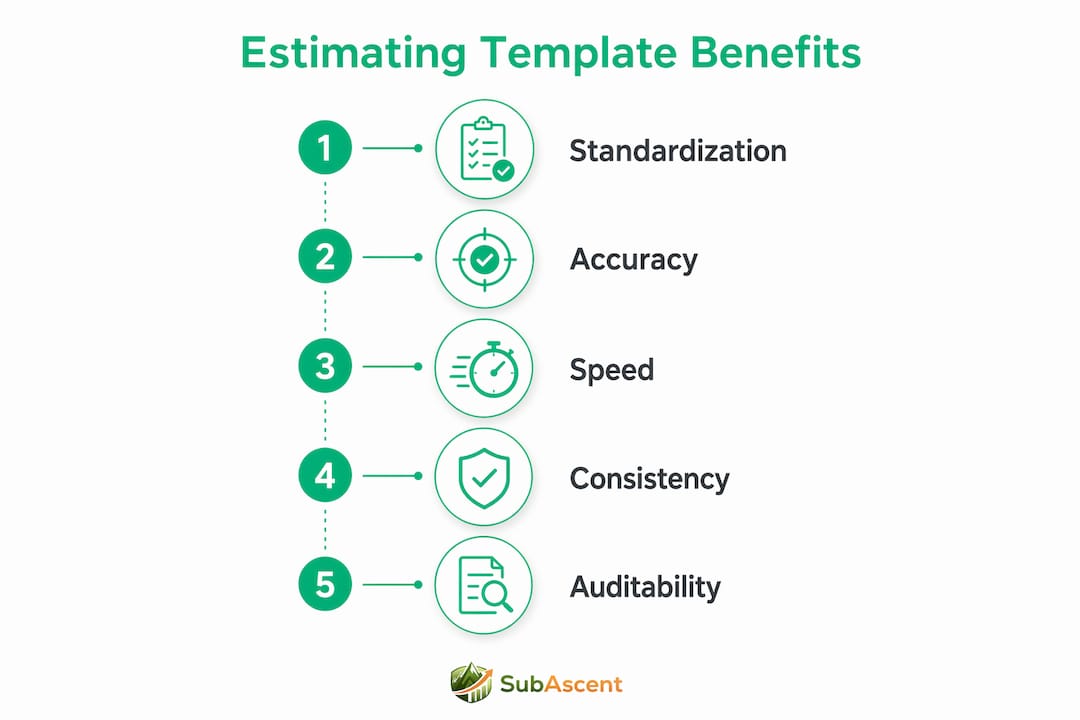
Estimating templates are the backbone of a repeatable bid process. They define what gets priced, how it gets organized, and what assumptions are documented before a number leaves your office. For a drywall or framing estimator juggling six bid invitations at once, a template is the difference between a confident submission and a guess dressed up as a quote.
The benefits for subcontractors go beyond speed. Templates create an audit trail. When a GC calls to question your number two weeks after award, you can point to a documented scope sheet, a labor unit cost column, and a clear inclusions/exclusions matrix. That paper trail protects your margin and your relationship.

Subcontractor pricing templates also enforce consistency across your estimating team. If your lead estimator builds bids one way and your backup builds them another, you end up with two different risk profiles on the same project type. A shared template eliminates that variance. It also makes onboarding faster because new estimators learn your pricing logic by working inside a structure that already reflects your trade's cost patterns.
The industry term for this practice is cost estimate standardization, and it sits at the center of every well-run estimating department in specialty trades.
What are the essential components of an effective estimating template?
A template that looks clean but lacks the right structure will fail you under pressure. The components below are non-negotiable for any trade estimator building bids on commercial or institutional work.
- CSI-based cost code structure. Organizing line items by Construction Specifications Institute (CSI) division keeps your estimate aligned with how GCs read and compare bids. It also makes scope leveling faster because everyone is speaking the same language.
- Labor and material columns with unit costs. Each line item needs a quantity, a unit of measure, a labor unit cost, and a material unit cost. Collapsing these into a single "installed cost" number hides your assumptions and makes it impossible to audit later.
- Inclusions and exclusions matrix. This is the section most templates skip. Every bid should explicitly state what is and is not included. For a fire protection estimator, that means stating whether the bid covers design, permits, inspections, and hanger installation separately.
- Subcontractor bid management section. A single cell for a sub bid number is not enough. Without a proper bid management section capturing inclusions, exclusions, and qualifications, you end up rebuilding work under deadline pressure and risking errors.
- Markup, overhead, and contingency lines. These must be visible and adjustable. Burying markup inside unit costs makes it impossible to sharpen a bid without rebuilding the whole estimate.
- Scope assumptions page. A short written summary of what you assumed about access, phasing, existing conditions, and drawing completeness. This single page prevents more disputes than any other document in your bid package.
Pro Tip: Keep your working estimate and your bid number separate. Separating the estimate from the bid lets you adjust margin based on competition without touching your cost calculation. That separation is what gives you bid agility without sacrificing defensibility.
How do estimating templates improve accuracy and reduce scope gaps?
Scope gaps are the single most expensive estimating problem specialty trade contractors face. A scope gap is any piece of work that belongs in the contract but does not appear in anyone's bid. It survives the award process, then surfaces as a change order or, worse, an unfunded obligation.
"Scope gaps survive when not highlighted pre-award, later becoming change orders. Templates structured to catch gaps improve project outcomes significantly." — meltplan.com
The financial impact is real. Unclear or missing scope details increase risk and margin erosion, and prevention during pre-award scope leveling is critical. For a concrete or masonry sub on a $2M project, a single missed scope item can erase the entire profit margin on that job.
Here is how a well-built template prevents that outcome:
- Force a scope review before pricing starts. The template's inclusions/exclusions matrix requires the estimator to read the spec book and drawings before entering a single number. That discipline catches gaps early, when they cost nothing to address.
- Document assumptions in writing. When your template includes a scope assumptions page, every ambiguity gets resolved or flagged. You either price it or explicitly exclude it. There is no gray zone.
- Standardize scope language across bids. Using the same scope descriptions on every bid makes it easier to compare your current bid against historical jobs. If your insulation estimate for a similar building came in at $X per square foot last year, a significant deviation triggers a review.
- Enable bid leveling by GCs. When your bid is structured with clear scope documentation, the GC's leveling process goes faster and your number is less likely to be adjusted with a plug. Clear scope and assumptions enable faster, more accurate pricing and reduce the chance of missed contract requirements.
The practical result is fewer RFIs after award, fewer disputes over what was included, and a stronger position when you need to issue a legitimate change order.
How do templates speed up subcontractor bid preparation?
Time is the resource specialty trade estimators run out of first. A roofing or glazing estimator handling 15 bid invitations a month cannot afford to rebuild a workbook from scratch on every project. Templates eliminate that rebuild.
Estimators spend 60 to 70% of bid prep reading rather than estimating. AI-assisted tools and structured templates shift that ratio by automating data extraction from bid packages, so the estimator spends more time on the actual pricing decisions. When AI tools are combined with a template framework, AI typically captures 85 to 95% of scope on the first pass, enabling faster turnaround and higher accuracy.
The table below shows the practical difference between a manual, unstructured process and a template-driven workflow:
| Task | Manual process | Template-driven process |
|---|---|---|
| Scope review and documentation | Rebuilt each bid | Pre-structured; estimator fills in gaps |
| Labor and material pricing | Re-entered from memory or prior bids | Pulled from unit cost library in template |
| Inclusions/exclusions | Often verbal or missing | Documented in matrix before submission |
| Bid preparation time | 3 to 5 days per complex bid | 1 to 2 days with AI-assisted extraction |
| Audit trail | Minimal | Full cost code and scope documentation |
Manual spreadsheets work well for fewer than 10 concurrent bids but break down at scale due to errors, versioning, and lack of audit trails. Template-based workflows or software become necessary as bid volume grows. For a low-voltage or painting contractor growing from $1M to $5M in revenue, that inflection point arrives faster than most owners expect.
Pro Tip: Build a separate tab in your template for bid-specific notes and open questions. Capturing every clarification request and GC response in one place cuts the back-and-forth before submission and protects you if scope questions arise after award.
How do subcontractors use templates to level bids and defend awards?
Bid leveling is the process of normalizing competing bids to the same scope baseline so that the lowest total price does not mask excluded work. For a steel or rebar sub, bid leveling is the mechanism that protects you from losing a job to a competitor who simply left out half the scope.
Bid leveling uses structured comparison templates to normalize bids by documenting inclusions, exclusions, and applying plug numbers for missing scope. A plug number is an estimated cost added to a bid to account for work the bidder excluded, making the comparison apples-to-apples. The legitimacy of that plug depends entirely on documentation.
Key practices for defensible bid leveling:
- Define the scope baseline from project documents first. Building bidder columns before defining the scope baseline leaves normalization incomplete. Start with what the contract requires, then map each bid against that baseline.
- Document every plug number. Each plug number's scope, source, and vendor assignment must be recorded. Poor documentation leads to overturned awards.
- Use the inclusions/exclusions matrix as the leveling grid. Your template's matrix becomes the comparison tool. Each bidder's inclusions and exclusions are mapped against the baseline, and gaps are filled with plugs.
- Retain the leveling worksheet after award. This document is your defense if a losing bidder protests or a GC questions your scope post-award.
| Bid leveling element | Purpose |
|---|---|
| Scope baseline from project docs | Defines what 100% of the work includes |
| Inclusions/exclusions matrix | Maps each bidder's scope against the baseline |
| Plug numbers with documented sources | Fills gaps to normalize total bid values |
| Audit trail worksheet | Defends award decisions and scope interpretations |
Front-end planning and bid leveling are among the highest-leverage activities to reduce cost and schedule variances and prevent costly disputes. For electrical and HVAC estimators, investing 30 minutes in a proper leveling worksheet before award saves hours of dispute resolution after it.
Key takeaways
Estimating templates protect subcontractor margins by enforcing scope discipline, preventing gaps, and creating the audit trail needed to defend every number you submit.
| Point | Details |
|---|---|
| Templates enforce scope discipline | A structured template forces scope review before pricing, catching gaps when they cost nothing to fix. |
| Essential components prevent errors | CSI cost codes, labor/material columns, and an inclusions/exclusions matrix are non-negotiable for defensible bids. |
| Templates reduce bid prep time | AI-assisted tools combined with templates cut complex bid preparation from days to hours. |
| Bid leveling depends on documentation | Plug numbers and scope matrices only hold up under scrutiny when sources and assignments are recorded. |
| Scale requires structured workflows | Manual spreadsheets break down past 10 concurrent bids; template-based systems protect accuracy at volume. |
What I've learned from watching subs skip the template step
I have seen electrical and HVAC estimators with 20 years of experience lose money on jobs they should have won cleanly. Not because their pricing was wrong. Because their documentation was thin. The GC leveled their bid with a plug number that assumed they included work they had explicitly excluded verbally but never put in writing.
The uncomfortable truth about estimating templates is that most subs treat them as a formatting convenience rather than a risk management tool. They use a template to make the bid look professional, but they skip the inclusions/exclusions matrix because it takes time. That is exactly backwards. The matrix is the template. Everything else is arithmetic.
I also see the opposite mistake: estimators who build a beautiful template and then treat it as a static spreadsheet. They never update the unit cost library, never refine the scope language based on what actually got disputed, and never connect the template to their job cost actuals. A template that does not learn from your completed jobs is just a prettier version of the same guess.
The estimating software options for small subs have improved significantly. The best ones connect your template to your bid tracking, your awarded jobs, and your actual costs. That connection is where templates stop being paperwork and start being a competitive advantage. If you are still working from a disconnected Excel file, you are leaving that advantage on the table.
— Dave
Put your estimating templates to work with Subascent

Subascent is built specifically for specialty trade subs: electrical, plumbing, HVAC, masonry, roofing, and more. The platform connects your bid and job management in one place, so your estimating templates feed directly into bid tracking, awarded job setup, and budget vs. actual reporting. You stop rebuilding the same workbook and start building on what you already know. If you are managing more than a handful of bids at once and your current process relies on disconnected spreadsheets, Subascent gives you the structure to bid faster, win smarter, and protect your margin on every job you take.
FAQ
What are estimating templates for subcontractors?
Estimating templates are structured documents that standardize how subcontractors organize scope, labor, material costs, and bid assumptions. They enforce consistency across bids and create an audit trail that supports defensible pricing.
How do estimating templates prevent scope gaps?
Templates with an inclusions/exclusions matrix require estimators to document what is and is not covered before submitting a number. This pre-bid discipline catches missing scope items when they are still free to address, rather than after award when they become change orders.
What should a subcontractor pricing template include?
An effective template includes CSI-based cost codes, labor and material unit cost columns, a subcontractor bid management section, an inclusions/exclusions matrix, markup and contingency lines, and a scope assumptions page. Omitting any of these components creates gaps that surface as disputes or margin erosion.
How do templates help with bid leveling?
Templates provide the structured inclusions/exclusions matrix and plug number documentation that bid leveling requires. Normalized bid comparison prevents the lowest total price from masking excluded work and results in more defensible award decisions.
When should subcontractors move from spreadsheets to estimating software?
Manual spreadsheets handle fewer than 10 concurrent bids reliably. Beyond that volume, versioning errors, missing audit trails, and disconnected workflows create risk. Template-based estimating software becomes the practical choice as bid volume and project complexity grow.