
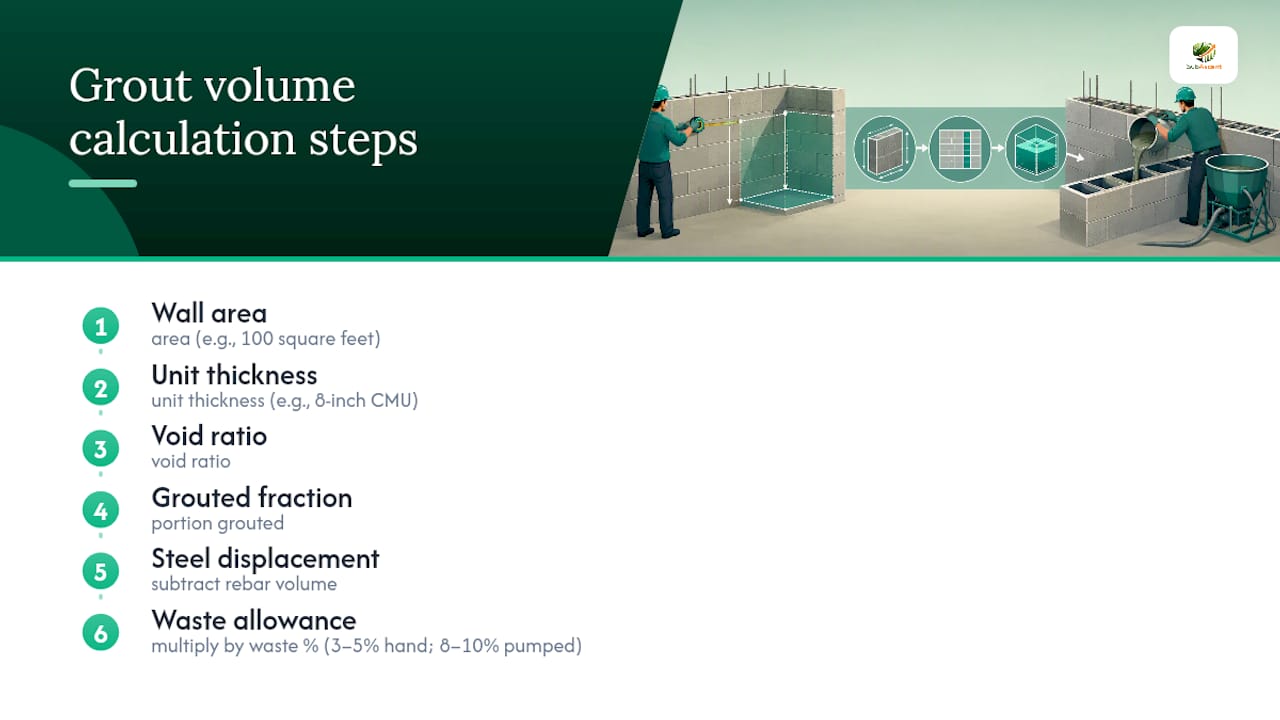
Net grout volume equals wall area times unit thickness times void ratio times grouted fraction, minus steel displacement. Multiply that by your waste allowance and convert to bags or cubic yards, then round up to your supplier's minimum load. That's the whole grout fill quantity calculation for masonry, and every estimating shortcut you'll ever use is just a variation on it.
For small jobs, bagged preblended grout usually wins on flexibility. Once you're pushing past two or three cubic yards, ready-mix delivered by the yard almost always beats bags on cost and labor. Either way, the arithmetic that gets you there doesn't change.
- Formula: net volume = (area × thickness × void ratio × grouted fraction) − steel displacement
- Order quantity = net volume × (1 + waste %), rounded to bags or supplier minimums
- Bagged grout for small pours; ready-mix once you're ordering multiple yards
Pro Tip: Always subtract rebar volume before you finalize an order. Skipping it is the single most common reason estimators over-order grout on reinforced CMU walls.
Key Takeaways
Accurate grout fill quantity calculation for masonry comes down to one repeatable formula, verified job conditions, and a waste margin sized to your actual placement method.
| Point | Details |
|---|---|
| Use the core formula | Net volume = area × thickness × void ratio × grouted fraction, minus steel displacement. |
| Subtract steel every time | Calculate bar volume with π × (diameter² / 4) × length to avoid systematic over-ordering. |
| Size waste to placement method | Budget 3 to 5% for hand placement, 8 to 10% or more for pumped or complex pours. |
| Check the table, verify with cells | Use per-100-block yield tables for early budgets, then switch to per-cell math for firm bids. |
| Decide bags versus bulk early | Bagged grout suits small jobs; ready-mix usually wins past 3 to 4 cubic yards. |
Table of Contents
- Variables and Steps in the Grout Volume Formula
- Worked Example for an 8-Inch CMU Wall
- Grout Yield Tables for Common CMU Wall Thicknesses
- Adjusting for Waste, Delivery Method, and Partial Grouting
- Bag Yields and When to Order by the Cubic Yard
- Pre-Order Checklist for Grout Quantity Verification
- Common Grout Calculation Mistakes to Avoid
- What I've Learned Estimating Grout on Masonry Bids
- Frequently Asked Questions
- Sources
Variables and Steps in the Grout Volume Formula
Every input in this formula comes from the wall assembly, the structural drawings, or a jobsite test. Get these six variables right and the math takes care of itself.
- Measure net wall area (length × height, minus openings).
- Convert to gross wall volume by multiplying area by nominal unit thickness.
- Apply the void ratio to isolate the actual cell volume inside the units.
- Apply the grouted-cell fraction if you're not grouting every cell.
- Subtract steel displacement for vertical and horizontal reinforcement.
- Add a waste margin, then convert cubic feet to cubic yards or bag counts.
Here's what each variable actually means on paper:
- Void ratio (r_v): the fraction of gross unit volume that's actually hollow core. Standard two-core 8-inch CMU typically runs 0.35 to 0.50, per estimating guidance from Calcexp.
- Grouted fraction (s_c): 1.0 for full grouting, 0.5 for every-other-cell, or whatever the structural notes call for.
- Waste margin: typically 5 to 10%, higher for pumped placement.
- Bag yield: cubic feet of grout per bag, usually 0.45 to 0.60 ft³ for an 80-lb bag.
Use a nominal-area table for a rough budget number early in bidding. Switch to per-cell math once you're pricing a firm bid, because that's where the CMHA warns that generic ballpark figures create the most costly surprises.
Worked Example for an 8-Inch CMU Wall
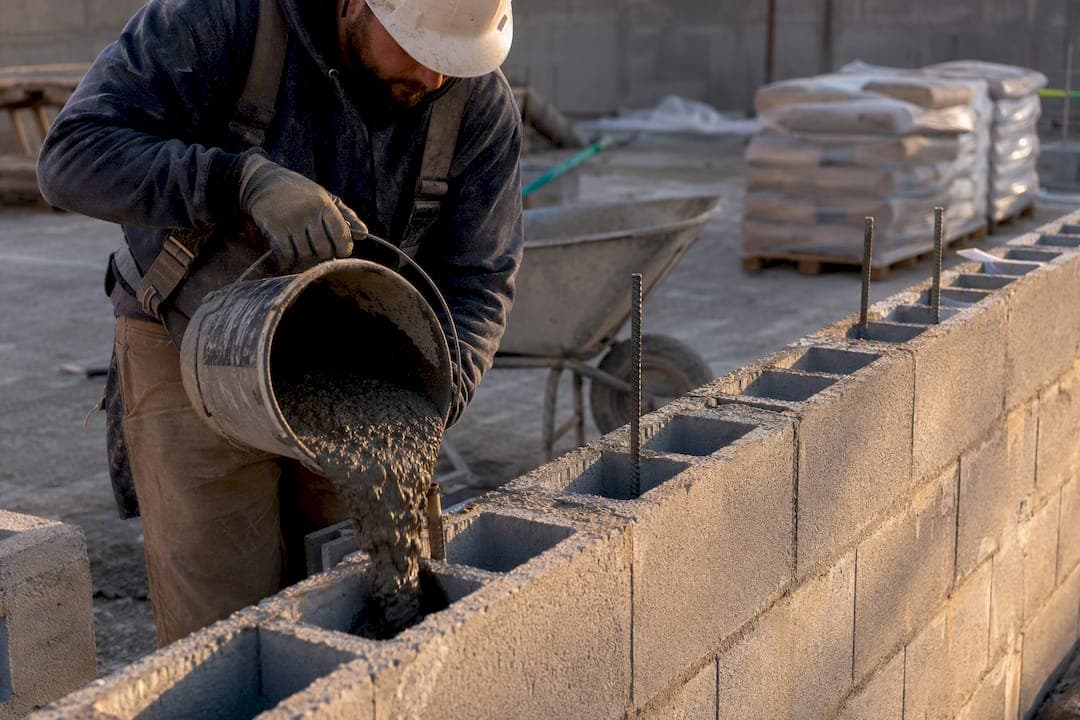
A 500 square foot wall, fully grouted, 8-inch CMU, number 5 bar at 16 inches on center, ends up needing roughly 45 cubic feet of net grout, or about 60 eighty-pound bags after waste. Here's the math that gets you there.
- Gross volume: 500 ft² × 0.667 ft (8-inch nominal thickness) = 333.5 ft³.
- Apply void ratio: using a conservative 0.45 for standard two-core block, 333.5 × 0.45 = 150 ft³ of core volume.
- Apply grouted fraction: full grouting means s_c = 1.0, so this stays at 150 ft³.
- Subtract steel displacement: number 5 bar has a diameter of 0.625 inch. Volume per bar = π × (0.625/12)² / 4 × height. For a 10-foot wall height at 16-inch spacing, that's roughly 375 linear feet of bar across the wall, displacing about 6.4 ft³.
Net volume comes to 150 minus 6.4, or 143.6 cubic feet.
Apply an 8% waste margin for pumped placement, a reasonable middle ground per the CMHA and defaults used by ConcreteToolkit's calculator: 143.6 × 1.08 = 155.1 ft³.
Convert to cubic yards: 155.1 ÷ 27 = 5.75 yd³. Convert to 80-lb bags at 0.5 ft³ yield: 155.1 ÷ 0.5 = 310.2, rounded up to 311 bags, or roughly 60 bags per 100 square feet of wall.
Pro Tip: Once you cross about three cubic yards, do the cost comparison against ready-mix. Bagged grout at 311 bags will usually cost more in labor and mixing time than a 5.75 to 6-yard truck load, and most suppliers set their minimum around 3 to 4 yards anyway.
Grout Yield Tables for Common CMU Wall Thicknesses
Quick-reference tables save you time on preliminary budgets, but they assume fully grouted walls at standard steel spacing unless noted otherwise. The figures below reflect NCMA/TEK-style yields for common configurations.
Per-100-block and per-100-ft² figures like these come from tabulated yields published by Fairbanks Materials and echoed in block fill calculators built around NCMA/TEK data.
- These numbers assume vertical cores fully grouted; partial grouting or bond-beam-only work needs the per-cell formula, not the table.
- The CMHA doesn't recommend full grouting of 4-inch units. That column exists for reference, not for spec'ing a fully grouted 4-inch wall.
- Use the table for early budget numbers; switch to per-cell math once rebar spacing or partial grouting patterns get specific enough to move the estimate.
Adjusting for Waste, Delivery Method, and Partial Grouting
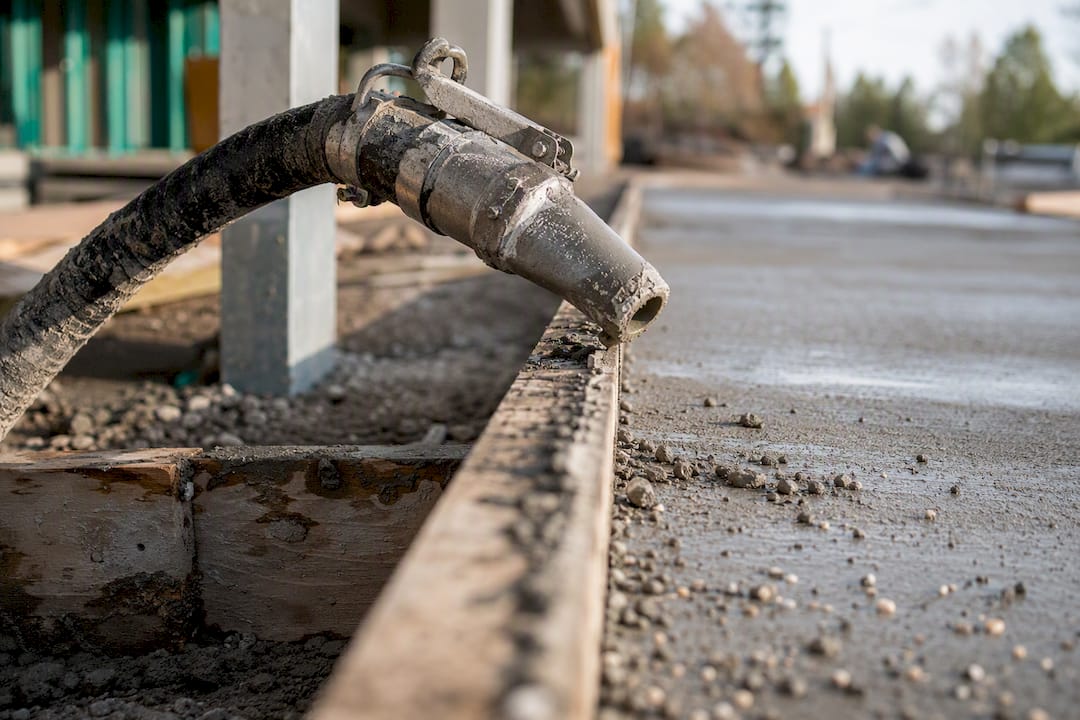
Waste margins are not a fixed number; they are a judgment call based on how the grout gets placed. Pumped placement, tight forms, or a job with lots of small pours regularly runs 8 to 10% or higher, since CMHA notes that pump priming and line residue eat into yield in ways bucket placement doesn't.
Unit density matters too. Low-density block absorbs more mix water than standard-weight units, which changes how far your grout actually goes once it's in the wall. If you're not sure what you're working with, test it: fill a sample block or two on-site and measure what it actually takes before you commit a waste number to the estimate.
A few more adjustments worth locking down before you finalize a number:
- Partial grouting patterns (every-other-cell, bond beams only) convert directly to a grouted fraction. Every-other-cell equals roughly 0.5.
- Rebar congestion at splices, corners, and lintels displaces more steel volume than a simple straight-run calculation assumes.
- Many experienced masons treat 5% waste as too tight for real field conditions. CMHA-aligned guidance suggests 8 to 10% is often the more realistic number once you factor in pump losses and modular inconsistencies on anything short of a large continuous pour.
Bag Yields and When to Order by the Cubic Yard
Bag yield and bulk pricing decide whether an order makes sense in 80-lb bags or a truck. Here's how the numbers typically shake out.
| Product | Typical Yield | Best For |
|---|---|---|
| 80-lb bag | 0.45 to 0.60 ft³ | Small jobs, touch-ups, hard-to-access pours |
| 60-lb bag | — to 0.45 ft³ | Hand-carry jobs, tight site access |
| Ready-mix (bulk) | Priced and delivered by the yard | Anything above roughly 3 to 4 yd³ |
The conversion path is simple: cubic feet ÷ 27 gives you cubic yards. Cubic feet ÷ bag yield gives you bag count, rounded up to the next whole bag. If your total lands near a supplier's minimum yard load, usually 3 to 4 yards, run the cost comparison before you order bags by the pallet.
- Bagged grout costs more per cubic foot but avoids truck minimums and scheduling a pour window.
- Bulk ready-mix gets cheaper per yard as volume goes up, but you're locked into the supplier's delivery schedule and slump requirements.
- Confirm your supplier's exact bag yield before finalizing a bid. Mix design and moisture content shift that 0.45 to 0.60 ft³ range more than most estimators expect, per ConcreteToolkit's calculator defaults.
Pre-Order Checklist for Grout Quantity Verification
Run through this before you submit a bid or place a material order, not after.
- Confirm actual block width and manufacturer void ratio, not just the nominal dimension.
- Verify grouted fraction against structural drawings, including shop drawing notes on grouting patterns.
- Pull the rebar schedule and calculate steel displacement rather than estimating it.
- Test a sample block on-site if void ratio isn't documented anywhere.
- Confirm placement method (pump or bucket) and set your waste margin accordingly.
- Check supplier minimum loads and lead times before you finalize bag versus bulk.
- Record your assumptions directly on the estimate: void ratio, waste percentage, and bag yield used.
- Confirm delivery windows and slump requirements with the supplier in writing, not a phone call.
- Have your foreman document actual deliveries against the order so you can reconcile usage after the pour.
Common Grout Calculation Mistakes to Avoid
- Forgetting steel displacement. Fix: calculate bar volume using π × (diameter² / 4) × length before finalizing net volume.
- Using nominal dimensions without adjusting for mortar joints. Fix: confirm actual unit width from the manufacturer spec sheet.
- Applying too thin a waste margin. Fix: default to 0.45 void ratio and 8% waste for standard 8-inch CMU unless site conditions say otherwise.
- Misreading the grouted fraction from structural notes. Fix: when the pattern is unusual or reinforcement is heavy, get engineer clarification instead of guessing.
What I've Learned Estimating Grout on Masonry Bids
The biggest recurring error I see isn't bad math, it's skipping the rebar subtraction entirely and eating the overage as a rounding error. Track your actual grout consumption against the estimate on every pour. That feedback loop is what turns a generic waste percentage into a number you can trust on the next bid.
Frequently Asked Questions
What is the standard formula for masonry grout volume calculation? Net grout volume equals wall area times unit thickness times void ratio times grouted fraction, minus steel displacement, then multiplied by your waste allowance to get the final order quantity.
How many bags of grout do I need per 100 square feet of 8-inch CMU wall? Fully grouted 8-inch CMU generally requires a grout volume estimated at about 2 cubic yards per 100 square feet before waste; bag count depends on bag size and yield but typically aligns with this volume for estimating purposes.
Should I order bagged grout or ready-mix for a masonry job? Bagged grout works better for small jobs under roughly 3 cubic yards. Ready-mix delivered by the yard is usually more economical above that, since most suppliers set minimum loads around 3 to 4 yards.
What waste percentage should I use for grout estimating? Use 3 to 5% for hand-bucketed placement on small jobs, and 8 to 10% or higher for pumped placement, complex geometry, or small jobs with frequent starts and stops.
Do I need to subtract rebar volume from my grout calculation? Yes. Skipping steel displacement is one of the most common causes of over-ordering grout, especially on walls with tight rebar spacing like 16 inches on center.
Sources
- CMHA technical guidance on masonry estimating (TEK 09-04A)
- CMU Block Void Fill Estimation - Calcexp
- Grout calculations for concrete blocks - Fairbanks Materials
- Concretetoolkit