
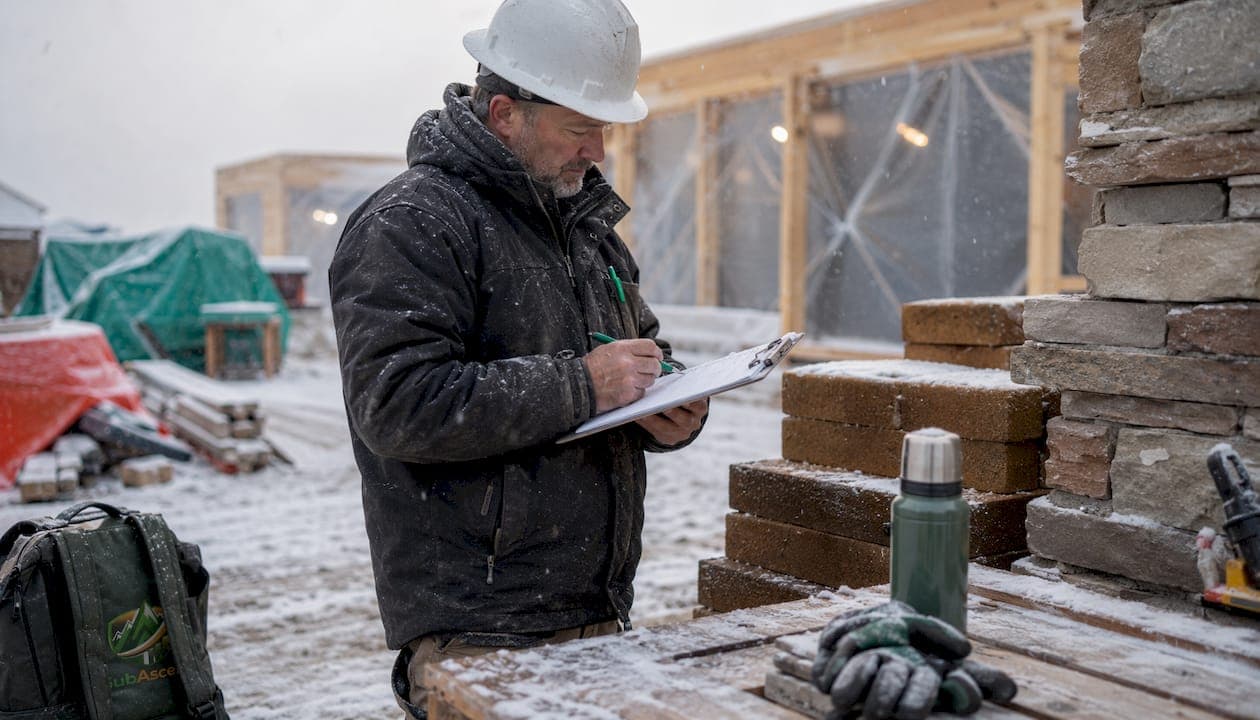
Winter masonry work costs more than summer work, and the margin difference comes down to three line items: heated enclosures, labor productivity loss, and material handling. The Masonry Advisory Council is direct about this: GCs and owners resist paying a flat winter premium, but they will accept itemized charges when each line is transparent and justified. That means your bid needs discrete, auditable line items, not a hidden overhead percentage.
What to price on your next winter bid:
- Heated enclosures and fuel: Propane or natural gas heaters, hose runs, ventilation, and overnight heater watch are daily costs that compound fast.
- Labor productivity allowance: Enclosures reduce output. Cramped space, extra PPE, and material reconfiguration all cut net production compared to open-air summer work.
- Material handling and pre-warm storage: Moving limited quantities of masonry units from a heated storage area to the scaffold just-in-time saves labor versus warming everything on site, but the logistics still cost money.
- Contingency for extreme freeze events: A temperature-triggered change-order clause protects you when a cold snap extends the protection window beyond your baseline estimate.
Estimator action items for the next bid:
- Itemize every protection cost as a separate bid line, never buried in overhead.
- Apply a productivity adjustment factor to your crew's baseline unit rate.
- Add a contingency allowance for extended cold events, sized to your local climate data.
- Include a fuel pass-through clause so you are not absorbing diesel or propane price swings.
Table of Contents
- What are the line-item cost drivers for winter masonry estimates?
- How does winter change production rates and schedule risk?
- How do cold temperatures affect mortar, grout, and material handling costs?
- What heating and enclosure options should you price for winter masonry?
- How should you price winter work and write contract clauses that protect margin?
- What QC steps and documentation protect you from rework and disputes?
- Worked example: converting winter impacts into priced bid items
- How do you present winter charges to the GC without losing the job?
- How does winter masonry work affect your insurance and liability costs?
- How do you choose winter-appropriate materials and suppliers?
- Which weather monitoring tools help you schedule winter masonry work?
- What crew training and certification do winter masonry jobs require?
- What contract clauses best allocate weather risk and cost overruns?
- Key Takeaways
- Why winter masonry is a different job, not just a harder one
- Authoritative sources and further reading
What are the line-item cost drivers for winter masonry estimates?
Every masonry subcontractor winter work cost factor falls into one of four buckets: protection infrastructure, labor adjustments, material handling, and equipment/fuel. Knowing which bucket each item belongs to determines how you price it and how you present it to the GC.
Protection infrastructure (per scaffold bay or per SF of enclosure):
- Tarp and poly sheeting for windbreaks or full enclosures
- Temporary scaffolding brackets and extra ties rated for enclosure loads
- Scaffold erection and teardown labor for enclosure framing
- Insulating blankets for freshly laid masonry
- Heater placement, hose runs, and combustion-air ducting
Labor adjustments (per crew per day):
- Loss-of-production allowance: working inside an enclosure creates confined space, slower tool access, and constant material reconfiguration
- Extra handling time for clearing snow and ice from units before laying
- Overnight heater watch (often a separate labor line, not part of the crew rate)
- Winter PPE: insulated gloves, boot covers, and layered clothing slow down fine motor tasks
Material handling (per delivery or per pallet):
- Pre-warm storage setup and management
- Just-in-time delivery coordination to move limited quantities from heated storage to scaffold
- Heated mixing water supply (tank, heater, and hose)
- Accelerated admixtures and Type III cement upcharges
- Sand and aggregate heating
Equipment and fuel (per day or per week):
- Propane or natural gas heater rental
- Fuel consumption (gallons per day, priced at current local rates)
- Generator rental if site power is unavailable for electric heaters
- Additional equipment rental days caused by schedule extension
Pro Tip: Present these as discrete line items on your bid form, not as a single "winter conditions" allowance. The Masonry Advisory Council recommends this approach specifically because GCs can audit each line, which reduces pushback and makes change orders easier to justify if the cold season runs long.
| Cost Category | Typical Unit | Pricing Basis |
|---|---|---|
| Heated enclosure material | Per SF of enclosure | Direct cost |
| Scaffold erection/teardown | Per bay or lump sum | Direct cost |
| Propane/NG heater rental | Per heater per day | Pass-through or direct |
| Fuel (propane or NG) | Per gallon/MCF | Pass-through with markup |
| Heated mixing water | Per day | Direct cost |
| Accelerated admixtures | Per bag or per CY | Direct cost |
| Pre-warm storage setup | Lump sum or per week | Direct cost |
| Overnight heater watch | Per shift | Direct cost |
| Productivity loss allowance | % of crew labor | Direct cost |
| Winter PPE | Per worker per week | Direct cost |
| Insulating blankets | Per SF or per set | Direct cost |
How does winter change production rates and schedule risk?
Productivity loss is the cost factor most estimators undercount. The physical constraints of working inside a heated enclosure, combined with extra PPE and constant material reconfiguration, produce a documented loss of production compared to open-air summer conditions. The right way to quantify this is as a daily-per-crew percentage, not a fixed per-unit time addition.
Typical productivity impacts by task:
- CMU laying in a full enclosure: Expect a 15% reduction in daily unit count due to tighter working space and slower material staging.
- Brick veneer: Comparable productivity loss, typically about 15% when the enclosure is narrow or units need pre-warming.
- Grouting: Cold slows grout flow and extends pour windows; plan for longer hold times between lifts, which compresses the number of grout pours per day.
- Tuckpointing and repointing: Mortar application in cold is slower, and joint preparation takes longer when surfaces are frost-covered.
- Scaffold moves inside enclosures: Moving scaffold inside a tented enclosure takes longer than in open air; budget extra time per move.
Cold-weather escalation in markets like Minneapolis is typically higher than warm-season equivalents for exposed masonry scopes. That range is a useful starting point, but your local labor rates and fuel costs will move the final number.
Statistic: Cold-weather escalation for exposed masonry scopes in Minneapolis-area guidance is notably above warm-season equivalents, driven by heater and enclosure costs plus schedule extension.
Sequencing and schedule buffer:
- Prioritize above-grade work that will be enclosed before temperatures drop below 40°F; work done before freeze avoids the full protection cost.
- Stage deliveries so masonry units arrive in small, just-in-time quantities rather than sitting on site in freezing temperatures overnight.
- Build a schedule buffer of at least one week per month of winter work to absorb inspection holds and extended curing windows.
- Off-peak shifts (early morning start before wind picks up, or mid-morning when overnight lows have recovered) can reduce fuel burn and improve mortar workability.
Scheduling conflicts between trades get worse in winter because enclosures shrink the shared workspace. Coordinate enclosure footprints with the GC's trade sequencing plan before you mobilize.

How do cold temperatures affect mortar, grout, and material handling costs?
Cement hydration slows measurably below 40°F, and the cost implications run through every line of your estimate. At 40°F, hydration begins to slow and extra measures become necessary; below 20°F, laying masonry units is generally restricted under industry guidance.
Temperature thresholds and their cost triggers:
- Below 40°F: Heated mixing water required; accelerated admixtures or Type III cement recommended; protection windows extend.
- Below 32°F: Masonry units must be pre-warmed; mortar must be mixed with heated water; freshly laid work must be covered with insulating blankets immediately.
- Below 20°F: Most industry guidance restricts laying operations unless full heated enclosures maintain ambient temperatures above 40°F at the work face.
ACI 306R and MSJC/TMS guidance require maintaining fresh masonry at minimum temperatures during early curing. The IMI technical bulletin on cold-weather masonry specifies that protection periods vary by cement type: Type III cement shortens the required protection window compared to Type I/II, which is a real cost trade-off worth pricing.
"Pre-warming units in a separate enclosure with just-in-time delivery reduces time spent removing ice and waiting for units to reach tool-able temperature, saving labor and improving the final product." — IMI Cold Weather Masonry Construction Technical Bulletin
Practical handling rules that add cost:
- Never lay frozen or snow-covered units; cleaning time is a direct labor cost.
- Store all masonry units on pallets, off the ground, covered with tarps or inside a temporary warm storage area.
- Just-in-time delivery from heated storage to the scaffold is the most labor-efficient method; warming all material on site at once creates re-handling.
- Heated mixing water requires a tank, an inline heater, and insulated hose runs; price these as a daily equipment line.
- Insulating blankets must cover freshly laid masonry within minutes of placement; budget for blanket sets sized to your daily production area.
The hidden cost here is re-handling. Moving units twice, once to a warm area and once to the scaffold, adds labor that estimators often miss. Price it explicitly as a material-handling line, not as part of the crew's base rate. For scope review guidance that covers material-handling submittals, the masonry subcontract scope review guide walks through how to document these requirements before the job starts.
What heating and enclosure options should you price for winter masonry?
Protection strategy determines the largest single cost variable on a winter masonry job. The Masonry Advisory Council frames it clearly: a fully enclosed site maintained above 40°F is ideal, but the economics have to justify the investment for each specific job.
Protection tiers:
- Windbreaks only: Poly sheeting or canvas on the windward side; no heat. Appropriate when daytime temps stay above 40°F and overnight lows are the only concern. Lowest cost, lowest protection.
- Insulating blankets: Applied directly to freshly laid masonry; no enclosure. Works for short protection windows when ambient temps are marginal.
- Partial enclosure: Scaffold-mounted poly or canvas on three sides with a propane heater. Suitable for temperatures down to the mid-20s°F with careful monitoring.
- Full heated enclosure: Complete scaffold tent with forced-air heaters maintaining 40°F+ at the work face. Required below 20°F; highest cost, highest productivity inside.
- Separate pre-warm storage: A heated trailer or room where masonry units are brought to temperature before being moved to the scaffold. Often combined with a partial or full enclosure.
| Protection Tier | Typical Daily Cost Driver | Best For | Key Risk |
|---|---|---|---|
| Windbreak only | Tarp material + labor | Temps 35–40°F, short duration | No heat; overnight freeze risk |
| Insulating blankets | Blanket rental/purchase | Marginal temps, small areas | Labor to apply/remove daily |
| Partial enclosure | Heater rental + fuel | Temps 20–35°F | Heat loss at open sides |
| Full heated enclosure | Heater + fuel + ventilation + watch | Temps below 20°F | CO risk; ventilation required |
| Pre-warm storage | Heated trailer rental | All cold-weather work | Logistics; double-handling |
Statistic: An enclosed construction site maintained above 40°F is widely recognized as the ideal protection standard for cold-weather masonry, but economic trade-offs determine which tier is practical for a given job scope and duration.
Fuel and heater cost drivers:
Propane heaters are the most common choice because they require no site utility connection, but propane logistics add cost: tank rental, delivery scheduling, and price volatility. Natural gas is cheaper per BTU where a site connection exists, but the connection cost and permit can offset the savings on short jobs. Electric forced-air heaters eliminate combustion risk but draw significant amperage; verify site power capacity before specifying them.
Safety and ventilation costs that belong in the bid:
- Combustion heaters inside enclosures require dedicated combustion-air inlets and exhaust paths; ducting and framing this correctly is a labor line.
- CO detection is a non-negotiable safety measure; budget for detector rental or purchase and daily inspection.
- OSHA and local fire codes may require a fire watch or heater-monitoring attendant; price overnight watch as a separate labor line.
- Daily heater inspection and fuel-level checks add 30–60 minutes of labor per day that crews often absorb informally; make it explicit in your estimate.
How should you price winter work and write contract clauses that protect margin?
The right pricing model for a winter masonry job depends on how much weather risk you are willing to carry. Lump-sum bids with a hidden winter contingency transfer all risk to you. Itemized allowances with temperature-triggered change-order language share the risk with the owner.
Pricing approaches:
- Itemized winter protection allowance: List each protection line at a fixed quantity and unit rate. If conditions exceed the allowance, a pre-agreed change-order trigger activates.
- Daily or weekly heater/fuel pass-through: Fuel is priced at cost plus a markup percentage, billed weekly with receipts. Removes fuel price risk from your margin.
- Productivity-adjusted unit rates: Multiply your baseline unit rate by a winter productivity factor (e.g., 1.15 for a 15% loss) and present it as a separate winter rate in the bid.
- T&M for protection work: Time-and-materials for enclosure erection, heater management, and overnight watch; lump sum for the masonry scope itself. Splits risk cleanly.
How to calculate a winter productivity multiplier:
Take your baseline crew output (units per day in summer conditions), apply the expected productivity loss percentage for your enclosure type and temperature range, and divide the baseline rate by the adjusted output to get a new unit cost. A crew that lays 500 CMU per day in summer at $2.00/unit becomes a $2.30/unit crew at a 15% productivity loss. Present that math in your bid backup.
Sample contract clause templates:
- Winter protection allowance: "Contractor includes an allowance of $[X] for cold-weather protection measures. Work performed when mean daily temperatures fall below 40°F will be tracked against this allowance; costs in excess of the allowance will be submitted as a change order with daily logs and receipts as backup."
- Temperature-triggered change-order clause: "If the mean daily low temperature at the project site falls below 25°F for three or more consecutive days, Contractor may submit a change order for extended protection costs. Trigger is based on NOAA weather station data for the project zip code."
- Fuel pass-through: "Propane and natural gas fuel costs for temporary heating are billed at Contractor's actual cost plus [X]%. Weekly fuel receipts will be provided with each billing cycle."
- GC approval of enclosure design: "Contractor's proposed enclosure design and heater type require written approval from the General Contractor prior to mobilization. Unapproved changes to enclosure design are at Contractor's risk."
| Pricing Model | Risk to Sub | Risk to Owner | Best When |
|---|---|---|---|
| Lump sum with contingency | High (sub absorbs overrun) | Low | Short duration, mild winter |
| Allowance with CO trigger | Moderate | Moderate | Multi-month winter scope |
| T&M for protection, LS for masonry | Low | Moderate | Uncertain duration or temps |
| Full T&M | Low | High | Emergency or repair work |
Pro Tip: Build your bid submission checklist to include a separate winter items section. Every winter line should be visible and labeled so the GC can see exactly what they are approving. Hidden winter costs that surface as change orders mid-job damage the relationship; visible ones in the bid build trust.
Estimator checklist for winter bid submittal:
- All protection lines itemized separately from the base masonry scope
- Productivity factor documented and explained in bid notes
- Fuel pass-through clause included or fuel priced at a stated rate with an escalation note
- Temperature trigger thresholds defined (40°F, 25°F, or project-specific)
- GC approval requirement for enclosure design included
- Contingency percentage stated and scoped to extended cold events only
What QC steps and documentation protect you from rework and disputes?
Cold-weather quality failures are expensive. Mortar that freezes before it cures, grout poured into units that haven't been pre-warmed, or masonry laid on frost-covered surfaces can all require full demolition and replacement. The documentation you collect daily is what separates a defensible change order from a warranty dispute.
Inspection and testing holds:
- Hold grouting operations until masonry units and ambient temperature at the work face are confirmed above 40°F.
- Grout protection windows vary by cement type: Type III requires a shorter protection period than Type I/II; confirm the spec before pricing.
- Request third-party temperature testing when the spec requires it or when the GC's inspector is not on site daily.
- Do not remove insulating blankets until the protection window specified in your cold-weather plan has elapsed.
Daily QC documentation to collect:
- Temperature log: ambient air temperature at the work face, recorded at start of shift, midday, and end of shift.
- Heater run-time log: hours of operation per heater, fuel level at start and end of shift.
- Fuel receipts: attach to daily log for pass-through billing backup.
- Material storage photos: show units on pallets, covered, off the ground, and in heated storage.
- Pre-warm storage manifest: record which units were pre-warmed, when they were moved to the scaffold, and ambient temperature at time of placement.
- Daily production rate: units laid per crew per day, compared to baseline, to document productivity loss.
The Masonry Advisory Council cold-weather checklist includes heaters, insulated material storage, enclosure brackets, and additional scaffold work as standard items to document. Use that checklist as the backbone of your daily sign-off form.
Integrating MSJC/ACI guidance into submittals:
Reference ACI 306R and the applicable TMS/MSJC standard in your cold-weather plan submittal. When a GC's inspector questions a protection decision, a submittal that cites the governing standard is far harder to dispute than a verbal explanation. Use shop drawings and submittals to get enclosure designs and heater layouts formally approved before work begins.
Templates to maintain on every winter job:
- Daily temperature log (time-stamped, signed by foreman)
- Heater watch sign-off sheet (per shift, per heater)
- Photographic evidence checklist (storage, placement, blanket coverage)
- Pre-warm manifest (unit type, quantity, time in storage, time to scaffold)
Consistent daily production reports that include temperature data and heater run-time give you the paper trail to defend every change order line.
Worked example: converting winter impacts into priced bid items
Scenario: A masonry subcontractor is bidding a 4,000 SF CMU exterior wall scope on a commercial project in Chicago, Illinois. Crew size: 4 masons plus 1 laborer. Baseline summer productivity: 400 CMU per day. Project runs December through February. Local masonry labor rates average $65/hr based on published estimating ranges for skilled masonry labor.
Worked cost adders:
- Establish baseline daily labor cost: 5 workers × 8 hours × $65/hr = $2,600/day.
- Apply 15% productivity loss: effective output drops from 400 to 340 CMU/day. To lay the same 400 CMU, the crew needs 400/340 × 8 hours = 9.4 hours. Extra labor per day: 1.4 hours × 5 workers × $65/hr = $455/day.
- Heater rental: 2 propane forced-air heaters at $35/day each = $70/day.
- Fuel: 20 gallons of propane per day at local current rates (use your supplier's current price; do not lock in a fixed rate in the bid).
- Enclosure material: 2,000 SF of poly sheeting and frame at $0.75/SF = $1,500 one-time cost.
- Scaffold erection/teardown for enclosure: 16 labor hours at $55/hr = $880 one-time cost.
- Overnight heater watch: 1 worker × 8 hours × $45/hr = $360/night.
- Pre-warm storage (heated trailer rental): $150/day.
- Admixtures (accelerator): $12/bag, approximately 2 bags per day = $24/day.
- Insulating blankets: $400 purchase, reusable across the job.
| Line Item | Unit | Qty | Unit Rate | Total (60-day job) |
|---|---|---|---|---|
| Productivity loss labor | Per day | 60 | $455 | — |
| Heater rental | Per day | 60 | $70 | — |
| Fuel (propane) | Per day | 60 | At cost | Pass-through |
| Enclosure material | One-time | 1 | $1,500 | $1,500 |
| Scaffold erection/teardown | One-time | 1 | $880 | $880 |
| Overnight heater watch | Per night | 60 | $360 | — |
| Pre-warm trailer rental | Per day | 60 | $150 | — |
| Admixtures | Per day | 60 | $24 | — |
| Insulating blankets | One-time | 1 | $400 | $400 |
Regional adjustment note: These unit rates are illustrative. Masonry labor rates vary from roughly $40 to $120/hr depending on market and skill level. Replace every rate in this table with your local union or open-shop rates before using it in a real bid. Fuel costs change weekly; always price fuel as a pass-through with receipts rather than a fixed line.
How do you present winter charges to the GC without losing the job?
Transparency wins more winter bids than low numbers. GCs who understand what they are paying for are far less likely to push back than GCs who see a single inflated lump sum with no explanation.
Step-by-step presentation plan:
- Lead with the standard. Open your winter cost narrative with a reference to ACI 306R or the Masonry Advisory Council guidance. This frames your charges as code-driven requirements, not contractor preference.
- Show the line-item backup. Attach your itemized winter cost sheet to the bid. Every line should have a unit, a quantity, and a rate.
- Define the triggers. State clearly which temperature thresholds activate each protection tier. The GC needs to know that a mild winter reduces the cost, not just that winter costs more.
- Offer options. Present two or three protection tiers with their associated costs. Let the GC or owner choose the level of protection they want to pay for, with a clear statement of the quality and schedule risk at each tier.
- Request written approval. Before mobilizing any enclosure or heater, get written sign-off on the protection plan. This is your change-order foundation.
Template RFI/clarification bullets to send before bid:
- "Please confirm whether owner-furnished temporary heat is available at the project site during the winter work period."
- "Please confirm the GC's preferred enclosure type and heater fuel source, or advise that Contractor is to propose."
- "Please confirm whether the schedule allows for a two-day cure hold after grouting operations when ambient temperatures are below 40°F."
- "Please advise whether the GC will provide snow removal from the work area, or whether this is included in Contractor's scope."
Negotiation tips:
Trade schedule acceleration for owner-provided heat when the GC is reluctant to pay for enclosures. If the owner can supply a natural gas connection or a temporary heat source, your fuel and heater rental lines drop significantly. Bundle the overnight watch with the heater rental line so it reads as a single safety-and-equipment cost rather than a separate labor charge, which can feel easier for a GC to approve. Always push for written approval of non-standard means and methods; verbal agreements disappear when a dispute arises.
Sample bid-meeting script (one paragraph): "Our winter protection costs are based on Masonry Advisory Council guidance and ACI 306R requirements. We've itemized every line so you can see exactly what drives the number. The biggest variable is fuel, which we've priced as a pass-through with weekly receipts. If the project schedule allows us to complete above-grade work before December 1, we can reduce the enclosure scope significantly. We're happy to walk through the line items and discuss which protections the owner wants to carry."
How does winter masonry work affect your insurance and liability costs?
Winter conditions raise your exposure in ways that don't show up in the direct-cost lines. Slip-and-fall risk on icy scaffolding, combustion heater fire risk, and CO exposure inside enclosures all translate to higher claims frequency, which affects your experience modification rate (EMR) and, over time, your workers' compensation premiums.
Key insurance cost drivers in winter:
- Workers' compensation: Icy surfaces, bulky PPE that reduces dexterity, and fatigue from cold all increase injury frequency. A single lost-time injury on a winter job can move your EMR enough to affect your bid eligibility on bonded public work for three years.
- General liability: Combustion heaters inside enclosures create fire and CO exposure. If a heater malfunction damages adjacent work or injures a worker from another trade, your GL policy responds first.
- Equipment floater: Heaters, generators, and temporary enclosure materials are often not covered under a standard tools-and-equipment policy above a per-item threshold. Verify coverage limits before mobilizing.
- Builder's risk: Some builder's risk policies exclude damage caused by freezing or inadequate temporary heat. Read the exclusions before assuming the owner's policy covers a freeze event that damages your work.
Practical steps to control winter insurance costs: document your daily heater inspection and CO monitoring with signed logs, require all workers to complete a site-specific cold-weather safety orientation before starting, and notify your insurance broker before mobilizing a heated enclosure so they can confirm coverage. Bonding capacity is also affected when winter claims push your EMR above the threshold your surety uses for underwriting.
How do you choose winter-appropriate materials and suppliers?
Material selection in winter is not just a quality decision; it is a cost decision. The wrong mortar type or a supplier who cannot guarantee pre-warmed delivery windows will add labor and rework costs that dwarf the material price difference.
Mortar and grout selection:
- Type III portland cement in mortar and grout shortens the required protection window compared to Type I/II, reducing heater run-time and overnight watch costs. The upcharge on Type III is usually worth it on jobs where protection duration is the primary cost driver.
- Pre-blended winter mortar mixes with factory-added accelerators reduce on-site mixing complexity and the risk of incorrect admixture dosing.
- Avoid calcium chloride as an accelerator in reinforced masonry; it accelerates corrosion of embedded steel. Use non-chloride accelerators instead.
Masonry unit selection:
- Specify units with lower absorption rates for winter work; high-absorption units draw moisture from mortar faster, which is a problem when mortar is already fighting cold temperatures.
- Confirm with your supplier that units will be delivered dry and palletized; wet or frost-covered units from outdoor storage yards add cleaning time and delay placement.
Supplier requirements to confirm before award:
- Can the supplier deliver in small, just-in-time quantities rather than full truckloads that sit on site overnight?
- Does the supplier have covered or heated storage for units ordered for winter delivery?
- What is the lead time for Type III cement or pre-blended winter mortar? Winter demand can create supply gaps.
- Will the supplier provide material certifications showing unit moisture content and temperature at time of delivery?
Multi-skilled crews who can handle material logistics, heater management, and masonry work reduce the number of bodies you need on site in winter, which directly cuts your overhead per day. A laborer who can also manage the pre-warm trailer and run fuel checks is worth more in December than in July.
Which weather monitoring tools help you schedule winter masonry work?
Weather data is a cost-control tool, not just a safety precaution. Average climatologic data helps you select the right protection type and estimate how long protections will be required, which directly sizes your allowance.
Tools worth using:
- NOAA Climate Data Online (CDO): Free historical temperature data by zip code. Use 10-year average daily lows for your project location to size your protection duration estimate. This is the data source to reference in your temperature-triggered change-order clause.
- Weather.gov hourly forecasts: 7-day hourly temperature forecasts for project zip codes. Check the overnight low forecast every afternoon to decide whether to activate heaters and blankets.
- The Weather Channel Pro or Weather Underground PWS network: Personal weather station data gives hyperlocal readings that can differ from the nearest NWS station by several degrees, which matters when your trigger threshold is 40°F or 25°F.
- Procore or Fieldwire weather integrations: If your GC uses a platform with weather logging, confirm whether daily weather data is automatically recorded in the project log. If not, your foreman's manual log is the only record.
How to use weather data in estimating:
Pull the 30-year average number of days below 40°F for your project location from NOAA CDO. That number is your baseline protection duration for the allowance. Add a contingency buffer of 10–15% for years that run colder than average. For a Chicago December–February scope, the historical average gives you a defensible quantity to price against; a cold year that exceeds it triggers your change-order clause rather than eating your margin.
What crew training and certification do winter masonry jobs require?
Cold-weather masonry is a skill set, not just a temperature adjustment. Crews who have not been trained on protection requirements, mortar temperature management, and heater safety make mistakes that cost more to fix than the training would have cost.
Training requirements to include in your winter mobilization plan:
- Cold-weather masonry techniques: Masonry Institute of America (MIA) and the International Masonry Institute (IMI) both publish cold-weather training resources. IMI's technical bulletins are free and cover mortar temperature management, unit pre-warming, and protection window requirements.
- Propane and combustion heater safety: OSHA 29 CFR 1926.154 covers temporary heating devices on construction sites. Every worker who operates or monitors a heater should be trained on fuel handling, CO risk, and emergency shutdown procedures.
- CO awareness: Workers inside heated enclosures must understand CO symptoms and know the location of CO detectors. This is a toolbox talk item, not optional.
- PPE for cold weather: Layered clothing, insulated gloves, and boot covers affect dexterity. Train crews on which tasks require which PPE level and how to work efficiently while dressed for cold.
Certification considerations:
Some union agreements and project specs require documented cold-weather training before a crew can work in heated enclosures. Check the project spec section on temporary facilities and controls (typically Division 01) before mobilizing. If the spec requires a cold-weather plan submittal, your crew training documentation should be an attachment.
Foreman documentation practices matter here: a foreman who records daily temperature readings, heater inspections, and crew sign-offs on a cold-weather orientation form creates the paper trail that protects you in a dispute.
What contract clauses best allocate weather risk and cost overruns?
The contract is where winter risk either lands on your margin or gets shared with the owner. Most standard subcontract forms (AIA A401, ConsensusDocs 750) include force majeure or excusable delay language, but they rarely address the specific cost allocation for cold-weather protection. You need to add that language yourself.
Clauses to include or negotiate into every winter masonry subcontract:
- Cold-weather protection allowance clause: Defines the dollar amount included in the base contract for winter protection, the temperature threshold that triggers additional compensation, and the documentation required to support a change order.
- Excusable delay for extreme cold: Specifies that days when the mean daily temperature falls below a defined threshold (e.g., 15°F) are excusable delays, entitling the sub to a time extension without liquidated damages exposure.
- Fuel escalation clause: Ties fuel costs to a published index (e.g., EIA weekly propane price for the relevant region) or requires pass-through billing with receipts, removing fuel price risk from both parties.
- Owner-furnished heat clause: If the owner or GC agrees to provide temporary heat, the clause should define the minimum temperature they must maintain at the work face, the consequences if they fail to maintain it, and the sub's right to stop work if the temperature drops below the minimum.
- Schedule adjustment for cold-weather curing: Grants the sub a time extension for each day that curing holds extend the schedule beyond the baseline, calculated using the protection windows in the approved cold-weather plan.
What to watch for in the GC's standard subcontract:
Many GC-drafted subcontracts include "no damage for delay" clauses that prevent you from recovering extended general conditions costs caused by weather delays. Push back on these for winter scopes. At minimum, negotiate a carve-out for cold-weather protection costs that exceed the stated allowance. Bid leveling practices that make your winter assumptions visible during scope review give you a stronger position when negotiating these clauses before award.
Unreliability in winter conditions often traces back to contract language that left risk allocation ambiguous. Addressing subcontractor reliability factors in the contract, rather than after a dispute arises, keeps both parties aligned on expectations.
Key Takeaways
Winter masonry work requires discrete, itemized bid lines for heating, productivity loss, and material handling, not a hidden overhead percentage, to protect margin and survive GC scrutiny.
| Point | Details |
|---|---|
| Itemize every winter cost | List heated enclosures, fuel, productivity loss, and material handling as separate bid lines, never buried in overhead. |
| Apply a productivity factor | Enclosure work typically reduces output by 15%; calculate a winter unit rate and show the math in your bid backup. |
| Use temperature-triggered clauses | Define 40°F and 25°F thresholds in your contract to activate change orders when cold events exceed your allowance. |
| Document daily with signed logs | Temperature readings, heater run-time, fuel receipts, and production rates are your change-order evidence. |
| Pass through fuel costs | Price propane and natural gas at cost plus markup with weekly receipts; never absorb fuel price volatility in a fixed line. |
Why winter masonry is a different job, not just a harder one
Most estimators treat winter as a cost adder. The better frame is that winter masonry is a different scope of work that happens to produce the same finished product. The protection infrastructure, the logistics, the safety monitoring, the documentation, the contract language — none of that exists on a summer job. When you treat it as a different job, you price it like one: separate line items, separate risk allocation, separate documentation requirements.
The estimators who consistently make money on winter work are not the ones who build the biggest contingency. They are the ones who have a repeatable system: a line-item template, a clause library, a daily log format, and a presentation script for the GC. The first time you build that system costs you a few hours. Every winter job after that, it pays for itself.
One practical place to apply the worked example and clause templates in this article is your next bid that runs into November or later. Pull the NOAA historical data for the project zip code, size your protection allowance against the 30-year average, and present the winter items as a separate section of your bid. The GC will either accept it, negotiate it, or tell you they are providing heat. Any of those outcomes is better than absorbing the cost in silence.
Authoritative sources and further reading
The standards and guidance documents below are the primary references for cold-weather masonry practice in the United States. Use them to support submittals, justify change orders, and respond to GC challenges on protection requirements.
- Masonry Advisory Council — Winter Costs: The most directly applicable document for masonry subcontractors pricing winter work. Covers line-item cost drivers, production loss, and the case for itemized charges. Reference this in your bid notes and change-order backup.
- Masonry Advisory Council — Cold/Hot Weather Construction: Covers protection tier selection, temperature thresholds, and planning guidance. Use the climatologic data recommendations to size your allowance.
- IMI — Cold Weather Masonry Construction Technical Bulletin: Detailed guidance on mortar temperature management, unit pre-warming, and protection windows by cement type. Attach relevant sections to your cold-weather plan submittal.
- ACI 306R — Guide to Cold Weather Concreting: The primary ACI reference for cold-weather curing temperature requirements. Masonry cold-weather plans routinely reference ACI 306R for the 50°F minimum curing temperature standard.
- TMS 402/602 (MSJC): The Masonry Standards Joint Committee specification is the governing standard for masonry construction in most U.S. jurisdictions. Section on cold-weather construction defines minimum temperatures and protection requirements.
- NOAA Climate Data Online (CDO): climate.weather.gov — Use for historical daily temperature data by zip code to size protection duration in estimates and to support temperature-triggered change-order documentation.
When a GC challenges a cold-weather charge, a submittal that cites the specific section of ACI 306R or TMS 402/602 is far more defensible than a general reference to "industry practice." Build these citations into your cold-weather plan template so they are there automatically on every winter job.
This article is general industry information for estimating and project management purposes. Confirm applicable code requirements, temperature thresholds, and contract terms with a qualified professional for your specific project and jurisdiction.