

A labor unit is the standard time required to install one repeatable masonry unit or assembly under normal conditions. The conversion formula is straightforward: labor units × quantity = total crew hours, then multiply crew hours by your all-in hourly rate (wage plus burden) to get labor dollars. A quick example: if your labor unit for an 8×8×16 CMU is 0.053 mason-hours per block, and you have 1,200 CMU on the takeoff, that's 63.6 mason-hours. At $65/hour fully burdened, you're looking at $4,134 for that line.
Four things an estimator must do right now:
- Assign the unit type — per CMU, per 100 brick, per square foot of veneer, per linear foot of lintel
- Pick a baseline labor unit from your production history or a published reference
- Apply site modifiers for height, access, crew skill, weather, and reinforcement
- Convert to dollars using wage plus burden, not bare wage
Table of Contents
- How do labor units work in masonry estimating?
- What are the baseline labor units for common masonry tasks?
- How do you convert labor units into crew hours and labor cost?
- How do site conditions change your labor units?
- Where do labor units fit in your takeoff-to-price workflow?
- What mistakes cause labor unit estimates to go wrong?
- Full worked example: from takeoff quantity to labor dollars
- Key Takeaways
- Why the feedback loop is the part most estimators skip
- Useful sources for masonry labor unit research
How do labor units work in masonry estimating?
Labor units and production rates are not the same thing, and confusing them is one of the most common errors in masonry cost estimation. A production rate tells you output: how many CMU a mason lays per shift. A labor unit tells you input: how many hours it takes to install one unit. They're inverses of each other, but they live in different parts of your estimate.
Common unit types in masonry estimating:
- Per CMU (each block, regardless of size)
- Per 100 brick (standard for face brick and modular brick)
- Per square foot of veneer or thin-set stone
- Per linear foot of lintel or bond beam
- Per cubic foot of grout or cell fill
- Per linear foot of pointing or tuckpointing
Crew composition matters here. A manday calculation covers everyone on the crew: masons (productive labor), laborers (support), equipment operators, and the foreperson. When you assign a labor unit to a mason, you're measuring productive output. But your cost per unit has to account for the whole crew. That distinction drives the manday concept: total daily payroll divided by the number of productive masons gives you a per-mason-day cost, which you then divide by daily unit output to get cost per unit.
Takeoff granularity also shapes which unit type you use. A simple CMU backup wall gets a per-block unit. A complex decorative veneer with multiple bond patterns, reveals, and special shapes needs a per-square-foot unit that already bakes in the added complexity. Takeoff best practices call for precise wall measurement, deduction of all openings, a waste factor of 5–10%, and conversion to unit counts using coursing tables before you ever assign a labor unit.
What are the baseline labor units for common masonry tasks?
The table below gives working baseline ranges for the most common masonry tasks. These are starting points, not guarantees. Your own production history always wins.
| Task | Unit Type | Baseline Labor Unit | Notes |
|---|---|---|---|
| 8×8×16 CMU, standard | Per block | 0.053 mason-hrs | Weight and hand-holds affect pace |
| 4×8×16 CMU, standard | Per block | 0.027–0.053 mason-hrs | Lighter; faster per unit |
| Modular brick (stretcher) | Per 100 brick | 7.0 mason-hrs | IRA, texture, and cuts drive variance |
| Brick soldier course | Per 100 brick | — | Alignment time adds about 30% |
| Brick veneer (sq ft) | Per sq ft | 0.11 mason-hrs | Pattern complexity, ties, flashing |
| Tuckpointing / pointing | Per sq ft | — | Joint depth and condition vary widely |
| Lintel install (precast) | Per each | — | Weight class and crane access |
| Grout / cell fill (8" CMU) | Per cell | — | Pump vs. hand-pour changes this |
Mason productivity for standard CMU typically runs 150–300 units per 8-hour shift, which maps to roughly 0.027–0.053 hours per block at the high end. The wide range reflects unit weight: increasing block weight from 37 to 52 pounds drops production from roughly 137 to 92 units per mason-day. Special block types (scored, split-face, slump) carry an additional production factor, typically 0.89–0.95 multiplied against the standard-unit baseline.
Three worked examples:
- 1,200 standard 8×8×16 CMU: Use 0.053 hrs/block (mid-range). 1,200 × 0.053 = 63.6 mason-hours.
- 2,720 modular brick (from a 400 sq ft wall): Use 7.0 hrs/100 brick. 2,720 ÷ 100 × 7.0 = 190.4 mason-hours.
- 800 sq ft of brick veneer: Use 0.11 hrs/sq ft. 800 × 0.11 = 88.0 mason-hours.
Use a range when the job scope is still loose or the spec is unclear. Lock to a single-point baseline once you have confirmed plans, and record which end of the range you used and why. That note becomes your audit trail when the PM asks why the bid came in where it did.
How do you convert labor units into crew hours and labor cost?
This is where the estimate becomes a dollar figure. Follow these steps in order.
- Compute mason-hours. Multiply your quantity by the adjusted labor unit (baseline × site modifier). This gives you productive mason-hours only.
- Add support labor. A manday calculation includes supervision, laborers, and operators. Divide total daily payroll by the number of productive masons to get a per-mason-day cost. A 1:1 mason-to-laborer ratio is common; going heavier on laborers raises your manday cost even if mason productivity holds.
- Apply wage rates. Use your actual wage for each crew role, not a blended average. A foreperson at $38/hour and a laborer at $26/hour are not interchangeable in the math.
- Add burden. Burden typically includes:
- FICA (Social Security and Medicare): ~7.65%
- Federal and state unemployment (FUTA/SUTA): ~2–4%
- Workers' compensation insurance: varies by state and trade classification, often 15–30% for masonry
- General liability allocation: varies by firm
- Benefits (health, retirement): varies
- Total burden commonly runs 35–55% on top of base wage for masonry trades
- Add equipment and supervision overhead. Scaffold rental, forklift time, and foreperson hours not already in the manday calculation belong here.
- Build the estimate line. Every labor line should carry these columns: Unit | Qty | Labor Unit (hrs) | Modifier | Adjusted Unit-Hrs | Total Hours | Wage Rate | Burden % | Total Labor Dollars.
Worked example (1,200 CMU line):
- Qty: 1,200 blocks
- Adjusted labor unit: 0.060 hrs/block (baseline 0.053 × 1.13 height modifier)
- Total mason-hours: 72.0
- Manday crew: 2 masons + 2 laborers + 0.25 foreperson
- Blended all-in rate (wage + burden): $65/mason-hr, $42/laborer-hr
- Mason labor: 72.0 × $65 = $4,680
- Support labor (laborer hours proportional to mason hours): 72.0 × $42 = $3,024
- Foreperson allocation: 18.0 hrs × $72 = $1,296
- Total labor cost for this line: $8,850
That's a very different number than the $4,134 you'd get if you only priced the mason hours. Labor can represent roughly half of total masonry project cost, so getting the full crew into the calculation is not optional.

How do site conditions change your labor units?
Baseline labor units assume a ground-level, unobstructed wall with a standard crew on a normal weather day. Real jobs are rarely that clean.
Common site modifiers and their direction of impact:
- Height above ground: Production slows as scaffold lifts increase. A second-lift wall (8–16 ft) typically runs 10–15% slower than ground level; third lift adds another 8–12%.
- Scaffold setup and strip: Often missed entirely. Scaffolding costs and the time to erect and strip them belong in the estimate as a separate line or as a modifier on the affected wall sections.
- Restricted access: Tight corridors, interior shafts, or phased work around active trades can add 15–25% to unit time.
- Reinforcement density: Heavily reinforced CMU (rebar at every cell, full grout) slows block-laying pace and adds separate grout and rebar labor units.
- Special units: Split-face, scored, or glazed block carries a production factor of 0.89–0.95 against the standard baseline.
- Cold weather: Winter masonry work adds heating, protection, and slower mortar set time. Budget a 10–20% productivity reduction and add material protection costs.
- Crew experience: A journeyman-heavy crew on a straightforward wall may beat baseline. A mixed crew on a complex pattern may run 20% below it.
Adjustment multiplier cheat-sheet (apply to baseline labor unit):
| Condition | Multiplier |
|---|---|
| Second scaffold lift | 1.12 |
Be conservative on your first bid with a new crew or a new GC. You can always tighten the multiplier on the next job once you have actuals.

Building the feedback loop. The only way to know whether your multipliers are right is to capture what actually happens. Daily production data is the raw material for better estimates. Firms that collect and use it see improved margin consistency; firms that don't are guessing against historical averages.
The minimal daily capture set is: unit-type, units installed, number of masons, number of support staff, and total crew hours. That's five data points. Feed them into your estimating system weekly and you'll build a rolling productivity profile for each unit-type and crew configuration.
Pro Tip: Keep task segregation tight. Separating tasks in daily reporting prevents distortion of unit costs — don't let cleanup hours bleed into brick installation counts. But don't track 20 separate tasks either; too many categories produce bad data because foremen stop filling them in accurately. Five to eight distinct unit-types per job is usually the right granularity.
Where do labor units fit in your takeoff-to-price workflow?
Labor units don't live in isolation. They connect your takeoff quantities to your bid price, and they have to be structured so the PM can reconcile field reports against the estimate after award.
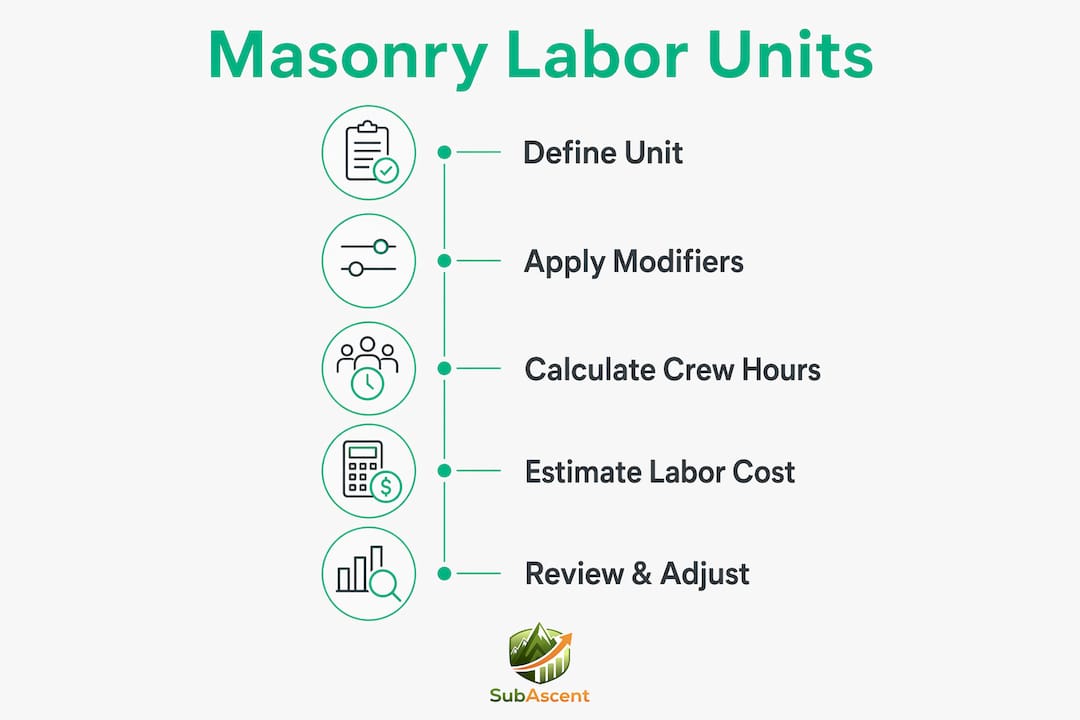
The workflow, step by step:
- Perform takeoff. Measure wall areas, deduct openings, apply a 5–10% waste factor, and convert to unit counts using coursing tables.
- Assign unit type. Match each takeoff line to the correct labor unit category (per CMU, per 100 brick, per sq ft, etc.).
- Apply baseline labor unit. Pull from your production history first; use a published reference only when you have no history for that unit type.
- Apply site modifiers. Work through the modifier cheat-sheet for each line. Document which modifiers you applied and why.
- Convert to hours. Qty × adjusted labor unit = total mason-hours. Add support labor per your manday model.
- Price with burden. Apply wage rates and burden to each crew role. Never use bare wage.
- Document assumptions. Every estimate line should carry a note field: baseline source, modifiers applied, crew model used.
Spreadsheet column checklist for each takeoff line:
Unit_Type— CMU, brick/100, sq ft veneer, LF lintelQty— from takeoffBaseline_Unit_Hrs— from production history or referenceModifier— decimal multiplier (e.g., 1.12 for second lift)Adj_Unit_Hrs—Baseline_Unit_Hrs × ModifierTotal_Mason_Hrs—Qty × Adj_Unit_HrsSupport_Ratio— laborers per mason (e.g., 1.0)Total_Crew_Hrs—Total_Mason_Hrs × (1 + Support_Ratio)All_In_Rate— blended burdened rate for the crewTotal_Labor_$—Total_Crew_Hrs × All_In_Rate
Annotate each line with the modifier rationale. When the PM gets the job and starts tracking crew hours against the estimate, those notes tell them exactly what assumption to test. Copy/paste errors most often happen in the Modifier column when estimators duplicate a line and forget to update the multiplier for a different wall condition. Lock that column to a dropdown or a named reference table.
Production is a critical driver of profit in masonry: more units laid than estimated increases margin, while poor material coordination and weak field organization erode it. The estimate-to-field handoff is where that connection either holds or breaks.
What mistakes cause labor unit estimates to go wrong?
Most masonry bid overruns trace back to a small set of recurring errors. Here's where to look.
Frequent mistakes:
- Confusing production rate with labor unit. A production rate (300 CMU/shift) is not a labor unit (0.027 hrs/block). Using the rate directly without inverting it produces wildly wrong hour totals.
- Ignoring support labor in the manday. Pricing only mason hours and forgetting laborers, operators, and foreperson time is the fastest way to underbid a job.
- Misassigning unit types. Pricing a decorative bond pattern at a standard stretcher rate, or pricing reinforced CMU at the same unit as plain CMU, buries the real cost.
- Forgetting scaffold and setup time. Scaffold erection, strip, and move time is real labor. It doesn't show up in the unit-laying rate.
- Carrying stale historical rates. A labor unit from a job three years ago with a different crew in a different market may be 20–30% off today. Calibrate rates against recent actuals before every bid season.
- Wrong mason-to-laborer ratio. The mason-to-laborer ratio materially affects unit cost. A 1:2 mason-to-laborer crew costs more per unit than a 1:1 crew even if the masons lay the same number of blocks.
Last-minute bid review: five checks to run on every labor line:
- Is the unit type correct for this scope (not a copy from a different wall section)?
- Is the modifier applied, and does it match the site condition in the plans?
- Does the manday model include all crew roles, not just masons?
- Is burden applied at the correct rate for this trade classification and state?
- Is scaffold/setup time captured as a separate line or modifier?
Red flags in the field that signal the estimate is trending off:
- Daily unit count is running 15% or more below the estimated rate for three consecutive days
- Support-labor hours are climbing relative to mason-hours (ratio drifting above your model)
- Rework tasks appearing in daily reports that weren't in the original scope
Full worked example: from takeoff quantity to labor dollars
Here's a complete calculation walkthrough for a single CMU wall line, then a three-scenario sensitivity table.
Setup: 1,200 standard 8×8×16 CMU, second-lift wall, 1:1 mason-to-laborer crew, two masons plus two laborers plus 0.25 foreperson.
Step-by-step calculation:
- Baseline labor unit: 0.053 hrs/block
- Height modifier (second lift): × 1.12
- Adjusted labor unit: 0.053 × 1.12 = 0.059 hrs/block
- Total mason-hours: 1,200 × 0.059 = 70.8 hrs
- Laborer hours (1:1 ratio): 70.8 hrs
- Foreperson hours: 70.8 × 0.25 = 17.7 hrs
- Mason labor (burdened at $65/hr): 70.8 × $65 = $4,602
- Laborer labor (burdened at $42/hr): 70.8 × $42 = $2,974
- Foreperson labor (burdened at $72/hr): 17.7 × $72 = $1,274
- Total labor cost: $8,850
Three-scenario sensitivity table:
| Scenario | Modifier | Adj Unit-Hrs | Total Mason-Hrs | Total Labor $ |
|---|---|---|---|---|
| Baseline (ground level) | — | 0.053 | 63.6 | $8,850 |
| Constrained access (second lift) | 1.12 | 0.059 | 70.8 | $8,850 |
| Premium skilled crew, ground level | — | 0.053 | 63.6 | $4,134 |
The $1,654 spread between the constrained-access scenario and the premium-crew scenario on a single 1,200-block line illustrates why scenario modeling matters. On a 10,000-block job, that spread becomes a $13,000+ swing in labor cost. Build at least three crew models for every significant bid and use them to stress-test your number before you submit.
To use this as a template, replicate the column structure above for each takeoff line. The Modifier column is the one most likely to carry a copy/paste error; treat it as a required field, not an optional note.
Key Takeaways
Accurate masonry labor cost estimation requires assigning the correct unit type, applying documented site modifiers, pricing the full crew (not just masons), and feeding daily actuals back into your baseline rates.
| Point | Details |
|---|---|
| Labor unit vs. production rate | A labor unit is hours per unit installed; a production rate is units per shift. Never use them interchangeably. |
| Full crew in the manday | Always include masons, laborers, operators, and foreperson in the manday cost, not just productive mason hours. |
| Apply site modifiers | Document every modifier (height, access, weather, unit type) on each estimate line before converting to dollars. |
| Burden is not optional | Burden (FICA, workers' comp, benefits) typically adds 35–55% on top of base wage; omitting it underbids every job. |
| Daily actuals close the loop | Capture unit-type, units installed, crew size, and hours daily to build a rolling productivity profile and sharpen future bids. |
Why the feedback loop is the part most estimators skip
Most estimators build a solid labor unit system and then stop. They assign units, apply modifiers, price with burden, and submit the bid. What they don't do is close the loop.
The feedback loop is not complicated. It's five data points captured daily: unit-type, units installed, number of masons, number of support staff, total crew hours. That's it. But it requires a foreman who fills out the form and an estimator who actually reads it. Those two things are harder than the math.
Here's what I've seen happen when the loop is missing: an estimator uses a CMU labor unit from a job two years ago, on a different crew, in a different season. The new job runs 18% over on labor. The PM blames the crew. The estimator blames the GC's schedule. Nobody looks at the labor unit, because nobody has the actuals to compare it against.
When you do have the actuals, the conversation changes completely. You can see exactly which unit-types ran over, which crew configurations performed, and which site conditions cost you the most. That's the difference between a bid that's a guess and a bid that's a forecast.
Start with your two or three highest-volume unit-types: standard CMU and your most common brick. Get clean daily counts on those first. Don't try to track everything at once. Once the foreman has the habit and the form is working, add the next unit-type. A daily production report doesn't need to be a 20-field form. The simpler it is, the more likely it gets filled out accurately.
The tradeoff between tracking granularity and on-site admin burden is real. Too many trackable tasks and foremen start combining categories or skipping lines. Five to eight distinct unit-types per job is the right ceiling for most masonry subs. Beyond that, data quality degrades faster than the additional insight is worth.
Useful sources for masonry labor unit research
These are the references worth bookmarking if you want to go deeper on rate baselines, manday methodology, and field reporting.
-
ESCSI Production Estimating Guide (escsi.org): The most detailed publicly available reference for CMU and brick production curves, unit weight vs. productivity relationships, and production factors for special block. Use it to validate your baseline labor units for non-standard block types and to build the production-factor table for your estimating system.
-
Mason Contractors Association of America (masoncontractors.org): The MCAA publishes estimating guidance, manday methodology articles, and labor cost frameworks. The "Estimating the Correct Cost Per Unit" article is particularly useful for building your manday model and understanding how crew composition affects unit cost.
-
Masonry Magazine labor cost articles (masonrymagazine.com): Practical field-level guidance on separating tasks in daily reporting, tracking crew sizes, and understanding where labor dollars actually go on a running job. Use this alongside your daily production forms.
-
Pro Masonry Guide unit pricing reference (promasonryguide.com): A straightforward worked example of unit price calculation for a brick-and-block wall, including material counts and mortar quantities. Useful for cross-checking your takeoff math and understanding how unit pricing relates to labor unit methodology.
Use all of these as starting points, not substitutes for your own production history. Published rates reflect average conditions and average crews. Your actuals, once you're collecting them consistently, will always be more accurate for your market, your crew, and your typical job type.