

Hiring a foreman does not simply add a salary line to your overhead. It restructures how your entire job runs. For electrical, plumbing, HVAC, roofing, and other specialty trade subs, a foreman sitting between you and your crew is the difference between a job that bleeds labor hours quietly and one that finishes on budget. The core effect is a shift: supervisory cost moves from passive overhead you carry regardless of output to active field management that directly protects your margin.
Here is what that shift looks like in practice:
- Labor productivity improves because someone on site is sequencing work, managing crew pace, and catching problems before they compound.
- Rework drops when a foreman enforces quality checks in real time rather than waiting for a punch list at closeout.
- Schedule adherence tightens, which cuts overtime exposure and the overhead that comes with compressed timelines.
- Owner supervision hours shrink, converting your time from daily firefighting to estimating and business development.
- Turnover costs decrease when a foreman builds crew stability and morale, reducing the recruiting and retraining cycle that quietly inflates overhead.
The net result for job cost management is that foreman-related overhead, when structured correctly, pays for itself through the costs it prevents.
What overhead actually includes when you hire a foreman
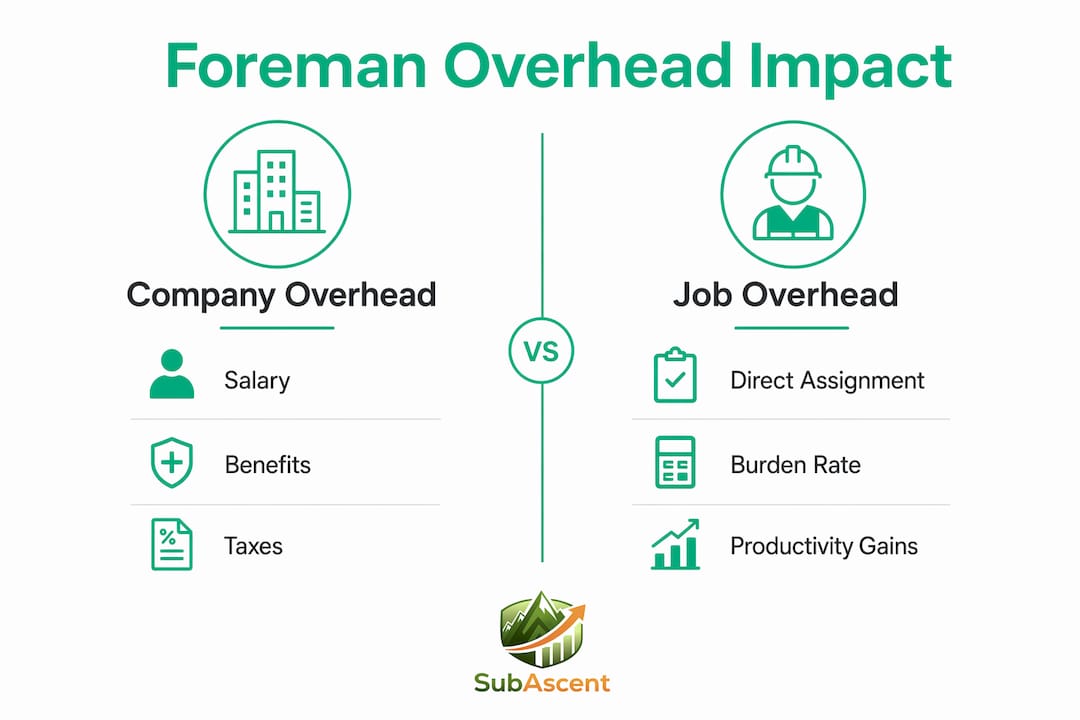
Overhead in specialty trade subcontracting splits into two buckets: company-level overhead and job-level overhead. Company-level overhead covers the costs you carry whether you have one job or ten: office rent, insurance, owner salary, estimating staff, accounting. Job-level overhead, sometimes called project overhead or general conditions, covers costs tied to a specific job but not directly to installing the work: supervision wages, fringe benefits, tools, vehicles, and site management time.
Foreman costs land primarily in job-level overhead, though they bleed into company-level overhead when a foreman is between projects or when turnover forces you to recruit. Administrative overhead consumes 8–12% of total project cost on mid-size commercial builds, per FMI Corporation's 2025 construction industry analysis. That figure includes management salaries, benefits, and coordination costs directly tied to field leadership roles like foremen.
The overhead components most directly influenced by foreman hiring include:
- Foreman wages and burden (base pay plus payroll taxes, workers' comp, health benefits, and retirement contributions)
- Fringe benefits that often run 25–45% on top of base wages in union trades
- Turnover and recruiting costs when foreman positions go unfilled or turn over frequently
- Owner and PM supervision time that a foreman either absorbs or forces you to spend yourself
- Rework and delay costs that show up in labor overruns and extended general conditions
The most common misconception owners make is treating the foreman's salary as pure overhead burden, a cost with no return. That framing misses the point entirely. Foreman salaries function as margin protection, not just cost. A foreman who prevents two days of rework on a drywall job or keeps an HVAC crew on sequence through a tight mechanical room pays for weeks of their own wages in a single decision. The salary is real, but so is the cost of not having one.
How foremen directly shape labor productivity and job costs
A foreman's job is not just to show up and supervise. On a well-run specialty trade job, the foreman handles sequencing, crew communication, material staging, quality control, safety compliance, and daily problem-solving. Foremen make upward of fifty decisions daily, covering crew planning, safety, and quality control, while typically earning only slightly more than a skilled craftsman. That pay-to-responsibility gap is one of the most underappreciated cost-value disparities in the trades.

The productivity impact is measurable. Projects with highly skilled foremen achieve 4% lower overall project costs and 10% lower labor cost growth than those with weaker supervision, according to IPA research on union labor and supervision. On a $2 million electrical job, 4% is $80,000. That is not a rounding error.
Consider a concrete framing scenario: a foreman who stages materials correctly at the start of each day eliminates the 20–30 minutes per worker per day that crews lose walking, repositioning, and waiting. Across a six-person crew over a 60-day job, that recovered time adds up to weeks of productive labor. No estimate accounts for that loss explicitly, but every job cost report eventually shows it.
The key productivity drivers a foreman controls include:
- Work sequencing to keep crews moving without waiting on prior trades or materials
- Real-time quality control that catches defects before they require tear-out
- Crew morale and pace through consistent, clear direction
- Scope boundary management to prevent crews from working in gray areas not covered by the contract
- Early escalation of problems to the PM before a minor issue becomes a schedule event
"When the foreman is present, the job gets done quickly. Waiting for orders from higher management often causes delays and rework." That observation, documented across multiple field studies, reflects a consistent pattern: direct, situational leadership at the crew level outperforms top-down management for day-to-day production control.
Pro Tip: Give your foreman a copy of the budgeted labor hours for each phase before the job starts. Foremen who understand the financial target work within it. Foremen who do not know the target cannot protect it.
Projects with active foreman supervision have experienced up to 20% fewer rework incidents, translating directly into lower material costs and fewer overtime hours. For a roofing or insulation sub where rework means tearing off completed work, that reduction is the difference between a profitable job and a break-even one.
How to assign and track foreman-related overhead on trade jobs
Getting the foreman cost into your job costing system correctly is where most specialty trade subs fall short. The salary is easy to track. The burden, the indirect time, and the allocation across multiple jobs are where the numbers get fuzzy.

The two primary methods for allocating foreman costs to jobs are burden rate allocation and direct assignment.
With burden rate allocation, you calculate a fully loaded hourly cost for the foreman (base wage plus all benefits, taxes, and insurance) and apply that rate to the hours they log against each job. This works cleanly when a foreman is dedicated to a single project. It gets complicated when one foreman floats across two or three smaller jobs simultaneously, which is common for electrical and low-voltage subs running multiple small commercial projects.
With direct assignment, you track foreman hours by job code daily and assign costs accordingly. This requires discipline from the foreman on timecards, but it produces the most accurate job cost data. Pairing this with a field app that captures hours in real time, rather than relying on end-of-week memory, closes the gap between what actually happened and what gets reported. Subascent's crew hour tracking approach addresses exactly this problem for trade subs.
The steps for tracking and allocating foreman overhead accurately:
- Set a fully loaded burden rate for each foreman before the job starts, including wages, payroll taxes, workers' comp, health insurance, and any fringe benefits
- Assign cost codes for foreman time that separate direct supervision from indirect activities like travel, training, and administrative tasks
- Capture daily hours by job using a mobile timecard system rather than paper or weekly recall
- Allocate shared foreman time across jobs proportionally based on logged hours, not estimates
- Review foreman cost vs. budget weekly, not monthly, so overruns surface while there is still time to adjust
- Include foreman burden in your bid estimate as a line item under general conditions, not buried in your overhead markup
For job costing accuracy, the foreman cost needs to appear in the estimate before the job starts, not get absorbed into overhead after the fact. When you hide foreman costs in your overhead markup, you lose visibility into whether the job is actually performing.
Timing of hire also creates overhead risk that most subs underestimate. Hiring lead foremen 4–6 months before mobilization is the industry best practice for commercial projects. Late hires compress onboarding, create site setup problems, and push schedule risk into the early phases of the job when sequencing decisions matter most.
Pro Tip: When you win a job, put the foreman hire date on the project schedule the same day you put the mobilization date. Treat it like a procurement milestone, not an afterthought. A foreman who joins two weeks before mobilization is already behind.
Turnover in the foreman role carries a cost that rarely shows up clearly in job cost reports. Replacing a skilled field worker incurs substantial costs due to recruiting, onboarding, and productivity losses during ramp-up. On average, replacing a skilled field worker costs 50% of their annual salary in real overhead cost per turnover event, before you count the schedule impact.
Field insights on optimizing foreman hiring to control overhead and boost profits
The labor market in 2026 makes foreman retention a direct overhead issue, not just an HR concern. Failing to adjust foreman salaries for current wage inflation leads to higher turnover and hidden overhead from recruiting and training costs. Specialty trade subs competing for experienced foremen in electrical, plumbing, and HVAC are seeing this play out in real time: underpaying a foreman by $8,000–$10,000 a year often costs more in turnover and schedule disruption than the raise would have.
"More foreman responsibility led to less supervision and fewer overhead expenses. Less supervision led to faster, better decision-making and problem-solving in the field." That outcome, documented in a case study on foreman development and profit growth, reflects a pattern that applies directly to specialty trade subs: investing in foreman capability reduces the management overhead you carry at the company level.
The mechanism is straightforward. When a foreman can make decisions independently, handle material requests, manage crew scheduling, and communicate directly with the GC's super, you stop paying for a layer of PM oversight on every job. Giving foremen more responsibility and better systems converts overhead-heavy management hours into productive decision-making that drives higher profit margins. That conversion is where the real overhead savings live.
The IPA research finding is worth anchoring here: projects with highly skilled foremen see 10% lower labor cost growth compared to those with weaker supervision. Labor cost growth is the overhead metric that kills jobs quietly. It does not show up as a single line item. It accumulates in overtime, rework, inefficiency, and extended general conditions until the job closes and you wonder where the margin went.
Pro Tip: Share weekly job cost scorecards with your foremen. Foremen who see how their labor hours compare to the budget make better daily decisions. Foremen with real-time access to job cost data can adjust crew assignments and pace before an overrun becomes unrecoverable.
The risks of getting foreman hiring wrong compound quickly. Late hiring creates compressed onboarding and schedule risk, as covered earlier. But underdeveloping the foremen you already have creates a different kind of overhead: the cost of constant owner involvement in field decisions that a capable foreman should be handling. For a masonry or concrete sub running three jobs simultaneously, that owner time is the most expensive overhead on the books.
Structured foreman development does not require a formal training program with outside consultants. It starts with three things: clear production expectations tied to budgeted hours, regular feedback on job cost performance, and post-project reviews that examine what worked and what did not. Transitioning foremen from manual supervisors to empowered field leaders converts overhead-laden management roles into hands-on, revenue-protecting leadership. That transition is available to any specialty trade sub willing to share information and set expectations clearly.
For subs tracking crew productivity across multiple jobs, the foreman is the single biggest variable in whether that data reflects reality or wishful thinking. A foreman who understands what good production looks like in square feet of drywall hung, linear feet of conduit run, or fixtures installed per day gives you a feedback loop that no office-based reporting system can replicate.
The overhead savings with foremen are not theoretical. They show up in lower labor overruns, fewer rework callbacks, tighter schedules, and reduced owner time per job. The cost of a foreman is visible on day one. The savings accumulate across the life of every job they run.
Key Takeaways
Hiring a skilled foreman shifts overhead from passive cost to active margin protection, with the productivity and rework savings typically exceeding the foreman's fully loaded wage cost across the life of a well-run specialty trade job.
| Point | Details |
|---|---|
| Foreman cost is margin protection | Skilled foremen reduce rework and delays, making their salary a profit driver rather than pure overhead burden. |
| Labor cost growth drops with skilled supervision | IPA research shows projects with highly skilled foremen achieve lower labor cost growth than those with weaker supervision. |
| Turnover is a direct overhead cost | Replacing a skilled field worker costs an average of 50% of their annual salary in recruiting, onboarding, and lost productivity. |
| Hire foremen early, not at mobilization | Best practice is hiring lead foremen 4–6 months before mobilization to avoid compressed onboarding and schedule risk. |
| Sharing job cost data improves foreman performance | Foremen with real-time access to budget performance make timely field adjustments that prevent cost overruns. |

Subascent is built for specialty trade subs who need to track job costs, crew hours, and foreman performance without the overhead of software designed for general contractors. If you are running electrical, plumbing, HVAC, roofing, or any other trade sub and want to see how job cost tracking works in practice, Subascent gives your foremen and PMs the tools to close the gap between what you estimated and what you actually spent.