

A lien waiver and release is a legal document where a claimant gives up mechanic's lien rights in exchange for payment. For electrical, plumbing, HVAC, masonry, and other specialty trade subs, getting this wrong means losing your most powerful payment protection tool. The lien waiver process subcontractors follow is not just paperwork. It is the mechanism that controls whether you keep your right to file a lien if a GC or owner fails to pay. This guide covers every stage: waiver types, state-specific lien waiver requirements, submission steps, and the tools that make the process faster and more reliable.
What types of lien waivers do subcontractors need to know?
The four waiver types form the foundation of any subcontractor lien waiver strategy. Get the type wrong and you either lose lien protection prematurely or create a document that does not hold up in court.
The two primary distinctions are conditional versus unconditional, and progress versus final. Conditional waivers become effective only when the specified payment actually clears. Unconditional waivers are effective the moment you sign them, regardless of whether funds arrive. That distinction is the single most important concept in understanding lien waivers.
Progress waivers cover a specific payment period or billing cycle, typically tied to a pay application. Final waivers cover all remaining lien rights on the project and are exchanged when the last payment is made. Mixing these up, such as signing a final waiver when you are only receiving a progress payment, can permanently eliminate rights you still need.
| Waiver type | When it becomes effective | When to use it |
|---|---|---|
| Conditional progress | When specified payment clears | Before or with each pay app, pre-payment |
| Unconditional progress | Upon signing | Only after confirmed payment for that billing period |
| Conditional final | When final payment clears | With your last pay app, before final payment arrives |
| Unconditional final | Upon signing | Only after final payment has fully cleared your account |
Pro Tip: Always send a conditional waiver before payment clears. Switch to an unconditional waiver only after the check has cleared or the wire has settled in your account. This one habit protects you from the most common and costly mistake in the process.
How do state-specific lien waiver requirements affect subcontractors?
State law governs lien waivers, and the rules vary significantly. Three states stand out as the most prescriptive: California, Texas, and Florida. If you work across state lines, you cannot use a one-size-fits-all template.
California operates under Civil Code sections 8132 through 8138. California requires that waiver forms substantially conform to four statutory forms covering all combinations of conditional/unconditional and progress/final payments. A nonconforming waiver in California is unenforceable. That means a roofing or drywall sub who uses a generic template downloaded from the internet may have zero lien protection, even if they signed something.
Texas takes an equally firm stance. Texas law voids lien waivers that do not substantially follow the forms prescribed under Texas Property Code §53.284. The four statutory forms mirror the same conditional/unconditional and progress/final structure. Any deviation risks making the waiver unenforceable, which cuts both ways. A GC cannot rely on a waiver you signed, and you cannot rely on one you received.
Florida provides a different kind of protection. Florida Statute §713.20 offers safe harbor forms for both progress and final payments. Follow those forms and your waiver is enforceable. The statute also prohibits requiring parties to use non-statutory forms, which means a GC cannot force you to sign something that strips more rights than the law allows.
Key compliance risks to watch across all states:
- Using non-statutory language in states with prescribed forms
- Dropping required statutory warnings or notices from the waiver body
- Using a form from the wrong state on a multi-state project
- Accepting altered waiver language from a GC without legal review
Pro Tip: Before you submit your first pay app on any new project, confirm whether the project state requires statutory waiver forms. A five-minute check at the start of a job can prevent an unenforceable waiver six months in.
What is the step-by-step lien waiver submission process?
Submitting lien waivers with each pay application is the standard that keeps payment approvals moving. Incomplete or incorrect submissions cause delays or outright rejection of your pay app. Here is the process that works.
Step 1: Prepare your pay application package. Bundle your invoice, schedule of values, any approved change orders, and the appropriate conditional progress waiver into a single submission. A framing or insulation sub sending a pay app without the waiver attached is asking the GC's accounting team to chase them down, which slows everything.
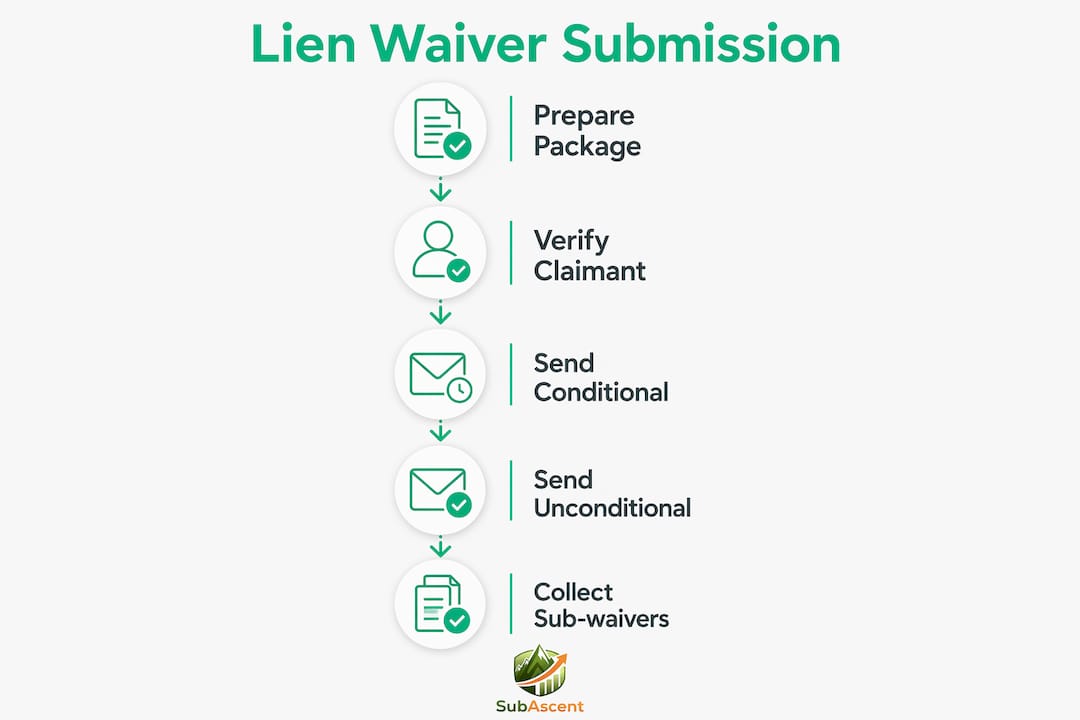
Step 2: Verify the claimant name exactly. The claimant name on the waiver must match your legal entity name on the contract and your W-9. If your company is "Apex Mechanical LLC" on the contract but the waiver says "Apex Mechanical," that mismatch can void the document. Pull your contract and W-9 before you fill out the first waiver on any project.
Step 3: Send the conditional waiver before payment clears. Attach the conditional progress waiver to your pay app. This signals to the GC that lien rights will be released once payment is confirmed, without releasing them prematurely.

Step 4: Follow up with the unconditional waiver after payment clears. Once the payment hits your account and clears, send the unconditional progress waiver. Some GCs require this before releasing the next pay app. Build it into your accounts receivable workflow so it happens automatically.
Step 5: Collect waivers from your lower-tier subs and suppliers. If you subcontract any work or buy materials from suppliers, full lien protection requires collecting waivers from every tier below you. A concrete sub who uses a rebar supplier needs that supplier's waiver too. Missing lower-tier waivers exposes the GC to unexpected liens, which creates friction in your relationship and can delay your own payments.
Step 6: Use electronic signatures and digital storage. Electronic signatures are legally valid for lien waivers in all U.S. states. Digital workflows create audit trails that protect you in disputes and speed up the entire exchange.
Common mistakes to eliminate from your process:
- Signing an unconditional waiver before confirming payment has cleared
- Mismatched payment amounts between the waiver and the pay app
- Missing or incorrect "through dates" that leave gaps in coverage
- Sending a final waiver when only a progress payment is being made
Pro Tip: Set a calendar reminder for two business days after each expected payment date. If the payment has cleared, send the unconditional waiver. If it has not, follow up on the payment before sending anything.
How do you troubleshoot common lien waiver challenges?
Even experienced specialty trade subs run into lien waiver problems. Knowing how to respond protects your payment rights without damaging your GC relationships.
The most dangerous scenario is signing an unconditional waiver before payment clears. If the check bounces or the wire never arrives, you have already surrendered your lien rights. You have no legal recourse through the lien process, leaving only contract claims or litigation. This is not a theoretical risk. Payment disputes are among the most common causes of subcontractor contract disputes, and a prematurely signed unconditional waiver removes your strongest leverage.
Amount discrepancies are the second most common problem. If the waiver amount does not match the pay app amount, the waiver may be invalid or may release more rights than intended. Always cross-check the dollar figure on the waiver against the approved pay app before signing.
When a GC asks you to sign a non-statutory form in a state with prescribed language, you have the right to decline. Using non-statutory language or dropping required warnings poses enforceability risk that goes beyond a paperwork error. Politely redirect to the state-mandated form. Most GCs will accept this without pushback once you explain the legal basis.
Lien waivers create trust in the cash flow chain by assuring payment approvers that lien rights are released only when legal conditions are met. That trust runs both directions. A sub who submits accurate, timely waivers builds a reputation for professionalism that GCs notice and reward with faster payment cycles.
Maintain a project-level waiver log that tracks every waiver sent, every waiver received from lower tiers, the payment amounts, and the through dates. This log becomes your primary evidence in any payment dispute and your proof of compliance during audits.
What tools can subcontractors use to manage lien waivers faster?
Manual lien waiver management, meaning Word templates, email chains, and paper files, creates errors and delays. The right digital tools cut processing time and reduce the risk of the mistakes covered above.
Key capabilities to look for in any lien waiver platform:
- Form generation with pre-filled data: The platform should pull claimant name, project address, payment amount, and through date from your existing job data. Manual re-entry is where entity mismatches and amount errors happen.
- State-specific form libraries: A good platform includes AIA G901 through G904 forms and statutory forms for California, Texas, Florida, and other prescriptive states. You should never have to hunt for the right template.
- Digital signature capture: Since electronic signatures are valid in all U.S. states, there is no reason to print, sign, scan, and email. Digital signatures cut the exchange from days to hours.
- Integration with pay application software: When your lien waiver tool connects to your pay app workflow, conditional waivers go out automatically with each billing cycle. Unconditional waivers trigger once payment is confirmed.
- Centralized document storage: Every waiver, signed and unsigned, lives in one searchable location. When a GC questions a waiver from eight months ago, you pull it in seconds instead of digging through email.
Understanding how lien waivers connect to your broader cash flow on projects is what separates subs who get paid consistently from those who are always chasing money.
Key takeaways
The lien waiver process subcontractors must follow requires matching the right waiver type to the right payment stage, complying with state-specific statutory forms, and building a consistent submission workflow that protects lien rights at every step.
| Point | Details |
|---|---|
| Conditional before unconditional | Send conditional waivers pre-payment; switch to unconditional only after funds clear. |
| State forms are mandatory | California, Texas, and Florida require statutory forms; nonconforming waivers are unenforceable. |
| Entity name must match exactly | The claimant name on every waiver must match your contract and W-9 precisely. |
| Collect lower-tier waivers | Gather waivers from sub-subs and suppliers to close the lien chain on your projects. |
| Digital tools reduce errors | Electronic signatures and integrated platforms eliminate the manual mistakes that void waivers. |
Why the lien waiver process deserves more respect than it gets
Most specialty trade subs treat lien waivers as an administrative chore. Fill it out, sign it, move on. I have seen that attitude cost electrical and plumbing contractors real money, not because they did not know what a lien waiver was, but because they did not understand the timing rules until it was too late.
The entity mismatch issue is the one that surprises people most. A glazing sub I know lost enforceability on a waiver because the company had rebranded six months earlier and nobody updated the waiver template. The contract still had the old name. The waiver had the new one. That is a fixable problem that costs nothing to prevent and thousands to untangle after the fact.
My honest advice: build a one-page lien waiver policy for your business. Write down which form you use in each state you work in, who is responsible for sending waivers, when conditional becomes unconditional, and where the files are stored. Make it part of onboarding for any new office admin or project manager. The subs who get paid fastest are not the ones with the best lawyers. They are the ones with the most consistent internal processes.
The relationship angle matters too. When you submit clean, accurate waivers with every pay app, GC accounting teams notice. You become the sub who does not create problems. That reputation has real value when payment schedules get tight and someone has to decide who gets paid first.
— Dave
How Subascent helps specialty trade subs manage lien waivers
Managing lien waivers manually across multiple active jobs is where errors compound and payments slow down. Subascent is built specifically for specialty trade subcontractors, covering electrical, HVAC, masonry, roofing, fire protection, and more, with tools that connect bid management, job tracking, and payment workflows in one place.
Subascent helps you generate the right waiver forms with pre-filled job data, capture digital signatures, and store every document in an audit-ready format. When a GC questions a waiver or a payment dispute arises, your records are organized and accessible. If you are running jobs across multiple states and managing lien waiver requirements for each one, Subascent gives you the structure to stay compliant and get paid faster. See how it works for your trade at subascent.com.
FAQ
What is a lien waiver in construction?
A lien waiver is a legal document where a claimant gives up mechanic's lien rights in exchange for payment. Owners and GCs typically require subcontractors to submit waivers as a condition for each payment.
What is the difference between conditional and unconditional lien waivers?
A conditional waiver becomes effective only when the specified payment clears. An unconditional waiver is effective the moment it is signed, regardless of whether payment arrives.
Which states require specific statutory lien waiver forms?
California, Texas, and Florida all require lien waivers to substantially follow state-prescribed forms. Using non-statutory language or altered forms in these states risks making the waiver unenforceable.
Can subcontractors use electronic signatures on lien waivers?
Electronic signatures are legally valid for lien waivers in all U.S. states. Digital workflows also create reliable audit trails that support enforcement in payment disputes.
What happens if you sign an unconditional waiver before payment clears?
You permanently surrender your lien rights for that payment period. If the payment fails to arrive, you have no lien protection and must pursue recovery through contract claims or litigation instead.