

To get retainage released fast, do four things right now: (1) submit a complete closeout package with your final pay application, final unconditional lien waiver, and punch-list sign-off attached; (2) request a scope-based partial release if your masonry work has been accepted, even while the broader project is still running; (3) deliver consent of surety from your bonding company if the project is bonded; and (4) start a 30/60/90-day follow-up cadence, copying the architect, GC's AP contact, and the owner's representative on every communication. The three documents that must be in every demand package are your punch-list sign-off (or architect's written acceptance of your scope), your final pay application, and your final unconditional lien waiver. Without all three, most GCs and owners will not even start the clock.
Table of Contents
- What retainage is and why it matters to your cash flow
- Step-by-step retainage release process
- Final payment documentation checklist
- Masonry-specific best practices for protecting retainage and cash flow
- What to do when retainage is late or disputed
- How to track retainage across jobs and protect working capital
- Practical timeline from final inspection to release
- Key Takeaways
- The part most masonry subs get wrong at closeout
- Subascent helps masonry subs close out faster and get paid sooner
- Useful sources for retainage rules and guidance
What retainage is and why it matters to your cash flow
Retainage — also called a holdback — is the portion of each progress payment that the owner or GC withholds until the project reaches substantial or final completion. The standard band is 5–10% of each pay application. On a typical masonry contract with standard retention, a significant amount can be withheld in someone else's account for the life of the job, tying up your working capital for the project duration.
Owners use retainage as leverage. It covers punch-list completion, warranty exposure, and the risk that a sub walks before the job is done. That rationale is legitimate. The problem for masonry subs is that your scope often finishes months before the general contractor closes out the project, so your retainage keeps getting held for risks that have nothing to do with your work.
FASA has documented that retainage is a persistent cash-flow challenge for subcontractors, and that legal review during the bid phase is the most reliable way to catch excessive holdback clauses before you are locked in. Read every retainage clause before you sign.
The math is simple: on a $600,000 masonry contract at 10% retention, you are carrying $60,000 in unpaid receivables. At a 7% annual cost of capital, every month that retainage sits costs you roughly $350. Six months of unnecessary delay costs $2,100 — and that is before you factor in the administrative time chasing it.
Step-by-step retainage release process
The fastest path to getting paid is straightforward: get your scope formally accepted, submit a complete closeout packet the same day, and then follow the statutory cadence without letting the clock slip.
1. Get written acceptance of your scope. Before you submit anything, get the GC or architect to sign off on your masonry work in writing. An email confirmation works. A signed punch-list works better. The AIA G704 Certificate of Substantial Completion is the gold standard on AIA projects. Without documented acceptance, every follow-up you send is easy to deflect.
2. Assemble and submit your final pay application. Your final pay application should show the full contract value, all prior payments, the retainage balance, and a $0 balance due after retainage release. Attach your punch-list sign-off, your final unconditional lien waiver, and any lower-tier waivers from your material suppliers and sub-tier subs.
3. Deliver the final unconditional lien waiver. This is the document most GCs will not release retainage without. Make sure it covers the full retainage amount and is dated correctly. If your state uses statutory waiver forms (California, Texas, and others do), use the state form — a custom waiver may not be enforceable.
4. Submit consent of surety if the project is bonded. On bonded projects, the surety's consent to final payment is a hard gate. Arkansas DBA closeout guidance lists consent of surety alongside the final payment request and contractor's affidavit as required items before any retainage is released. Request it from your bonding company early — it takes time.
5. Deliver O&M manuals, as-builts, and warranty documents. If your scope included specialty masonry systems, waterproofing, or any item with a manufacturer warranty, the owner will often hold retainage until they have the documentation in hand. Submit these with your closeout package, not after.
6. Send a formal demand if the statutory window passes. If the owner or GC misses the prompt-pay deadline, send a written demand by certified mail. Reference the applicable statute, state the amount owed, and include the per-day interest calculation. Copy the architect, the owner's representative, and the GC's AP contact.
Follow-up cadence: Day 30 after submission — polite email follow-up. Day 60 — certified letter invoking statutory interest. Day 90 — escalate to lien or bond claim if no response.
Final payment documentation checklist
The fastest retainage releases come from a complete, correctly dated closeout packet submitted in one shot. A missing document does not just slow things down — it resets the clock.
| Document | Notes / Common Failure Mode |
|---|---|
| Final pay application | Must show full contract value, all prior payments, and exact retainage balance. Undated or unsigned apps get kicked back. |
| Final unconditional lien waiver | Use your state's statutory form if one exists. Conditional waivers will not satisfy most GCs at final release. |
| Lower-tier lien waivers | Required from material suppliers and any sub-tier subs. Missing one supplier waiver can hold the whole release. |
| Consent of surety | Required on bonded projects. Request from your bonding company at least two weeks before you plan to submit. |
| Certified payroll / WH-347 | Required on Davis-Bacon (federal prevailing wage) projects. Missing a week's report will stop the release. |
| O&M manuals and as-builts | Required when your scope includes systems with maintenance requirements. Submit in the format specified in the contract. |
| Warranty acknowledgment | Some owners require a signed warranty letter separate from the O&M package. Check the contract. |
| Certificate of insurance (COI) | Must be active at the date of release. An expired COI is a common, easily avoided delay. |
On conditional vs. unconditional waivers: A conditional waiver releases lien rights only upon receipt of payment — appropriate for progress payments. An unconditional waiver releases lien rights regardless of payment status — appropriate only when you have actually been paid. Never sign an unconditional final waiver before the retainage check clears.
Pro tip on state forms: California, Texas, Arizona, Nevada, and several other states have mandatory statutory lien waiver forms. Using a non-statutory form in those states may leave your lien rights intact but will not satisfy the GC's legal requirement, which means they will ask you to resubmit. Use the right form the first time.
Masonry-specific best practices for protecting retainage and cash flow
Masonry is an early-finishing trade. Your block, brick, or stone work is typically done months before the project reaches substantial completion. That gap is where retainage gets trapped. The best practices below are specifically aimed at closing that gap.
Negotiate scope-based release language before you sign. The single highest-value clause you can add to a masonry subcontract is a scope-based partial release provision: retainage on your accepted work is released when your scope is accepted, not when the whole project closes out. FASA recommends integrating legal review early in the bid process and negotiating retainage terms before signing — not after. If the GC refuses scope-based release, price the cost of carrying the retainage into your bid.
Sample clause to request:
Push for a step-down retention schedule. If scope-based release is off the table, ask for a step-down: 10% retention until 50% of your scope is complete, then 5% through acceptance. Some GCs will agree to this because it reduces their administrative burden at closeout.
Sample step-down clause:
Use a retention bond when the math supports it. A retention bond substitutes a surety instrument for the cash holdback, freeing your working capital immediately. The cost is typically 1–3% of the bond amount annually. On a $120,000 retainage hold over 12 months, a 2% bond premium costs $2,400 — less than the financing cost of carrying that cash at most small-business lending rates. Retention bonds and step-down schedules are among the most effective tactics for recovering cash faster.
Run a pre-punch inspection walk. Before the GC schedules the formal punch-list walk, do your own internal inspection. Fix everything you find. When the GC's punch list comes back short or clean, you have a documented basis to request immediate scope acceptance. Bring your foreman and a camera — photo-document every finished surface, especially concealed work like waterproofing membranes and flashing details.

Price retainage carrying cost into every bid. If you cannot negotiate scope-based release, add a line to your masonry bid breakdown for retainage carrying cost. On a 12-month project with 10% retention and a 7% cost of capital, that is roughly 0.7% of contract value. Small number, but it adds up across a portfolio of jobs.
Pro Tip: When you send a retainage follow-up to a GC's AP contact, include the per-day statutory interest calculation in the email body. Something like: "Per [State] prompt-pay statute, interest accrues at [X]% per annum on the $60,000 balance, or approximately $[Y] per day after [date]." Most AP departments escalate immediately when they see a daily interest number — it is a concrete liability, not a vague complaint.
What to do when retainage is late or disputed
Late retainage is not just frustrating — it is often a statutory violation with real financial consequences for the party withholding it. Missouri courts have awarded statutory interest to subcontractors when retainage was withheld without reasonable cause, and prompt-pay statutes in most states impose interest automatically once the payment window passes.
Which remedy to try first depends on the project type:
On public work, start with a prompt-pay demand. Public contracts almost always have a statutory clock and an interest penalty. A certified letter referencing the statute is often enough to trigger payment without litigation.
On private bonded work, a payment bond claim is usually faster than a mechanics' lien. The bond is there specifically for this situation — file a written claim against the bond before the claim deadline (often 90 days after your last day of work, but check your state).
On private unbonded work, a mechanics' lien is your primary leverage. Know your state's preliminary notice requirements, lien deadlines, and the required form.
Escalation timeline:
- Day 0: Send your complete closeout package with a cover letter stating the amount owed and the statutory payment deadline.
- Day 15–30: If no payment or written dispute, send a certified demand letter referencing the applicable prompt-pay statute, the interest rate, and the daily accrual. Copy the architect and owner's rep.
- Day 30–45: File a notice of intent to lien (required in some states) or a payment bond claim. Consult your attorney before this step on public projects — bond claim procedures are strict.
- Day 60–90: File the mechanics' lien or bond claim. At this point, also consider whether the amount justifies small claims court, mediation through the American Subcontractors Association (ASA), or formal legal action.
Non-litigation options worth trying first:
- Propose an escrow arrangement: the disputed amount goes into a neutral escrow while the rest of the retainage is released.
- Offer a negotiated partial release tied to a specific unconditional waiver for the undisputed portion.
- Contact your state's ASA chapter — many offer mediation resources that resolve disputes faster than litigation.
This article provides general information, not legal advice. Verify current statutory deadlines and requirements with a licensed construction attorney in your state.
How to track retainage across jobs and protect working capital
Treat retainage as a line item in your job cash flow, not as a vague future receivable. Every job should have a projected release date, and that date should be tied to specific gate conditions — not to a guess about when the GC will get around to it.
A simple per-job retainage tracker needs these columns:
- Job name and contract value
- Retainage rate and total amount withheld to date
- Scope acceptance date (actual or projected)
- Closeout package submitted date
- Gate status: unconditional waiver delivered (Y/N), lower-tier waivers collected (Y/N), surety consent delivered (Y/N), WH-347 complete (Y/N), COI active (Y/N)
- Projected release date (calculated only when all gates are green)
- Statutory deadline and daily interest rate
A well-designed tracker treats every gate as a hard stop — the release date does not populate until every gate flips. That discipline forces your PM team to close out documentation proactively instead of scrambling at the end.
Accounting and cash-flow tactics:
- Build retainage assumptions into your bid pricing using your masonry estimating labor units as a baseline for project duration and carrying cost.
- Maintain a working-capital reserve equal to at least your average retainage balance across active jobs. If that number is $300,000, you need $300,000 in accessible credit or cash.
- Consider a short-term line of credit specifically sized to your retainage exposure. The interest cost is predictable and often lower than the opportunity cost of turning down work.
- Set calendar alerts at 30, 60, and 90 days after each scope acceptance date. If the gate has not flipped by day 30, your PM should already be on the phone.
Pro Tip: Keep a centralized closeout binder (physical or digital) for every project, organized by the checklist above. When a GC calls asking for a document, you can email it in five minutes instead of spending two hours hunting through job folders. Speed of response directly affects how fast the GC processes your release.
Practical timeline from final inspection to release
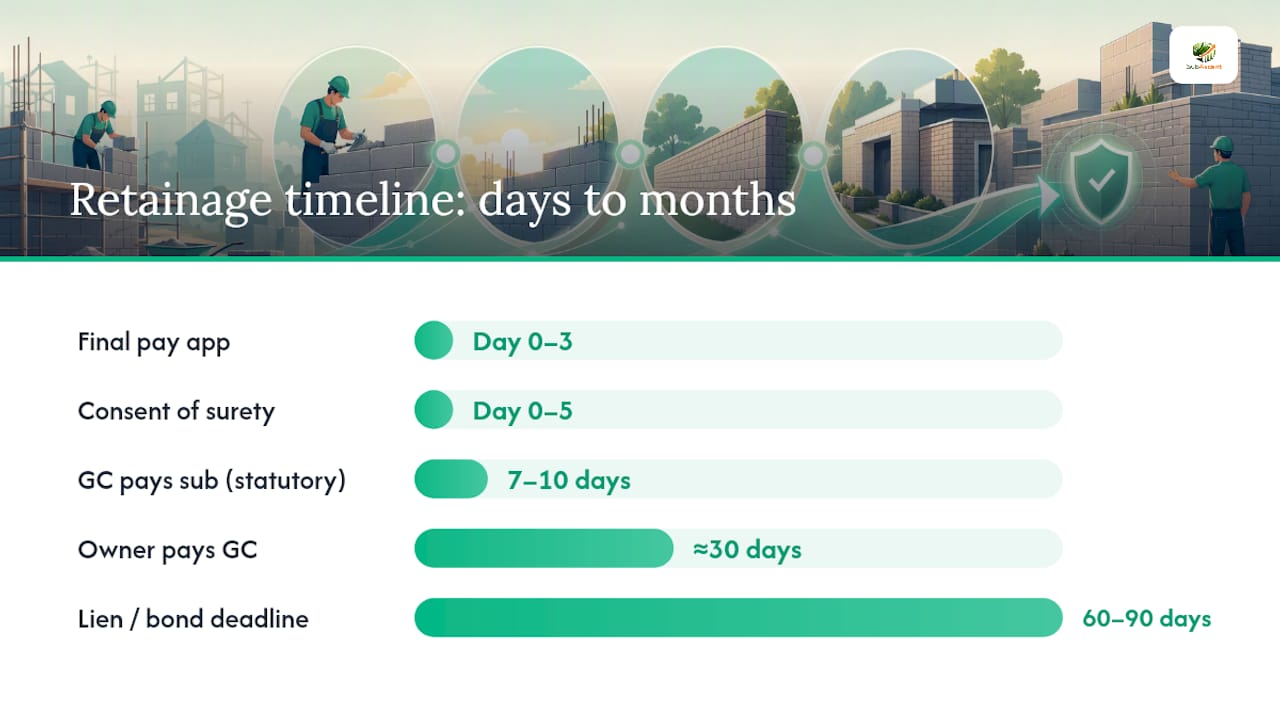
A complete packet plus a timed follow-up letter typically triggers release within the statutory window. The table below maps the key milestones and what you need in hand at each one.
| Milestone | Typical Window | What You Must Have Ready |
|---|---|---|
| Scope acceptance / punch-list sign-off | Day 0 | Written acceptance from GC or architect; your internal pre-punch inspection complete |
| Final pay application submitted | Day 0–3 | Final pay app, final unconditional waiver, lower-tier waivers, COI |
| Consent of surety delivered | Day 0–5 | Surety's written consent to final payment (bonded projects only) |
| O&Ms, as-builts, warranty docs submitted | Day 0–5 | All documents in contract-specified format |
| Owner pays GC | Varies by contract; often 30 days after final certificate | GC should have your complete package before this date |
| GC pays sub (statutory clock) | Typically 7–10 days after GC receives owner payment (varies by state) | Certified demand letter ready if GC misses this window |
| Statutory interest begins | Day after statutory deadline | Daily interest calculation prepared; certified demand ready to send |
| Lien / bond claim deadline | Typically 60–90 days after last day of work (state-specific) | Notice of intent filed if required; attorney consulted |
Template A — Polite first request email:
Subject: Retainage Release Request — [Project Name] — [Your Company Name]
[GC Name],
Our masonry scope on [Project Name] was accepted on [Date]. We submitted our final pay application and complete closeout package on [Date]. The retainage balance due is $[Amount].
Please confirm receipt of our package and advise on the expected release date. We are happy to provide any additional documentation needed.
Thank you, [Name, Title, Company, Phone]
Template B — Certified demand letter invoking statutory interest:
[Date] — Via Certified Mail
Re: Demand for Retainage Payment — [Project Name]
Dear [GC Name],
Our final pay application for $[Amount] was submitted on [Date]. Per [State] prompt-pay statute [cite statute], payment is due within [X] days of our submission. That deadline passed on [Date].
Interest accrues at [X]% per annum, or approximately $[Y] per day. As of today, $[Z] in statutory interest has accrued.
Please remit $[Total] within 10 days to avoid further interest accrual and additional remedies available under [State] law.
[Name, Title, Company]
Template C — Closeout package table of contents:
- Final pay application (signed and dated)
- Final unconditional lien waiver (state statutory form)
- Lower-tier lien waivers (list suppliers and amounts)
- Consent of surety (bonded projects)
- Certified payroll / WH-347 (Davis-Bacon projects)
- O&M manuals (list by system)
- As-built drawings
- Warranty letters / manufacturer warranties
- Certificate of insurance (active at release date)
Key Takeaways
Masonry subs who negotiate scope-based release language, submit a complete closeout packet on day one, and follow a documented statutory cadence recover retainage significantly faster than those who wait for the GC to act.
| Point | Details |
|---|---|
| Negotiate before you sign | Push for scope-based release or a step-down schedule at bid time; price the carrying cost if the GC refuses. |
| Submit a complete packet on day one | Missing a single document resets the clock; use the nine-item checklist every time. |
| Treat retainage as a cash-flow line item | Track it per job with hard gates; compute a release date only when every gate is green. |
| Use statutory interest as leverage | Reference the daily interest accrual in every demand letter; most AP departments escalate immediately. |
| Subascent | Subascent's job and AR management tools track retainage per job, automate follow-up alerts, and sync to QuickBooks so your release package is always current. |
The part most masonry subs get wrong at closeout
The conventional wisdom says retainage disputes are a GC problem — that the GC is holding your money and there is not much you can do until the owner pays them. That framing costs masonry subs real money.
The truth is that most retainage delays are self-inflicted, and they happen at the beginning of a project, not the end. The sub signs a contract with no scope-based release clause, no step-down schedule, and no defined trigger for what "acceptance" means. Then, when the job is done and the money is not coming, they are negotiating from a position of zero leverage.
The subs who recover retainage fastest are the ones who treated the contract as a cash-flow document from day one. They pushed for scope-based release language during preconstruction. They ran a pre-punch walk before the GC scheduled theirs. They submitted a complete closeout package the same week their last brick was laid. And when the statutory deadline passed, they sent a certified letter with a daily interest number in the subject line — not a polite follow-up email.
The other important thing that gets overlooked: masonry is a concealment trade. Once your waterproofing is behind the brick, no one can verify it without tearing the wall apart. Photo-document every concealed detail during installation, not after. That documentation is not just good practice for warranty claims — it is the evidence that gets your punch list closed in one walk instead of three.
If you are running multiple jobs and tracking retainage in a spreadsheet, you are already behind. The subs who have a system — a per-job tracker with hard gates, automated alerts, and a centralized closeout binder — are the ones who get paid on time consistently.
Subascent helps masonry subs close out faster and get paid sooner
Chasing retainage across five or ten active jobs in a spreadsheet is how money gets left on the table. Subascent is built specifically for specialty trade subs — masonry, concrete, framing, and the rest — and it handles the AR and closeout tracking that most GC-built platforms ignore entirely.
With Subascent, you get per-job retainage tracking with hard-gate checklists, automated 30/60/90-day follow-up alerts, and a QuickBooks sync that keeps your AP records current so you always know exactly what is outstanding and when the statutory clock started. Closeout package templates mean your PM can assemble a complete final pay package in minutes, not hours. No more hunting for the consent of surety or realizing the COI expired last month.
If you are a masonry sub owner, estimator, or PM who wants to stop leaving retainage on the table, start a free trial at Subascent and see how much faster your releases move when the system is tracking the gates for you.
Useful sources for retainage rules and guidance
These are the primary sources used in this article. Check them directly to verify current statutory requirements for your state and project type.
- Why Retainage Remains a Persistent Challenge for Subs Nationwide … and What You Can Do to Manage the Risks — FASA
- Final retention release — Project Delivery Manual (City of Los Angeles)
- Retainage — TxDOT Local Government Projects guidance
- Retainage Release Mechanics in Commercial Construction (2026) — AIA vs ConsensusDocs | TCG
- Retainage Management for Subcontractors: 7 Proven Strategies to Recover Cash Faster
- Subcontractor retainage release schedule tracking guide
- Jerry Bennett Masonry, Inc. v. Crossland Const. Co., Inc. (Missouri Court of Appeals, 2005)
Always check both your prime contract's flow-down language and your state's prompt-pay and retainage statutes. State rules change, and the contract you signed may impose obligations that differ from the statutory default. When the amount at stake is significant, have a construction attorney review your demand before you send it.