

Painting subcontractor square foot pricing is a systematic method for estimating painting costs by surface area, accounting for labor, materials, substrate type, and job complexity. It is the standard approach for commercial painting bids and gives estimators a repeatable framework to price work accurately without rebuilding every bid from scratch. The method works because it ties cost directly to paintable surface area, not floor area, which is where most underbidding starts. Mastering this framework separates profitable painting subs from those who win jobs and lose money on them.
What are typical square foot pricing ranges for painting surfaces?
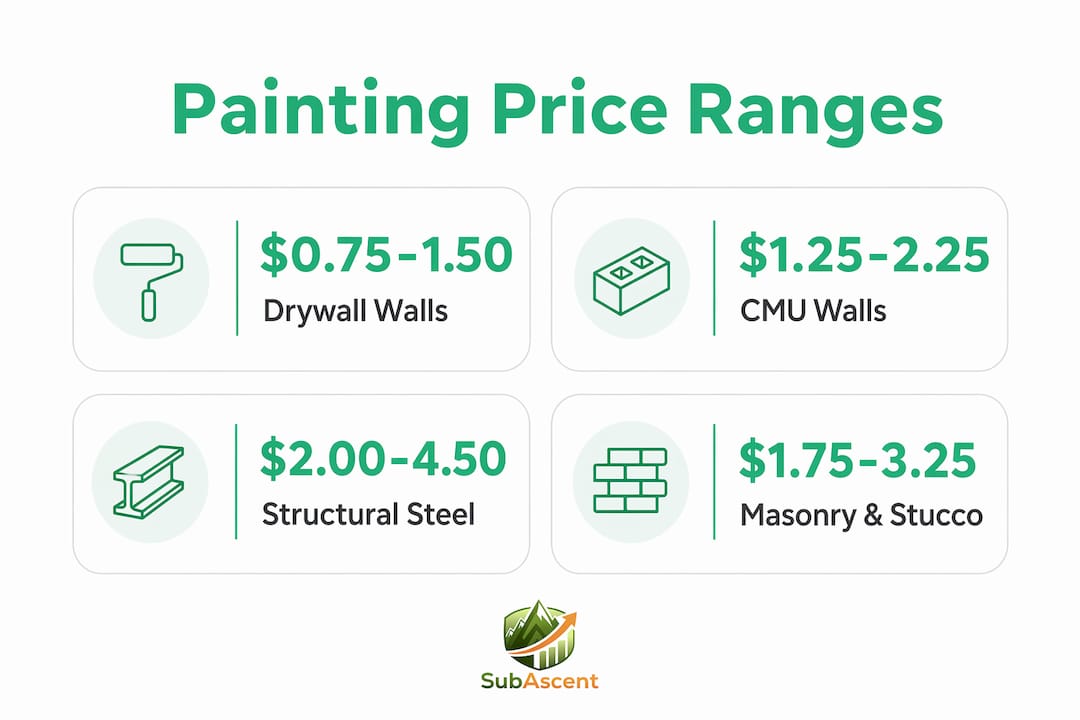
Square foot pricing starts with the surface type. Each substrate carries a different baseline rate because porosity, prep requirements, and coat count all vary.
Drywall walls in new construction typically cost $0.75–$1.50 per square foot, including primer and two finish coats. That range shifts up toward $1.80 per square foot when sheen level increases or access is limited. Drywall is the most forgiving substrate, but estimators still need to account for sheen and coat count before locking in a number.
CMU walls require block filler plus two finish coats, pushing costs to $1.25–$2.25 per square foot. The block filler coat is not optional. Without it, paint absorbs unevenly and coverage fails, which means callbacks and rework that eat your margin.
Structural steel painting ranges from $2.00–$4.50 per square foot depending on whether shop priming is included and how much surface prep is required in the field. Field application always costs more than shop application. Specialty coatings like epoxy or intumescent push the rate toward the top of that range.
Exterior masonry and stucco with elastomeric coatings runs $1.75–$3.25 per square foot. Weather exposure and crack bridging requirements drive the higher end of that range.
Ceilings cost more than walls in most commercial settings, with typical rates of $0.90–$1.80 per square foot. Heights above 10 feet require lifts, and lift time is pure labor cost with no production offset.
Not every surface prices by the square foot. Doors and metal frames price by unit, with typical costs of $30–$75 per door. Wood trim prices by the linear foot. Mixing square foot rates into unit items is one of the fastest ways to underbid a job.
| Surface type | Baseline rate (per SF) | Notes |
|---|---|---|
| Drywall walls (new construction) | $0.75–$1.50 | Primer + 2 finish coats |
| CMU walls | $1.25–$2.25 | Block filler required |
| Structural steel | $2.00–$4.50 | Field prep increases cost |
| Exterior masonry/elastomeric | $1.75–$3.25 | Weather and crack bridging |
| Ceilings | $0.90–$1.80 | Heights above 10 ft add cost |
| Doors/metal frames | $30–$75 per unit | Not priced by SF |
How to adjust square foot prices for site conditions and complexity
Baseline rates are starting points. Every job has conditions that move the number up or down, and failing to apply those adjustments is where bids go wrong.
Surface prep and repair add cost before a single coat goes on. Drywall patching, skim coating, sanding, and caulking all require labor that does not show up in a base square foot rate. Price prep as a separate line item or build an explicit adder into your rate.
Ceiling height is one of the most underpriced factors in commercial painting. Once you cross 10 feet, you need lifts or scaffolding. Lift rental, setup time, and reduced production speed all increase your effective cost per square foot. A ceiling at 20 feet can cost 30–50% more per square foot than the same ceiling at 9 feet, even with the same paint system.
Substrate porosity matters on CMU and concrete. A first coat on raw block can disappear into the surface. Block filler solves this, but it takes time to apply and adds material cost. Porous concrete may need two block filler coats before finish coats produce acceptable coverage.
Specialty coatings change the math entirely. Epoxy, intumescent, and anti-graffiti coatings require specific application methods, longer dry times, and sometimes specialized equipment. Price these systems separately from standard latex work.
Exterior exposure adds prep cost. Power washing, mildew treatment, and caulking joints all happen before the first coat. In humid or coastal climates, coating thickness requirements increase, which means more material per square foot.
Key adjustment factors to build into every bid:
- Surface prep and repair (separate line or explicit adder)
- Ceiling height above 10 feet (lift cost and reduced production)
- Substrate porosity (block filler coats on CMU and concrete)
- Specialty coating systems (epoxy, intumescent, anti-graffiti)
- Exterior weather exposure (power washing, caulking, thicker coats)
- Repaint versus new construction (repaint adds masking and protection)
Pro Tip: Build a one-page adjustment checklist for every bid. Walk through each factor before you finalize your rate. Estimators who skip this step consistently leave money on the table or lose money on the job.
How do you calculate paintable surface area for a bid?
Standard commercial painting pricing uses paintable surface area, not floor area. That distinction matters because floor area ignores ceiling height, partition count, and the actual surfaces that need paint. Estimators must work from architectural drawings, calculating wall area, ceiling area, and unit counts for doors and trim separately.
The calculation method is straightforward. Measure wall length times wall height for each room or zone. Subtract openings like doors and windows. Add ceiling area. Count doors and frames as units. Count linear feet of trim. Apply your rate per coat to each surface type, not a blended rate across the whole job.
One gallon of paint covers approximately 350–400 square feet per coat on smooth surfaces. Rough or damaged surfaces reduce that coverage significantly. Add a 5–10% waste factor to every gallon calculation to account for overspray, touch-ups, and container waste.
| Calculation method | Best use | Accuracy level |
|---|---|---|
| Floor area multiplier | Rough budget only | Low |
| Paintable surface area by room | Standard commercial bids | High |
| Unit rate per coat by surface type | Spec-driven commercial work | Highest |
| Linear foot pricing for trim | Trim and base only | High for trim |
Applying unit rates per coat rather than a single blended rate gives you the most accurate bid. A room with drywall walls, a CMU accent wall, and a painted ceiling needs three separate rates, not one average. Blending rates hides cost and creates margin risk.
Estimating templates built around surface type and coat count make this process faster and more consistent. Templates also reduce the chance of missing a surface type during takeoff.
Pro Tip: Never use floor area as your pricing base on a commercial bid. A 10,000 SF warehouse with 30-foot ceilings has far more paintable surface area than a 10,000 SF office with 9-foot ceilings. Floor area will underprice the warehouse every time.
How to break down labor, materials, and overhead in your pricing
Interior painting labor represents 70–85% of total project cost, with materials accounting for the remaining 15–30%. That ratio holds across most commercial painting work. It means your labor rate accuracy matters far more than your paint pricing.
Material costs include paint, primer, block filler, masking tape, drop cloths, roller covers, brushes, and sundries. These add up faster than most estimators budget. A detailed material list tied to your surface area calculations keeps material cost accurate.
Overhead and markup must sit on top of direct cost, not inside it. A common mistake is burying overhead in the labor rate and then forgetting to add markup. Price it explicitly: direct labor plus materials plus overhead plus profit margin. That structure makes it easy to track job profitability against your bid after the job closes.
Cost breakdown best practices for painting bids:
- Price labor by production rate per surface type, not a blended hourly guess
- List materials by coat and surface, not as a single lump sum
- Add overhead as a percentage of direct cost, applied consistently
- Apply profit margin last, after all costs are accounted for
- Keep residential and commercial cost structures separate
Commercial work carries higher overhead than residential because of submittal requirements, coordination with GCs, and longer payment cycles. A residential pricing structure applied to a commercial job will understate overhead every time.
What are the most common pricing mistakes in square foot estimating?
Using residential square foot pricing tables for commercial projects leads to underbidding because those tables ignore substrate porosity and height access costs. This is the single most common mistake painting estimators make when moving from residential to commercial work.
Other frequent errors include:
- Ignoring prep complexity. A repaint job with peeling paint, water stains, and damaged drywall costs far more to prep than new construction. The base rate does not capture that.
- Pricing doors by square foot. A standard hollow metal door and frame at 3 feet by 7 feet priced at a wall rate will be underpriced. Price doors as units at $30–$75 each.
- Skipping local labor rate adjustments. Labor rates vary significantly by market. A rate that works in a mid-tier market will lose money in a high-cost metro area.
- Ignoring specialty coating requirements. Epoxy and intumescent coatings require different application equipment and longer schedules. Standard latex rates do not apply.
- Missing surfaces during takeoff. Soffits, mechanical room walls, and stairwell ceilings get missed on rushed takeoffs. A systematic room-by-room approach prevents this.
Pro Tip: After every job closes, compare your bid to actual cost by surface type. That feedback loop is how you sharpen your rates over time. Estimators who skip this step repeat the same pricing errors on every bid.
For a broader view of how project planning affects bid accuracy, the planning phase is where most cost errors originate, not the field.
Key Takeaways
Accurate painting subcontractor square foot pricing requires surface-specific baseline rates, systematic adjustments for site conditions, and a clear separation of labor, materials, and overhead in every bid.
| Point | Details |
|---|---|
| Use surface-specific rates | Apply separate rates for drywall, CMU, steel, and ceilings rather than a blended average. |
| Price by paintable area, not floor area | Measure actual wall, ceiling, and unit counts from architectural drawings for accurate takeoffs. |
| Adjust for height and substrate | Add explicit cost for lifts above 10 feet and block filler on porous CMU and concrete surfaces. |
| Separate unit items from SF pricing | Price doors at $30–$75 per unit and trim by linear foot, not by square foot. |
| Track labor as the dominant cost | Labor runs 70–85% of total cost; accurate production rates matter more than material pricing. |
Why square foot pricing only works if you do the takeoff right
Most estimators I talk to know the rates. They know drywall runs around $1.25 per square foot and CMU costs more. The part that trips people up is the takeoff, and that is where bids fall apart before they even get to pricing.
I have seen estimators apply a solid rate to the wrong surface area because they used floor area instead of paintable surface area. The bid looks reasonable on paper, but the job scope is completely different from what was priced. You get to the field and realize the ceiling is 24 feet, there are 40 hollow metal doors, and half the walls are CMU. The rate was fine. The takeoff was wrong.
The other thing I keep coming back to is the value of estimating software built for trade subs. Not GC platforms that have a painting module bolted on. Tools built around how painting estimators actually work, with surface types, coat counts, and unit pricing built into the structure. That changes how fast and how accurately you can build a bid.
The best painting estimators I know treat every bid as a data point. They close a job, pull the actuals, and compare them to the bid by surface type. Over time, their rates get tighter and their margins get more predictable. That discipline is worth more than any pricing table.
— Dave
How Subascent supports painting estimators on every bid
Painting estimators who build bids in spreadsheets spend too much time rebuilding the same structure on every job. Subascent gives painting subcontractors a purpose-built platform for estimating, job costing, and bid management that fits how trade subs actually work.

With Subascent, you can build takeoffs by surface type, apply coat-specific unit rates, and track actual cost against your bid as the job runs. The platform keeps your historical rates accessible so every new bid gets sharper. Visit Subascent to see how painting subs use it to build faster, more accurate bids and protect their margins on every project.
FAQ
What is a typical square foot rate for commercial interior painting?
Drywall walls in commercial new construction typically run $0.75–$1.50 per square foot for primer and two finish coats. CMU walls cost more, ranging from $1.25–$2.25 per square foot due to block filler requirements.
Should painting subcontractors price by floor area or paintable surface area?
Always price by paintable surface area. Floor area ignores ceiling height, partition count, and actual surface types, which leads to underbidding on most commercial projects.
How do you price doors and trim in a painting bid?
Doors and metal frames price by unit at $30–$75 per door, not by square foot. Trim prices by the linear foot. Applying square foot rates to these items consistently underprices them.
Why does ceiling height affect square foot pricing?
Ceilings above 10 feet require lifts or scaffolding, which adds rental cost and reduces production speed. That combination can increase the effective cost per square foot by 30–50% compared to standard height ceilings.
What is the labor-to-material ratio in painting bids?
Labor typically represents 70–85% of total painting project cost, with materials at 15–30%. Accurate labor production rates matter more to bid accuracy than material pricing on most jobs.